Quartzite vs. Quartz: Which Surface Is Right for Your Kitchen?
Quartzite and quartz are often discussed as though they are variations of the same material. They are not.
Quartzite is a natural metamorphic stone formed when quartz-rich sandstone is transformed by heat and pressure. Quartz countertops, by contrast, are engineered surfaces made from mineral material combined with binders and manufactured into slabs.
That difference affects far more than terminology. It influences appearance, consistency, maintenance, heat considerations, slab selection, and the way the surface interacts with cabinetry and the rest of a kitchen.
For homeowners and design professionals planning kitchens in Menlo Park and throughout the Bay Area, neither material is automatically the “better” luxury option. The better choice depends on what you want the surface to contribute to the room and how you expect to live with it.
What Is Quartzite?
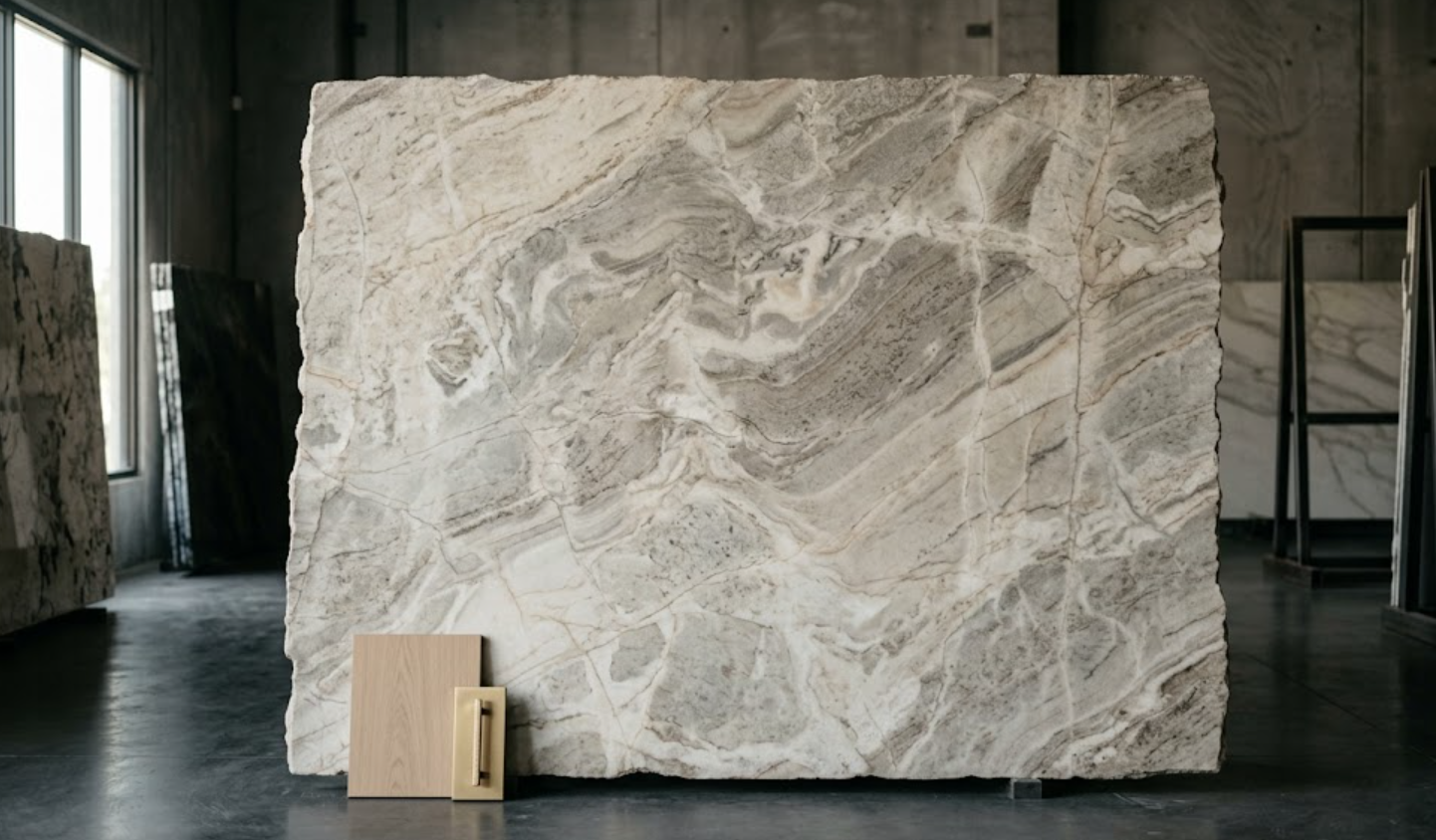
Quartzite is a natural stone, not a manufactured quartz surface. It begins as quartz-rich sandstone and becomes a dense metamorphic rock through geological heat and pressure.
Because it is natural, each slab has its own mineral variation, pattern, movement, and coloration. That individuality is often one of the primary reasons homeowners and designers are drawn to it.
A dramatic quartzite slab can become one of the strongest architectural materials in a kitchen, particularly when used across a large island or full-height backsplash. But selecting natural stone also means accepting variation.
The exact slab matters. The section of that slab used on the island matters. Where seams fall matters. How the fabricator lays out the pattern matters.
Choosing quartzite is therefore not just choosing a material name or color. It is choosing a particular piece of stone.
What Is Quartz?
Quartz countertops are engineered surfaces rather than slabs quarried directly from the earth in finished form. Manufacturers combine mineral content with binding materials and produce slabs in controlled designs and finishes. Caesarstone describes quartz slabs as engineered or compound stone, while Cambria describes its quartz surfaces as nonporous and manufactured for consistency and easy care.
That manufacturing process creates a different design experience. Natural stone asks you to respond to what exists in a particular slab. Quartz allows you to choose from a designed surface with a more predictable appearance from slab to slab.
That predictability can be extremely useful. A large kitchen with several countertop runs may benefit from visual consistency. A designer may want a restrained surface that supports distinctive cabinetry rather than becoming the focal point itself.
Quartz can also imitate some of the movement associated with natural stone, but it remains a manufactured material. That is not necessarily a disadvantage. It is simply a different design proposition.
What Is the Biggest Visual Difference Between Quartzite and Quartz?
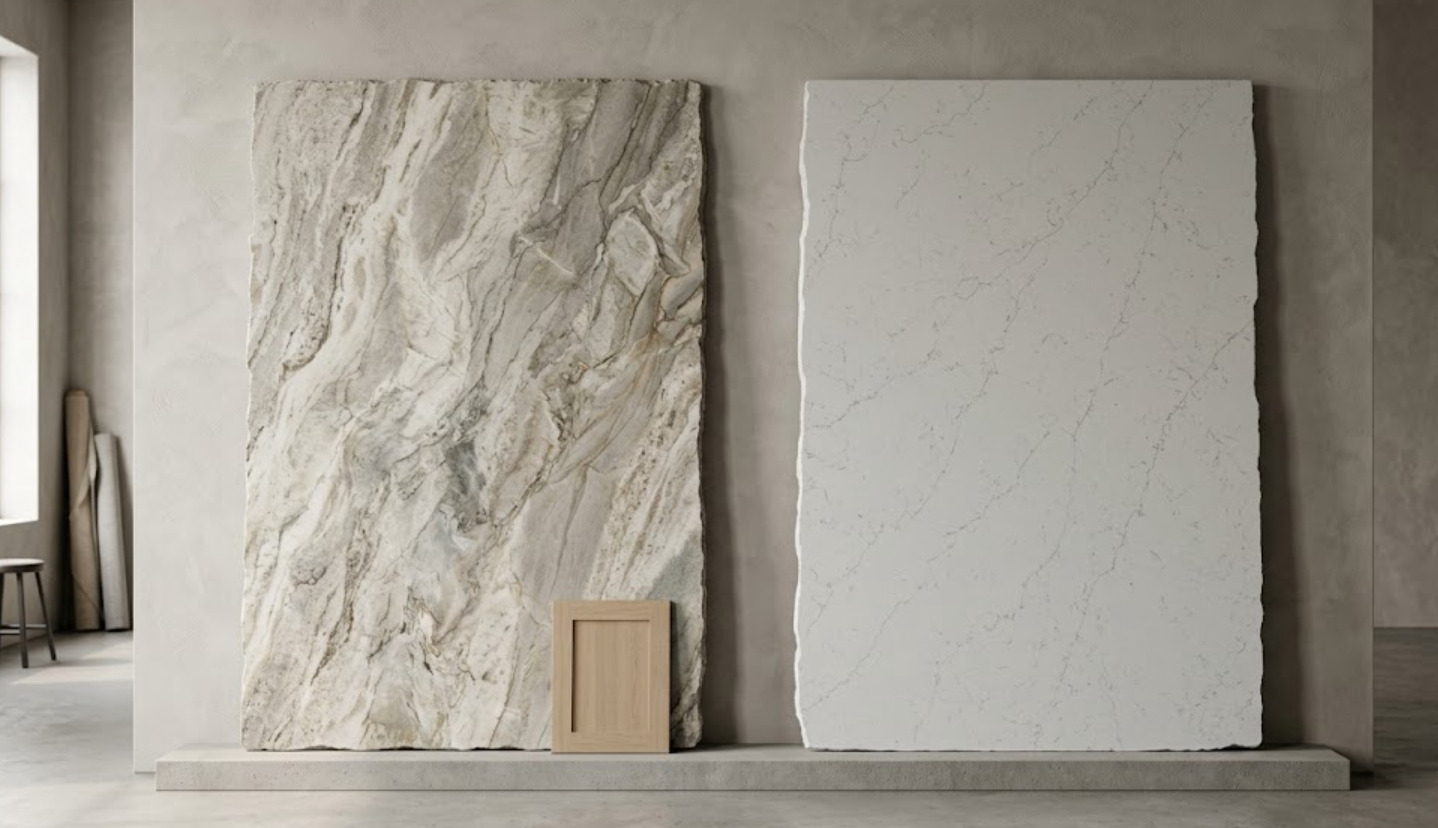
Quartzite offers natural variation that cannot be precisely repeated. Quartz generally offers greater visual consistency and predictability. Cambria specifically notes that its quartz designs have enough consistency that buyers do not typically need to select the exact individual slab the way they often do with natural stone.
That distinction becomes easier to understand at kitchen scale. With quartzite, one portion of a slab may contain strong movement while another is relatively quiet. A vein may cross an island diagonally. Color can shift subtly from one section to another. Those characteristics become part of the design.
With quartz, the pattern has been developed intentionally and tends to be more controlled. For some projects, that consistency is exactly what the cabinetry needs. For others, the unpredictability of a natural slab is the reason to choose it.
Is Quartzite More Durable Than Quartz?
That question needs a more careful answer than a simple ranking.
Quartzite is a very hard natural stone because of its quartz-rich geological composition. Quartz surfaces are also designed for durable countertop use, but their performance characteristics are influenced by the manufactured composition, including the binding materials within the slab.
In a residential kitchen, both can serve as durable countertop materials when properly specified, fabricated, installed, and maintained.
The more useful question is often: What type of maintenance and everyday use are you comfortable with?
A material can be technically strong and still require habits that matter to a particular homeowner. That is where the comparison becomes more practical.
Does Quartzite Need to Be Sealed?
Natural stone care depends on the specific stone and its absorption characteristics, so maintenance recommendations should be confirmed for the actual material being selected.
This is especially important because stones sold commercially under broad labels can behave differently. The Natural Stone Institute's technical resources even document cases where materials sold as quartzite showed unexpected acid sensitivity, reinforcing why the specific slab and stone identification matter rather than assuming every material carrying the name behaves identically.
For a homeowner considering quartzite, this is a good reason to ask specific questions before purchase:
What is the actual stone?
What maintenance does the supplier recommend?
Does it require sealing?
How frequently should that be evaluated?
How does the particular slab respond to common kitchen substances?
Luxury material selection should involve understanding the material, not just admiring it.
Does Quartz Need to Be Sealed?
Many engineered quartz products are nonporous and do not require sealing. For example, Cambria states that its quartz surfaces are nonporous, nonabsorbent, and do not require sealing.
That can make quartz appealing to homeowners who prioritize lower routine maintenance. Every manufacturer's care instructions should still be followed for the specific product selected.
“Low maintenance” does not mean indestructible. It means some of the maintenance considerations associated with natural stone may be reduced or eliminated.
Which Material Handles Heat Better?
Heat is one area where homeowners should avoid assuming every countertop performs the same way.
Engineered quartz contains binding materials, and quartz manufacturers commonly recommend using trivets or hot pads rather than placing extremely hot cookware directly on the surface. Caesarstone and Cambria both provide guidance to protect quartz surfaces from direct high heat.
Natural quartzite does not contain the same manufactured resin binders, but that does not make care irrelevant. Countertop assemblies also involve seams, adhesives, sealers where applicable, and fabrication details.
A trivet is a very small inconvenience compared with repairing an expensive surface. For either material, the safest approach is to follow the stone supplier's, fabricator's, and manufacturer's care recommendations.
Which Surface Is More Resistant to Staining?
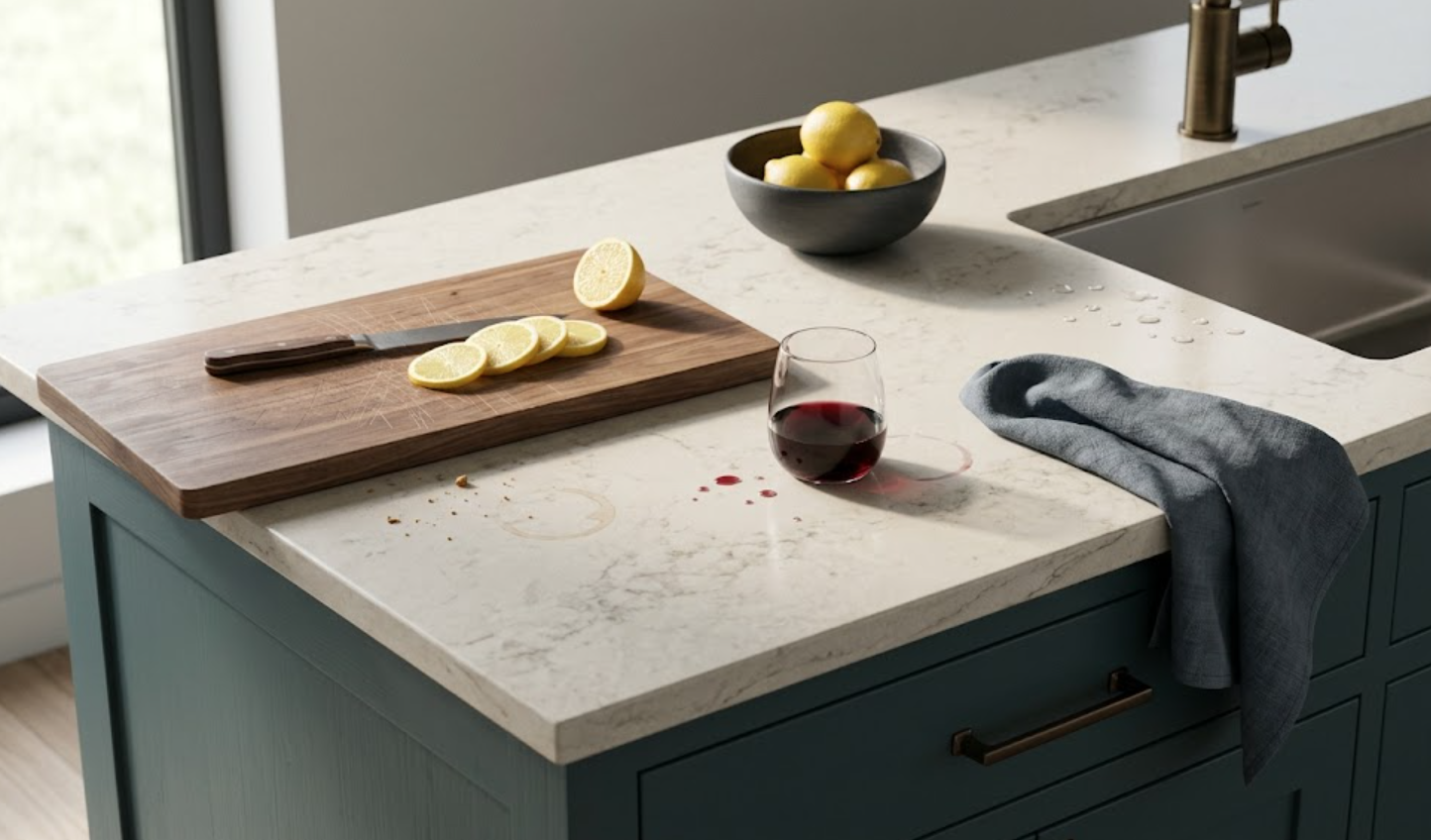
Engineered quartz's nonporous construction can be a significant advantage here. Cambria states that its surfaces are nonporous and resistant to staining because liquids are not absorbed into the material.
Natural quartzite can vary by stone. That variability is another reason not to treat every slab labeled “quartzite” as though it has identical performance characteristics.
If stain resistance is a major concern, ask the stone supplier and fabricator about the specific slab rather than relying on the category name alone. That question matters particularly in kitchens where wine, oils, coffee, citrus, and other strongly colored or acidic substances are part of everyday use.
Which One Looks More Luxurious?
Neither material owns the idea of luxury.
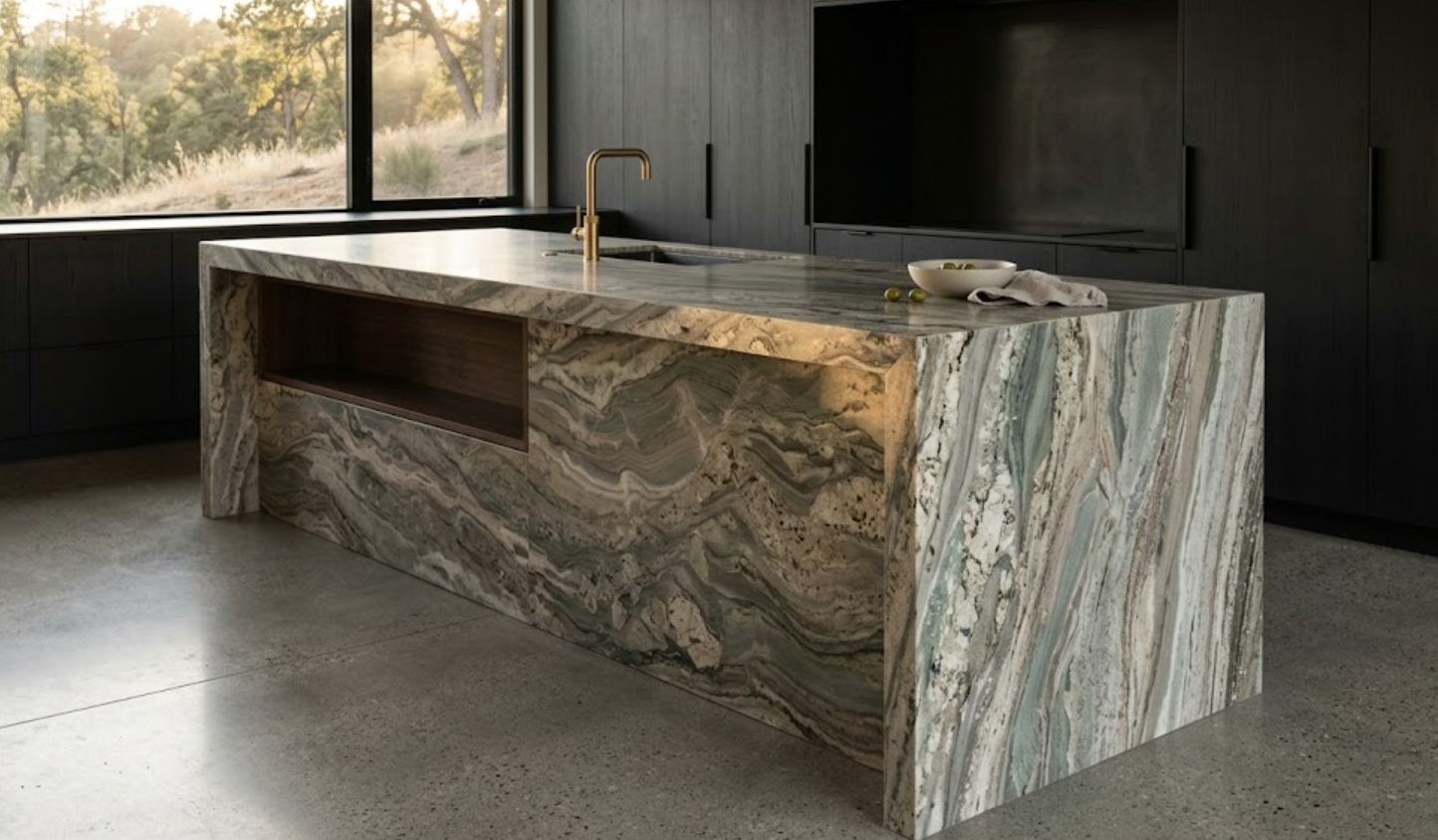
A spectacular natural quartzite slab can create something engineered surfaces cannot completely replicate: a geological pattern unique to that piece of stone. That can be powerful in a kitchen where the countertop is intended to become a major visual element.
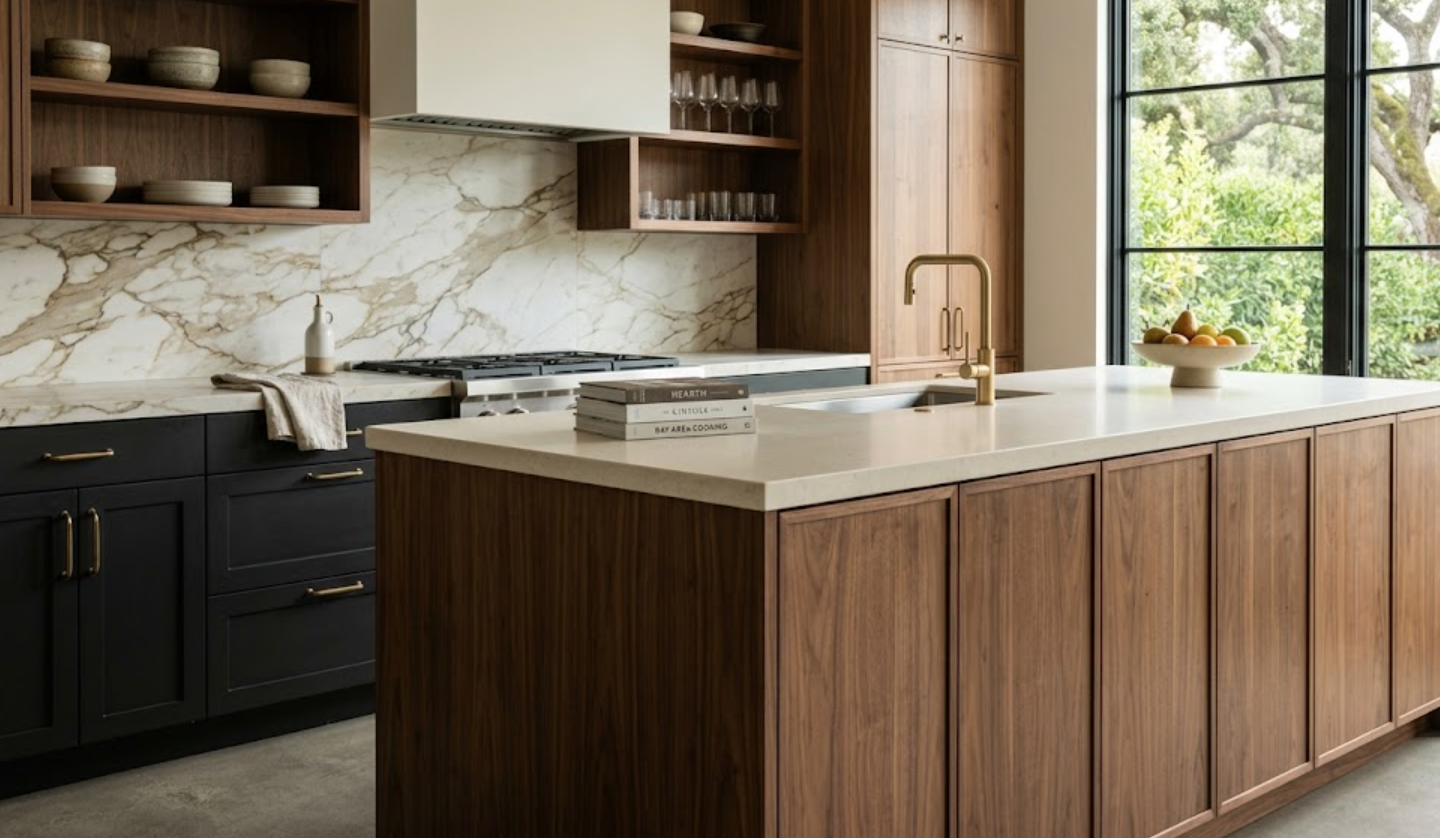
Quartz can create a different kind of sophistication. A restrained surface may allow walnut cabinetry, painted cabinetry, architectural lighting, or another element to take more attention. Its consistency can also be valuable when the design depends on visual control across several surfaces.
Luxury is not determined by how much movement a countertop has. It is determined by whether the material supports the larger design.
When Does Quartz Make More Sense?
Quartz may be especially appealing when the project prioritizes:
Consistency across several countertop areas
A more controlled pattern
A nonporous surface
No routine sealing requirement for the selected product
Straightforward everyday care
A surface intended to support rather than dominate the cabinetry
Those characteristics are product-dependent, but reputable quartz manufacturers such as Cambria specifically highlight nonporosity, stain resistance, and no sealing requirement as key features of their quartz surfaces.
This can make quartz a strong option for kitchens where predictability and maintenance simplicity are high priorities. It can also work especially well when cabinetry already provides significant visual character.
A kitchen with expressive walnut or a strong painted cabinetry color may not need another highly active material competing for attention.
When Does Quartzite Make More Sense?
Quartzite may be worth exploring when the homeowner or designer wants the individuality of natural stone to become part of the kitchen. No two natural slabs are exactly alike. That gives the material an authenticity and variation that cannot be controlled in the same way as a manufactured surface.
A strong quartzite selection can be particularly effective on a large island, backsplash, or other area where the stone can be seen at meaningful scale.
But choosing natural stone also requires more participation in the selection process. The exact slab should be considered. Its pattern should be evaluated. Fabrication and seam placement deserve attention. Maintenance expectations for that specific material should be understood before installation.
How Should Countertop Material Influence Cabinetry?
The countertop and cabinetry should be selected as a relationship.
A highly expressive quartzite may work best with quieter cabinetry. A restrained quartz surface may allow cabinetry grain, color, or door detail to become stronger.
The stone edge affects the visual weight of the cabinetry underneath it. A full-height backsplash changes the proportion of upper cabinetry. Waterfall conditions can affect finished island dimensions. Even countertop color can change how a wood species reads.
This is why selecting cabinetry from one image and stone from another can be risky. Both materials may be beautiful individually. The question is whether they become better when placed beside each other.
Should You Choose the Countertop or Cabinetry First?
There is no rule that one must always be selected completely before the other. In a strong design process, they evolve together.
If a homeowner has already fallen in love with a particular quartzite slab, that stone may influence the cabinetry finish. If the cabinetry is the defining material of the kitchen, the countertop may be selected to support it.
What matters is avoiding decisions in isolation. Cabinetry occupies substantial vertical visual space. Countertops create strong horizontal planes. Together, they establish much of the material character of the room.
They should have a conversation.
Should You See Quartz and Quartzite in Person Before Choosing?
Yes. Natural quartzite should ideally be evaluated at slab scale because its pattern and coloration vary naturally across the stone.
Engineered quartz is typically more consistent, but seeing a larger piece still helps reveal pattern scale, sheen, color, and how the material responds to surrounding finishes and real light. Cambria also recommends seeing its quartz designs in person when making a selection.
Bring cabinetry samples when possible:
Put walnut beside the stone.
Put the painted cabinet finish beside it.
Add the hardware.
Look at the combination from several feet away.
Materials that seem compatible as individual digital images can tell a very different story once they occupy the same physical space.
So, Is Quartzite or Quartz Better for Your Kitchen?
Choose based on priorities, not on which material sounds more luxurious.
Consider quartzite if natural variation, unique slab character, and the visual presence of genuine stone are central to the design.
Consider quartz if consistency, nonporosity, and lower routine maintenance for the selected product better suit the household and project.
Then consider the cabinetry:
Does the kitchen need a dramatic stone?
Does it already have enough visual interest?
Will the countertop be the focal point?
Should it quietly support cabinetry, architecture, and lighting?
For homeowners and design professionals planning kitchens in Menlo Park, Atherton, Palo Alto, Woodside, Portola Valley, Los Altos, and surrounding Bay Area communities, the answer will depend on the home as much as the material itself.
Atelier Design Society works with homeowners and design professionals exploring cabinetry and complementary material selections for luxury residential projects.
Visit the Atelier Design Society showroom in Menlo Park to explore cabinetry finishes and discuss how surface selections can work with the larger kitchen design.