Dekton vs. Quartz: Comparing High-Performance Kitchen Surfaces
Dekton and quartz are often considered for the same reason: both can create a refined, highly controlled kitchen surface without the unpredictability associated with some natural stones. They are durable, available in sophisticated colors and patterns, and can work especially well in contemporary kitchens where the material needs to support cabinetry rather than dominate it. But the two surfaces are not interchangeable.
Dekton is an ultracompact engineered surface developed by Cosentino using intense heat and pressure. It is designed for high resistance to heat, scratching, stains, UV exposure, and everyday wear, which also allows it to move beyond countertops into applications such as exterior surfaces, cladding, and flooring. Quartz countertops are engineered surfaces made using natural quartz minerals combined with binders and pigments. They are nonporous, highly stain resistant, and do not require sealing, but manufacturers generally recommend protecting them from direct or prolonged heat.
For a luxury kitchen, the decision should go beyond asking which material is “better.” The more useful questions are about performance, appearance, fabrication, heat exposure, edge detailing, maintenance, cabinetry, and how the surface will be used throughout the home.
What Is Dekton?
Dekton is classified as an ultracompact surface. Cosentino describes its manufacturing process as using extreme heat and pressure to create a very dense material with extremely low water absorption. The resulting surface is engineered to resist common kitchen stains, scratching, heat, abrasion, and UV exposure.
That combination of properties makes Dekton particularly interesting when one material needs to perform across several architectural applications. It can be used for kitchen countertops, but its technical properties also make it suitable for cladding, flooring, exterior applications, and other surfaces where conventional quartz may not be appropriate.
From a design perspective, Dekton is available in finishes that range from matte to polished and textured, with visual directions inspired by natural stone, concrete, wood, and other architectural materials.
What Is Quartz?
Quartz countertops are engineered surfaces made from natural quartz mineral combined with pigments and binding materials. The exact formulation varies by manufacturer, but the goal is to create a dense, nonporous slab with controlled color and pattern. Caesarstone, for example, describes its traditional quartz composition as crushed quartz combined with polyester resins and pigments, then compacted under vibration, vacuum, and pressure.
Quartz is popular because it offers a combination of visual consistency, stain resistance, and relatively straightforward care. Premium quartz manufacturers state that their surfaces do not require sealing and can typically be maintained with warm water, mild soap, and nonabrasive cleaning methods.
The category also offers a broad range of visual directions, including quiet solids, concrete-inspired surfaces, subtle neutrals, and elaborate marble-inspired veining.
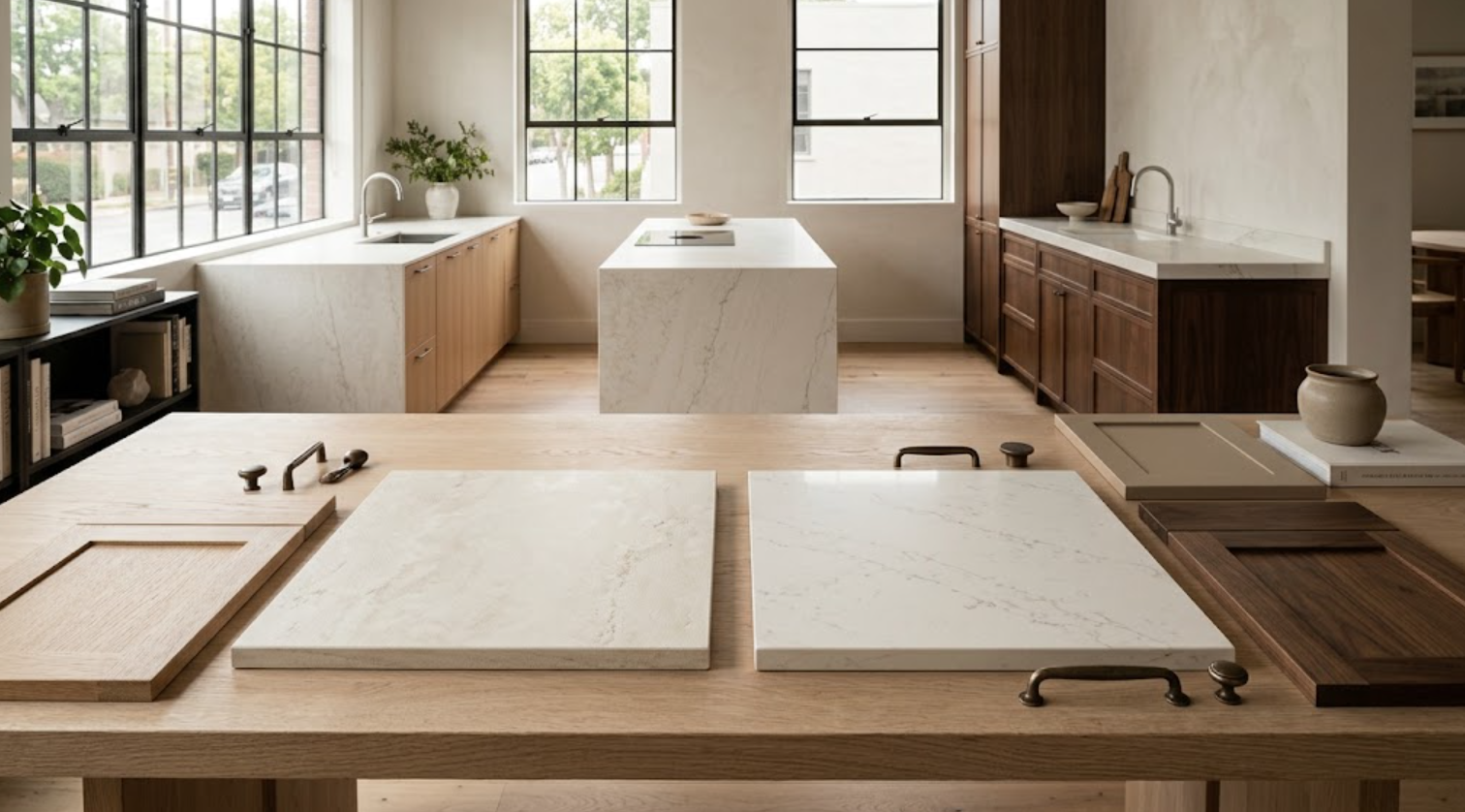
Which Surface Handles Heat Better?
This is one of the clearest differences between the two.
Cosentino specifically positions Dekton as highly resistant to heat and suitable for demanding kitchen applications. Its technical performance is one of the reasons it is often considered around cooking zones and in projects where high temperatures are a major concern.
Quartz requires more caution. Cambria and Caesarstone both recommend using trivets or hot pads beneath hot cookware and countertop appliances that create sustained heat. Direct or prolonged heat can potentially damage the surface or its binders, especially around edges.
That does not make quartz unsuitable for kitchens. It simply means heat management should be part of how the surface is used.
Does That Mean You Can Ignore Heat Protection With Dekton?
No surface should be treated carelessly simply because it has strong technical performance.
Dekton’s heat resistance is substantially different from quartz, but good kitchen practice still matters. Countertop edges, seams, adjoining materials, cabinetry, and other components may not have the same tolerance as the surface itself.
The useful distinction is that Dekton is engineered with high-temperature resistance as one of its major performance characteristics, while quartz manufacturers explicitly recommend heat protection.
Which Surface Is More Scratch Resistant?
Dekton is highly scratch resistant, and Cosentino specifically promotes scratch and abrasion resistance as major performance advantages.
Quartz is also durable and scratch resistant, but manufacturers do not describe it as scratch-proof. Cambria notes that surface marks can occur and recommends cutting boards rather than cutting directly on the countertop. Caesarstone gives similar guidance.
In practical design terms, both can perform well in residential kitchens, but Dekton has the stronger technical position when abrasion and scratching are primary concerns.
Should You Cut Directly on Either Surface?
It is better not to.
Even when a surface is highly scratch resistant, using a cutting board protects the countertop and protects knife edges. Cosentino recommends cutting boards with Dekton primarily to protect utensils, while quartz manufacturers recommend them to protect both the surface and everyday finish quality.
Luxury materials should not need unnecessary abuse to prove they are durable.
How Do They Compare for Stain Resistance?
Both perform very well.
Dekton has very low porosity and is designed to resist common household stains including coffee, wine, lemon juice, and other everyday substances.
Quartz is also nonporous and highly stain resistant. Cambria states that its quartz is nonabsorbent and does not require sealing, while Caesarstone similarly describes quartz as nonporous and resistant to staining.
For most residential kitchens, stain resistance is therefore a strength of both categories rather than a major reason to choose one over the other.
Do Dekton or Quartz Need Sealing?
Quartz generally does not require sealing. Both Cambria and Caesarstone explicitly state that their quartz surfaces do not need routine sealers.
Dekton’s low porosity likewise means it is designed as a low-maintenance surface rather than one dependent on regular sealing.
This is one reason both materials appeal to homeowners who like the look of stone-inspired surfaces but do not want the maintenance considerations associated with certain natural stones.
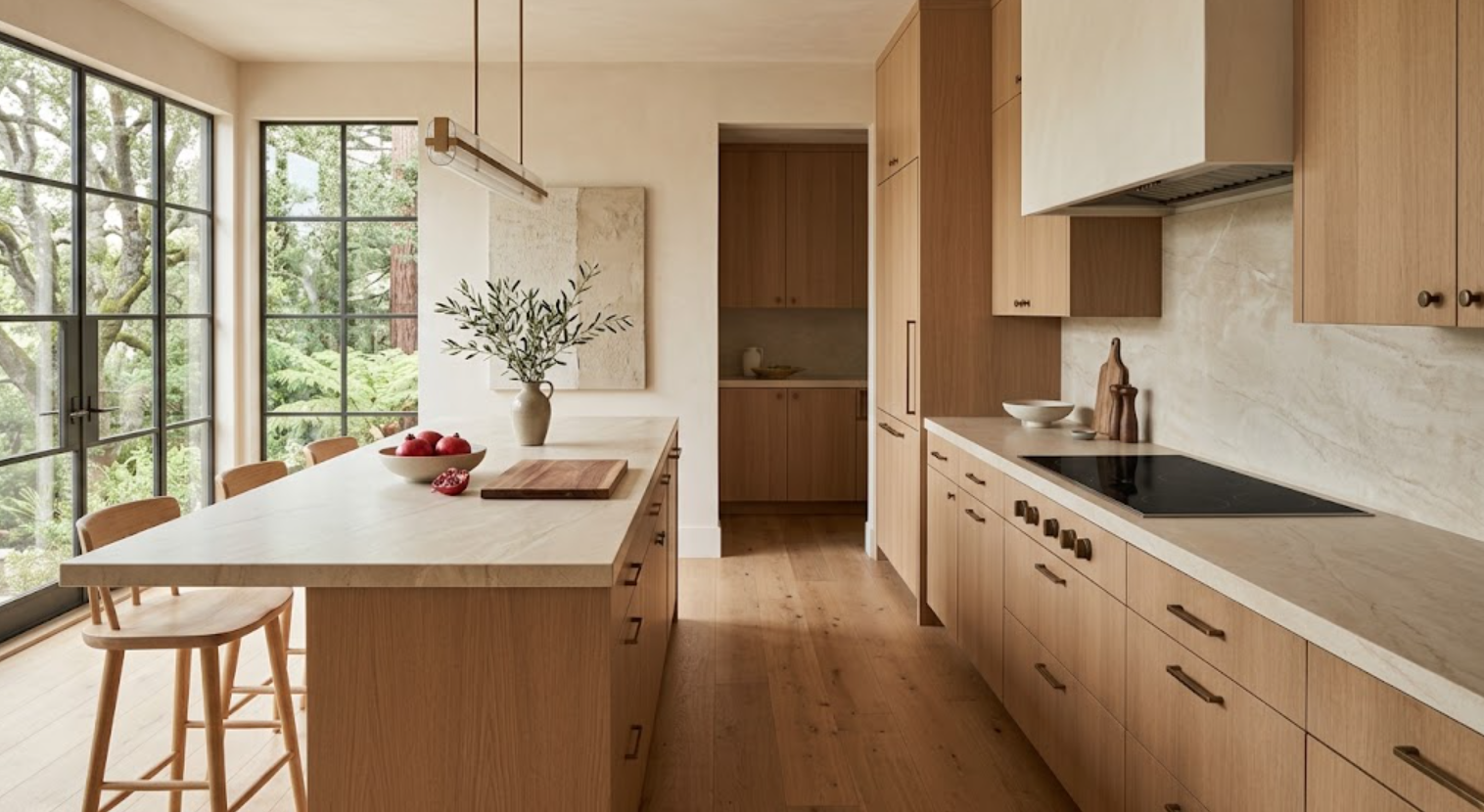
Which One Is Easier to Maintain?
Both are relatively easy to maintain compared with many porous natural materials.
Quartz manufacturers generally recommend warm water, mild soap, and nonabrasive cleaning methods for routine care. They also caution against harsh chemicals, abrasive pads, and certain strong cleaners that can damage the finish.
Dekton is similarly designed for straightforward cleaning because of its low porosity and stain resistance.
The difference is less about daily wiping and more about how each material handles specific stresses such as heat, UV exposure, abrasion, and chemicals.
What About UV Exposure?
This is another important difference.
Cosentino specifically designs Dekton for UV resistance and indoor-outdoor applications. Its color stability under sunlight is one of the material’s technical advantages.
That can matter in kitchens with extreme sunlight, indoor-outdoor rooms, outdoor kitchens, covered terraces, and projects where one surface is intended to move between interior and exterior architecture.
Quartz is primarily used as an interior countertop material. Outdoor suitability depends on the specific manufacturer and product, so it should not be assumed.
When Does UV Resistance Matter in an Interior Kitchen?
More often than expected.
Consider a Bay Area residence with:
Large south- or west-facing glazing
Sliding glass walls
A kitchen opening directly onto an outdoor cooking area
A countertop extending into a covered exterior bar
Strong sunlight across the island for much of the day
In those situations, UV stability may become part of the specification rather than a purely exterior concern.
Can Dekton Create Better Indoor-Outdoor Continuity?
It can be particularly useful for that goal because the same surface family can potentially continue from an interior kitchen to an exterior kitchen, bar, wall cladding, or other architectural application.
That does not mean every surface needs to match. But having a material capable of working in multiple environments gives designers another way to create continuity.
A warm stone-inspired surface might appear on the indoor island and then return outdoors at the grilling area. The cabinetry can change while the surface language remains connected.
What Does Quartz Do Particularly Well?
Quartz excels when controlled appearance and interior practicality are priorities.
Because the pattern is engineered, designers can select a surface with a more predictable background and vein direction than natural stone. This can simplify larger kitchens where several countertop areas need to relate consistently.
Quartz can also be particularly effective when cabinetry is intended to provide most of the natural character. For example, a large wall of rift-cut white oak or walnut may benefit from a quieter countertop rather than another highly variable material.
In that situation, quartz becomes a calm architectural plane.
How Consistent Is Quartz?
More consistent than natural stone, but not visually identical in every circumstance. Manufacturers may incorporate variation intentionally, especially in designs intended to mimic natural materials.
Cambria notes that variation in quartz color, pattern, size, shape, and shade can occur as an inherent part of the product.
The important distinction is that quartz offers substantially more controlled patterning than a naturally quarried slab.
That predictability can be a design advantage.
How Consistent Is Dekton?
Dekton is also highly controlled compared with natural stone. Its colors and textures are engineered rather than geologically variable.
This can be particularly helpful when the material covers multiple surfaces or architectural planes.
But designers should still review full slabs or large-format samples whenever possible. A small chip cannot communicate large-scale veining, movement, or the way the pattern interacts with seams and cutouts.
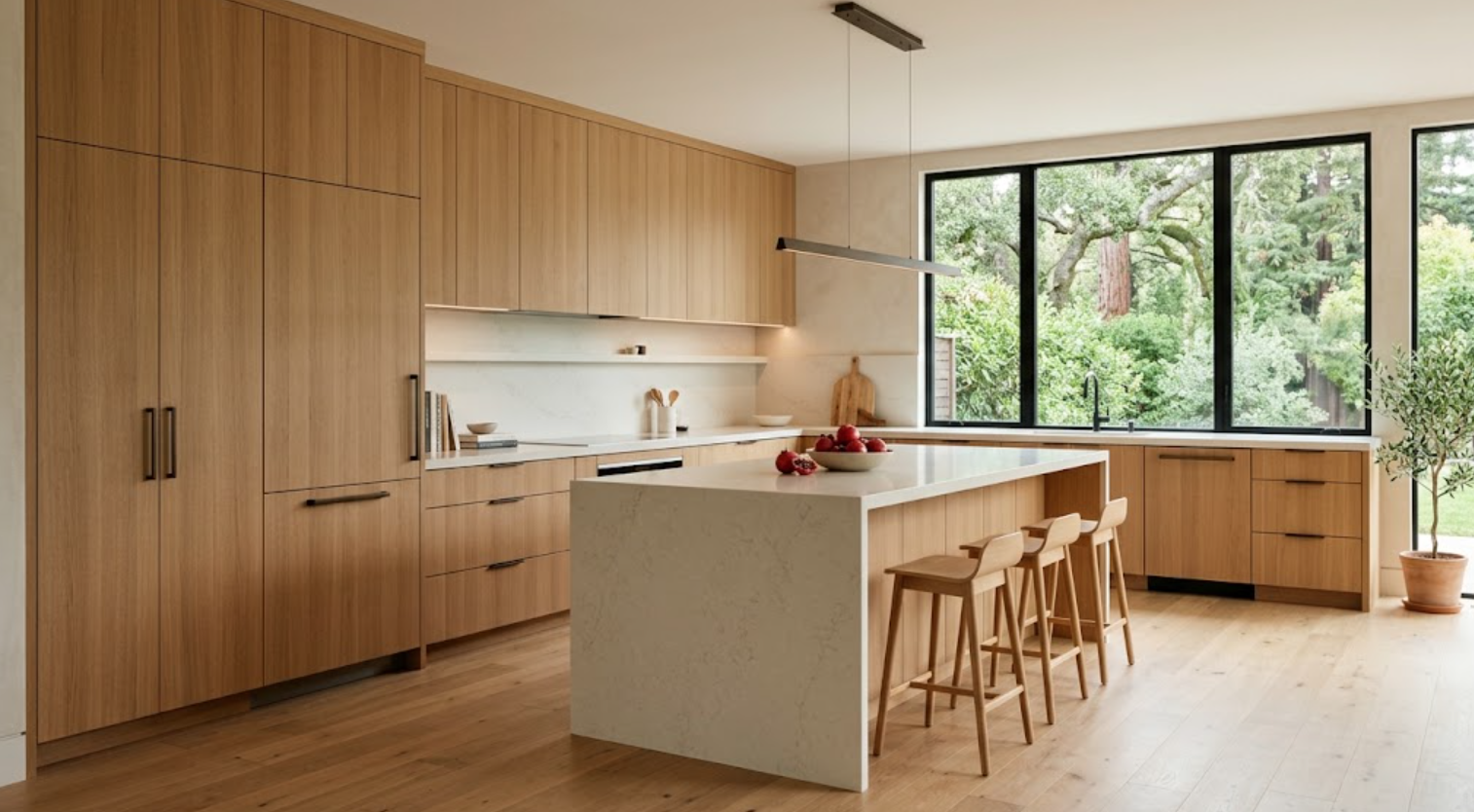
Which Material Looks More Like Natural Stone?
Both categories include stone-inspired designs, so this depends on the specific product rather than the category alone.
Quartz has become increasingly sophisticated in reproducing broad marble-like veining, warm backgrounds, and softer natural-stone effects. Dekton also includes colors and textures inspired by marble, limestone, slate, and other natural materials.
The more useful design question is whether you want the surface to imitate natural stone at all.
A high-performance engineered surface can also be beautiful when it embraces a quieter architectural identity rather than attempting to reproduce dramatic geology.
Should an Engineered Surface Try to Look Exactly Like Marble?
Not necessarily.
If the design depends on the unpredictable veining and geological depth of real marble, natural stone may still be the more compelling material.
But engineered surfaces offer something different: control.
That control can be valuable when the room already contains expressive natural wood, wallcovering, architectural metal, or another strong material.
A quieter surface can create visual space.
Luxury does not require maximum pattern.
What About Matte vs. Polished Finishes?
Finish changes how both materials interact with cabinetry and light.
Dekton offers different texture and finish directions, including matte and polished options. Quartz manufacturers similarly offer polished and textured finishes, although maintenance characteristics can vary slightly by finish. Caesarstone notes that honed, concrete, and rough textures may require somewhat more frequent cleaning because marks can be more noticeable on those surfaces.
A matte or honed-looking surface often pairs especially well with natural wood because both feel tactile and restrained. A polished surface introduces more reflection and may be useful in darker interiors where additional light is beneficial.
How Should Finish Relate to Cabinetry?
Consider the total amount of reflection in the room.
If the kitchen already includes:
High-gloss cabinetry
Polished metal
Reflective appliances
Large glass surfaces
Bright architectural lighting
A highly polished countertop may add more reflection than the room needs.
With matte white oak, plaster, and restrained metals, polished stone-inspired surfaces can provide useful contrast.
The decision should be made as part of the material palette rather than from a countertop sample alone.
What About Edge Profiles?
Dekton can create very crisp, contemporary architectural edges, which makes it particularly suited to minimalist cabinetry and thin visual profiles. But thin material and sharp edge conditions require highly competent fabrication and installation.
Quartz offers substantial flexibility in countertop edge detailing as well, including more conventional built-up profiles where a thicker visual mass is desired.
The appropriate edge depends on:
Cabinet construction
Island size
Desired visual weight
Surface pattern
Architectural style
Fabrication requirements
A large island does not automatically need a thick edge. Sometimes a thinner plane reinforces the architecture more successfully.
Is Dekton More Fragile at Edges?
Dekton is highly resistant to everyday wear, but like other very hard engineered slab materials, edge design and fabrication still matter. Hardness does not mean invulnerability.
Corners, sink cutouts, edge profiles, transportation, and installation should be handled by fabricators experienced with the material.
This is an important distinction in surface specification: performance on the broad face of a countertop is not the same as performance at every fabricated edge and opening.
Can Quartz Chip?
Yes. Quartz is durable but not chip-proof. Cambria specifically notes that impacts around edges, sinks, and dishwashers can cause chips.
That does not make quartz fragile. It means realistic expectations are important.
No countertop should be selected under the assumption that it cannot be damaged.
Why Does Fabricator Experience Matter So Much?
Because the finished countertop is the combination of material and fabrication.
A high-performance slab can still look unsuccessful if:
Seams are poorly positioned
Vein direction is ignored
Edges are inconsistent
Sink cutouts are handled poorly
Island proportions are not coordinated with slab dimensions
Waterfall joints are misaligned
The surface is installed without appropriate support
This is particularly important when using large-format surfaces or highly architectural edge conditions.
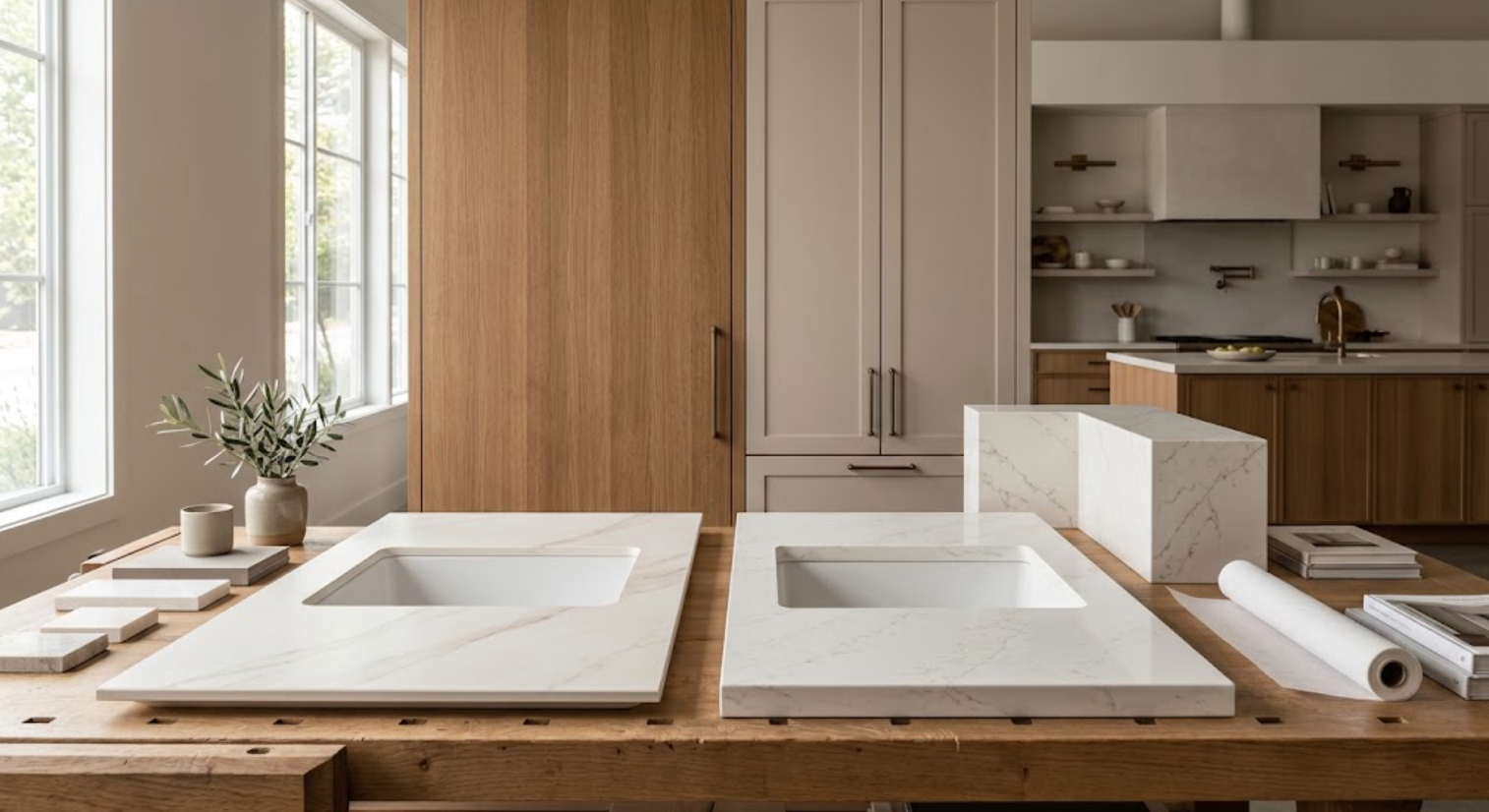
Which Surface Works Better With White Oak?
Both can work extremely well.
White oak already contributes natural grain and warmth. The countertop can either support that character or create deliberate contrast.
With white oak, consider:
Warm white or cream Dekton for a quiet architectural pairing
Pale stone-inspired quartz with restrained taupe movement
Deeper charcoal surfaces when the kitchen needs visual weight
Soft mineral gray when the oak needs a cooler counterpoint
Matte finishes when the goal is tactile and restrained
Polished finishes when the room needs more reflection
The exact undertone matters more than the product category.
A cold blue-white quartz can make warm white oak appear unexpectedly yellow. A warmer off-white Dekton may integrate more naturally, or the opposite may be true depending on the specific cabinet finish.
Always compare physical samples.
Which Surface Works Better With Walnut?
Walnut is naturally richer and more visually expressive than many white oak finishes, so the countertop often benefits from restraint.
Cream.
Warm gray.
Soft white.
Taupe.
Deep brown.
Certain charcoal tones.
All can work.
A quiet quartz may allow walnut grain to remain the dominant material. A matte stone-inspired Dekton can create a more architectural contrast, especially in contemporary cabinetry.
Again, neither category automatically wins.
The specific color and finish determine the relationship.
What About Painted Cabinetry?
Painted cabinetry can support greater countertop movement because the cabinet surface itself is more visually controlled.
Warm mushroom cabinetry can work with a stronger marble-inspired quartz.
Deep green cabinets can support warm white Dekton.
Charcoal cabinetry may look exceptional against pale stone-inspired surfaces.
Paint also gives designers greater control over undertones, making it easier to intentionally bridge the cabinetry and countertop.
Can You Use Dekton as a Backsplash?
Yes. Dekton’s broader architectural application range makes it useful beyond the horizontal countertop surface.
Using the same material vertically can create continuity and simplify the palette.
This can work especially well in minimalist kitchens where one large, uninterrupted plane is more appropriate than tile.
The surface can move from countertop to backsplash while cabinetry provides the warmth and texture.
Can Quartz Be Used as a Full-Height Backsplash?
Quartz is also commonly extended vertically as a backsplash, subject to manufacturer and fabrication requirements.
This can be particularly effective with marble-inspired patterns because the material creates the visual impact of stone without introducing the same slab-to-slab unpredictability as natural marble.
But pattern placement still matters.
A manufactured pattern may be controlled, but seams and large-scale vein direction still need to be planned.
What About Waterfall Islands?
Both materials can be used to create waterfall effects when properly fabricated.
The design question is whether the stone should cover the island end at all.
If the cabinetry uses beautifully grain-matched white oak or walnut, a waterfall hides that material.
If the countertop is intended to become the island’s main architectural feature, the waterfall may make sense.
Do not automatically add one simply because the material can support it.
Which Surface Is Better for a Very Large Kitchen?
It depends on what the kitchen needs visually and technically.
Quartz can be excellent when several perimeter areas, a large island, pantry counters, and secondary work zones need a controlled surface language.
Dekton may be particularly compelling when the project also involves high heat, strong sunlight, indoor-outdoor continuity, or additional cladding applications.
Large kitchens also amplify pattern.
What looked subtle on a small sample can become prominent across multiple slabs.
Always evaluate the surface at full scale.
Should You View Full Slabs?
Yes.
Even engineered surfaces should be reviewed beyond a small sample when possible.
Large veining, tonal movement, pattern repetition, finish, and seam strategy are difficult to understand from a small chip.
This is especially important for marble-inspired designs.
A sample tells you color.
A full slab tells you composition.
Which Surface Works Better for an Outdoor Kitchen?
Dekton has a significant advantage here because Cosentino specifically engineers and markets it for UV resistance and indoor-outdoor applications.
If a project includes a true outdoor kitchen, exterior bar, or surface exposed to substantial sunlight, the specification should be based on the exact manufacturer’s exterior-use guidance.
Do not assume that all quartz products can be used outside simply because they perform well indoors.
What About Sustainability?
This should be evaluated product by product rather than by making broad claims about one entire category.
Manufacturing process, raw materials, transportation, recycled content, fabrication waste, durability, local sourcing, certifications, and end-of-life considerations can all affect the environmental profile of a surface.
Cosentino currently presents Dekton as a carbon-neutral product across its lifecycle through carbon reduction and offsetting initiatives.
For quartz, sustainability claims and certifications differ between manufacturers and individual product lines.
If environmental performance is an important project requirement, request current documentation for the exact material being specified rather than relying on general category assumptions.
How Should Cost Be Compared?
Do not compare material price alone.
The final installed cost can be affected by:
Product series
Slab size
Thickness
Edge treatment
Number of slabs
Cutouts
Waterfalls
Backsplashes
Fabrication complexity
Transportation
Installation conditions
Local labor
A more expensive slab with simple fabrication may cost less than a less expensive material used in a highly complicated installation.
For a luxury kitchen, total installed scope is the more useful number.
What Is the Biggest Mistake When Comparing Dekton and Quartz?
Reducing the decision to durability.
Both are high-performance engineered surfaces.
The project still needs to answer architectural questions.
How much pattern does the cabinetry already have?
Will the surface continue outdoors?
How much direct heat will the countertop experience?
Do you want a thin architectural edge?
Will the material cover vertical surfaces?
How controlled should the pattern be?
How much sunlight reaches the kitchen?
What finish works with the cabinetry?
The strongest specification comes from combining those design questions with performance requirements.
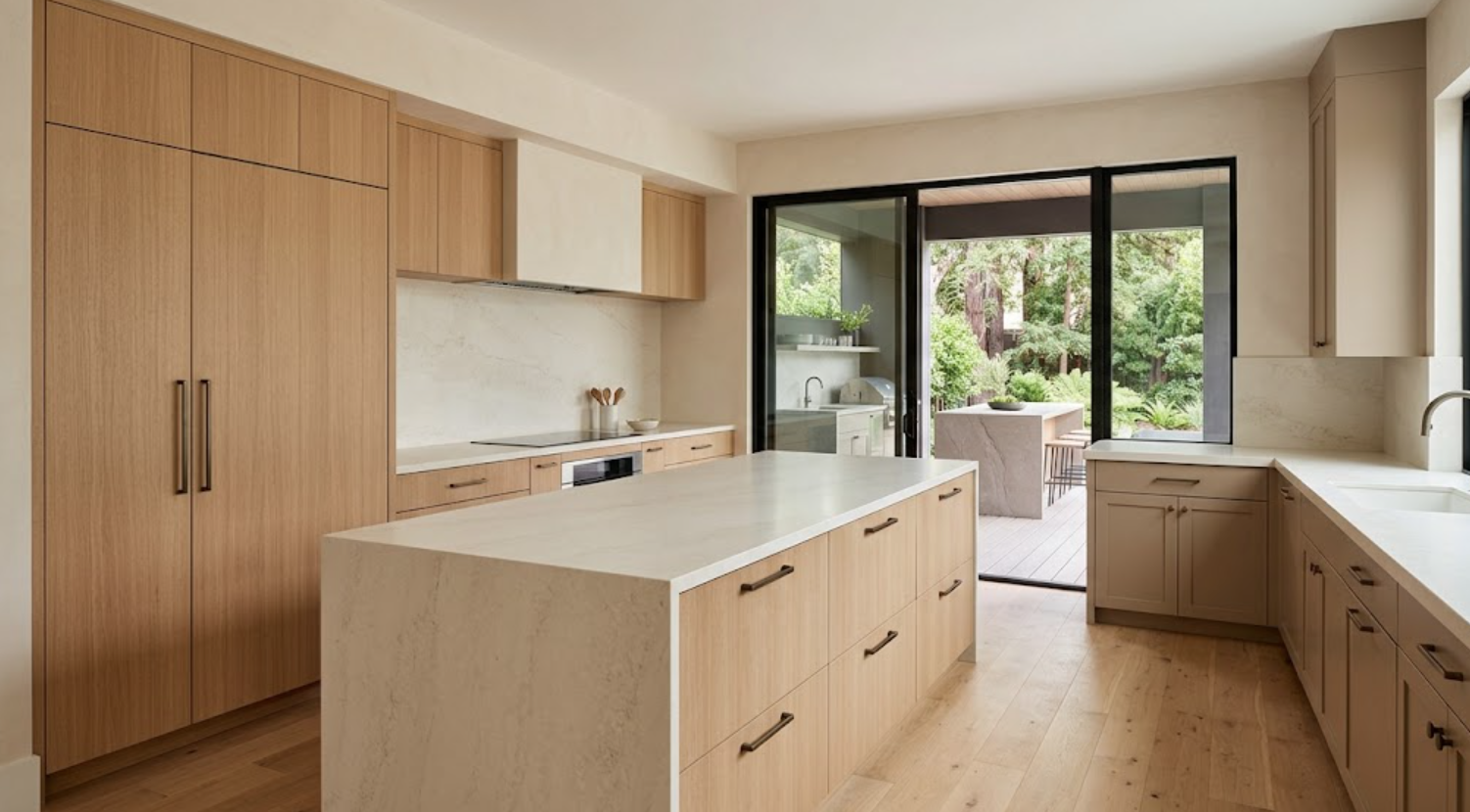
So, When Should You Choose Dekton?
Dekton is particularly compelling when the project prioritizes technical performance across several conditions. Consider it when high heat resistance matters, when surfaces receive substantial sunlight, when an indoor-outdoor material connection is desired, or when the design calls for an ultracompact surface across countertops and additional architectural applications. Its scratch, stain, heat, abrasion, and UV resistance create a performance profile that extends beyond the typical interior countertop.
It can also be a strong choice for contemporary cabinetry where thin visual profiles, matte finishes, and restrained architectural surfaces support the overall design.
When Should You Choose Quartz?
Quartz remains an excellent option for interior kitchens that prioritize controlled appearance, low maintenance, stain resistance, and a wide range of stone-inspired patterns. Because it is nonporous, it does not require routine sealing, and daily maintenance is generally straightforward.
It is particularly useful when the cabinetry should provide most of the natural texture, when several countertop zones need to remain visually consistent, or when a specific marble-inspired appearance is desired without the maintenance considerations associated with some natural stones.
The main practical consideration is heat. Quartz should be used with trivets and hot pads according to manufacturer guidance, particularly beneath hot cookware and heat-generating countertop appliances.
Dekton vs. Quartz: Which Is Better for a Luxury Kitchen?
Neither category is universally better.
Dekton offers a particularly strong combination of heat resistance, UV stability, scratch resistance, low porosity, and broader architectural application. Quartz offers nonporous performance, excellent stain resistance, visual consistency, straightforward care, and a very broad range of interior design options.
The right choice depends on what the kitchen actually needs.
Choose based on:
Heat exposure
Sunlight
Indoor versus outdoor use
Pattern consistency
Desired finish
Edge profile
Fabrication requirements
Cabinetry material
Backsplash strategy
Maintenance expectations
Whole-home material continuity
Then evaluate the actual surface beside the cabinetry, flooring, hardware, wall finish, and lighting.
A high-performance surface should not only survive the kitchen.
It should belong to the architecture.
Compare High-Performance Kitchen Surfaces With Atelier Design Society
Atelier Design Society works with homeowners, architects, interior designers, builders, and other design professionals developing premium cabinetry and material palettes for sophisticated Bay Area kitchens. At the Atelier Design Society showroom in Menlo Park, project teams can compare cabinetry materials, engineered surfaces, natural stone, white oak, walnut, painted finishes, hardware, and related architectural materials while evaluating performance, undertone, texture, edge profile, and visual hierarchy.
Bring cabinetry samples, surface references, flooring, hardware, appliance information, architectural drawings, and other project materials when available. The goal is not simply to choose the surface with the longest list of technical specifications. It is to select the material whose performance and appearance best support the way the kitchen is designed to function.