Natural Stone in Luxury Kitchens: What Makes Every Slab Unique
Natural stone brings something to a luxury kitchen that manufactured materials cannot fully reproduce: true variation. Every slab is shaped by geological processes, mineral composition, pressure, heat, crystallization, and time. That means no two slabs are exactly the same, even when they come from the same stone family or the same block.
This variation is one of the main reasons designers continue to specify natural stone in high-end kitchens. The material has depth, movement, and irregularity that feel authentic rather than repeated. But that same uniqueness also means natural stone should be selected carefully. A small sample is not enough. The full slab, its movement, its color shifts, its fissures, its crystalline areas, and the way it relates to cabinetry all need to be considered before fabrication begins.
Choosing natural stone is not simply choosing marble, quartzite, granite, or limestone. It is choosing one specific slab and deciding how that slab will become part of the architecture.
Why Is Every Natural Stone Slab Different?
Natural stone forms under changing geological conditions, so variation is built into the material. Mineral content may shift from one part of the slab to another. Veining can become stronger or quieter. Crystalline areas can appear unexpectedly. Some sections may feel warmer, cooler, lighter, or darker.
Even consecutive slabs can look different. One may have broad veining, while the next is much quieter. One may contain more visible mineral deposits, while another appears more uniform.
That is why natural stone should never be treated like a repeatable surface pattern. Its variation is part of the material.
What Creates the Movement in Natural Stone?
Different stone types create visual movement in different ways. Marble may show flowing veins and soft color transitions. Quartzite can reveal crystalline bands, layered mineral movement, and dramatic directional veining. Granite may contain visible crystals and more complex speckled patterns. Limestone may appear quieter but can still contain fossils, subtle mineral changes, and natural tonal variation.
These characteristics are not surface decoration. They are part of the stone itself. That physical depth is one reason natural stone feels so different from printed or engineered patterns.
Why Is Full-Slab Viewing So Important?
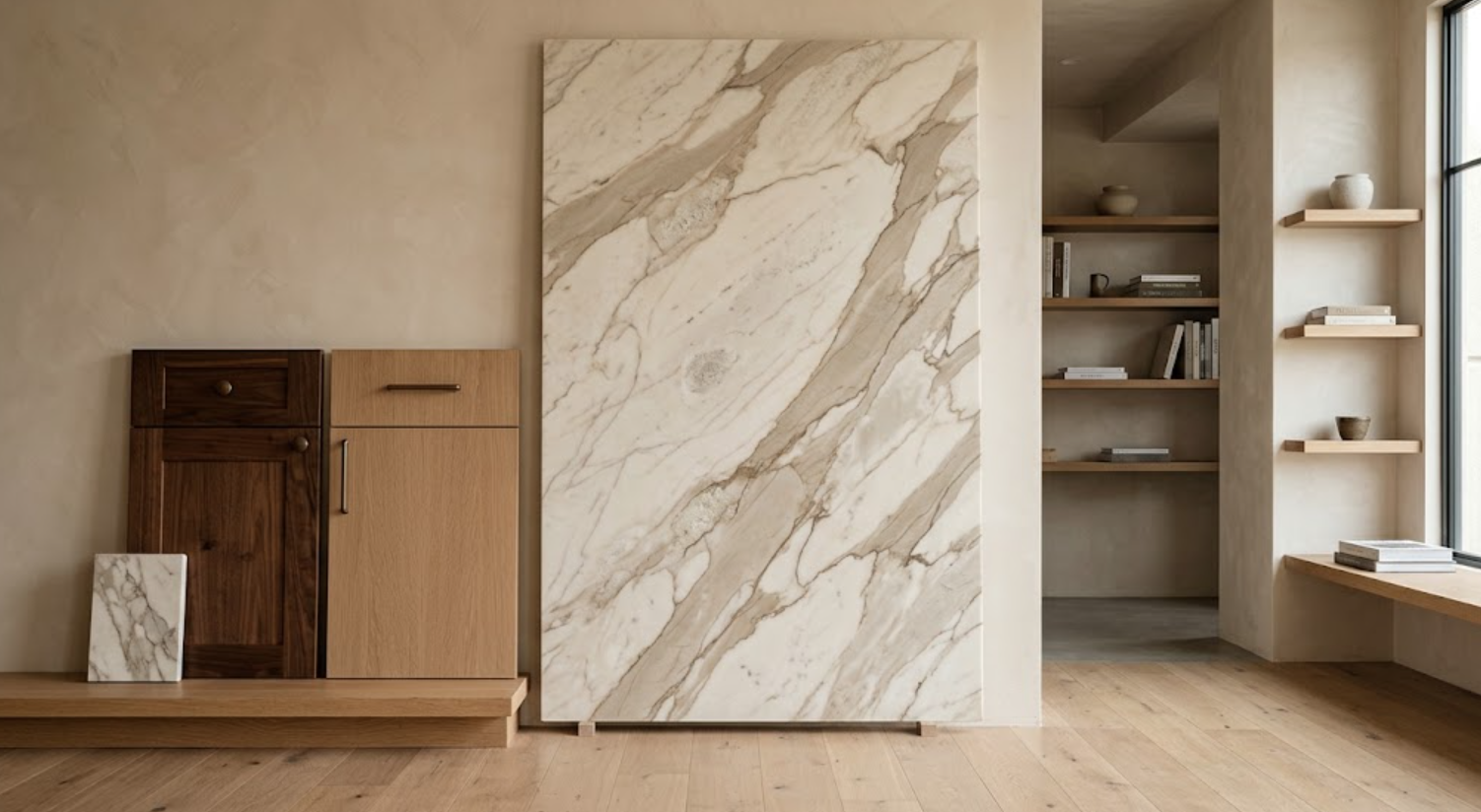
A small sample can help with basic color and finish, but it cannot show the complete composition of a slab. A six-inch sample may look pale and quiet while the full slab contains a major vein running diagonally across several feet.
The sample is not wrong. It is incomplete.
Full-slab viewing allows the design team to evaluate:
Overall movement
Vein direction
Color shifts
Quiet and active areas
Fissures
Crystalline sections
Translucency
Slab-to-slab variation
Potential focal areas
Possible cut locations
For a luxury kitchen, those details can affect the entire design.
Why Can Two Slabs With the Same Name Look Different?
Stone names identify a material family, not a perfectly repeatable appearance. Two slabs sold under the same name may differ in background color, vein intensity, warmth, mineral concentration, and pattern direction.
This matters when a project requires more than one slab. The designer should not assume that ordering additional slabs under the same name will create visual continuity automatically. Multiple slabs should be reviewed together whenever possible.
Why Does Slab Sequence Matter?
Consecutive slabs can share related movement because they were cut from the same block in sequence. This can be useful when a project requires stone across a large island, long perimeter, backsplash, waterfall, or adjoining pantry.
The slabs do not need to be identical, but they should relate. If one slab contains a major diagonal vein and the next is almost completely quiet, the transition should be planned before fabrication.
Slab sequence becomes especially important when the stone will be highly visible from multiple viewpoints.
What Is Bookmatching?
Bookmatching uses two consecutive slabs opened like pages of a book, creating a mirrored relationship between their veining. It can be striking on full-height backsplashes, fireplaces, large walls, or certain island applications.
But bookmatching is not automatically the best choice. Sometimes a more natural sequential layout creates a stronger composition. The technique should respond to the slab rather than being used simply because it feels luxurious.
Does Bookmatched Stone Need to Be Perfectly Symmetrical?
No. Natural stone is not a digitally repeated pattern. Even two consecutive slabs can vary slightly in color, vein width, and mineral structure.
The goal is not perfect mathematical symmetry. The goal is a visual relationship that feels intentional.
How Should Designers Think About Vein Direction?
As part of the architecture.
A strong horizontal vein can emphasize the length of an island. Vertical movement can make a backsplash feel taller. Diagonal movement can bring energy to an otherwise very structured cabinet elevation.
Vein direction should be studied before fabrication. Where the movement begins, where it ends, and what it crosses can all affect the finished room.
Why Does an Island Matter So Much for Natural Stone?
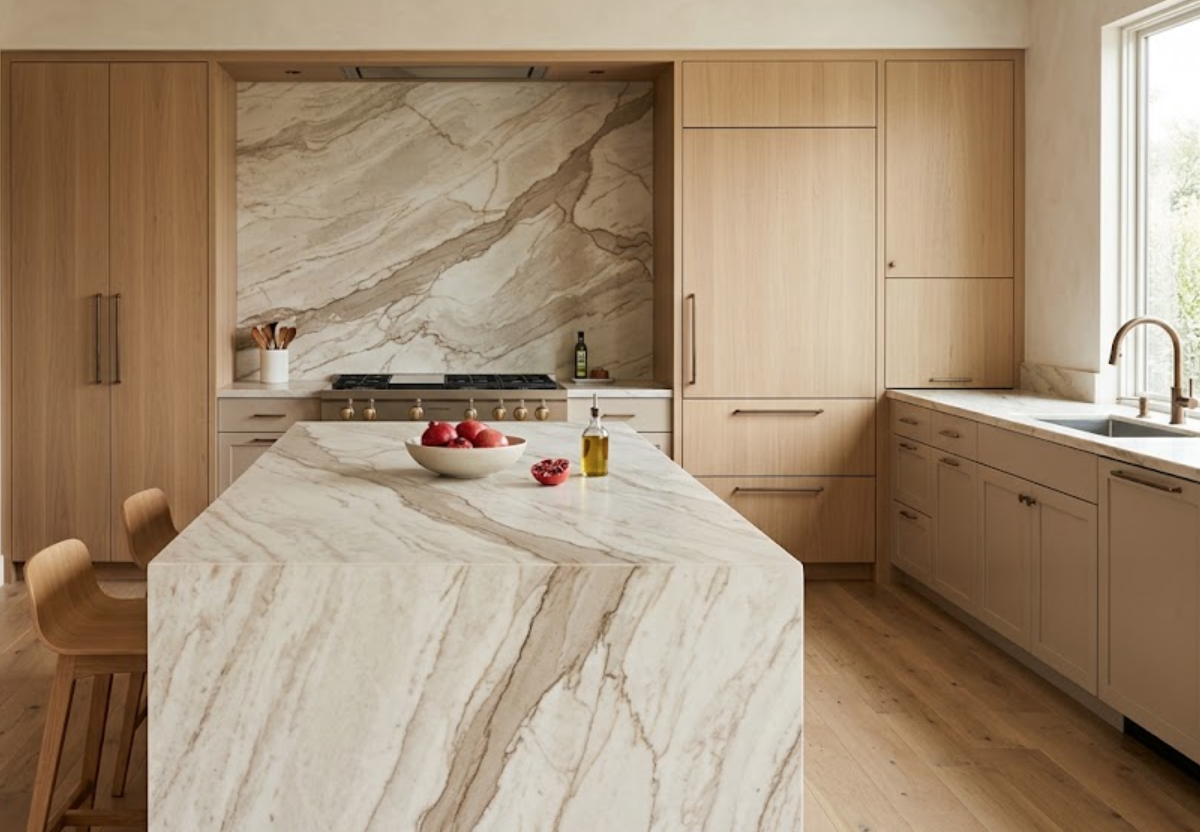
An island creates one of the largest uninterrupted surfaces in the kitchen. Because there are fewer interruptions, the slab can be experienced more fully.
That makes the island an ideal place for one of the strongest sections of the stone, but “strongest” does not always mean “busiest.” A quieter section may be more appropriate if the cabinetry or architecture already carries significant visual interest.
The island should use the part of the slab that best supports the overall hierarchy of the room.
Should the Most Dramatic Part Always Go on the Island?
No. In some kitchens, the range wall is the main focal point. In others, the island dominates the view from adjoining spaces.
If the backsplash is visible from the living or dining area, the strongest stone section may belong there. If the island is central to the open floor plan, it may deserve the most expressive part of the slab.
The architecture should decide where the strongest movement goes.
Why Is a Full-Height Stone Backsplash So Different?
Vertical stone is viewed more directly than a countertop. Veining becomes more noticeable, seams become more important, and the slab reads more like artwork.
A dramatic backsplash can be exceptional, but it can also make a room visually busy if the countertop, cabinetry, floor, and wall treatments all contain strong movement.
Full-height stone should be studied as part of the entire elevation.
How Does Natural Stone Affect Cabinetry Design?
Stone introduces organic movement. Cabinetry introduces structure.
The two should balance each other.
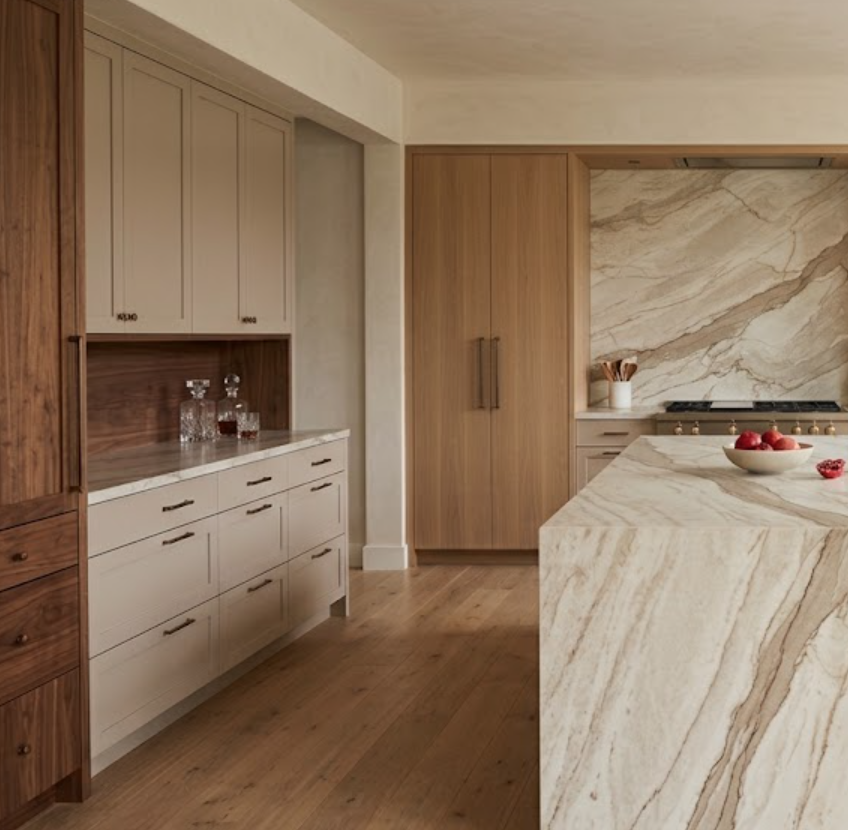
Highly expressive stone often works well with simpler cabinetry:
Slab fronts
Controlled grain
Restrained hardware
Fewer decorative details
Quieter stone may allow more architectural expression in the cabinetry:
Inset construction
Rich walnut
Detailed doors
Furniture-like islands
Mixed cabinet finishes
The goal is not to make either material disappear. It is to decide which one leads.
Why Does Wood Grain Matter Next to Stone?
Wood is another natural pattern. White oak, walnut, and other species already contain visible grain.
If both the wood and stone are highly expressive, the room can become visually busy. A more controlled rift-cut oak may work beautifully with broad mineral movement because the two patterns operate at different scales.
The strongest pairings are usually based on more than color. Grain direction, vein scale, contrast, and repetition all matter.
What About Painted Cabinetry?
Painted cabinetry creates a calmer visual field, which gives natural stone more room to become expressive.
A warm mushroom cabinet can support dramatic quartzite. Warm white cabinetry can frame marble. Deep green or charcoal can create stronger contrast around pale stone.
Paint is particularly effective when the stone is intended to become the main material statement.
What Are Fissures in Natural Stone?
Fissures are natural geological characteristics within the stone. They are not automatically the same as cracks caused by damage.
Some slabs contain more visible fissures than others, and certain materials naturally show them more clearly. A knowledgeable stone supplier and fabricator can help determine which features are normal and which areas may need additional attention during fabrication.
The important point is that not every irregular line is a defect, but significant features should still be understood before approval.
What About Crystalline Areas and Mineral Deposits?
Crystalline areas and mineral concentrations are often some of the most visually interesting parts of natural stone. They can create depth, translucency, and changing reflections under different lighting conditions.
These features can also affect slab layout. A beautiful crystalline section might be worth preserving rather than losing beneath a sink cutout. A strong mineral deposit might become a focal point on an island or backsplash.
This is why slab layout should happen before cutting begins.
Can Natural Stone Shift in Color Across One Slab?
Yes. One side of a slab may appear warmer, while another becomes cooler or grayer. A creamy background may shift toward taupe in certain sections.
These changes may be subtle while viewing the slab vertically, then become more noticeable once the stone is installed across horizontal and vertical surfaces.
Variation should be understood, not eliminated.
What Is Translucency?
Some natural stones contain areas that allow light to pass through more visibly than others. This can create added depth, especially in crystalline quartzites.
Translucent sections may look different depending on natural light, artificial light, and what sits behind them. This characteristic is difficult to judge from digital photographs alone, which is another reason physical slab viewing matters.
Does Finish Change the Stone?
Significantly.
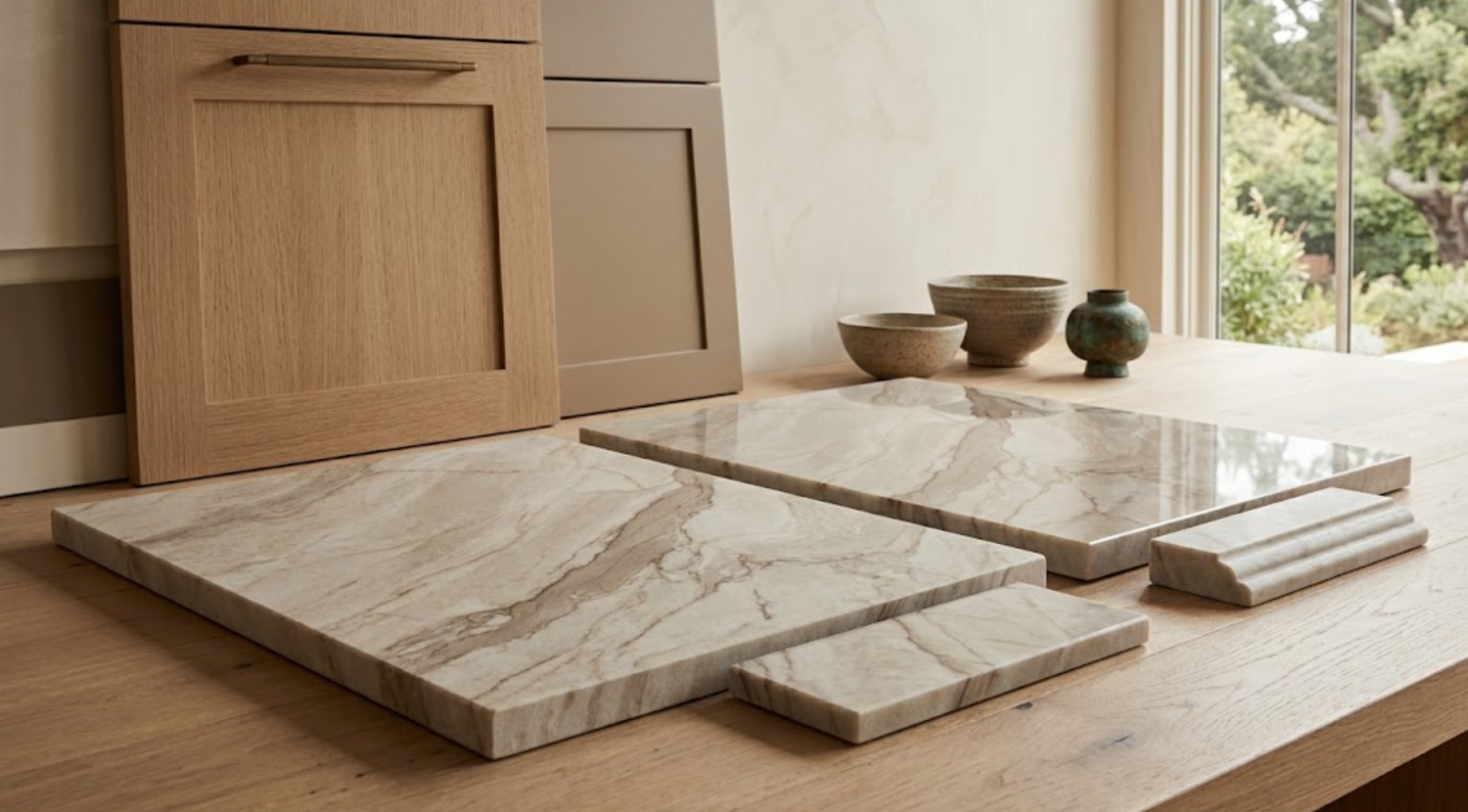
A polished finish reflects more light and can intensify color and mineral detail. A honed finish creates a softer, more matte appearance and can make strong movement feel quieter. Leathered or textured finishes create another type of tactile depth.
The same slab can feel completely different depending on finish. Stone selection should therefore include both the slab and the surface treatment.
How Does Polished Stone Work With Cabinetry?
Polished stone introduces reflection. That can create effective contrast against matte wood or painted cabinetry.
But if the room already includes glossy cabinetry, polished appliances, bright metal, and reflective lighting, another polished surface may create too much visual activity.
Sheen should be coordinated just like color and pattern.
When Does Honed Stone Work Well?
Honed stone often works beautifully in warm contemporary interiors because it pairs naturally with matte wood, plaster, and understated metals.
The result can feel tactile and architectural rather than overly polished. White oak and walnut are particularly effective beside honed natural stone because both materials have visible depth without requiring high shine.
What About Edge Profiles?
The edge changes how heavy or refined the stone feels.
A thin-looking edge can reinforce contemporary cabinetry. A thicker built-up edge adds visual weight. A soft eased edge remains quiet. More detailed edge profiles can create a more traditional or furniture-like expression.
The edge should respond to the cabinet door style, island size, stone character, and broader architecture.
Why Should the Fabricator Be Involved Early?
Because natural stone is both beautiful and physical.
Fabricators need to consider slab dimensions, island size, seams, cutouts, support, edge details, fissures, vein direction, transportation, and installation access.
A slab may look perfect in the stone yard but require compromises if the island is larger than the usable area. A major vein may fall directly beneath the sink cutout. A waterfall may require careful alignment across two surfaces.
Early fabrication input allows these issues to influence the design before cutting begins.
How Do Seams Affect the Design?
Seams are sometimes unavoidable, especially on large islands and long countertops.
Their visibility depends on stone pattern, color, vein direction, slab dimensions, location, and fabrication quality.
A quiet stone may hide seams more easily. A dramatic vein may require more careful alignment. Seam locations should therefore be part of the slab layout, not an afterthought.
Can Veins Continue Across a Seam?
Sometimes, particularly with consecutive slabs. But perfect continuation is not always possible.
Natural stone changes. The goal should be a visually intelligent transition rather than artificial perfection.
Experienced fabricators can help determine the best orientation and cutting strategy.
Why Do Sink and Cooktop Locations Matter?
Because every cutout removes part of the slab.
If the strongest mineral feature falls directly under a sink, it disappears. Moving the layout slightly may preserve it.
The same applies to cooktops, faucet holes, pop-up outlets, and other penetrations. Natural stone should be mapped around the functional requirements of the kitchen before fabrication.
What About Waterfall Islands?
Waterfall ends turn the stone vertically to the floor, making the slab even more visible.
They can be beautiful when the vein alignment is thoughtful, but they also hide the cabinetry end panel.
If the island uses exceptional walnut or carefully grain-matched white oak, covering that material may not be the best decision.
Choose whether the stone or cabinetry deserves more visibility.
Is More Stone Always Better?
No.
Using stone on the island, perimeter, backsplash, waterfall, hood, pantry, and bar can easily dilute its impact.
Sometimes one exceptional island creates a stronger room than using the same stone everywhere. Scarcity can make the material feel more important.
A luxury kitchen does not need maximum material coverage. It needs deliberate material placement.
How Does Natural Stone Work Across the Whole Home?
Natural stone can create continuity without exact repetition. A creamy kitchen quartzite might establish the direction for a primary bathroom, while a darker related stone appears at the bar. A fireplace might introduce another natural surface with similar warmth.
The residence can feel connected through tone, mineral character, and texture without using one identical stone in every room.
How Does Lighting Change Natural Stone?
Natural stone can look noticeably different throughout the day.
Daylight may reveal translucency and subtle color shifts. Warm artificial light can bring forward cream, gold, and taupe. Cooler light may emphasize gray or blue minerals. Directional light can make crystalline areas more visible.
If possible, evaluate stone samples under conditions similar to the finished room.
Should Stone Be Selected Before Cabinetry?
Sometimes.
If an exceptional slab becomes the central design idea, selecting it early may make sense. The cabinetry can then respond to its color, movement, and visual intensity.
In other projects, the cabinetry may be more important. A kitchen centered on custom walnut may begin with the wood, followed by a quieter stone.
The right sequence depends on which material carries the strongest idea.
Should Cabinetry Be Final Before the Slab Is Chosen?
Ideally, the two should overlap.
The cabinetry direction may be established first, but the final finish should still be evaluated with the stone. The slab may reveal that the wood is too warm, the paint needs adjustment, the hardware should become quieter, or the backsplash needs to be simplified.
Material development works best when decisions can still respond to one another.
Why Does Natural Stone Work So Well in Restrained Kitchens?
Because it adds complexity without requiring decoration.
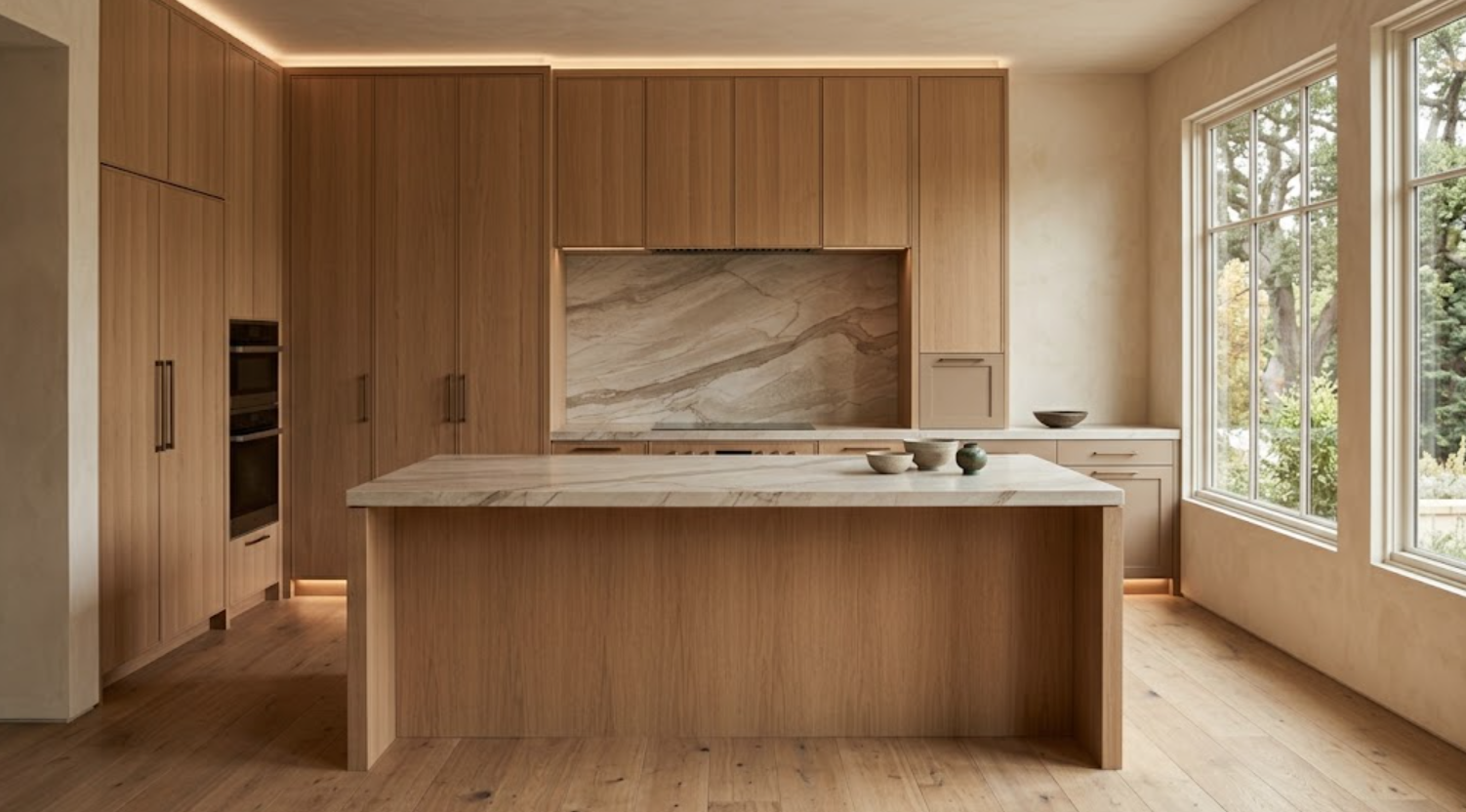
A kitchen might use only white oak, plaster, bronze, and natural stone, yet the room can still feel visually rich because the stone contains movement, mineral variation, color changes, and depth.
The architecture can remain simple while the material carries character.
What Should You Look for Before Approving a Slab?
Before final approval, review the slab as a complete composition.
Ask:
What is the overall background color?
Does the color shift across the slab?
Where is the strongest movement?
Where are the quiet areas?
Are there visible fissures or crystalline sections?
Are there features worth preserving?
How does this slab relate to additional slabs?
Where will seams occur?
Which sections belong on the island, perimeter, backsplash, or waterfall?
How does the stone look beside the actual cabinetry finish?
Then step back and look at the slab from several feet away. Natural stone should be judged at architectural scale, not only from close-up detail.
Why Is Natural Variation a Strength?
Because variation is what gives the material identity.
A mineral shift can become the most memorable section of an island. A crystalline area can catch afternoon light. A vein that changes direction can create a backsplash that feels completely individual.
The goal is not to force natural stone to behave like a manufactured surface. The goal is to understand its irregularities and use them intentionally.
Natural Stone in Luxury Kitchens: What Makes Every Slab Unique?
Every natural stone slab is different because it records a geological process that cannot be repeated exactly. Veining, mineral composition, color, crystals, fissures, translucency, and movement all vary from one slab to another.
That uniqueness creates both beauty and responsibility. The slab needs to be viewed at full scale. Its movement needs to be understood. Multiple slabs should be compared. Fabrication needs to be planned early. Cabinetry and stone should be developed together. Important areas of the slab should be positioned intentionally before sinks, cooktops, seams, and waterfalls are cut.
A successful luxury kitchen does not simply use natural stone because it is expensive or visually dramatic. It uses the specific qualities of one slab to strengthen the architecture around it.
That is what makes the finished kitchen impossible to duplicate exactly.
Explore Natural Stone and Cabinetry With Atelier Design Society
Atelier Design Society works with homeowners, architects, interior designers, builders, and other design professionals developing premium cabinetry and material palettes for sophisticated Bay Area residences. At the Atelier Design Society showroom in Menlo Park, project teams can compare natural stone directions alongside white oak, walnut, painted cabinetry, hardware, flooring, and other architectural finishes while evaluating movement, undertone, scale, and material hierarchy.
Bring slab photographs, stone samples, cabinetry selections, architectural drawings, flooring, hardware, and paint or plaster references when available. The goal is not simply to find a beautiful stone. It is to understand what makes that particular slab unique and determine where it belongs in the architecture.