Dura Supreme Cabinets: A Designer’s Guide to the Collection
Dura Supreme can be useful to designers for one simple reason.
It gives them range.
Not every residential project needs the same cabinet construction. Not every room needs the same level of visual expression. Not every client wants the same relationship between traditional detailing and contemporary restraint.
Dura Supreme’s current offering is built around two primary cabinetry lines: Crestwood, its framed line, and Bria, its frameless full-access line. Across those lines, designers can work with a broad selection of door styles, finishes, materials, storage solutions, and design details.
That makes the collection less about finding one signature look.
It is more about understanding which construction, door style, material, and interior configuration best support the project.
For designers, that distinction matters.
A strong specification starts by understanding what the collection can actually do.
What Are the Two Main Dura Supreme Cabinetry Lines?
The easiest place to begin is with construction.
Dura Supreme currently organizes its main cabinetry offering around:
Crestwood Cabinetry, which uses framed construction
Bria Cabinetry, which uses frameless, full-access construction
Those two systems create different visual and technical possibilities.
Neither should be treated as automatically better.
The choice depends on the architecture, the intended cabinet expression, and the way the designer wants the fronts and cabinet box to relate.
What Is Crestwood Cabinetry?
Crestwood is Dura Supreme’s framed cabinetry line.
It uses traditional American-style face-frame construction, with a solid hardwood frame at the front of the cabinet box. Dura Supreme currently offers Crestwood with Full Overlay, Standard Overlay, and Inset door configurations.
That gives the designer several ways to change the visual presence of the frame.
Full Overlay minimizes how much of the face frame is visible.
Standard Overlay exposes more of it.
Inset places the doors and drawer fronts within the frame itself, creating a flush relationship between the front and face frame.
This makes Crestwood especially flexible when the project calls for a stronger furniture or millwork character.
Why Might a Designer Choose Crestwood?
Because framed cabinetry can support a broad range of design languages.
Traditional interiors are an obvious application.
But Crestwood is not limited to traditional work.
Dura Supreme offers slab inset doors, transitional profiles, full-overlay configurations, and other options that can make framed construction feel much quieter and more contemporary.
The important question is not whether the project is “traditional.”
It is whether the visible frame, overlay condition, and cabinet proportions contribute to the intended architecture.
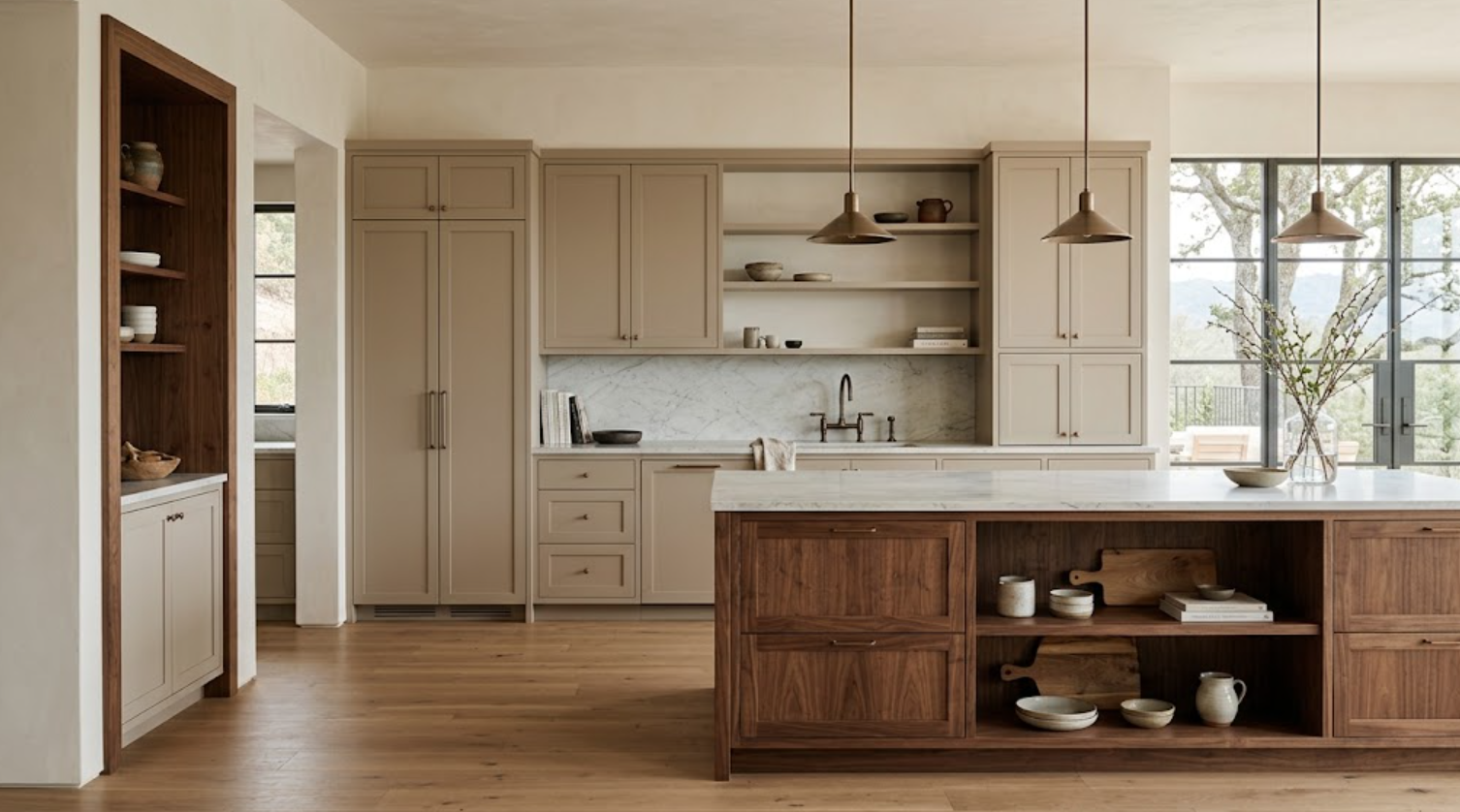
What Is Bria Cabinetry?
Bria is Dura Supreme’s frameless, full-access cabinetry line.
Instead of using a face frame at the front of the box, the cabinet construction relies on the cabinet box itself. This allows doors and drawer fronts to sit across the front with minimal visible structure between them.
This construction is frequently associated with contemporary and European-influenced cabinetry.
It can create a very clean visual grid.
It can also provide broad access to the cabinet interior because there is no face frame projecting into the opening.
Dura Supreme offers Bria with options for materials, edge treatments, drawer systems, shelving, and other interior construction details.
When Does Bria Make Sense?
Bria can be particularly useful when the design depends on:
Slab fronts
Minimal reveals
Broad drawers
Continuous elevations
Contemporary architecture
Cleaner interior openings
Integrated appliance walls
That does not mean it must look stark or ultra-modern.
A frameless cabinet can still be warm.
Natural wood, soft painted finishes, stone, textured materials, and restrained hardware can produce a much more residential expression.
The construction simply creates a different framework.
Crestwood or Bria: Which Should a Designer Specify?
Start with the elevation.
If the project benefits from an articulated face frame, inset condition, or more furniture-like cabinet expression, Crestwood may provide the right language.
If the design depends on uninterrupted fronts, tighter visual continuity, and a frameless cabinet box, Bria may be the stronger starting point.
The decision can also vary by room.
A project does not necessarily have to use the same construction everywhere. One space might benefit from framed inset cabinetry, while another works better with frameless full-access cabinetry.
What matters is that the shift is intentional.
Does Dura Supreme Offer Inset Cabinetry?
Yes, through Crestwood.
Dura Supreme’s inset doors and drawer fronts are fitted within the face frame rather than overlaying it. The company currently offers both flush and beaded face-frame options for inset applications.
That is an important distinction for designers.
A flush frame can make inset cabinetry feel cleaner and more restrained.
A beaded frame introduces more visual detail.
Inset does not have to mean highly traditional.
The door style, frame condition, finish, hardware, and surrounding architecture determine the final character.
Why Do Designers Need to Understand Overlay?
Because overlay changes the rhythm of the elevation.
Full Overlay covers most of the face frame and leaves relatively little frame visible between adjacent fronts.
Standard Overlay exposes more of the frame.
Inset reveals the face frame around each door and drawer front.
Those differences affect:
Shadow lines
Visual spacing
Front proportions
Hardware placement
Overall cabinetry character
A designer should not treat overlay as a technical afterthought.
It is part of the architecture of the cabinetry.
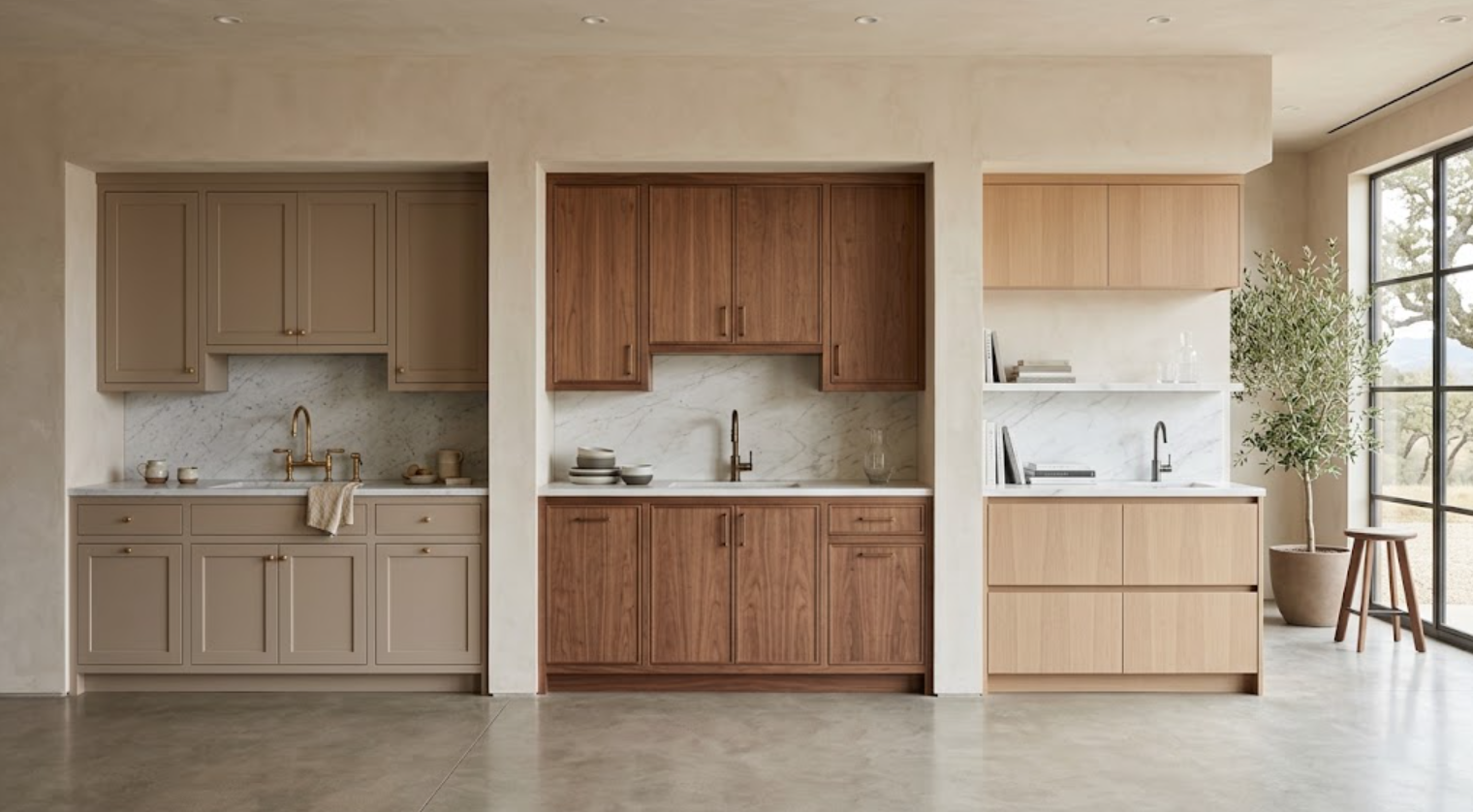
What Door Styles Are Available?
Dura Supreme currently offers multiple door categories, including:
Slab doors
Flat-panel doors
Raised-panel doors
Mullion doors
Within those categories, the exact profiles vary significantly.
That gives designers room to move from traditional to transitional to contemporary work without changing brands.
A slab door can create the cleanest visual field.
A flat-panel door can introduce frame detail without becoming ornate.
A raised panel can support a more traditional interior.
Mullion doors can introduce glass or other inserts for display cabinetry and focal conditions.
What About Modern Shaker Cabinetry?
Dura Supreme has continued to develop narrower and more restrained Shaker-style profiles.
Its current trend guidance specifically highlights modern Shaker doors with thinner or shallower rails and stiles as a contemporary reinterpretation of the classic form.
That is useful for projects that need more detail than a slab door but less visual weight than a conventional wide-frame Shaker.
The designer can retain a familiar framed-door language while making the cabinetry feel lighter.
Are Slab Doors Limited to Frameless Cabinetry?
No.
That is an important point.
Dura Supreme offers slab door styles in both Bria and Crestwood. It even offers slab inset options within Crestwood.
A designer can therefore create a relatively minimal slab-front composition without automatically selecting frameless construction.
That opens up more nuanced combinations.
A slab inset cabinet, for example, can create an interesting tension between furniture-like framed construction and a very clean front.
What Materials Can Designers Explore?
Dura Supreme’s current material offering includes a range of hardwoods and other finish materials.
Its official design resources identify options including:
Cherry
Maple
Hickory
Oak
Veneers
Laminates
Acrylics
Thermofoil
The exact material availability varies by door style, product line, and finish.
Material selection should always be coordinated against the specific cabinet configuration being specified.
Do not assume every finish is available on every door in every construction.
What White Oak Options Does Dura Supreme Offer?
Dura Supreme currently includes Quarter-Sawn White Oak among its wood species and finish selections.
Quarter-sawn oak has a more controlled grain structure than more conventional plain-sawn oak.
For designers working on contemporary or transitional Bay Area interiors, that can make it useful where the project calls for warmth and visible wood character without a highly irregular grain pattern.
As with all natural wood, physical samples should be reviewed.
What About Walnut?
Dura Supreme identifies Walnut among its specialty veneer offerings.
For designers, this can create another route to achieving a richer wood expression in selected cabinetry applications.
Walnut can be particularly effective when used as:
A feature island
A bar
A home office
An accent wall of cabinetry
A secondary whole-home material
The important point is to verify the exact door, veneer, finish, and construction combinations available for the project before treating a concept as fully specified.
How Broad Is the Finish Offering?
Broad.
Dura Supreme currently offers stains, paints, and additional finish categories, with custom-color capabilities available in parts of the collection.
Crestwood, for example, is promoted with an expansive finish palette and the ability to create custom colors for specific design needs.
That gives designers considerable flexibility.
But the number of options makes curation more important.
The objective is not to show the client everything.
It is to identify the finishes that work with the project’s stone, flooring, plaster, metal, and natural light.
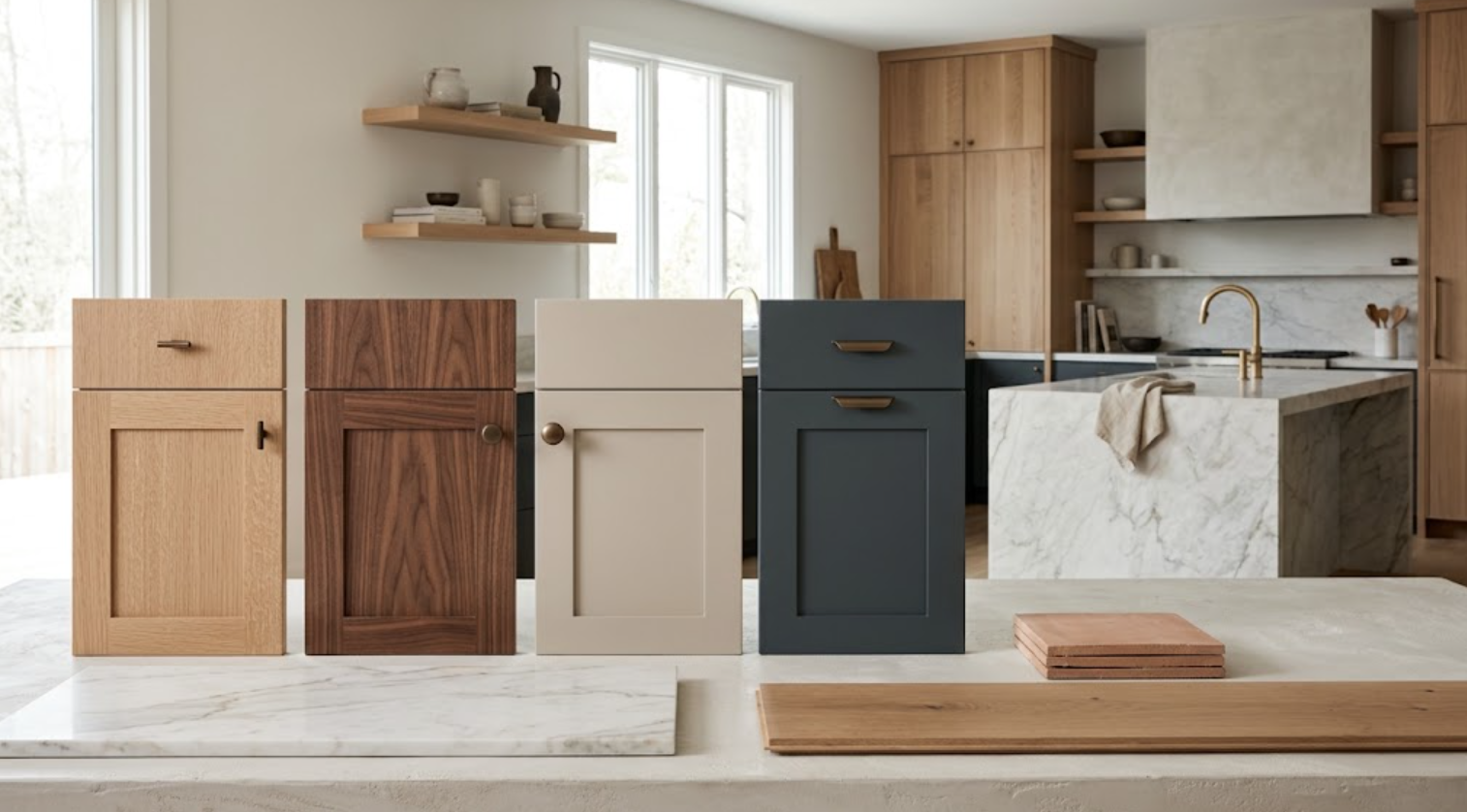
Why Should Designers Review Dura Supreme Finishes in Person?
Because finish color changes with context.
Dura Supreme advises that finish selections should be made using physical door samples and displays rather than relying solely on screen color. Its guidance also notes that lighting conditions and surrounding materials can change how a finish is perceived.
That matters in residential design.
A warm paint can look different beside a cool stone. A white oak stain can shift beside warm flooring. A deep finish may feel sophisticated in strong daylight but much heavier in a darker room.
The physical sample should be evaluated as part of the material composition.
Should Designers Look at More Than One Sample of Natural Wood?
Yes.
Especially when the cabinetry uses natural wood across a large area.
A single door cannot communicate every possible grain or tonal variation.
Reviewing multiple samples helps the designer and client understand the acceptable material range.
It also establishes more realistic expectations before installation.
Natural variation is not a defect.
It is part of specifying natural material responsibly.
What Painted Cabinetry Options Are Worth Understanding?
Dura Supreme offers painted finishes across several material and door options, including paintable HDF for certain applications.
The company describes its premium-grade HDF as an engineered material intended to create smooth, stable painted cabinetry surfaces.
For designers, the important questions include:
What substrate is being painted?
What door style is being used?
What sheen is appropriate?
How will the finish relate to wall color and plaster?
How much visible texture is desired?
Paint should not be selected as an isolated color chip.
The full cabinet door is the better design reference.
What About Custom Paint?
Crestwood’s current offering includes custom-color capabilities, which can be useful when the cabinetry needs to coordinate closely with an established interior palette.
Custom color can be valuable.
But it should still be tested physically.
An exact wall-paint reference does not guarantee that cabinetry and wall surfaces will look identical. Substrate, sheen, application, and lighting can all change perception.
Sometimes a coordinated undertone is more important than literal matching.
Does Dura Supreme Offer More Decorative Finish Treatments?
Yes.
Dura Supreme’s finish vocabulary includes techniques such as glazes, accent glazes, distressing, and other specialty treatments.
These are not appropriate for every project.
For contemporary Bay Area interiors, designers may use the cleaner portions of the collection more frequently.
But the breadth can be useful for homes that require transitional, traditional, or highly customized character.
The collection should be edited according to the architecture.
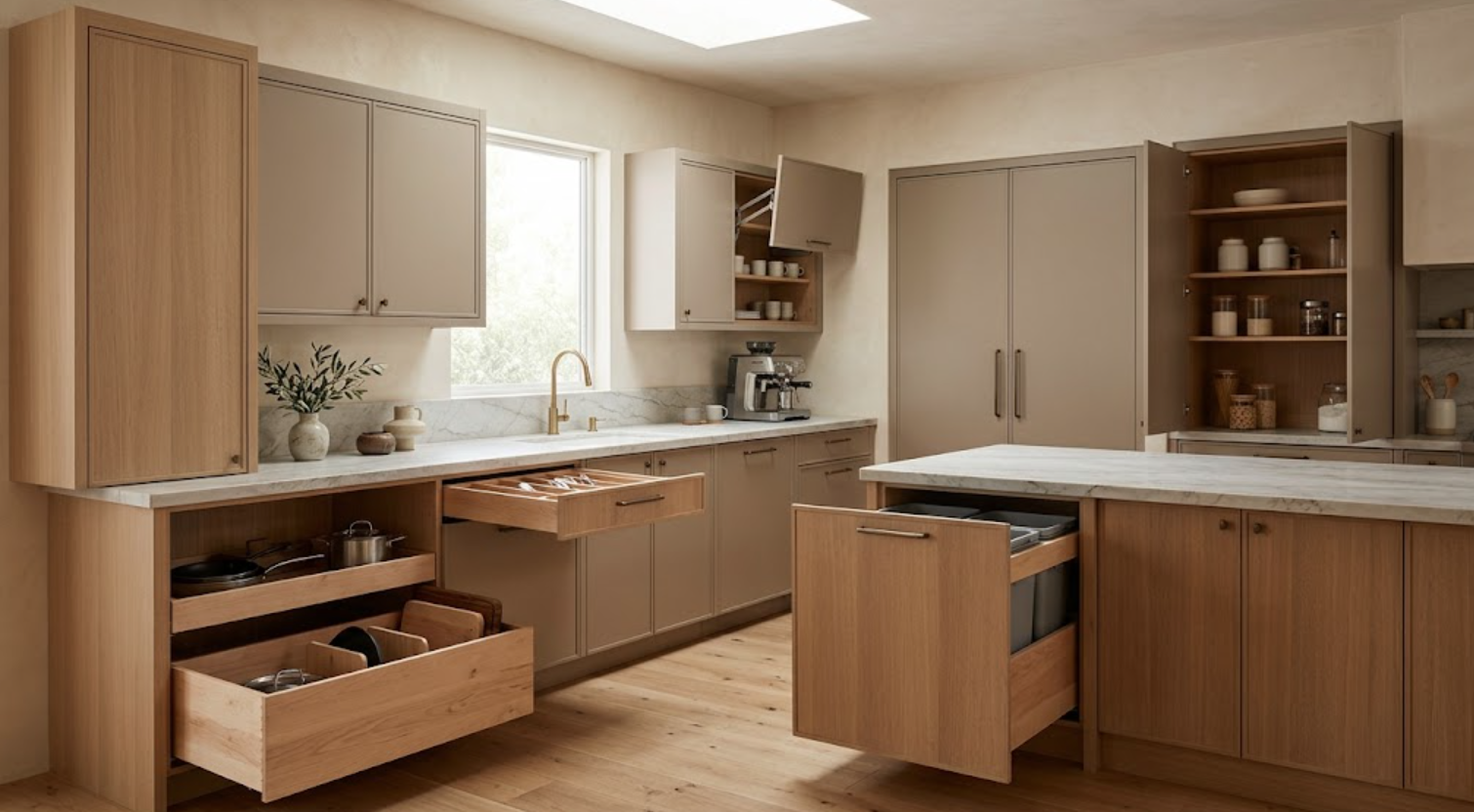
What Storage Solutions Does Dura Supreme Offer?
A substantial range.
Current examples in the Dura Supreme storage catalog include:
Tall pull-out pantries
Deep-drawer partitions
Toe-space drawers
Cutlery organizers
Spice storage
Pull-outs
Roll-out shelves
Specialized dish storage
Swing-up appliance shelving
That gives designers many ways to develop cabinet interiors around actual use.
But the presence of many accessories does not mean every cabinet needs one.
How Should Designers Specify Interior Storage?
Start with routines.
Not the accessory catalog.
Ask:
What gets used every morning?
Where are small appliances stored?
Where should waste and recycling live?
How are pots and pans accessed?
What needs to be near the cooktop?
What belongs beside the dishwasher?
Which storage needs to remain adjustable?
Then select the interior solution.
That creates cabinetry around the client rather than cabinetry around the accessory.
What Role Can Dura Supreme Play in a Whole-Home Project?
It does not need to be limited to the kitchen.
The collection can be evaluated for other cabinetry applications, such as:
Bathroom vanities
Bars
Home offices
Laundry rooms
Mudrooms
Media cabinetry
Specialized built-ins
Dura Supreme also maintains bathroom furniture and wall-hung vanity solutions within its broader offering.
For designers, this creates an opportunity to carry a cabinetry language into several rooms without making every room identical.
Can Crestwood and Bria Be Used Within the Same Residence?
Potentially, yes.
This can be particularly useful in a whole-home cabinetry strategy.
A kitchen might benefit from Bria’s frameless construction. A primary bathroom might use Crestwood inset for a more furniture-like vanity. A utility room may use another streamlined configuration.
The broader point is that construction can become part of the hierarchy.
Different rooms can receive different solutions while the finish palette, hardware, proportions, or other details keep the home connected.
When Should a Designer Use a Higher Level of Customization?
Where the architecture demands it.
Examples include:
Unusual wall conditions
Special widths
Custom hoods
Furniture-like islands
Unique built-ins
Specific appliance integrations
Tall cabinetry terminating into unusual ceilings
Dura Supreme describes Crestwood as offering extensive configurations and modifications, including custom-built solutions for special conditions.
The design should determine where that flexibility creates meaningful value.
Not every cabinet needs to be customized simply because customization is available.
How Should Designers Approach Integrated Appliances?
Early.
Especially with panel-ready appliances.
The designer should confirm:
Actual appliance model
Required opening
Panel dimensions
Panel weight
Ventilation
Door swing
Handle projection
Toe-kick relationship
Electrical
Plumbing
Adjacent cabinet clearances
The cabinetry line may provide flexibility, but the appliance manufacturer’s requirements still govern the appliance itself.
An integrated elevation works only when both systems are coordinated.
What About Aluminum Frame Doors and Glass?
Dura Supreme currently offers aluminum-frame door options within both Bria and Crestwood, with broader availability in Bria.
These can be paired with different inserts and can work with contemporary or transitional cabinetry.
For designers, these doors can be useful for:
Display cabinetry
Bars
Upper cabinets
Specialty storage
They can introduce another material without requiring a heavy decorative frame.
Use them selectively.
A small amount can create contrast.
Too much can shift the entire visual language of the room.
Does Dura Supreme Support Integrated Lighting?
Yes.
Dura Supreme currently includes integrated lighting among its design options, with controls that can include wall-switch, remote, motion-sensor, and connected activation options depending on the application.
For a designer, the important part is not simply that lighting exists.
It is coordination.
Cabinet lighting may require:
Channels
Wiring
Drivers
Power locations
Switching
Access
Those requirements should be coordinated before electrical work is finalized.
What Construction Details Should Designers Review?
Do not stop at the exterior.
Review:
Drawer boxes
Roll-out shelves
Adjustable shelves
End panels
Interior edge conditions
Toe kicks
Hinges
Slides
Interior finishes
Both Crestwood and Bria offer multiple construction and material options within those categories.
Crestwood uses framed construction, while Bria uses frameless construction with its own box, edge-banding, and interior options.
These choices influence both performance and the experience of using the cabinetry.
Why Does the Drawer Matter?
Because clients touch it constantly.
A cabinet can photograph beautifully while feeling ordinary in use.
Drawer construction, glide performance, interior finish, and organization are part of the premium experience.
Dura Supreme currently offers hardwood dovetailed drawer options in both major product lines, with Bria also listing a stainless-steel drawer-box option.
Those distinctions are worth experiencing physically in a showroom.
How Should Designers Evaluate Dura Supreme for a Specific Project?
Do not begin with the brand name.
Begin with the project.
Ask:
What cabinet construction supports the architecture?
How minimal or articulated should the fronts feel?
Does the project need inset?
Which natural woods or painted finishes support the material story?
How much customization is required?
What storage functions matter?
Which appliances need integration?
Is the cabinetry continuing into other rooms?
Then evaluate Dura Supreme against those needs.
That creates a stronger specification than beginning with a catalog and trying to find something attractive.
Why Is a Showroom Particularly Useful With a Collection This Broad?
Because a broad collection can become difficult to understand from screens and samples alone.
In a showroom, designers can compare:
Crestwood and Bria construction
Inset and overlay relationships
Door profiles
Natural woods
Painted finishes
Interior storage
Drawer construction
Hardware scale
Full-height cabinetry
Integrated appliances
Those comparisons become much more tangible at full scale.
Dura Supreme itself recommends reviewing physical samples and showroom displays when making finish selections.
What Should Designers Confirm Before Final Specification?
Confirm the exact combination.
Not just the general idea.
That means verifying:
Product line
Cabinet construction
Overlay or inset condition
Door style
Wood or substrate
Finish
Special modifications
Interior configuration
Hardware
Appliance requirements
Integrated lighting
Any specialty doors or inserts
Dura Supreme has a broad collection.
That breadth creates flexibility.
But flexibility only becomes useful once the exact combination has been technically confirmed.
How Should Dura Supreme Be Used in a Luxury Residential Project?
Selectively.
The strength of a broad collection is not that every available feature should appear.
It is that the designer can choose the few features that support the project.
A restrained kitchen might use:
Bria frameless construction
Slab quarter-sawn white oak fronts
Panel-ready appliances
Broad drawers
Minimal hardware
Another project might use:
Crestwood
Flush inset construction
A narrow-frame painted door
A walnut island
Furniture-like detailing
Both can be successful.
The collection should adapt to the architecture rather than define it.
What Is the Most Important Dura Supreme Decision?
Construction first.
Then expression.
Once the designer knows whether the project is better served by framed or frameless cabinetry, many subsequent decisions become easier to organize.
From there:
Choose the overlay condition where relevant.
Choose the door.
Choose the material.
Choose the finish.
Develop the interior function.
Coordinate appliances.
Resolve technical details.
That sequence creates a much clearer design process than selecting a finish first and working backward.
Dura Supreme Cabinets: A Designer’s Guide to the Collection
Dura Supreme gives designers multiple ways to approach premium residential cabinetry.
Crestwood offers framed construction with Full Overlay, Standard Overlay, and Inset options.
Bria offers frameless full-access construction.
The collection spans slab, flat-panel, raised-panel, and mullion doors, along with natural woods, painted finishes, veneers, other contemporary materials, storage solutions, specialty details, and integrated features.
That range is useful.
But the range itself is not the design.
The designer still needs to edit.
The architecture should determine the construction. The elevation should determine the door language. The material story should determine the finish. The client’s routines should determine the interior storage. The technical conditions should determine where customization is actually needed.
Used that way, Dura Supreme becomes a flexible cabinetry resource rather than a predefined aesthetic.
Explore Dura Supreme Cabinetry With Atelier Design Society
Atelier Design Society works with interior designers, architects, builders, homeowners, and other design professionals evaluating premium cabinetry for sophisticated residential projects throughout the Bay Area.
At the Atelier Design Society showroom in Menlo Park, designers can explore Dura Supreme cabinetry in the context of physical door styles, natural woods, painted finishes, construction options, storage solutions, hardware, surfaces, and full-scale cabinetry applications.
Bring architectural drawings, preliminary elevations, appliance information, stone or flooring samples, and an overall material direction when available.
The objective is not to review the entire collection.
It is to identify the construction, materials, and details that belong in the project.