How Much Should You Budget for High-End Kitchen Cabinets in the Bay Area?
If you have started researching high-end kitchen cabinetry, you have probably discovered something frustrating: it is difficult to find a useful price online.
One source gives a price per linear foot. Another gives a total kitchen number. One quote includes installation while another does not. A “custom kitchen” can mean something very different from one cabinetry company to another.
In the Bay Area, the range can become especially wide. A straightforward kitchen using premium semi-custom cabinetry might require a very different investment from a large Atherton kitchen with specialty walnut, integrated appliances, custom dimensions, elaborate interior storage, and cabinetry extending into a pantry or adjacent bar.
So, how much should you actually budget?
Current Bay Area estimates commonly place premium semi-custom cabinetry around $15,000 to $35,000 for a typical kitchen, while full custom cabinetry can reach $50,000 to $80,000 or considerably more, depending on size, material, customization, installation, and scope. Other 2026 Bay Area sources put highly customized or design-intensive cabinetry above those ranges, which is why a single universal number can be misleading.
For homeowners planning a high-end kitchen in Menlo Park, Palo Alto, Atherton, or elsewhere on the Peninsula, the more useful question is: What is actually driving the cabinetry budget?
That is what we will break down.
What Is a Realistic Budget for High-End Kitchen Cabinets in the Bay Area?
For planning purposes, it helps to think in ranges rather than one fixed price.
Current 2026 Bay Area estimates show substantial variation, but a general starting point looks something like this:
Premium semi-custom: $15,000–$35,000+
Custom: $30,000–$60,000+
Highly customized luxury cabinetry: $60,000–$100,000+
These are planning ranges, not Atelier Design Society quotes. Published Bay Area sources vary significantly depending on whether installation is included, kitchen size, materials, and what they consider “custom.” Some local estimates put high-end custom kitchens well above $60,000.
A large kitchen with specialty materials, extensive appliance integration, complex interiors, or unusually customized construction can move beyond $100,000.
The number alone is not particularly useful until you understand what is included.
Why Is There Such a Large Range in Cabinet Pricing?
Because “kitchen cabinets” is not one standardized product.
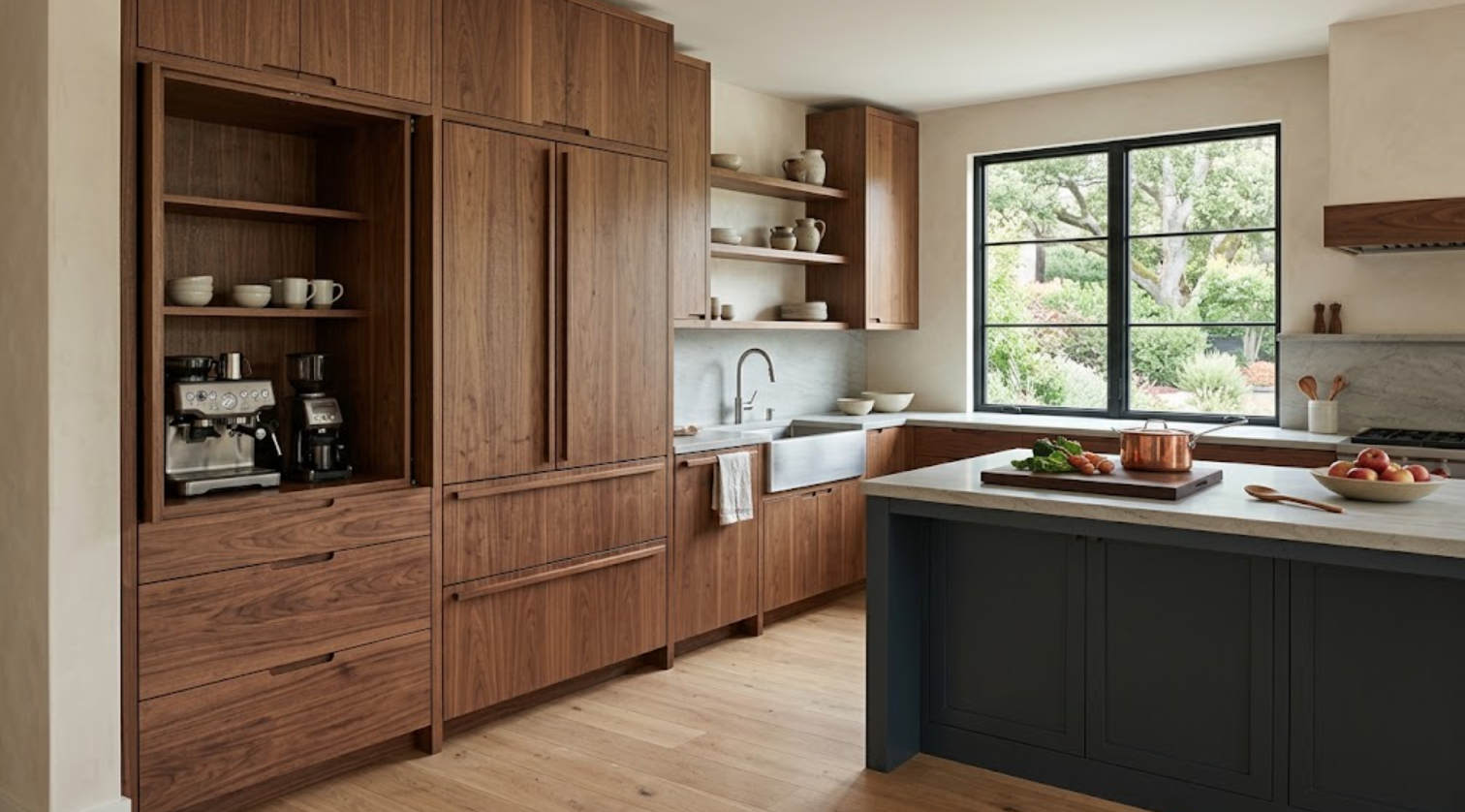
Consider two kitchens with approximately the same footprint. The first uses a manufacturer’s established cabinet dimensions, a standard painted finish, straightforward drawer interiors, and conventional appliances. The second uses custom-sized walnut cabinetry, integrated refrigerator and freezer columns, specialty interior accessories, custom finish development, floor-to-ceiling panels, an appliance garage, and an adjacent pantry.
Both projects need cabinets. They are not buying the same thing.
Price can be affected by:
Cabinet quantity and dimensions
Construction
Cabinetry line
Door style
Wood species
Finish
Custom modifications
Interior storage
Decorative and architectural panels
Appliance integration
Hardware
Delivery
Installation
That is why comparing two cabinetry quotes based only on the final number can be misleading. You need to compare what each number actually includes.
How Much Does Kitchen Size Affect the Cabinetry Budget?
Considerably, but square footage alone does not tell the full story.
A physically large kitchen with relatively simple cabinetry may cost less than a smaller kitchen packed with specialized storage and custom architectural conditions. What matters more is the amount and type of cabinetry.
A kitchen with one long perimeter and a simple island is different from one with:
Floor-to-ceiling pantry storage
Two appliance walls
A large island with cabinetry on multiple sides
A coffee station
A separate pantry
A bar
Upper cabinets extending to a tall ceiling
Even if both rooms have similar floor areas, the amount of cabinetry can be very different. That is why early budgeting works better from plans than from square footage alone.
How Much Does the Cabinetry Level Affect Cost?
This is one of the largest variables.
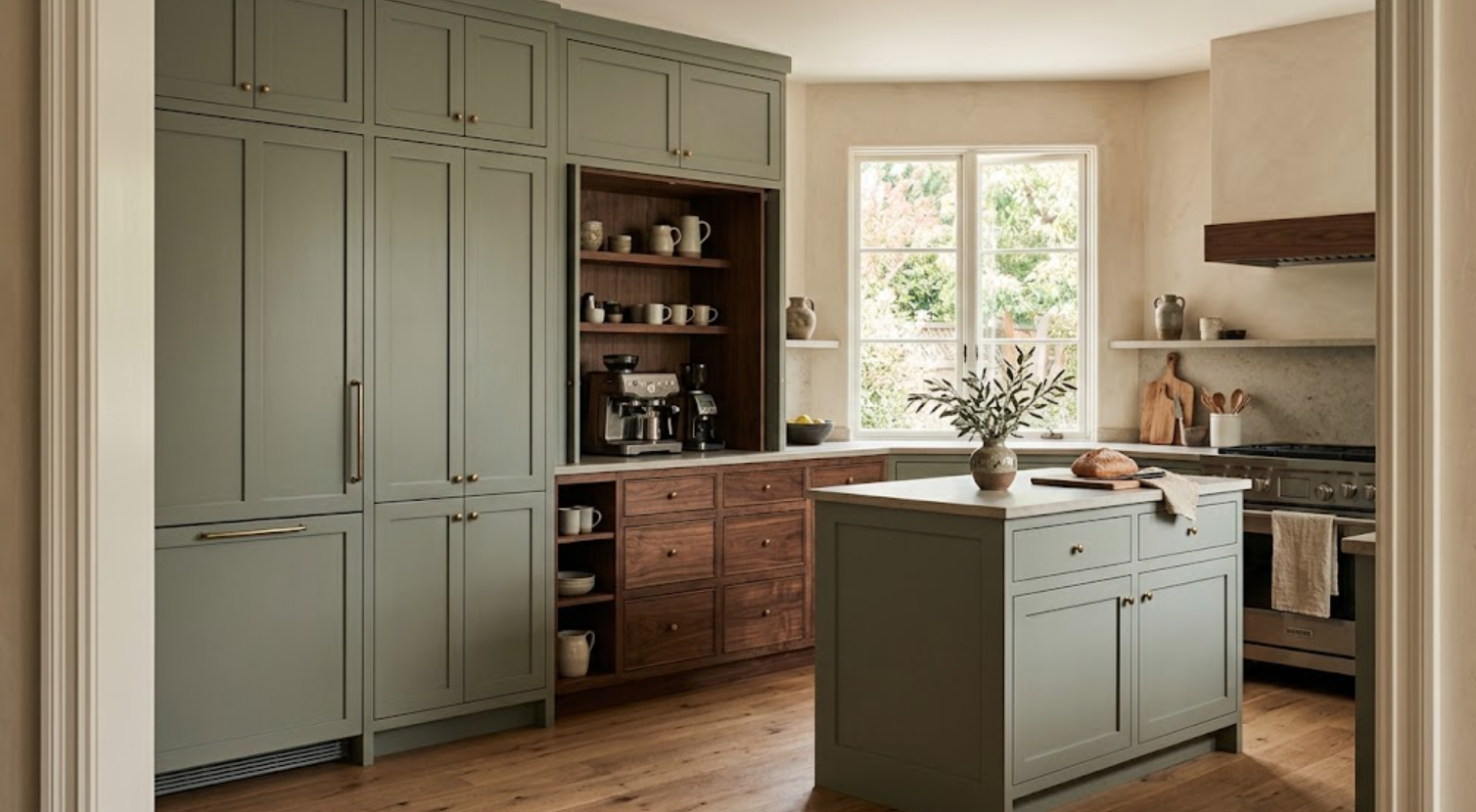
Semi-custom cabinetry generally works within a manufacturer’s established system of sizes, finishes, door styles, and available modifications. Custom cabinetry offers greater freedom to change dimensions, materials, configurations, and details around the project.
That additional flexibility can require more design, engineering, manufacturing, and finishing. But custom is not automatically necessary for every high-end kitchen.
If a premium semi-custom cabinetry line already offers the right finish, dimensions, storage, and design flexibility, it may be a very strong solution. Custom becomes more valuable when the architecture keeps asking for something the existing system cannot resolve elegantly.
The goal should be to pay for flexibility where the project actually benefits from it.
Does Walnut or White Oak Cost More Than Painted Cabinetry?
Material and finish selection can meaningfully affect price, but there is no universal rule that one finish will always cost more than another.
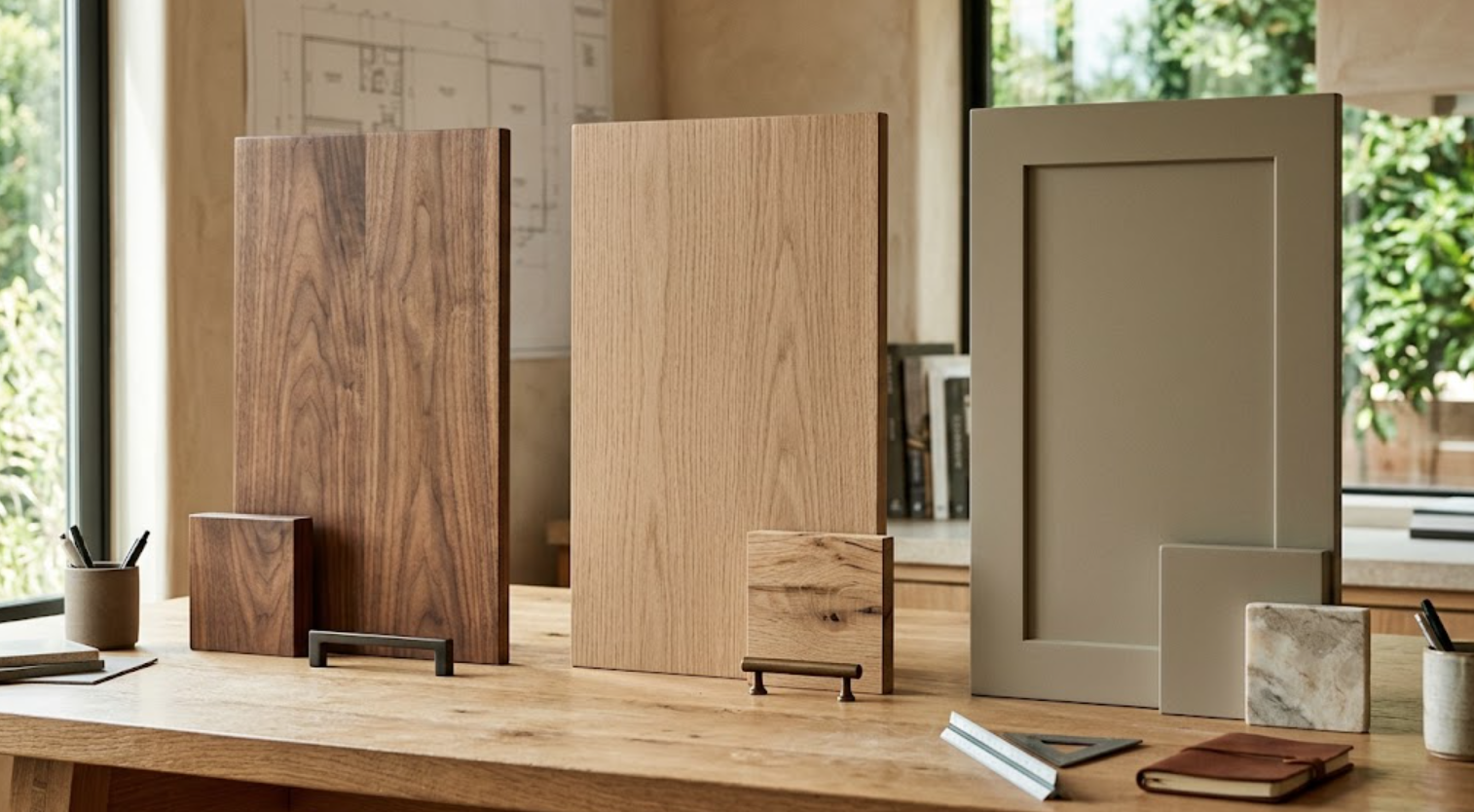
Natural wood cabinetry introduces variables such as species, cut, veneer selection, grain matching, board selection, stain, and finishing. Rift-sawn white oak can carry a premium because of the way the material is cut and selected. Walnut may also increase the cabinetry budget compared with more readily available woods or certain painted options.
But painted cabinetry can become expensive too:
Specialty colors
Complex finishing processes
Inset construction
Detailed door profiles
High-touch finish work
The better approach is to compare the actual options being specified rather than assume “paint” is the budget choice and “wood” is the expensive choice.
How Much Do Integrated Appliances Add to Cabinetry Costs?
Potentially more than homeowners expect.
A panel-ready refrigerator requires more than purchasing a cabinet panel. The cabinetry needs to be designed around the exact appliance specifications. Panels need to be fabricated appropriately. Clearances and ventilation need to work. Adjacent cabinetry needs to align. The refrigerator panel may need to continue the grain or proportions of the surrounding elevation.
Dishwashers introduce similar considerations. Then there are refrigerator and freezer columns, wall ovens, warming drawers, built-in coffee machines, and other appliances.
The more the design asks appliances to disappear into the cabinetry, the more coordination is usually required. This is one reason appliance selections should happen early.
How Much Should You Budget for Cabinet Interiors?
This is one of the easiest areas for a cabinetry budget to grow quietly. One pullout may not change the project significantly. Twenty specialized interiors can.
Consider:
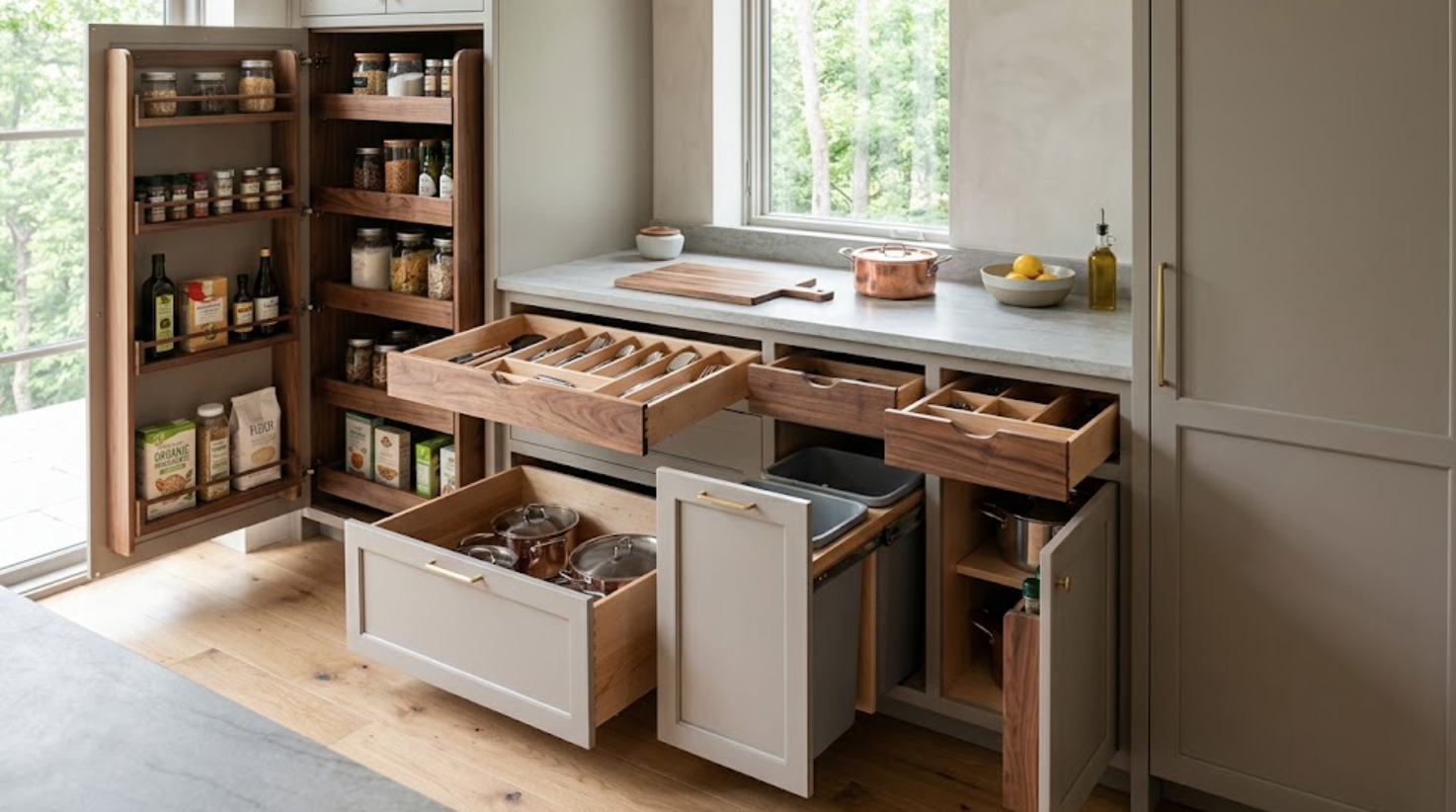
Deep drawer organizers
Tray dividers
Waste and recycling pullouts
Spice storage
Interior drawers
Pantry systems
Corner mechanisms
Pocket-door hardware
Integrated lighting
Specialized inserts
These features can improve daily use considerably when they solve real needs. But not every cabinet needs an accessory.
Start with the problems you actually want the cabinetry to solve:
Where does trash need to go?
Which appliances should disappear?
What is currently difficult to reach?
Which items deserve dedicated storage?
Spend on the interiors you will appreciate every day.
Does Door Style Affect the Budget?
It can.
A straightforward slab door and a detailed framed or inset door do not necessarily require the same construction or finishing process. But door style should not be chosen based solely on price. It has a major effect on how the entire kitchen feels.
A slab door places emphasis on material, grain, proportion, and alignment. A Shaker or narrow-frame door introduces more shadow and architectural detail. Inset cabinetry creates another level of visual precision because the doors and drawers sit within the cabinet frame rather than over it.
Each approach has different implications for construction, finish, hardware, and installation.
Choose the design direction first. Then understand what that choice does to the budget.
How Much Does Customization Affect the Price?
Customization can range from small dimensional changes to cabinetry designed almost entirely around a particular architecture.
A modified cabinet width may have a relatively modest impact. An entire wall of unusual cabinet sizes, specialty panels, custom interiors, and bespoke finishes is another matter.
This is where budgeting becomes strategic. Not every cabinet needs to be special.
Perhaps standard dimensions work beautifully across most of the kitchen, but one architectural wall needs significant customization. Or the cabinetry itself can remain relatively straightforward while the homeowner invests in a specialty walnut finish.
The most thoughtful high-end kitchens often concentrate complexity where it has the greatest visual or functional effect.
Is Installation Included in the Cabinet Price?
Do not assume it is. This is one of the most important questions to ask when comparing cabinetry proposals.
Some published Bay Area cabinet ranges include installation. Others refer only to the cabinetry itself. Some separate delivery, installation, hardware, field modifications, or finishing work.
Local 2026 estimates illustrate why this matters: one Bay Area design source places cabinetry installation at roughly $3,000 to $8,000 on top of the cabinet package for its typical projects, while other published cabinet prices are already presented as installed totals.
Ask:
What does the cabinetry number include?
What is separate?
Who installs it?
Who handles final adjustments?
Who coordinates appliance panels?
Who resolves field conditions?
A lower initial number is not necessarily a lower final number.
Should Cabinetry Be Budgeted Separately From the Kitchen Remodel?
Yes. At least during planning.
A full kitchen renovation can include:
Cabinetry
Countertops
Appliances
Plumbing fixtures
Lighting
Flooring
Electrical
Plumbing
Construction
Architecture
Interior design
Permits
Structural work
Those costs should not be confused with the cabinetry package itself.
Current Bay Area remodel estimates often place cabinetry among the largest individual portions of a kitchen budget, with some sources estimating roughly 25% to 40% of the overall project, depending on scope.
Breaking the project into categories makes it easier to see where money is actually going.
What Should You Prioritize if the Cabinet Budget Starts Getting Too High?
Do not immediately downgrade everything. First identify what is driving the number:
Is it the wood species?
Custom finish?
Interior accessories?
Cabinet quantity?
Specialty construction?
Appliance panels?
A highly customized architectural condition?
Once you know, you can make targeted decisions.
Perhaps several specialty inserts can be simplified while keeping the cabinetry construction and finish. Maybe one dramatic walnut wall stays while a secondary area moves to painted cabinetry. Perhaps a highly customized cabinet in a low-priority location can return to a standard dimension.
A good value-engineering conversation protects the parts of the design that matter most instead of reducing quality everywhere equally.
Should You Use a Price Per Linear Foot?
Only as a very early reference.
Linear-foot pricing can help establish a rough sense of scale. It is much less useful for comparing detailed high-end cabinetry.
A linear foot containing three simple base cabinets is not equivalent to a linear foot containing a tall appliance cabinet, integrated refrigerator panel, specialty interior, and finished end panel. The same length of cabinetry can represent dramatically different products.
For a serious budget, the actual design is more useful than a generic per-foot calculation.
When Should You Establish Your Cabinetry Budget?
Earlier than many homeowners expect.
Cabinetry affects:
The kitchen layout
Appliance integration
Electrical locations
Plumbing
Lighting
Stone dimensions
Storage
Material relationships
If the cabinetry budget is not discussed until the design is largely complete, you may discover that several major decisions were developed around assumptions that no longer work.
You do not need an exact number on day one. But having a realistic range helps the design team make better decisions from the beginning.
How Can You Get a More Accurate Cabinetry Budget?
Bring the actual project information into the conversation:
Floor plans
Elevations if available
Ceiling heights
Appliance selections
Inspiration
Material preferences
Information about storage
The more developed the project becomes, the more meaningful the cabinetry estimate can become.
This is also why comparing cabinetry in a showroom can be useful. You can see what a specialty finish actually looks like. Compare semi-custom and more highly customized solutions. Open the interior accessories you are considering. Look at different construction options.
Then decide which details deserve a place in your budget.
So, How Much Should You Budget for High-End Kitchen Cabinets?
For an early Bay Area planning conversation, roughly $30,000 to $60,000+ is a reasonable territory to keep in mind for many custom or high-end cabinetry projects, while more elaborate luxury kitchens can move well beyond that range. Published 2026 Bay Area pricing varies substantially, with some custom installations around $25,000–$55,000+ and other high-end projects reaching $60,000–$100,000 or more.
But do not design a kitchen around that number alone. A smaller premium semi-custom project may fall below it. A large custom kitchen in Atherton with specialty wood, extensive integrated appliances, and complex storage could substantially exceed it.
The most useful budget is the one based on your actual cabinetry plan. That is when the number begins to mean something.
Discuss Your Kitchen Cabinetry Project in Menlo Park
Atelier Design Society works with homeowners, interior designers, architects, builders, and other design professionals planning premium kitchen cabinetry throughout the Bay Area.
At the Atelier Design Society showroom in Menlo Park, you can compare cabinetry lines, construction, finishes, materials, storage systems, and different levels of customization while discussing what those decisions could mean for your project's cabinetry budget.
Bring your plans if you have them. If you are earlier in the process, bring the information you do have.
The goal is to move from a generic online price range toward a cabinetry plan that reflects the architecture, priorities, and investment level of your home.