The Details That Separate Premium Cabinetry From Standard Cabinets
At first glance, the difference between premium cabinetry and standard cabinets can be surprisingly difficult to see. Both can have attractive doors. Both can come in popular colors and wood finishes. Both can look polished in a photograph.
The differences tend to become more noticeable when you look closer and, especially, when you begin using the cabinetry.
Open a drawer. Look at how the doors align. Examine the interior. Run your hand across the finish. Notice what happens where the cabinetry meets the ceiling, an appliance, a wall, or another material.
Premium cabinetry is rarely defined by one dramatic feature. It is usually the accumulation of smaller decisions involving construction, proportions, materials, finish quality, hardware, customization, and installation.
For homeowners and design professionals comparing premium cabinetry in the Bay Area, understanding those details can make it much easier to evaluate what you are actually getting for the investment.
What Actually Makes Cabinetry “Premium”?
There is no single feature that automatically turns a cabinet into premium cabinetry. A particular wood species does not do it. Neither does expensive hardware or a custom paint color on its own.
The distinction comes from how the entire cabinetry system is designed, manufactured, finished, and installed. That includes elements you immediately see and others that remain almost invisible once the project is complete:
Door and drawer alignment
Cabinet-box construction
Interior materials
Finish consistency
Hardware performance
Available modifications
Panel sizing
Edge details
The way cabinetry resolves architectural conditions
Premium cabinetry tends to give designers and homeowners greater control over those details and greater consistency in how they are executed.
Why Does Cabinet Construction Matter?
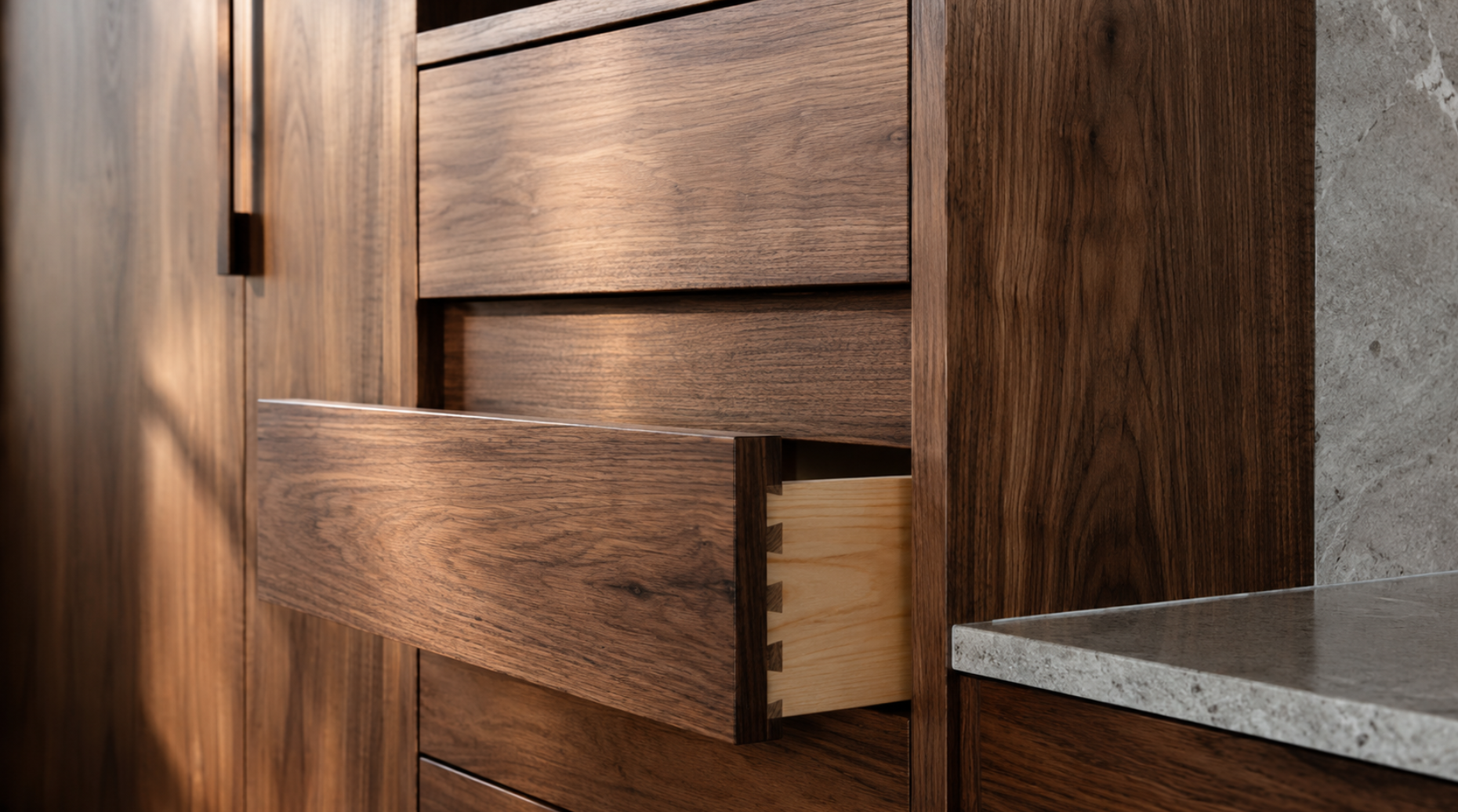
Much of a cabinet’s construction disappears once the kitchen is finished. That does not make it unimportant.
Cabinet boxes support doors, drawers, shelves, countertops, hardware, and everything stored inside them. Drawer boxes are opened and closed repeatedly. Hinges support substantial doors. Shelves carry weight over long periods.
Construction influences how cabinetry feels when you use it and how well it continues to perform.
When comparing cabinetry, look beyond the exterior door:
Open the cabinets.
Examine the drawer boxes.
Look at shelf thickness and interior finishes.
Ask how the cabinet is constructed.
The most visually exciting feature in the showroom may not be the one that matters most five or ten years later.
What Should You Notice About Drawers?
Drawers are one of the easiest places to physically experience differences between cabinetry systems.
Open one slowly. Pull it all the way out. Notice its stability. Look at the drawer-box material and joinery. Consider how much usable interior space it provides. Then close it.
The movement should feel controlled and appropriate to the cabinetry. Hardware is important, but the experience is not only about whether a drawer has soft-close runners. The drawer itself, the runner system, installation, alignment, and cabinet construction all work together.
A premium drawer should not need to announce itself. It should simply feel right every time it is used.
Why Are Cabinet Reveals and Alignment Important?
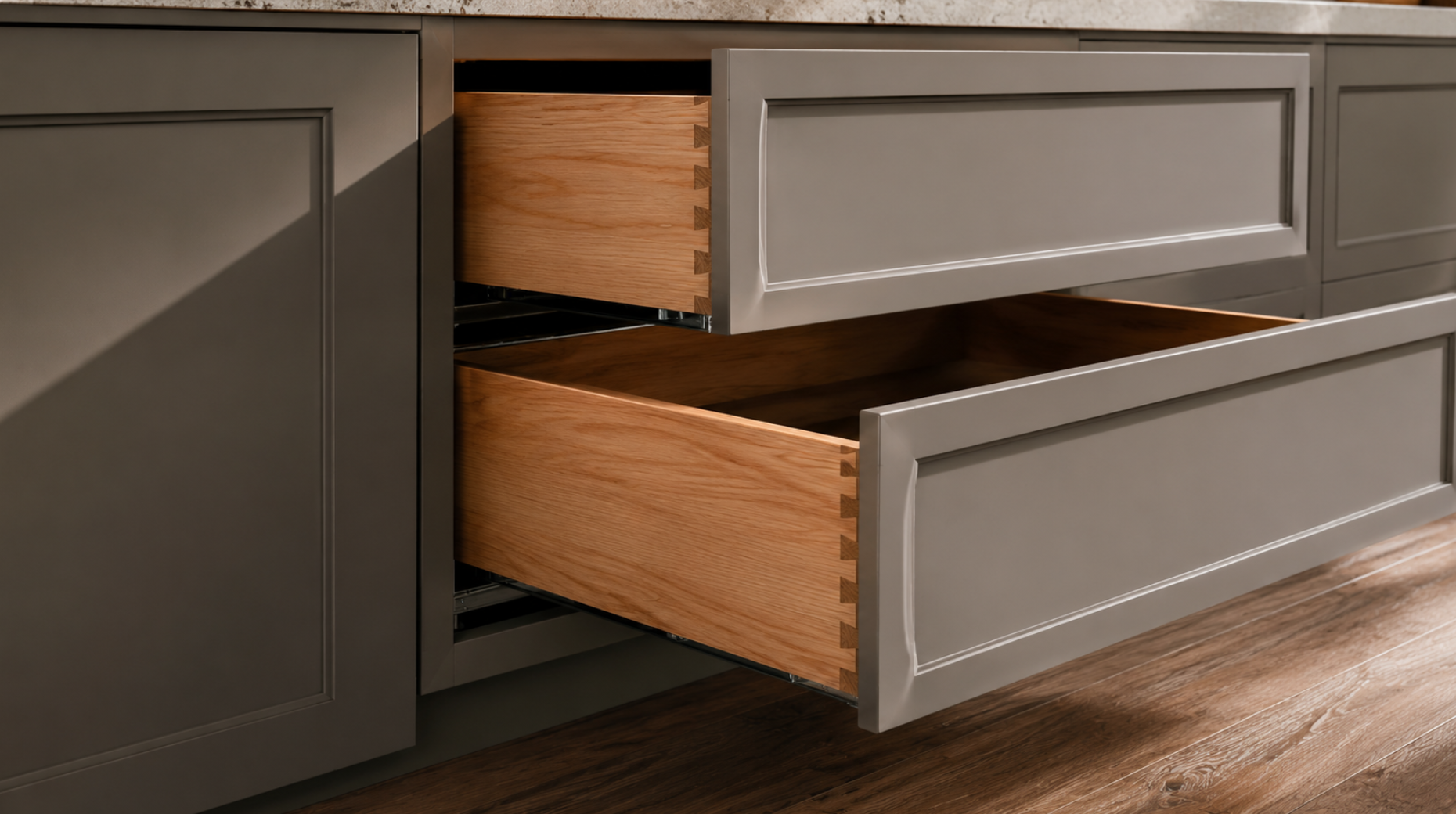
Some of the strongest indicators of cabinetry quality are measured in very small distances.
Look at the gaps:
Between adjacent doors
Between drawers
Around appliance panels
Where a cabinet meets a finished end panel
These spaces are often called reveals. When they are consistent, the cabinetry feels calm and intentional. When they vary noticeably, the eye may register that something feels slightly wrong even if you cannot immediately identify why.
This becomes especially important in contemporary cabinetry. A simple slab-door kitchen has fewer decorative elements to distract from alignment. Every horizontal and vertical line becomes visible.
The simpler the design appears, the more precise the execution often needs to be.
How Much Does the Cabinet Finish Matter?
A lot. The finish is one of the few parts of the cabinetry you see and touch every day.
With painted cabinetry:
Look at consistency across doors and panels.
Notice the sheen.
Look at corners and edges.
Consider how the paint responds to light.
With stained or natural wood cabinetry, pay attention to grain, tonal variation, and how the finish interacts with the underlying material.
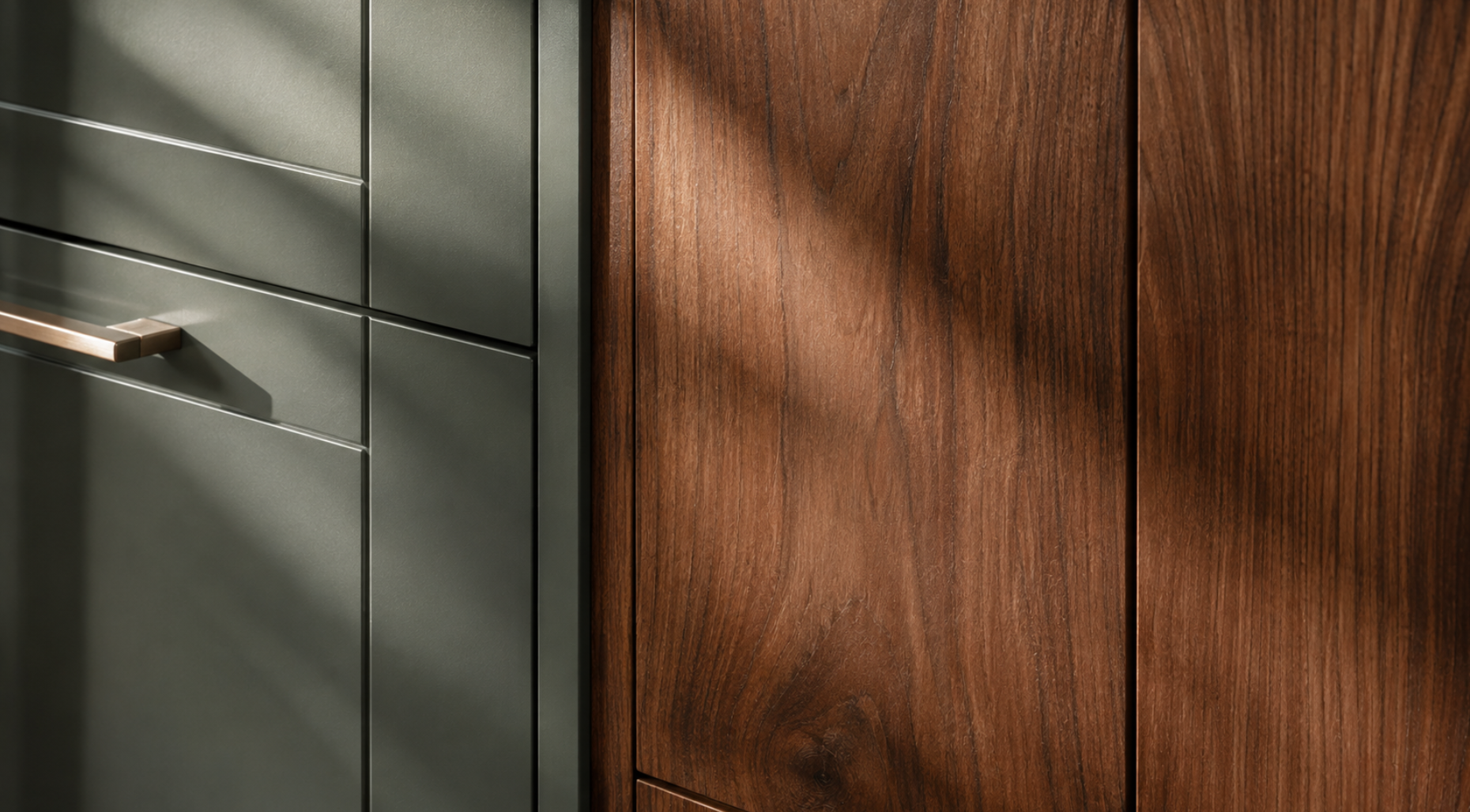
Premium finishing does not necessarily mean making natural wood perfectly uniform. Walnut, white oak, and other natural materials should still have character.
The goal is controlled execution. Natural variation should feel like part of the material rather than an accident the design failed to consider.
Does Premium Cabinetry Offer Better Materials?
Premium cabinetry often provides access to a broader or more carefully curated range of materials and finishes, but material names alone do not tell the whole story.
“Walnut cabinetry” can describe very different finished products. So can white oak. Painted cabinetry. Veneer.
Even two doors using the same wood species can look different depending on cut, board selection, grain direction, stain, sheen, and finishing process.
When comparing cabinetry, ask to see actual finish samples. Better yet, look for full-scale installations.
A small sample can help with color. A larger cabinet elevation helps you understand how that material behaves across the room.
Why Do Cabinet Proportions Make Such a Difference?
You can use expensive materials and still end up with cabinetry that feels awkward. Proportion is one reason.
How wide should the drawers be?
Where should horizontal lines occur?
How should tall cabinetry relate to a nearby window?
Should an upper cabinet stop at one height or continue to the ceiling?
How should a refrigerator panel relate to adjacent doors?
These decisions create the visual rhythm of the room.
Premium cabinetry can provide more dimensional flexibility, allowing those proportions to respond more closely to the architecture rather than relying entirely on predetermined cabinet sizes.
But flexibility alone does not guarantee a better result. Someone still has to make good decisions with it.
What Is the Difference at the End of a Cabinet Run?
Look at the edges of the room. They often reveal more than the middle.
Where does the cabinetry stop?
How does it meet the wall?
What happens beside the refrigerator?
How does a finished panel return around an island?
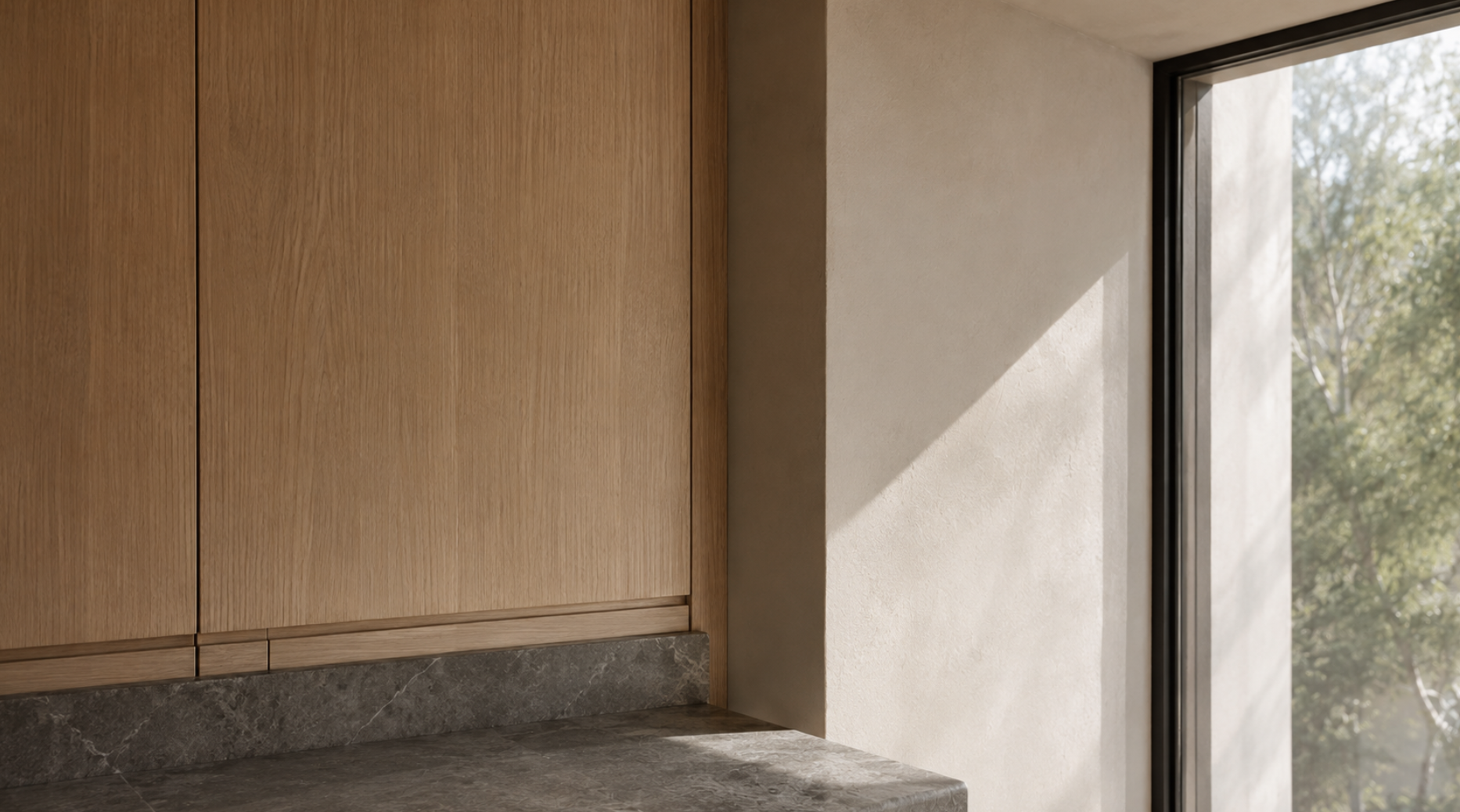
What happens at the ceiling?
These transitions can make cabinetry feel integrated into the architecture or simply placed inside it.
Standard solutions may use fillers and predetermined panel sizes to resolve these conditions. That can work perfectly well when the architecture cooperates.
More customizable cabinetry can provide additional ways to resolve unusual conditions, particularly when dimensions, alignments, or material transitions need to be very specific.
Why Does Appliance Integration Matter?
Appliances introduce some of the most technically demanding conditions in a kitchen.
Refrigerators need ventilation and clearance. Dishwashers require appropriately sized panels. Wall ovens create horizontal lines that affect surrounding cabinetry. Coffee systems, warming drawers, and other built-in appliances introduce additional dimensions.
Premium cabinetry can offer more flexibility in coordinating these elements so appliances feel integrated into the overall composition.
Panel-ready appliances can become particularly convincing when door proportions, grain direction, and reveals align with surrounding cabinetry.
The result may look simple. Getting there usually requires careful planning.
Is Premium Hardware Really Different?
Hardware deserves attention because it is where you physically interact with cabinetry. That includes decorative pulls and knobs, but also the hardware you rarely see:
Hinges
Drawer runners
Pocket-door mechanisms
Interior pullouts
Lift systems
The quality and suitability of these components influence how cabinetry operates.
Premium does not necessarily mean adding complicated mechanisms everywhere. In fact, unnecessary hardware can make cabinetry less pleasant to use.
The best hardware solves a specific problem and does so reliably. A simple drawer that operates beautifully may be more valuable than an elaborate accessory that rarely gets used.
What About Cabinet Interiors?
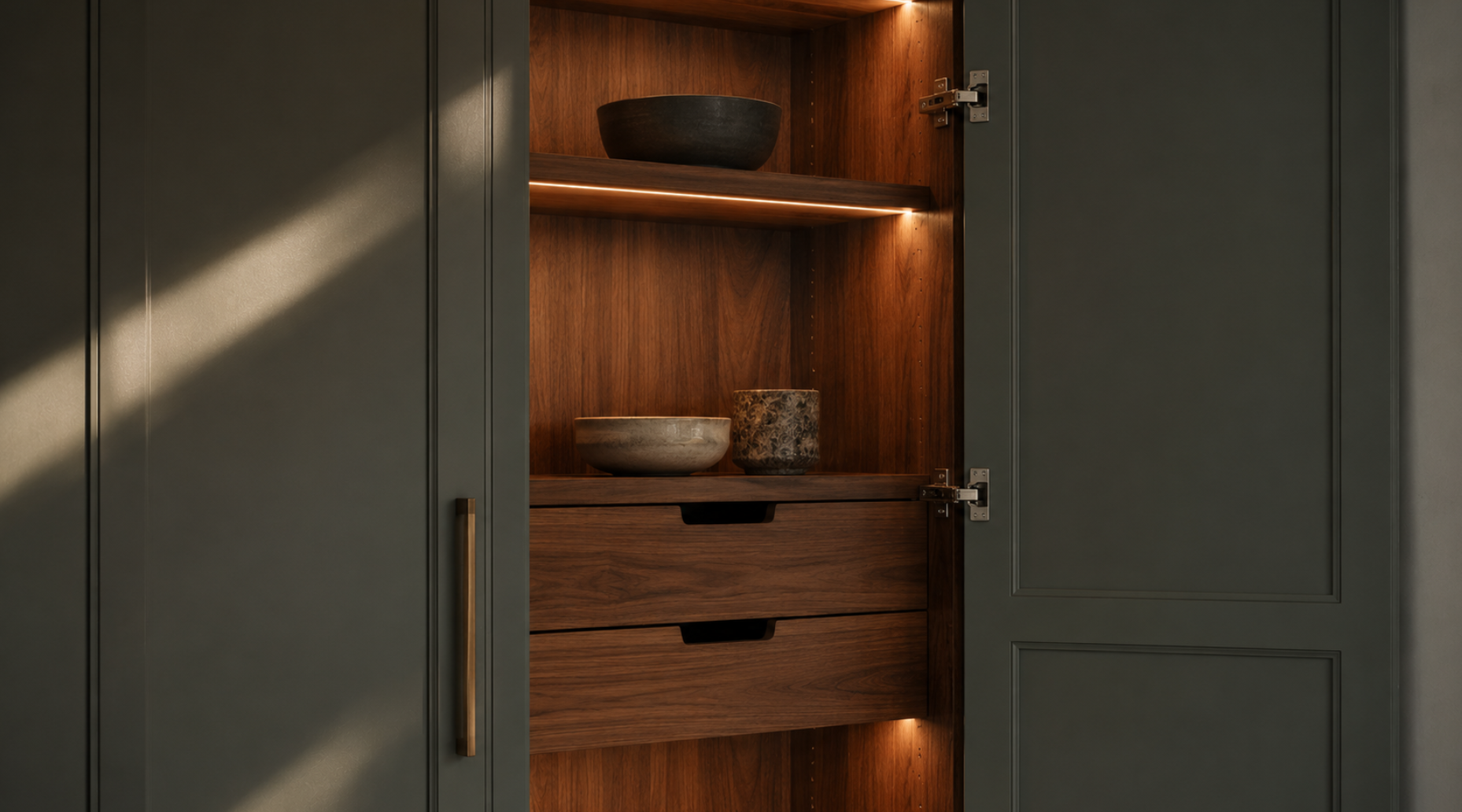
Cabinet interiors are easy to ignore because they spend most of their time behind closed doors. But you see them every time you reach for something.
Look at:
The finish
Shelving
Edge details
Interior drawers
Hardware
How the interior relates to the exterior
In some cabinetry systems, interior material and finish options may be relatively standardized. Others offer more flexibility. The right level depends on the project.
A highly visible glass cabinet or open bar may justify a different interior treatment from a closed pantry cabinet.
Premium cabinetry is not necessarily about making every hidden surface elaborate. It is about having the ability to make the appropriate decision for each condition.
Does Premium Cabinetry Mean Everything Has to Be Custom?
No. This is an important distinction.
A project does not become better simply because every cabinet has been modified. Sometimes an established cabinet dimension works perfectly. Sometimes a manufacturer’s standard finish is exactly right. Sometimes a straightforward drawer is better than a specialized storage mechanism.
Customization is valuable when it solves something:
An architectural condition
A storage need
A material relationship
An appliance requirement
A proportion problem
The objective is not to maximize customization. It is to use flexibility where it improves the finished home.
Does Installation Affect Cabinet Quality?
Significantly. Beautiful cabinetry can be compromised by poor installation.
Walls and floors are not always perfectly level or square, particularly in remodeled homes. Cabinetry needs to be positioned, leveled, aligned, adjusted, and finished carefully within those real-world conditions.
Doors and drawers may require final adjustments. Panels need to meet walls and ceilings properly. Appliance interfaces need coordination. Hardware needs alignment.
The finished cabinetry is the combination of the product and the way it is installed. When comparing cabinetry options, installation should be part of the conversation.
Can You See the Difference Between Premium and Standard Cabinets in Photos?
Sometimes. But photographs tend to emphasize the most visible elements:
Color
Door style
Countertops
Hardware
Lighting
Many of the differences discussed in this article are difficult to understand from an image. Drawer operation cannot be photographed. The weight of a door cannot be photographed. Finish texture is difficult to reproduce accurately on a screen. Construction may be hidden.
Even subtle differences in proportion become much easier to understand at full scale. That is why physically comparing cabinetry can be useful before making a major decision.
Is Premium Cabinetry Worth It?
That depends on the project.
For a straightforward room where standard dimensions, finishes, and configurations work naturally, additional customization may provide limited value.
For a complex renovation or custom home where cabinetry needs to respond precisely to architecture, appliances, materials, storage, and adjacent rooms, the additional flexibility and detailing can become much more meaningful.
The right question is not: “Is premium cabinetry worth more?”
It is: “Which differences will actually matter in this home?”
That is a much more useful way to evaluate the investment.
What Should You Compare in a Cabinet Showroom?
When looking at cabinetry in person, move past the door color.
Open things. Look inside. Stand back and study proportions. Then get close.
Look at:
Reveals
Edges
Panels
Interior construction
Finish quality
Hardware
Material transitions
Ask which details are standard and which can be modified.
The more carefully you look, the easier it becomes to understand why two cabinetry options that appeared similar online may feel very different in person.
See Premium Cabinetry in Menlo Park
Atelier Design Society works with homeowners, interior designers, architects, builders, and other design professionals planning premium cabinetry throughout the Bay Area.
At the Atelier Design Society showroom in Menlo Park, you can examine cabinetry at full scale, open doors and drawers, compare finishes and materials, study construction details, and understand how different cabinetry options respond to real architectural conditions.
Whether you are planning a kitchen or cabinetry throughout several rooms of the home, seeing those details in person can make it easier to determine where quality and customization will matter most to your project.