How to Choose Between Atelier’s Cabinetry Collections
Choosing a cabinetry collection should not begin with a favorite brand.
It should begin with the project.
The architecture.
The level of customization.
The construction method.
The material palette.
The rooms being designed.
The technical conditions.
And the amount of flexibility the cabinetry needs to provide.
Atelier Design Society works with several premium cabinetry collections, including Grabill, Columbia, Dura Supreme, and Urban Effects.
They are not interchangeable.
One project may need the extensive flexibility of true custom cabinetry.
Another may be better served by a premium framed or frameless collection with a broad range of established options.
A contemporary residence may prioritize full-access frameless construction and material consistency.
A whole-home project may even benefit from using more than one collection.
The goal is not to determine which cabinetry brand is universally “best.”
It is to identify which collection provides the right level of design freedom for each project.
Why Does Atelier Work With More Than One Cabinetry Collection?
Because residential projects do not all ask the same thing from cabinetry.
Consider two kitchens.
The first is part of a highly customized residence with unusual architecture, project-specific millwork, custom finishes, and cabinetry that needs to be fabricated around conditions that do not fit comfortably within standard dimensions.
The second is a contemporary remodel with straightforward architecture, frameless cabinetry, natural wood slab doors, integrated appliances, and well-planned interior storage.
Both can be premium projects.
But they may not need the same cabinetry system.
Working with several collections allows the specification to follow the project instead of forcing every project into one manufacturer.
What Cabinetry Collections Does Atelier Design Society Offer?
The primary collections include:
Grabill Cabinets
Columbia Cabinets
Dura Supreme Cabinetry
Urban Effects Cabinetry
Each occupies a different position within Atelier’s cabinetry offering.
Grabill provides extensive true-custom capability.
Columbia brings custom cabinetry with a particularly strong material and contemporary design vocabulary.
Dura Supreme offers substantial breadth across framed and frameless construction, door styles, finishes, and organizational solutions.
Urban Effects provides full-access frameless cabinetry with broad material options and semi-custom flexibility.
Understanding those differences is the beginning of a more useful comparison.
Do You Need Fully Custom Cabinetry?
This is one of the first questions to ask.
“Custom” is often used loosely in residential design.
But the meaningful question is:
How much freedom does the project actually require?
Does the design need cabinetry manufactured to highly specific dimensions?
Does it require a custom door profile?
A project-specific molding?
A custom hood?
An unusual island?
Finish matching?
Cabinetry integrated directly into architectural millwork?
If so, a true-custom collection may provide meaningful value.
If the project can be resolved beautifully within an established cabinetry system, another collection may be more appropriate.
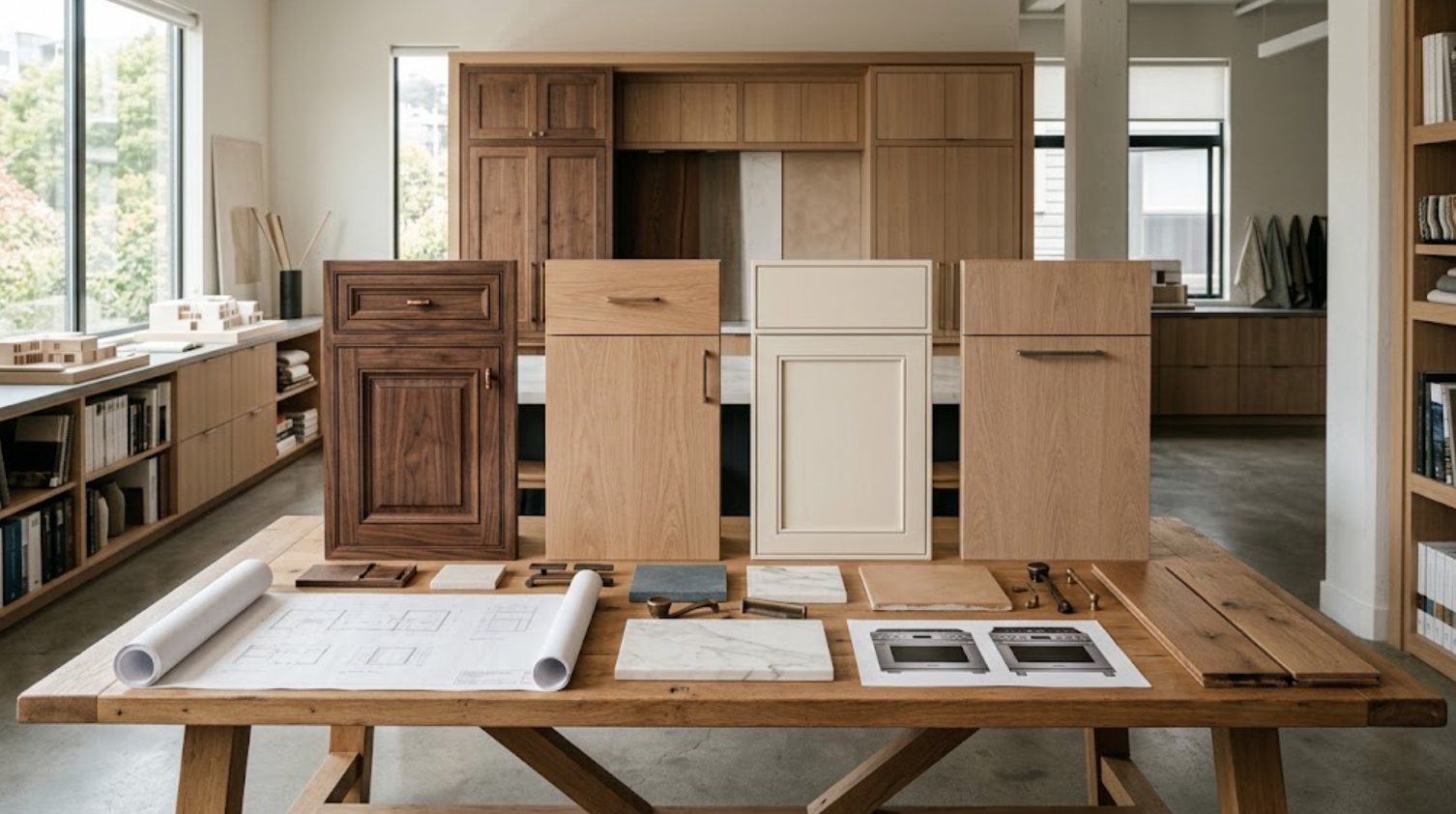
When Should You Consider Grabill Cabinets?
Grabill becomes particularly relevant when the project requires extensive customization.
The company describes itself as a true-custom cabinetry manufacturer, with capabilities that include custom dimensions, millwork, finishes, door designs, hoods, islands, posts, moldings, and profile matching.
That makes Grabill useful when cabinetry needs to respond closely to the architecture.
For example, a project may include an unusual ceiling condition.
Or cabinetry that must transition into architectural wall paneling.
Perhaps an existing historic molding needs to be reproduced.
Maybe the designer has developed a specific finish that does not exist within a standard palette.
These are situations where true custom capability becomes valuable.
Is Grabill Only for Traditional Cabinetry?
No.
The level of customization should not be confused with the aesthetic.
Grabill can support traditional cabinetry, but it can also produce highly restrained contemporary work.
A custom project might use:
Broad walnut slab fronts
Minimal frameless cabinetry
Contemporary inset doors
Custom metal details
Precisely aligned appliance panels
Furniture-like cabinetry with very little ornament
In contemporary interiors, customization may actually be used to remove visual complexity rather than add it.
What Is the Main Advantage of Grabill?
Control.
Control over:
Dimensions
Profiles
Finishes
Millwork
Proportions
Special conditions
That makes it particularly compelling when the cabinetry is one of the defining architectural elements of the residence.
When Might Grabill Be More Than the Project Needs?
When the design does not use that flexibility.
If the project works comfortably within established dimensions, door styles, finishes, and modifications offered by another premium collection, moving into true-custom fabrication may not create enough additional design value.
The highest level of customization should not be the automatic specification for every luxury project.
It should solve something.
When Should You Consider Columbia Cabinets?
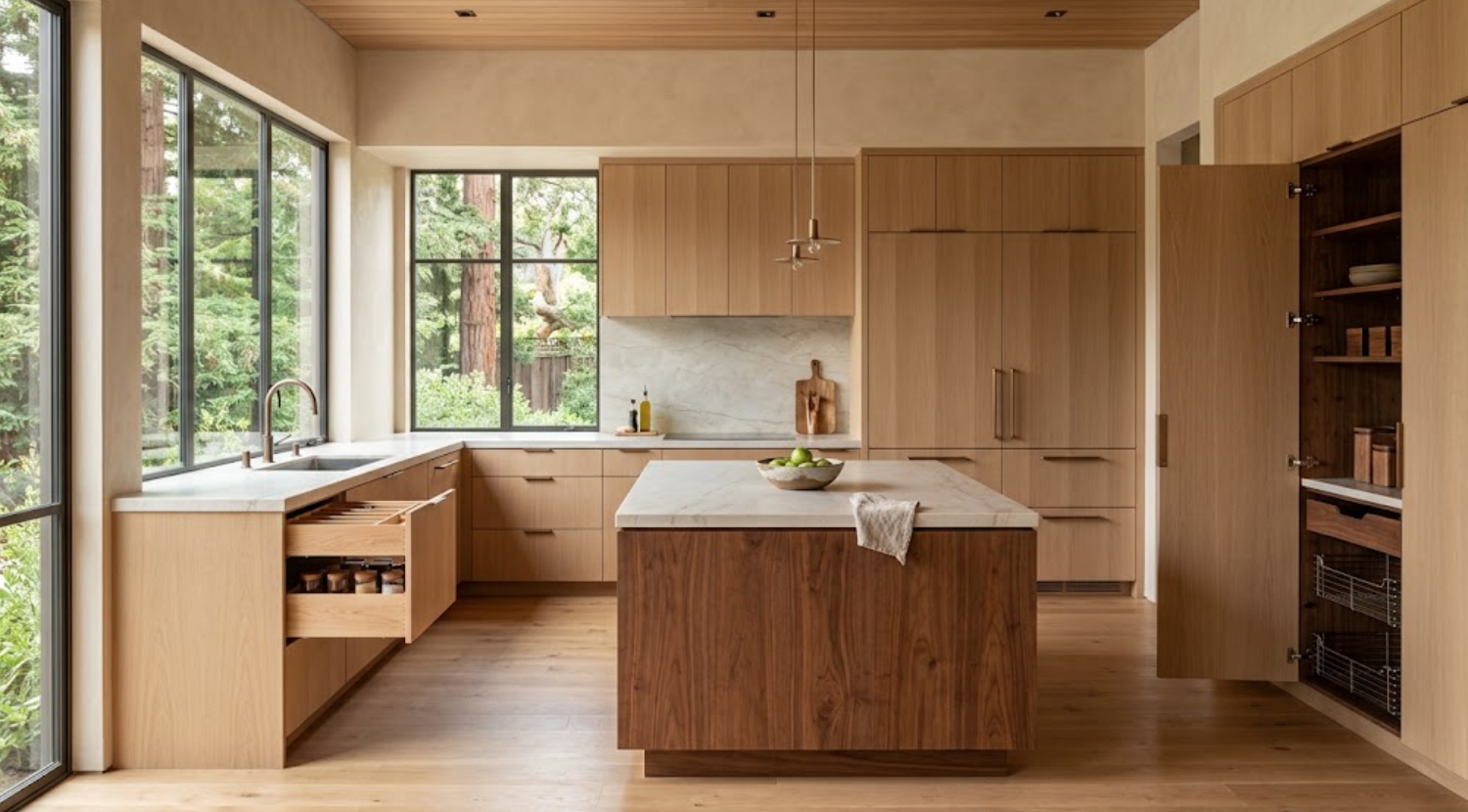
Columbia can be particularly compelling when the project needs custom cabinetry with a strong emphasis on material, craftsmanship, and contemporary residential design.
Its cabinetry offering includes natural woods such as walnut and rift-cut white oak, along with painted finishes, TFL, HPL, and other material directions.
That gives designers flexibility to move between natural, tactile cabinetry and more controlled contemporary surfaces.
Where Does Columbia Fit Aesthetically?
It works particularly well in interiors where cabinetry is being treated as architecture.
Think:
Large natural-wood cabinet walls
Integrated appliances
Quiet slab fronts
Precisely aligned drawers
Material-rich kitchens
Contemporary vanities
Whole-home built-ins
But Columbia does not need to produce an aggressively minimal result.
Wood grain, interior detailing, and material combinations can introduce substantial warmth.
When Should You Consider Dura Supreme?
Dura Supreme is particularly useful when a project needs breadth.
Its primary cabinetry families give designers access to both Crestwood framed cabinetry and Bria frameless full-access cabinetry.
That distinction immediately opens several architectural directions.
A designer can explore:
Inset cabinetry
Full-overlay framed cabinetry
Frameless cabinetry
Slab doors
Shaker profiles
Raised panels
Mullion doors
Natural woods
Painted cabinetry
Specialty surfaces
Extensive storage solutions
The collection can therefore move across contemporary, transitional, and more traditional residential interiors.
Why Is Dura Supreme Useful When the Design Direction Is Still Developing?
Because there are multiple paths within one manufacturer.
Imagine the design team knows the project needs premium cabinetry but has not yet determined whether the final expression should be:
Painted inset
Natural wood frameless
A narrow Shaker
A slab door
Or some combination of those directions
Dura Supreme gives the team room to explore without immediately changing cabinetry manufacturers.
That can make it particularly useful during early specification.
When Is Crestwood the Better Direction?
Crestwood is Dura Supreme’s framed cabinetry line.
It becomes particularly useful when the project needs the visual or construction characteristics of framed cabinetry.
That may include:
Inset doors
Visible frame rhythm
Traditional millwork references
Transitional cabinetry
Furniture-like compositions
But framed does not automatically mean traditional.
A restrained inset slab or narrow-frame door can feel highly contemporary.
When Is Bria the Better Direction?
Bria is Dura Supreme’s frameless, full-access cabinetry line.
It supports cleaner elevations and greater access to cabinet interiors without a traditional face frame around the opening.
That makes it particularly useful for:
Contemporary kitchens
Large drawer compositions
Slab cabinetry
Integrated appliance walls
Modern vanities
Storage-focused spaces
The choice between Crestwood and Bria should begin with the architecture and desired construction, not simply appearance.
When Does Dura Supreme Make Particular Sense?
When the project needs a broad range of options without requiring every element to be fabricated from scratch.
The collection can be especially useful when the designer needs:
Several door directions
Multiple wood species
Painted finishes
Custom-color possibilities
Framed and frameless construction
Inset cabinetry
Organizational accessories
Whole-home applications
It provides considerable design flexibility within an established premium cabinetry system.
How Is Urban Effects Different From Dura Supreme?
Both can support contemporary frameless cabinetry.
But they approach the market differently.
Urban Effects is centered around full-access frameless construction.
That gives the collection a particularly clear starting point.
The designer is not deciding between framed and frameless construction within the collection.
The project begins with frameless cabinetry and develops through:
Door style
Material
Finish
Color
Storage
Semi-custom modifications
For a project that already has a clear contemporary or full-access direction, that focus can simplify the specification.
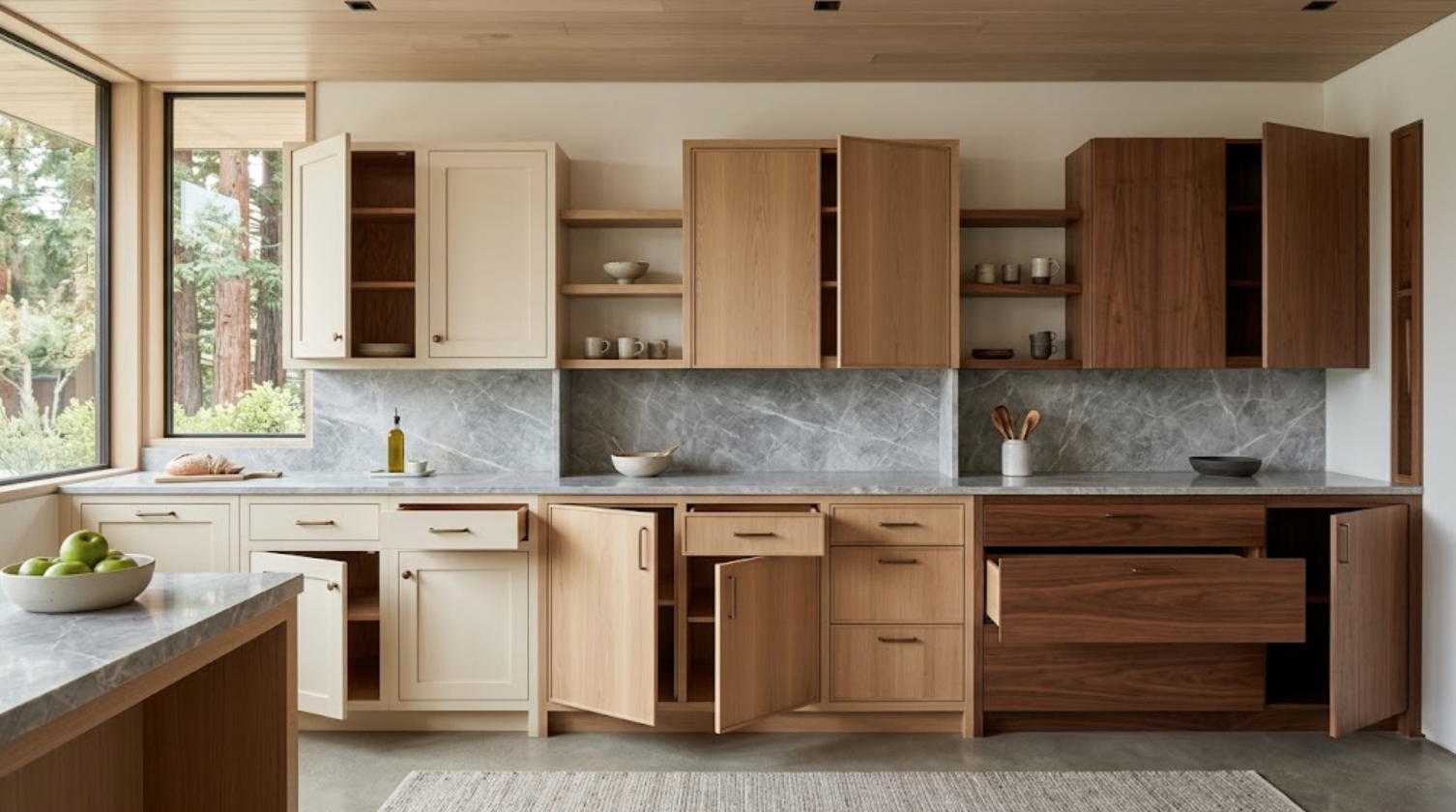
When Should You Consider Urban Effects?
When full-access frameless cabinetry already aligns with the project.
Urban Effects offers more than 35 door styles and materials that include natural woods such as walnut and rift oak, as well as manufactured materials such as acrylic, melamine, thermofoil, PureStyle, and Echo Wood.
The collection also provides paint, stain, custom-color, storage, and semi-custom capabilities.
That combination can be useful in contemporary residential projects that need flexibility but do not require true custom fabrication throughout.
What Kind of Project Is a Strong Urban Effects Candidate?
A contemporary kitchen with clean elevations
A modern ADU where storage efficiency matters
A bathroom with floating frameless cabinetry
A laundry room where full-access interiors improve function
A media wall
A home bar
A whole-home project using a consistent contemporary cabinetry language
The collection is particularly logical when frameless construction is already a settled design decision.
Does Urban Effects Only Offer Slab Doors?
No.
Urban Effects also offers Shaker, wide-rail Shaker, and other door directions.
That means frameless construction can support transitional design too.
A simple framed door on a full-access cabinet can provide some architectural detail without introducing the stronger frame rhythm associated with traditional framed cabinet construction.
How Do You Choose Between Dura Supreme Bria and Urban Effects?
This is where the comparison becomes more project-specific.
Both can provide frameless cabinetry.
So construction alone may not answer the question.
The designer should compare:
Available door profiles
Natural woods
Finish directions
Manufactured materials
Storage solutions
Modification requirements
Interior specifications
The exact elevations being designed
The most useful comparison is not brand versus brand in the abstract.
It is the actual project specification in each collection.
How Do You Choose Between Columbia and Grabill?
Again, begin with what the design requires.
If the project has highly unusual architectural conditions, custom profiles, project-specific millwork, finish matching, or details that need to be developed from the ground up, Grabill’s true-custom capabilities may become particularly valuable.
If the project needs premium custom cabinetry with strong material expression and the design can be resolved effectively within Columbia’s capabilities, Columbia may provide the right fit.
The decision becomes clearer once actual elevations and material requirements exist.
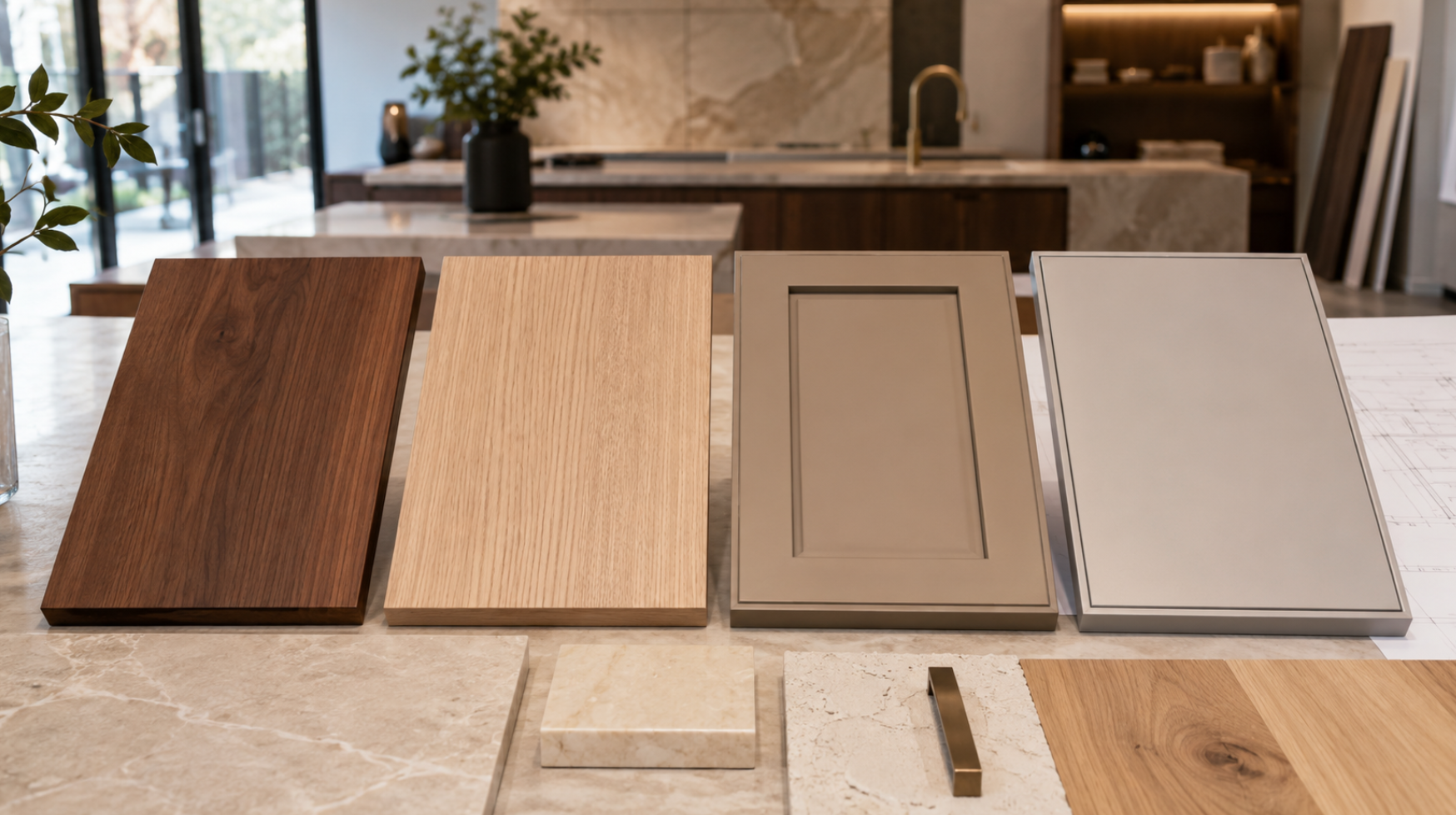
Why Is Looking at Door Samples Alone Not Enough?
Because the cabinetry collection affects more than the door.
Two manufacturers may both offer a walnut slab front.
That does not make the resulting cabinetry identical.
The designer still needs to understand:
Construction
Interior options
Available dimensions
Modifications
Finish
Grain
Storage
Drawer construction
Edge conditions
Appliance integration
Technical limitations
A door sample tells you something important.
It does not tell you everything.
How Important Is the Finish Palette?
Very.
The cabinetry finish occupies a significant portion of many rooms.
If the design requires a very specific:
White oak
Walnut
Paint
Custom color
Textured surface
Specialty material
That may narrow the cabinetry collections quickly.
Instead of trying to make every collection imitate the same material, identify which manufacturer naturally supports the desired direction.
That often produces a better specification.
What If the Project Needs a Custom Paint Color?
Several Atelier collections offer substantial finish flexibility, but the exact process and available substrates vary.
This is where the cabinetry partner becomes useful.
The design team can establish the intended color first.
Then evaluate which cabinetry collection can execute that direction appropriately within the project’s construction and material requirements.
The finish should be evaluated as part of the entire cabinet specification.
Not separately.
Should Budget Determine the Cabinetry Collection?
It should inform the decision.
But budget should be considered alongside customization and design priorities.
The most customized cabinetry does not need to appear in every room simply because the project has a substantial overall budget.
Instead, determine where cabinetry carries the greatest architectural importance.
Perhaps the main kitchen requires more customization.
The laundry does not.
Perhaps a library needs custom millwork.
Secondary bathrooms can use a more structured premium collection.
Budget becomes more effective when cabinetry is allocated according to the role of each room.
Can You Use More Than One Cabinetry Collection in the Same Residence?
Yes.
And for some projects, that may be the most intelligent approach.
A whole-home cabinetry strategy does not necessarily require one manufacturer.
It requires coordination.
Imagine a residence where:
Grabill handles a highly bespoke kitchen and library
Columbia is used for a contemporary walnut home office
Dura Supreme handles painted bathroom vanities and a wardrobe
Urban Effects is used in the laundry, mudroom, or other frameless cabinetry areas
The exact combination will vary.
What matters is that the collections are selected intentionally.
Won’t Multiple Collections Make the House Feel Inconsistent?
Not when the material strategy is coordinated.
The rooms can share:
Wood undertones
Paint relationships
Hardware families
Door proportions
Stone
Interior detailing
Repeated architectural ideas
One manufacturer is not the only way to create continuity.
A whole-home material story can connect cabinetry from different collections.
When Is Using One Collection Throughout the Home Better?
When that collection comfortably handles the entire scope.
There are advantages to reducing complexity:
One finish system
One construction vocabulary
One set of product standards
Fewer manufacturer-specific decisions
If a single collection can satisfy the architecture, materials, customization, and functional requirements across the residence, using it broadly may simplify coordination.
The goal is not variety.
The goal is fit.
How Does the Room Affect the Collection Choice?
Significantly.
A kitchen has different requirements from a wardrobe.
A bar has different requirements from a laundry room.
A library may require more architectural integration.
A bathroom vanity may need furniture-like proportions.
A media room may require technical integration.
Before choosing the cabinetry collection, identify what the room is asking the cabinetry to do.
What About Kitchens?
For kitchens, evaluate:
Architecture
Appliances
Construction
Storage
Finish
Door style
Island design
Special conditions
A highly bespoke architectural kitchen may point toward Grabill.
A material-driven custom contemporary kitchen may make Columbia compelling.
A kitchen needing broad framed or frameless options may align well with Dura Supreme.
A clean full-access project may make Urban Effects a strong candidate.
Those are starting points.
The actual design should make the final decision.
What About Bathrooms?
Bathroom cabinetry often occupies less area, but the vanity can function as an important furniture element.
Ask whether it requires:
A custom furniture-like form
Special dimensions
Integrated linen storage
Frameless efficiency
A particular finish
A floating condition
The appropriate collection may differ from the kitchen.
What About Home Offices, Bars, and Libraries?
These rooms can reveal where customization is worth allocating.
A library integrated into architectural paneling may justify true custom cabinetry.
A contemporary home office may be driven primarily by beautiful wood and clean built-ins.
A bar may need specialty interiors, glass, metal, lighting, or furniture-like details.
Secondary spaces are not automatically simpler.
Sometimes they contain the most specialized cabinetry in the residence.
What Role Does the Cabinetry Partner Play?
A useful cabinetry partner should help narrow the options.
Not simply present four brands and ask the designer to choose.
The project can be evaluated according to:
Architecture
Construction
Material
Customization
Function
Budget
Schedule
Technical conditions
Then the available cabinetry collections can be compared against those requirements.
That is much more useful than beginning with catalogs.
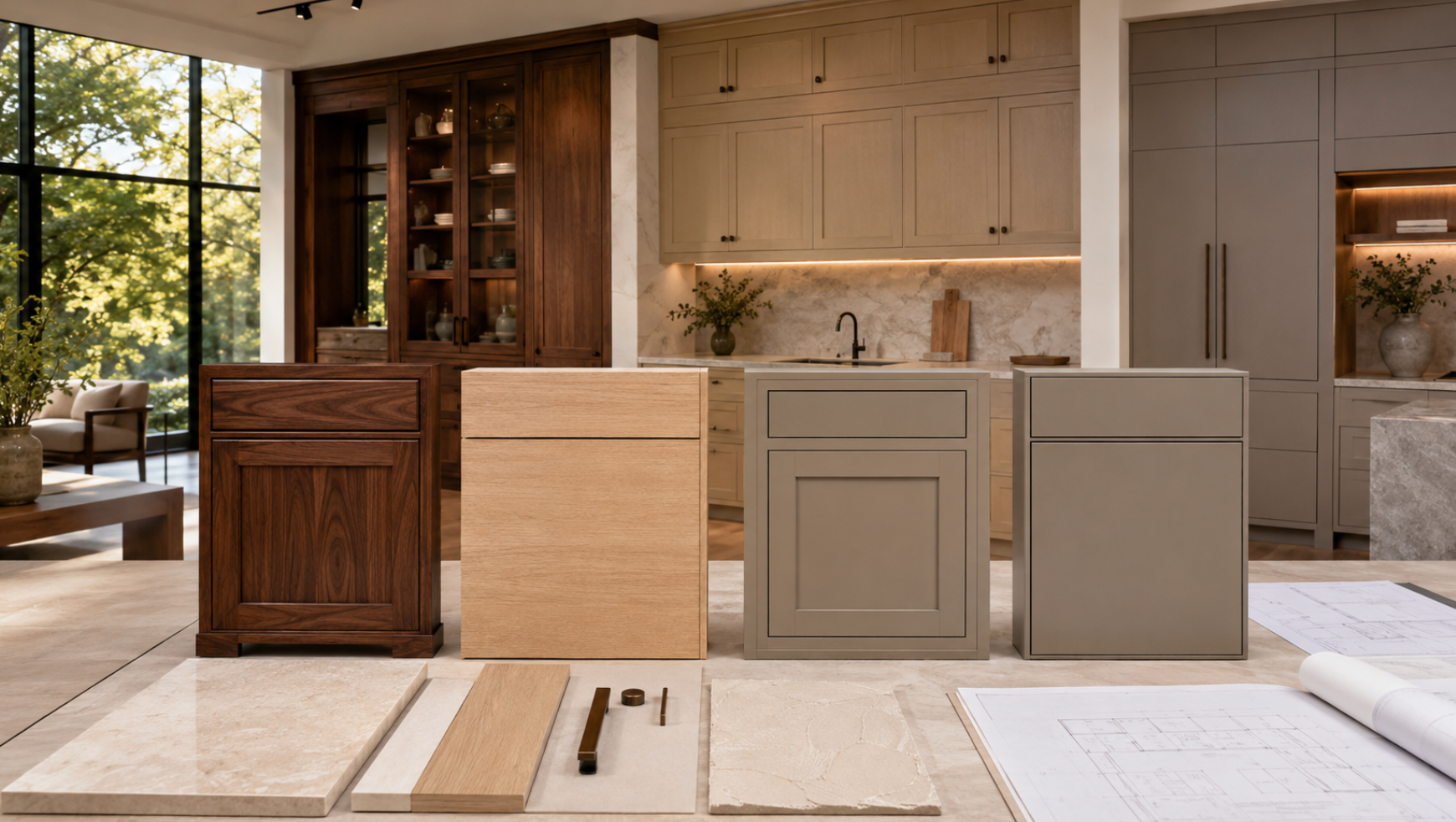
What Should You Bring When Comparing Cabinetry Collections?
The more project information available, the more meaningful the comparison becomes.
Bring:
Architectural plans
Preliminary elevations
Appliance specifications
Inspiration
Stone
Flooring
Paint or plaster references
Hardware
Existing millwork information
Storage requirements
Budget parameters
The objective is to compare cabinetry against a real project.
Not an imaginary kitchen.
Should You Choose the Cabinetry Collection Before the Design Is Complete?
Often, yes.
Not necessarily on the first day.
But cabinetry should be identified early enough that its construction and technical requirements can inform the architecture.
Different collections may handle:
Dimensions
Panels
Fillers
Appliances
Insets
Interior configurations
Custom conditions
Differently.
Waiting until construction is advanced can limit the design unnecessarily.
What If You Are Still Unsure Between Two Collections?
Compare them using one real elevation.
Choose an important cabinet wall or island.
Develop the same design direction through both cabinetry systems.
Then compare:
How naturally does each collection resolve the elevation?
How many modifications are required?
Does the desired material exist?
Does the door profile work?
Can the appliances integrate properly?
Are the interior options appropriate?
Does one system require unnecessary compromises?
That exercise often reveals more than comparing dozens of samples.
How to Choose Between Atelier’s Cabinetry Collections
There is no single hierarchy where one cabinetry collection is automatically better than the others.
There is only a better fit for a particular project.
Choose Grabill when true-custom capability, bespoke millwork, unusual dimensions, custom profiles, or highly specific finish development are central to the design.
Consider Columbia when custom cabinetry, natural material expression, craftsmanship, and contemporary architectural design are important to the project.
Explore Dura Supreme when the design benefits from substantial breadth across framed, frameless, inset, door styles, finishes, storage, and whole-home applications.
Consider Urban Effects when full-access frameless construction, contemporary materials, storage efficiency, custom color, and semi-custom flexibility align with the project.
And do not assume the entire residence must use one collection.
The right cabinetry strategy may involve one manufacturer.
Or several.
What matters is that each decision supports the same architecture and material story.
The cabinetry collection should never become the concept.
It should be the tool that allows the concept to be built.
Compare Atelier’s Cabinetry Collections in Menlo Park
Atelier Design Society works with homeowners, architects, interior designers, builders, and other design professionals selecting premium cabinetry for kitchens, bathrooms, wardrobes, offices, bars, libraries, laundry rooms, and other spaces throughout the home.
At the Atelier Design Society showroom in Menlo Park, project teams can compare Grabill, Columbia, Dura Supreme, and Urban Effects while evaluating construction, customization, natural woods, painted finishes, door styles, interiors, storage, and full-scale cabinetry details.
Bring the project with you.
Plans, materials, appliances, and preliminary design direction make it easier to determine which cabinetry collection belongs in the specification.