Urban Effects Cabinetry: Modern Design Meets Craftsmanship
Modern cabinetry can look deceptively simple.
Clean doors.
Minimal hardware.
Long horizontal lines.
Uninterrupted cabinet walls.
A restrained material palette.
But when there are fewer decorative elements, every proportion becomes more visible.
The width of a drawer.
The alignment of a panel.
The grain direction.
The reveal between doors.
The way cabinetry meets an appliance, wall, or countertop.
That is where the relationship between modern design and cabinetry craftsmanship becomes important.
Urban Effects Cabinetry is built around full-access, frameless construction, a system in which doors and drawers cover the cabinet without a traditional face-frame border. The result supports a cleaner, more contemporary appearance while also maximizing accessible cabinet space.
But Urban Effects is not limited to one narrow modern aesthetic.
Its current collection includes more than 35 door styles, natural woods, manufactured materials, paints, stains, textured finishes, custom colors, storage solutions, and semi-custom modifications.
For designers, that creates an interesting position.
Urban Effects can provide the visual clarity associated with modern frameless cabinetry while still leaving room to develop warmth, texture, color, storage, and project-specific details.
The result does not have to feel cold.
It does not have to feel overly minimal.
And it does not have to look like every other contemporary kitchen.
The design depends on how those possibilities are edited.
What Is Urban Effects Cabinetry?
Urban Effects is a semi-custom, full-access cabinetry collection designed for residential projects.
Full-access cabinetry is another term for frameless cabinetry.
Instead of constructing the cabinet with a face frame around the opening, the doors and drawer fronts cover the cabinet box more completely.
Urban Effects describes this approach as creating a more modern appearance while maximizing storage space.
For contemporary residential design, that construction method can be particularly useful.
It creates cleaner elevations.
The doors and drawers become the dominant visual surface.
And because there is no traditional face frame defining every cabinet opening, larger compositions can feel quieter.
Why Does Frameless Construction Work So Well With Modern Design?
Because modern interiors often depend on continuity.
A tall cabinet wall may need to read as one architectural plane.
An island may depend on broad, uninterrupted drawer fronts.
A pantry may need to disappear into surrounding cabinetry.
A bathroom vanity may need to feel like a simple furniture volume rather than a conventional cabinet.
Frameless construction supports those ideas.
But the absence of a visible face frame also means the proportions of the fronts become more important.
There is less visual information to distract from poor alignment.
That is where design discipline matters.
Modern Cabinetry Is About More Than Flat Doors
“Modern cabinets” are often reduced to one formula:
Slab door.
Minimal hardware.
Neutral color.
But that is only one direction.
Urban Effects currently offers slab, Shaker, wide-rail Shaker, and raised-panel door styles across modern, transitional, and traditional aesthetics.
That range gives designers room to create different interpretations of contemporary cabinetry.
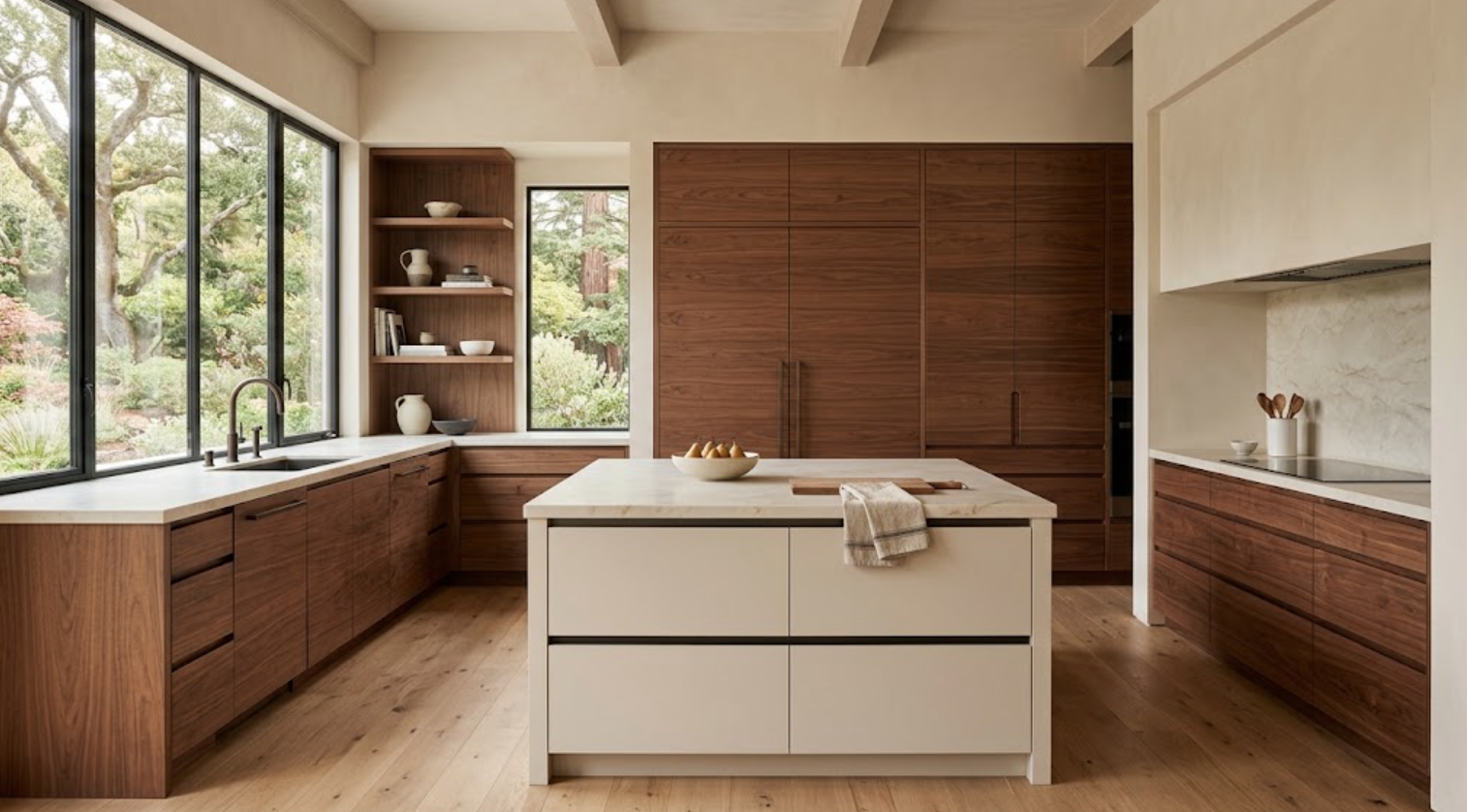
A modern kitchen might use a completely flat walnut slab.
Another might use a restrained narrow-profile painted door.
A transitional Bay Area home might combine simple framed doors with full-access construction.
The architecture should determine how much detail the cabinetry needs.
What Materials Are Available From Urban Effects?
The current Urban Effects material collection extends well beyond one wood species or painted MDF.
Natural wood options include:
Cherry.
Maple.
Oak.
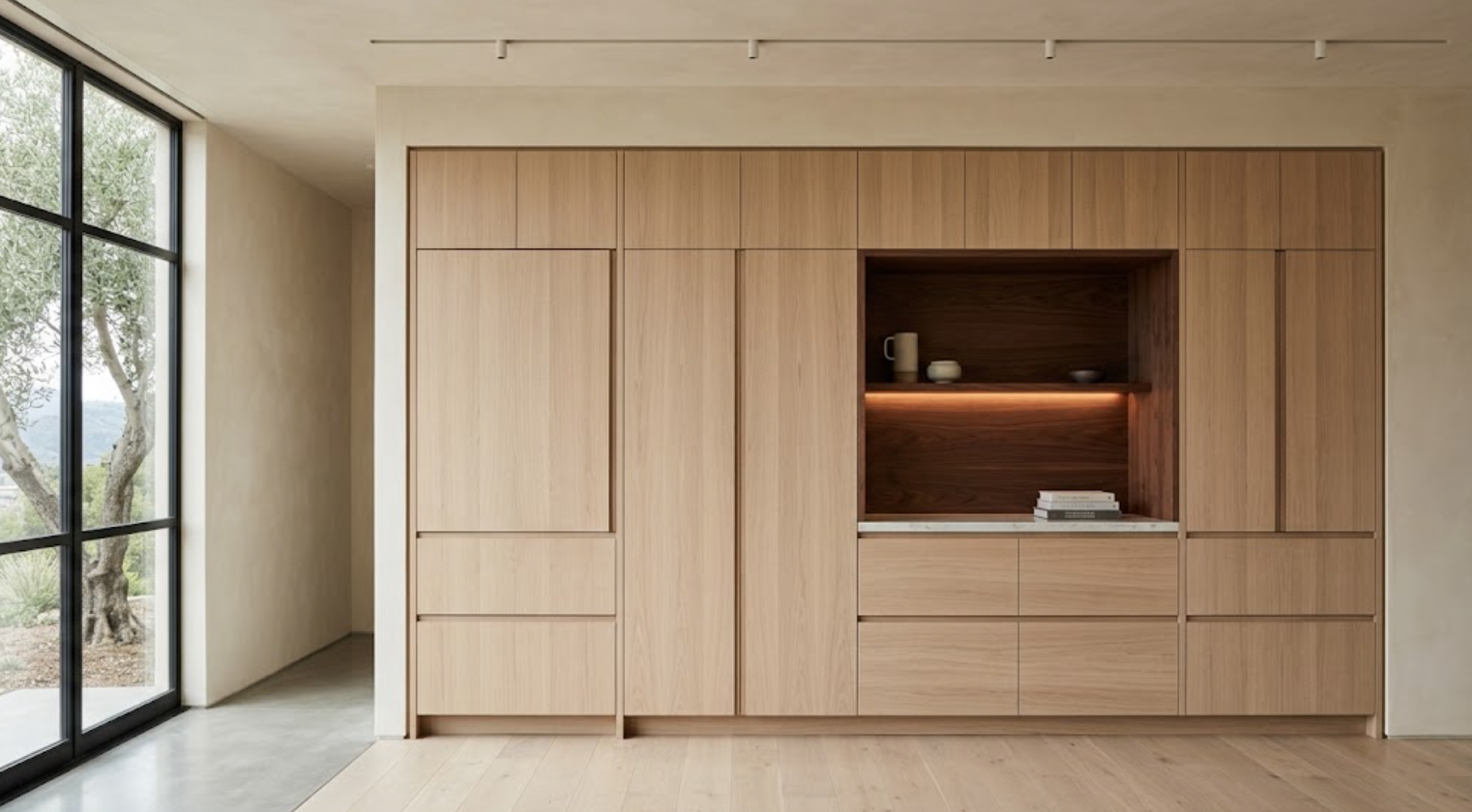
Rift Oak.
Rustic Alder.
Walnut.
The collection also includes Acrylic, MDF, Thermofoil, Melamine, PureStyle, and Echo Wood.
That breadth matters because modern cabinetry is highly material-dependent.
When the door profile becomes simpler, the material often has to do more visual work.
Why Is Walnut Particularly Effective in Modern Cabinetry?
Walnut brings natural depth without requiring decorative detail.
Urban Effects describes Walnut as ranging from creamy sapwood to light and dark brown heartwood, sometimes with darker streaks, and notes that the material develops a richer patina as it ages.
Its grain can be relatively straight or more expressive.
On a slab door, those characteristics remain visible.
That can make a simple cabinet front feel materially rich without adding molding or ornament.
Walnut works particularly well when the architecture needs warmth.
It can soften:
Stone.
Plaster.
Metal.
Glass.
Large contemporary windows.
Minimal interiors.
What About Rift Oak?
Rift Oak offers a different expression.
Urban Effects describes its quarter and rift sawn Red Oak as producing more radial and vertical grain than conventional tangential cutting, with visible medullary rays and additional stability.
For designers, the straighter grain direction can be especially useful in modern cabinetry.
It creates visual rhythm without excessive movement.
On tall doors or broad drawer fronts, that grain can reinforce the vertical or horizontal geometry of the elevation.
Should Natural Wood Be Used Throughout the Entire Kitchen?
Not necessarily.
A large room covered entirely in wood can become visually heavy.
One approach is to establish hierarchy.
Natural wood on the tall cabinetry.
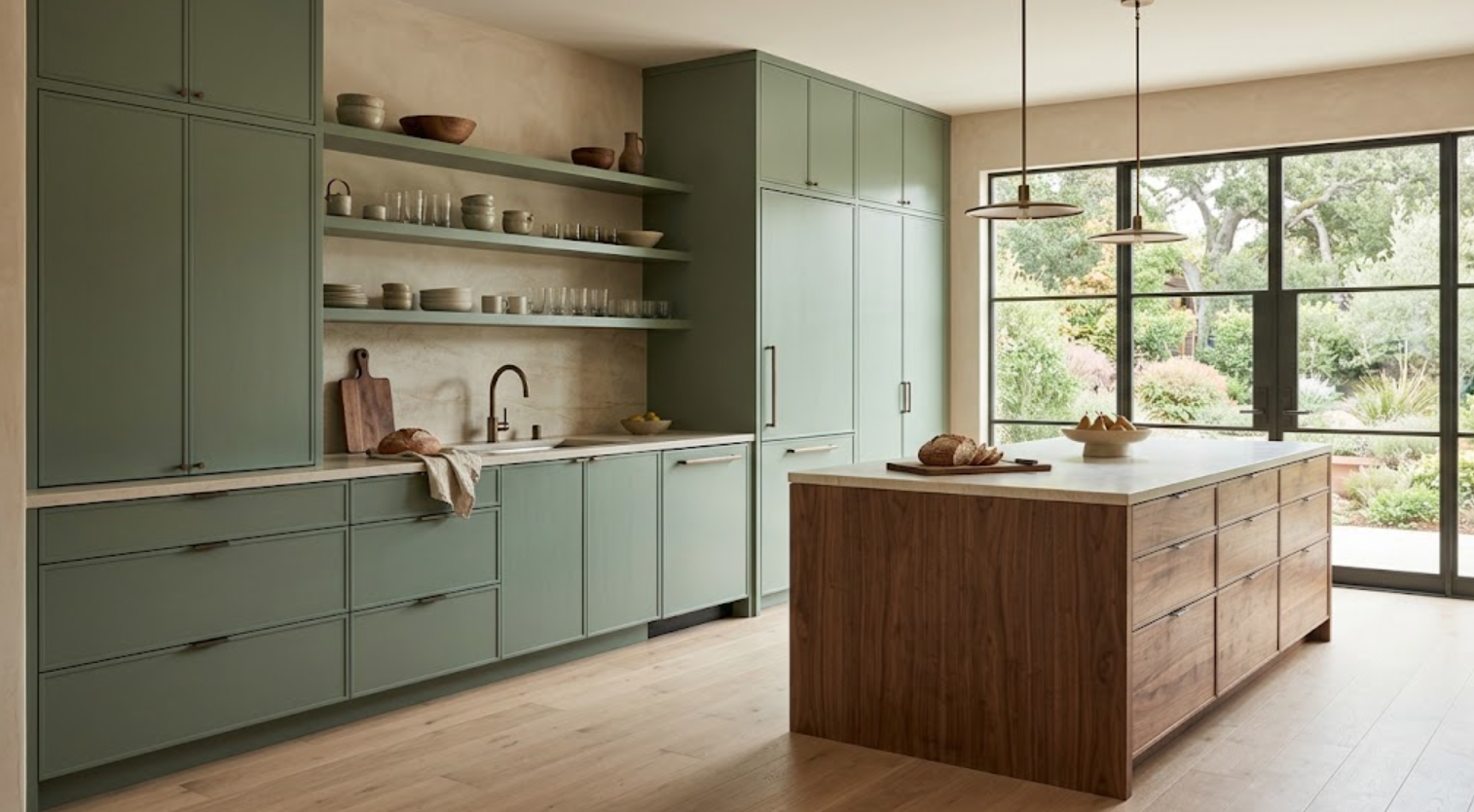
Paint on the island.
Or painted perimeter cabinetry with a wood feature wall.
Perhaps walnut appears only on:
The island.
A bar.
A pantry wall.
An appliance wall.
A furniture-like secondary element.
The material becomes stronger when its role is clear.
Grain Direction Is a Design Decision
On contemporary cabinetry, grain direction becomes part of the elevation.
Vertical grain can emphasize height.
Horizontal grain can visually connect adjacent fronts.
A continuous wood composition can make multiple cabinets feel like one larger architectural surface.
This should be considered during specification rather than treated as a minor finish detail.
The simpler the door, the more visible the grain becomes.
What Role Do Manufactured Materials Play?
Modern cabinetry does not have to rely exclusively on natural wood.
Urban Effects offers several engineered and manufactured surfaces that provide different visual and performance characteristics.
Acrylic can create a highly polished contemporary surface.
Melamine can provide consistent color and texture.
Thermofoil offers another durable surface direction.
PureStyle uses wrapped MDF components to create clean profiles with a surface designed to resist abrasion, dents, and scratches.
The correct material depends on the design objective.
Natural wood offers variation.
Manufactured surfaces can provide greater consistency.
Neither quality is inherently better.
They solve different problems.
What Is Echo Wood?
Echo Wood is one of the more interesting materials in the Urban Effects collection.
It is a reconstituted wood product manufactured using common wood fiber sourced from plantation-grown, FSC-certified forests. Urban Effects describes it as an alternative for achieving controlled architectural wood veneers while maintaining consistent color and grain.
This consistency can be useful in contemporary interiors.
Especially when the design depends on large areas of visually controlled wood.
Natural wood variation can be beautiful.
But there are projects where predictable grain and tone are part of the architectural concept.
When Does Consistency Become a Design Advantage?
Consider a large wall of cabinetry.
Ten feet high.
Multiple doors.
Integrated refrigeration.
Pantry storage.
Perhaps a concealed doorway.
If the design intent is a very quiet wood plane, dramatic board-to-board variation may compete with that idea.
A more consistent material can help the cabinetry read as architecture rather than a collection of individual doors.
That is one reason designers should think beyond the simple question of “real wood or manufactured material.”
The desired visual behavior matters too.
How Does Urban Effects Approach Color?
Urban Effects currently offers paints, stains, hand-brushed finishes, glazes, textured finishes, and custom color capabilities.
That gives designers several ways to approach color.
Cabinetry can remain neutral.
It can closely relate to surrounding plaster or wall finishes.
Or it can become the strongest color in the room.
The key is deciding what role color should play before browsing every available option.
Is Custom Color Available?
Yes.
Urban Effects offers a Custom Color Program.
The company states that a designer can provide the paint manufacturer, paint name, and paint code for a selected swatch, and Urban Effects can match that color for the cabinetry.
For a design practice, that capability can be particularly useful.
The cabinetry palette does not always have to begin with the cabinet manufacturer’s standard paint collection.
It can begin with the room.
When Is Custom Color Worth Using?
When the cabinetry needs to relate closely to a broader material concept.
Perhaps the designer has already established:
A particular warm neutral.
A mineral green.
A deep charcoal.
A muted blue.
A plaster-inspired beige.
Custom color can allow the cabinetry to participate more intentionally in that palette.
But custom color should still have a reason.
More choice does not automatically create better design.
How Much Customization Does Urban Effects Offer?
Urban Effects is semi-custom rather than fully custom.
That distinction is useful.
The collection begins with an established cabinetry system, but Urban Effects states that measurements can be customized and cabinetry can be built to selected specifications beyond the standard product offering. Designers can submit drawings for unique requests, which are then reviewed by the manufacturer’s engineering team for feasibility and quoting.
This creates a middle ground.
The designer has more flexibility than a strictly standardized cabinet line without necessarily moving the entire project into fully bespoke fabrication.
When Is Semi-Custom Cabinetry the Right Level?
When the architecture needs flexibility but not complete reinvention.
Perhaps the project requires:
Modified widths.
An unusual storage condition.
A particular cabinet configuration.
A specialized panel.
A custom organizational solution.
But the overall project still works effectively within a frameless cabinetry system.
That can be an efficient place for semi-custom cabinetry.
What Happens When a Project Needs Something Truly Unusual?
That is when the cabinetry partner should evaluate whether Urban Effects remains the appropriate collection.
A highly complex architectural condition may be better served by a fully custom line.
The goal should not be to force every project into the same manufacturer.
Atelier works with multiple cabinetry collections precisely because different projects require different levels of customization.
Urban Effects becomes compelling when its combination of frameless construction, material range, finish flexibility, storage, and semi-custom capability aligns with the project.
Does Semi-Custom Mean the Design Has to Look Standard?
No.
A standard cabinet system can produce a highly individualized interior when the designer controls:
Composition.
Material.
Color.
Door selection.
Hardware.
Stone.
Lighting.
Proportion.
Storage.
The mistake is assuming uniqueness comes only from unusual cabinet fabrication.
Often the strongest design is created through disciplined editing.
Storage Is Part of Modern Design
A modern kitchen that looks beautiful but functions poorly is incomplete.
Urban Effects places significant emphasis on storage and organization within its cabinetry system.
That includes solutions for otherwise difficult or underused cabinet areas.
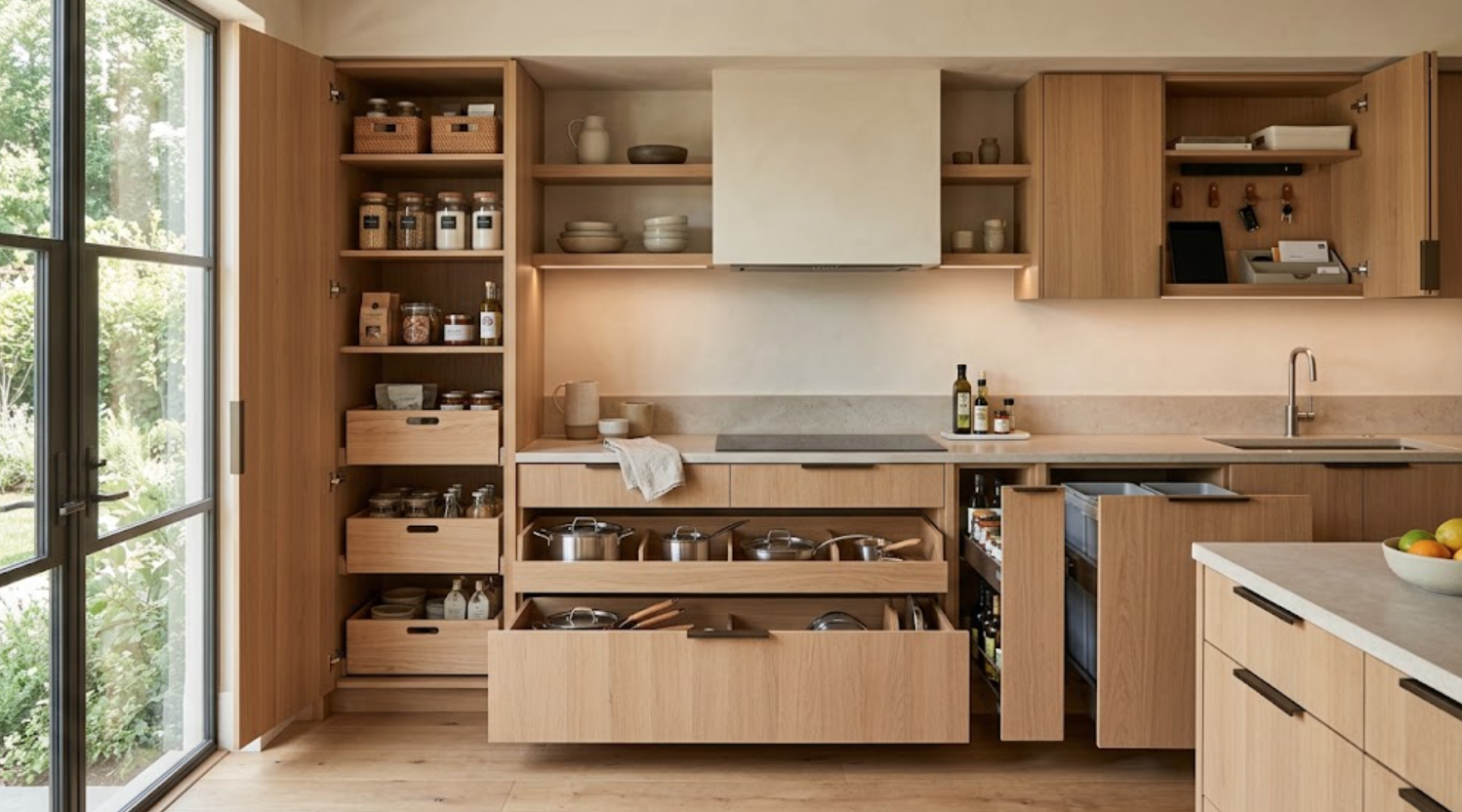
For example, its current storage collection includes narrow base pull-outs designed to make small spaces functional rather than leaving them unused.
The important principle is not how many accessories can be added.
It is whether the cabinetry supports the way the client actually lives.
Why Is Full-Access Construction Useful for Storage?
Because frameless cabinetry removes the traditional face-frame obstruction around the cabinet opening.
Urban Effects specifically associates full-access construction with maximizing storage space.
That can make cabinet interiors feel more accessible.
Especially in:
Broad drawer bases.
Pantry storage.
Vanities.
Utility cabinetry.
Small kitchens.
ADUs.
Other spaces where every usable inch matters.
What Should Be Planned Inside the Cabinets?
Start with routines.
Not accessories.
Ask:
Where does the client prepare coffee?
Where are dishes unloaded?
What needs to be close to the range?
Where are oils and spices used?
Does the household buy in bulk?
Is recycling integrated?
Are small appliances left out or stored?
Urban Effects itself recommends discussing lifestyle habits, cooking, entertaining, bulk purchasing, recycling, pets, and appliances early in the design process.
Those answers should shape the cabinetry interior.
Why Should Appliances Be Selected Early?
Because cabinetry is built around them.
Urban Effects specifically recommends selecting appliances early because large refrigerators, freezers, double ovens, and other equipment can substantially affect space allocation.
This matters even more in modern cabinetry.
Appliances interrupt the elevation.
Their widths.
Heights.
Handles.
Ventilation requirements.
Clearances.
All influence the surrounding cabinetry.
If the goal is a calm, integrated cabinet wall, appliance coordination cannot happen at the end.
How Should Modern Cabinetry Meet Appliances?
As intentionally as possible.
A range can become the center of a symmetrical elevation.
Refrigeration may be integrated behind cabinetry panels when the appliance supports it.
Wall ovens can align with surrounding drawer or door divisions.
A dishwasher can disappear into an island.
The specific solution depends on the equipment.
But the visual relationship should be studied as part of the cabinetry composition.
What About Hardware?
Hardware can either reinforce or interrupt modern cabinetry.
Minimal does not automatically mean handleless.
A simple pull can create rhythm.
A longer pull can emphasize the proportion of a tall door.
A small knob can introduce a furniture reference.
Integrated or highly discreet hardware can allow the cabinet material to dominate.
The choice should follow the door and the overall architecture.
Can Urban Effects Work in Transitional Interiors?
Yes.
The collection is not restricted to slab doors.
Urban Effects explicitly describes its door offering as spanning modern, transitional, and traditional styles, including Shaker, wide-rail Shaker, slab, and raised-panel configurations.
A transitional project might use full-access construction with a restrained Shaker front.
That creates an interesting combination.
The door provides familiarity and detail.
The frameless construction keeps the overall composition cleaner.
Can It Work Beyond the Kitchen?
Yes.
Urban Effects currently promotes its cabinetry for bathrooms, laundry rooms, mudrooms, living spaces, basement bars, and other areas of the home.
That matters for whole-home cabinetry planning.
The same construction system can move through multiple rooms while the material or door style changes according to function.
Should Every Room Use the Same Urban Effects Finish?
No.
Consistency does not require repetition.
A residence might use:
Rift oak in the kitchen.
A warm painted finish in the laundry.
Walnut in the bar.
A deeper custom color in a home office.
A quiet neutral vanity in a bathroom.
The connection may come from:
Similar door proportions.
Hardware.
Construction.
Material undertones.
Repeated wood.
The goal is to create a family of rooms rather than copies of the same room.
How Can Urban Effects Fit Into a Larger Whole-Home Cabinetry Strategy?
By being assigned where its strengths make sense.
Perhaps Urban Effects handles:
The kitchen.
Laundry.
Mudroom.
Secondary bathrooms.
Media cabinetry.
Another collection may be used where the project requires a different level of customization or another construction approach.
One cabinetry partner can coordinate those choices without requiring one manufacturer to solve every condition.
That allows the specification to follow the architecture.
What Should Designers Evaluate in Person?
Review:
The physical door.
The material.
The finish.
The edge.
The way the door meets the adjacent front.
The interior.
The drawer.
The storage.
The relationship between a painted sample and natural wood.
Urban Effects itself advises clients to request physical door, wood, and finish samples before placing an order and notes that digital swatches can differ from the actual product because of lighting, manufacturing variation, and screens.
For designers, this is especially important.
Modern cabinetry often relies on subtle differences.
A finish that appears neutral online may reveal an unexpected undertone in person.
How Should Natural Wood Variation Be Presented to Clients?
Clearly.
Urban Effects notes that natural woods vary in color and character and can continue changing with age and environmental exposure.
That is part of using natural material.
Walnut can develop differently.
Cherry can darken with exposure to light.
Maple contains natural mineral or sugar streaks.
Oak can include variation in grain and coloration.
Clients should understand those characteristics before approval.
A physical sample communicates direction.
It does not guarantee that every natural board will be identical.
Why Does This Matter More With Slab Doors?
Because the material is exposed across a larger uninterrupted area.
A Shaker frame breaks the surface into smaller visual components.
A slab door does not.
Grain.
Color variation.
Panel alignment.
Edge detail.
Finish quality.
All become more prominent.
That simplicity is part of the appeal.
It also makes material specification more important.
When Is Urban Effects a Strong Choice for a Project?
When the design benefits from frameless construction.
When clean cabinet elevations matter.
When storage efficiency is important.
When the project needs a broad material and finish palette.
When custom color can support the interior concept.
When some dimensional or configuration flexibility is needed without moving entirely into fully custom fabrication.
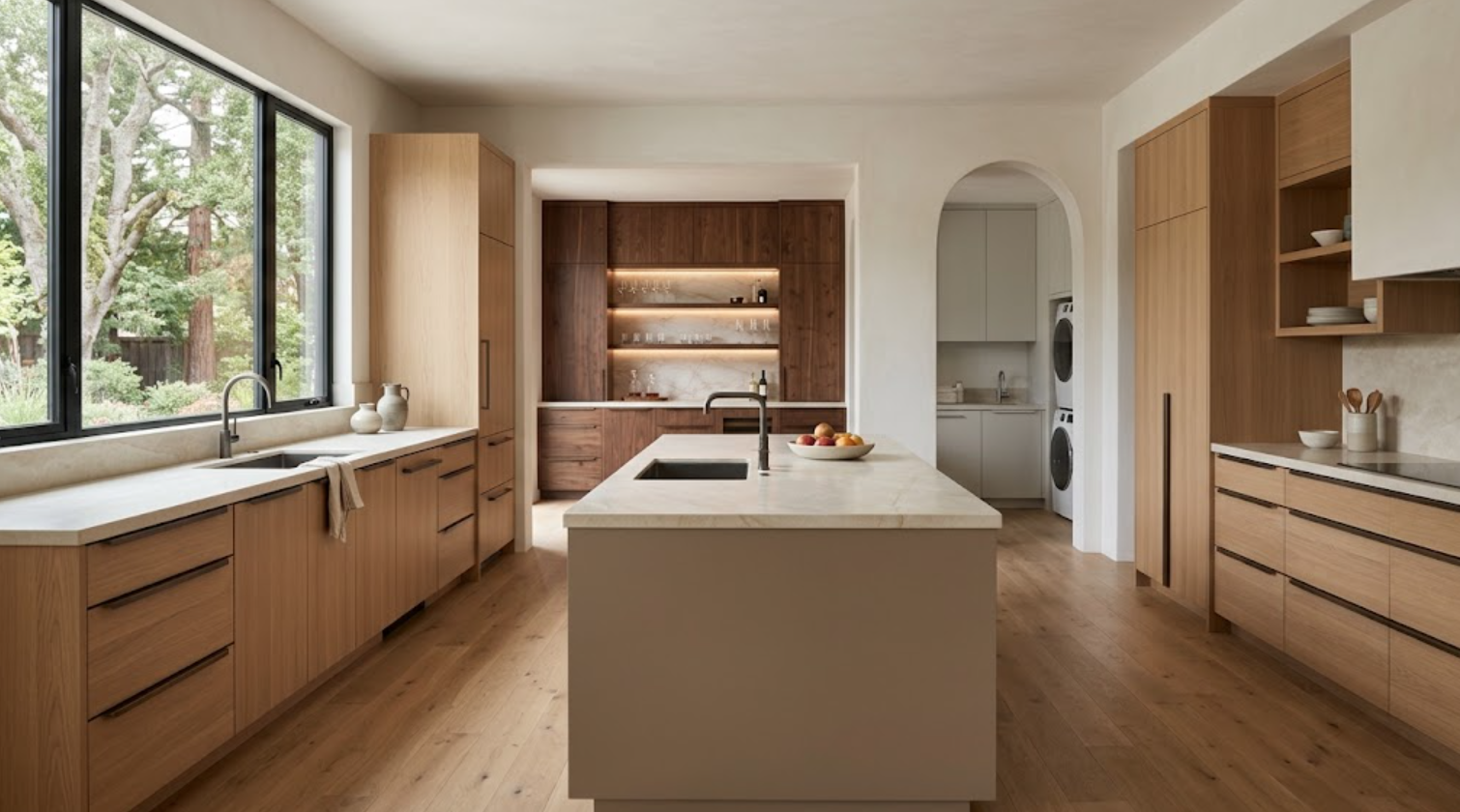
And when the designer wants modern cabinetry that can still feel warm, layered, and residential.
Urban Effects occupies a useful position between rigid standardization and fully bespoke cabinetry.
Is Urban Effects Only Appropriate for Contemporary Homes?
No.
Its full-access construction naturally supports contemporary design, but the door collection allows the cabinetry to move toward transitional and more detailed interiors as well.
What matters is how the pieces are combined:
Frameless construction.
Door style.
Material.
Finish.
Hardware.
Stone.
Architecture.
A simple construction system can produce very different results depending on those decisions.
Urban Effects Cabinetry: Modern Design Meets Craftsmanship
Good modern cabinetry is not defined by how little detail it contains.
It is defined by how carefully the remaining details are resolved:
Proportion.
Alignment.
Material.
Grain.
Color.
Storage.
Function.
Urban Effects combines full-access frameless construction with more than 35 door styles, a broad range of natural and manufactured materials, paints and stains, custom color, organizational solutions, and semi-custom capabilities.
That gives designers flexibility without removing structure from the specification process.
The strongest Urban Effects projects will not necessarily be the most minimal.
They will be the ones where the cabinetry supports the architecture.
Where natural wood is allowed to provide warmth.
Where color has a clear role.
Where storage has been planned around actual routines.
Where appliances are considered early.
And where every visible line feels intentional.
That is where modern design and cabinetry craftsmanship begin to work together.
Explore Urban Effects Cabinetry With Atelier Design Society
Atelier Design Society works with homeowners, architects, interior designers, builders, and other design professionals planning premium cabinetry throughout the home.
At the Atelier Design Society showroom in Menlo Park, project teams can compare Urban Effects cabinetry materials, construction, natural woods, painted finishes, door styles, hardware, interiors, and storage solutions while determining whether full-access frameless cabinetry is the right fit for the project.
Bring architectural drawings, preliminary elevations, appliance specifications, stone, flooring, paint references, and other project materials when available.
The goal is not simply to choose modern cabinetry.
It is to determine how the cabinetry can support the architecture, material palette, and way the home will actually be used.