Inside the Craftsmanship of Fully Custom Grabill Cabinetry
Fully custom cabinetry is often described in visual terms:
The wood.
The finish.
The door style.
The hardware.
The way the cabinetry looks when the project is complete.
But much of what separates truly custom cabinetry from a more standardized product is less visible.
It is in the construction.
The joinery.
The way lumber is selected.
How edges are prepared.
How doors are assembled.
How finishes are developed.
How unusual details are engineered.
And how closely the final cabinetry follows the designer’s intent.
Grabill has been producing cabinetry in Indiana since 1946, and the company continues to position craftsmanship, custom capability, and durability at the center of its approach.
For designers and builders working on luxury residential projects, that matters.
A beautiful cabinet front is important.
But craftsmanship is what determines whether the cabinetry still feels precise when the doors open, the drawers move, the materials age, and the home has been lived in for years.
What Does “Fully Custom” Mean in Grabill Cabinetry?
It means the cabinetry is developed around the project rather than forcing the project into a narrow catalog of fixed solutions.
Grabill describes itself as a custom cabinetry shop that produces individual pieces according to the exact needs and specifications of a project. Its capabilities include frameless and inset construction, custom cabinet modifications, custom millwork, custom finishes, and a broad range of door styles.
That distinction matters.
Custom craftsmanship is not simply the ability to change a cabinet width.
It can involve:
A custom profile.
A specific molding.
An unusual door proportion.
A one-off finish.
A furniture-like island.
Specialized interior cabinetry.
A concealed appliance condition.
Cabinetry integrated with architectural millwork.
A detail created specifically because the design requires it.
The craftsmanship begins before anything reaches the installation site.
It begins with how the project is translated into something that can actually be built.
Craftsmanship Starts With the Material
Before joinery.
Before finishing.
Before assembly.
There is the material itself.
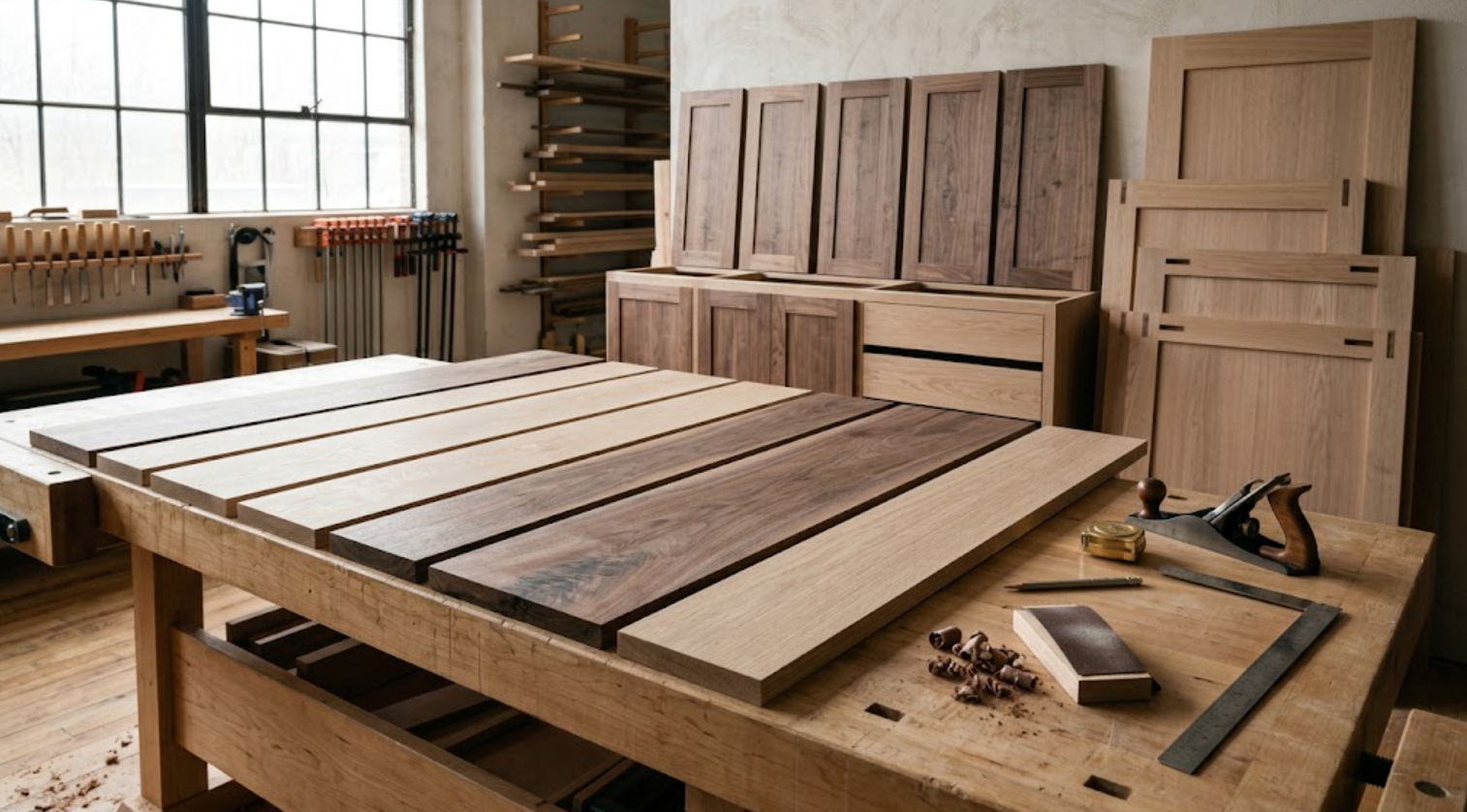
Grabill has historically described hand-sorting lumber for color, stability, and grain characteristics, allowing its craftspeople to work around defects and improve visual consistency across cabinetry components.
That is particularly important in luxury cabinetry using natural wood.
Natural material varies.
No two boards are exactly the same.
The craft is not eliminating that variation.
It is understanding how to work with it.
Why Does Lumber Selection Matter in a Finished Room?
Because a cabinet elevation is read as one composition.
A single walnut door may look beautiful on its own.
But if neighboring fronts vary dramatically without intention, the full elevation may feel disconnected.
The same is true of:
White oak.
Cherry.
Maple.
Hickory.
Other natural species.
Thoughtful material selection helps the grain and tone work across a larger architectural surface.
This becomes even more important with broad slab doors, tall panels, large islands, and highly visible whole-wall cabinetry.
What Does Grabill Mean by Old-World Joinery?
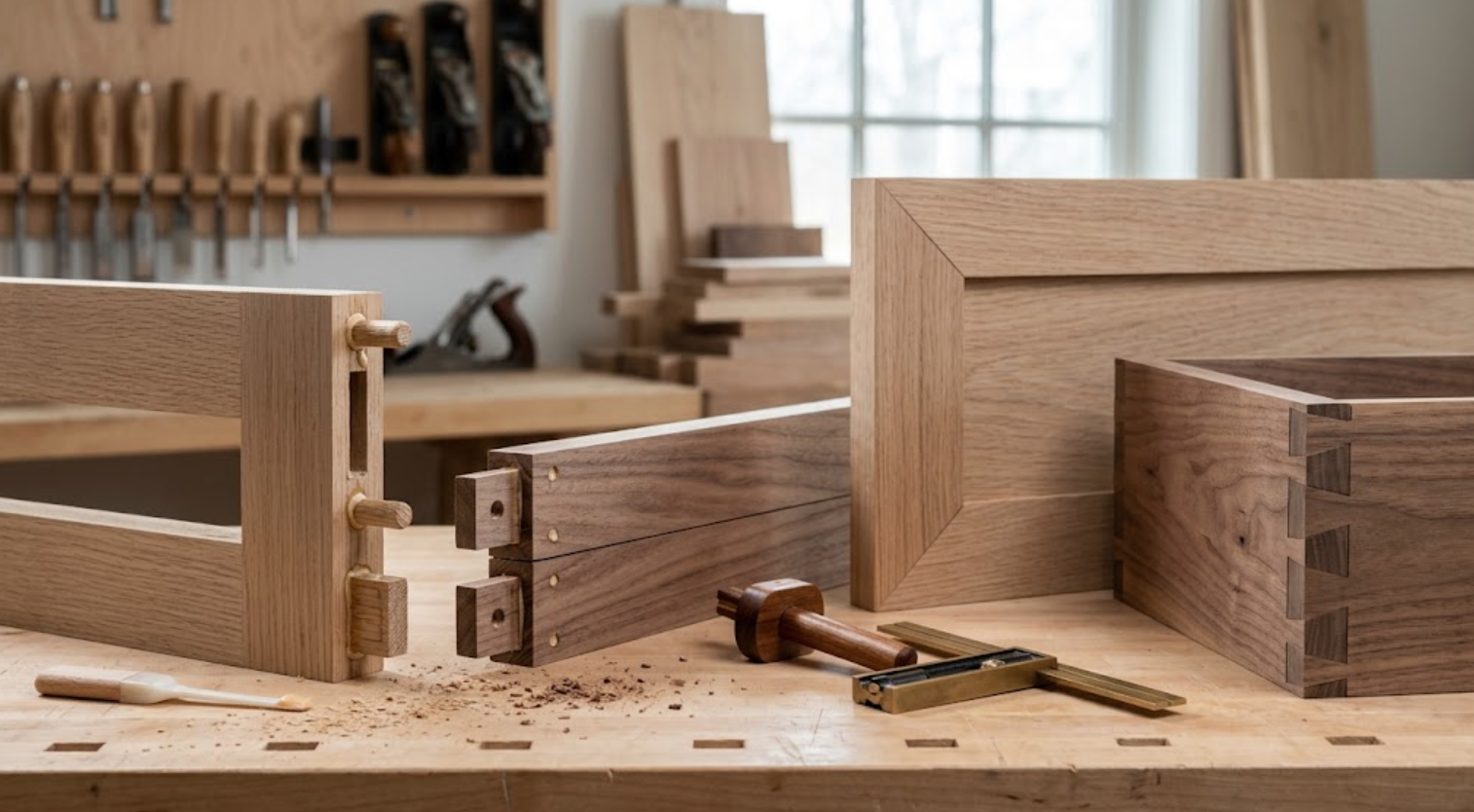
Grabill uses the term to describe traditional joining techniques intended to improve strength and stability.
The company states that its cabinetry uses wooden dowels to reinforce joints, with each dowel receiving hand-applied glue for consistent coverage. Grabill also describes mitered doors with interlocking joints designed to improve long-term stability.
That is very different from evaluating cabinetry only by how the finished door appears.
The joint is largely invisible once the cabinetry is installed.
But it is one of the places where construction quality lives.
Why Do Cabinet Joints Matter?
Because cabinetry is constantly under stress.
Doors open.
Drawers move.
Shelves carry weight.
Large panels respond to environmental changes.
Cabinet boxes need to remain square.
A joint that looks perfectly aligned on installation day also needs to continue performing after years of use.
Grabill specifically emphasizes stability and squareness in its cabinet construction, along with robust joints and precise fitting.
Those are not particularly glamorous words.
But they are essential to good cabinetry.
What Is the Purpose of a Wooden Dowel?
A dowel reinforces the connection between pieces of wood.
Grabill states that its traditional joinery uses hardwood dowels to strengthen joints, and earlier company construction materials have described mortise-and-tenon and finger-jointed miter conditions reinforced with hardwood dowels.
For a designer, the exact joinery terminology may not become part of every client presentation.
But understanding that the manufacturer is thinking about joint stability helps explain why craftsmanship goes beyond surface appearance.
Why Does Hand Gluing Matter?
Consistency.
Grabill specifically notes that its craftspeople hand-glue individual dowels rather than relying only on an automated glue application.
That is a small process detail.
But custom cabinetry is made up of many small process details.
Most will never be seen in the completed kitchen.
Together, they influence how the finished cabinetry performs.
How Important Is Squareness in Cabinet Construction?
Very.
A cabinet box that does not remain square creates problems throughout the installation.
Doors may not align properly.
Drawer movement can suffer.
Reveals can become inconsistent.
Adjacent cabinets may not sit cleanly together.
Tall cabinetry can magnify small errors across a large elevation.
Grabill describes its cabinet construction as intentionally developed around maintaining stability and precise squareness under everyday use.
That is the type of craftsmanship that may be invisible when everything is correct.
You notice it most when it is not.
What About Cabinet Boxes?
Grabill’s published construction materials have historically identified plywood cabinet boxes as a core element of its cabinetry construction, although exact materials and specifications should always be verified for the particular cabinetry program being ordered.
The larger lesson for a luxury project is simple.
Do not evaluate only the door.
Ask what is behind it.
Review:
Cabinet-box material.
Interior finish.
Shelf construction.
Drawer construction.
Joinery.
Edge treatment.
Hardware.
A premium exterior deserves an interior construction standard that supports it.
Why Are Drawer Boxes a Good Measure of Craftsmanship?
Because the drawer is used constantly.
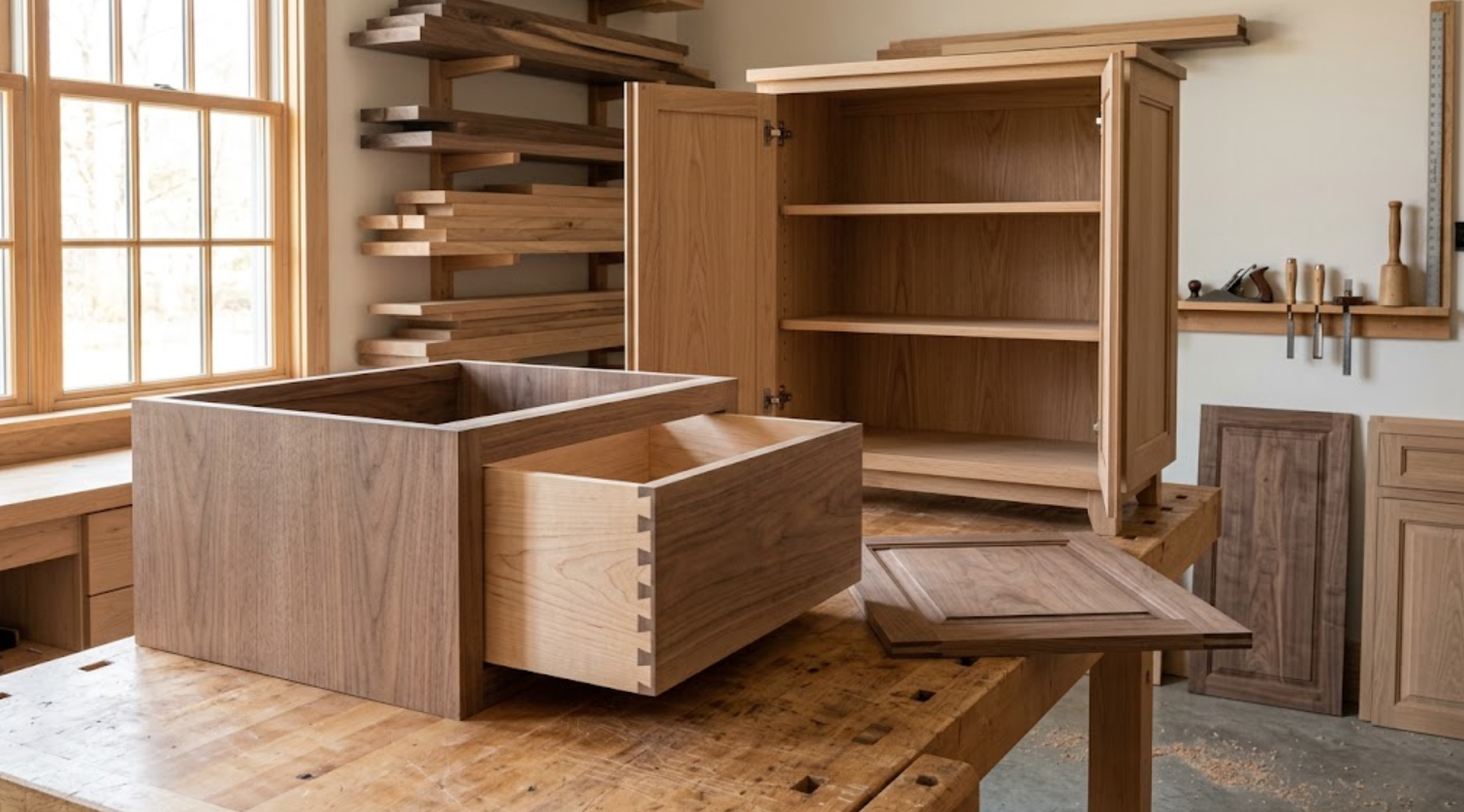
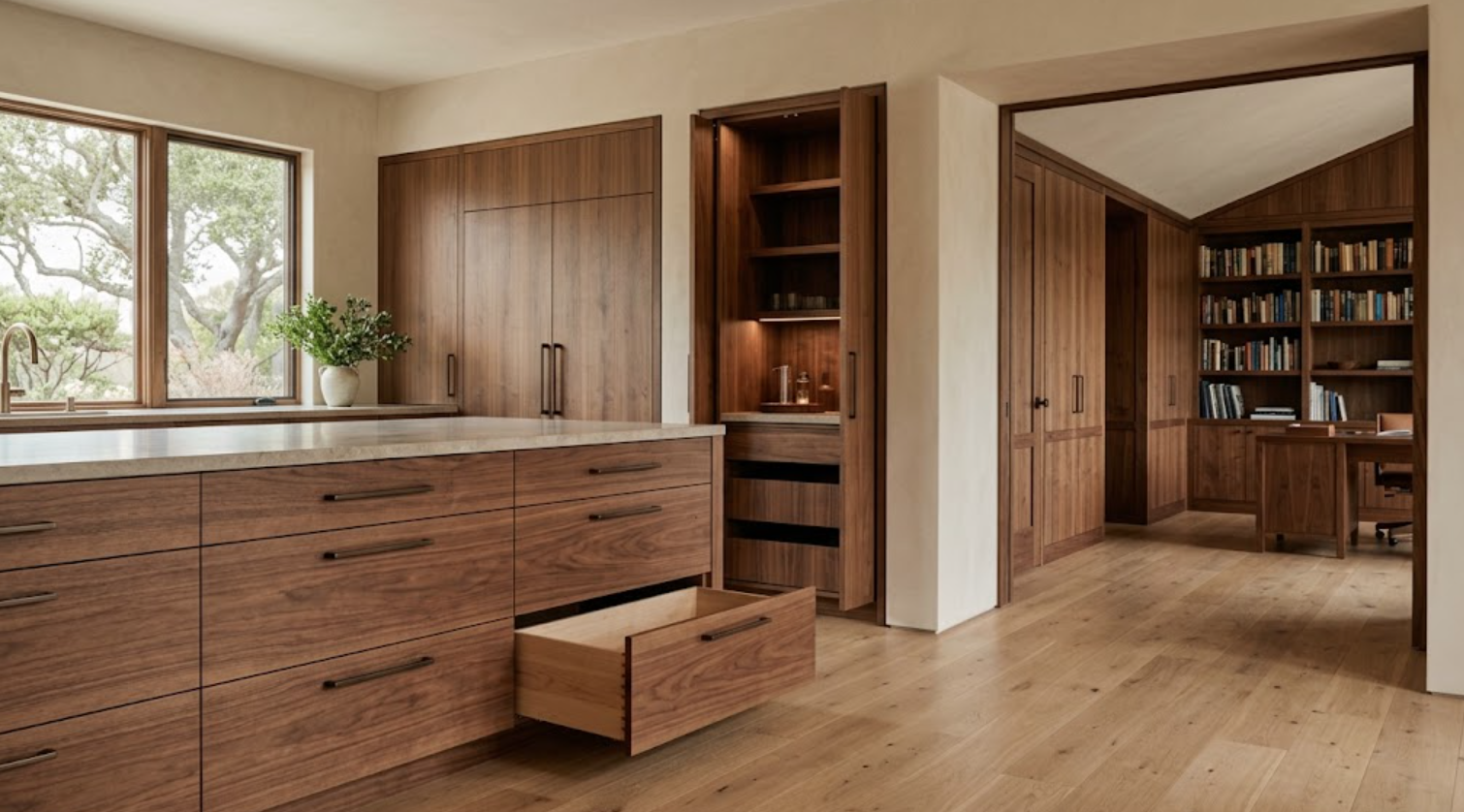
Grabill has historically used solid-wood dovetail drawer construction within parts of its offering, and its published cabinetry-line information has included maple, walnut, and rift-cut white oak dovetail drawer options depending on the product configuration.
Earlier company materials also describe hand-sanding dovetail drawer joinery after assembly to refine the fit.
That level of attention is easy to understand once the drawer is opened.
The exterior may establish the visual character.
The drawer tells you something about how the cabinetry was built.
Should Cabinet Interiors Be Considered Part of Luxury Craftsmanship?
Absolutely.
A custom kitchen does not stop being custom when a door opens.
Interior cabinetry can influence:
How a drawer feels.
How shelving relates to the exterior material.
Whether the cabinet interior supports the room’s material language.
How organized the cabinetry feels.
How well specialized storage functions.
Grabill’s historical line documentation has included interior veneer choices such as maple, walnut, and rift-cut white oak in certain cabinetry configurations.
That creates the opportunity for the inside of the cabinet to feel deliberate too.
Why Might a Designer Specify Walnut Interiors?
Because sometimes opening the cabinetry should reveal another layer of material quality.
Imagine quiet painted cabinetry on the exterior.
Then the drawer opens to reveal warm walnut.
Or a walnut bar continues the same material inside its drawers and shelving.
Those decisions are subtle.
But subtlety is often where luxury residential craftsmanship is felt most strongly.
Does Every Cabinet Need an Upgraded Interior?
No.
Craftsmanship is not the same as adding the most expensive option everywhere.
A highly visible bar may justify a walnut interior.
A primary wardrobe may benefit from a refined wood interior.
A secondary utility cabinet may not need the same treatment.
The designer should allocate material quality according to use and visibility.
That creates hierarchy without lowering the overall standard.
How Does Grabill Approach Door Construction?
The answer varies because Grabill’s current door collection is broad.
The manufacturer offers slab doors, frame-and-panel doors, doors with applied molding, metal-inlay designs, and numerous other configurations across frameless and inset cabinetry.
That variety means craftsmanship must adapt to the door being built.
A slab walnut front presents different challenges from a mitered frame-and-panel door.
A metal-inlay door introduces another material interface.
A custom profile may require project-specific tooling.
The construction process follows the design.
Why Does a Mitered Door Require Particular Attention?
Because the corners need to stay precise.
A poor miter can open.
Shift.
Or create visible alignment problems.
Grabill states that its mitered doors use interlocking joints to improve stability.
That is especially important when the finish and profile make the joint highly visible.
A refined door requires both the geometry and the material to cooperate.
What Happens When a Project Requires a Custom Profile?
That is where craftsmanship begins to overlap with tooling and engineering.
Grabill states that it can fabricate custom profiles and even reproduce molding for restoration or matching applications using custom-made tooling.
That can be particularly relevant when cabinetry needs to relate to:
Historic millwork.
Existing trim.
Architectural wall paneling.
Interior doors.
Furniture.
A unique design detail developed specifically for the residence.
Instead of selecting the nearest available profile, the profile itself can become part of the custom scope.
Why Does That Matter in a Luxury Renovation?
Existing architecture often refuses to behave like a new-build catalog.
Perhaps the house contains:
Original paneling.
Unusual casing.
Existing woodwork.
A historic molding.
A distinctive furniture detail.
Replacing everything with a generic new profile may weaken the design.
Being able to recreate or reinterpret an existing detail gives the designer another way to connect new cabinetry with the building.
Is Custom Tooling Only for Traditional Cabinetry?
No.
A custom tool might create an extremely simple contemporary profile.
Perhaps the designer wants:
A very specific edge condition.
An unusual narrow frame.
A subtle recessed pull.
A project-specific panel profile.
Customization is not about adding ornament.
It is about making the component accurately.
How Is a Custom Finish Crafted?
The process depends on the finish.
Grabill distinguishes between single-step and multi-step custom finish developments.
A single-step custom finish uses one color application in addition to basic processes such as sanding, sealing, and top coating.
A multi-step finish may involve multiple color applications or processes such as glazing, wear-through, distressing, or other special effects. For multi-step development, Grabill requires a physical sample as the reference and specifies a larger door sample for approval.
For designers, this reveals something important.
A finish is a process.
Not simply a color formula.
Why Is Surface Preparation So Important?
Because finish quality depends on what happens before the color is applied.
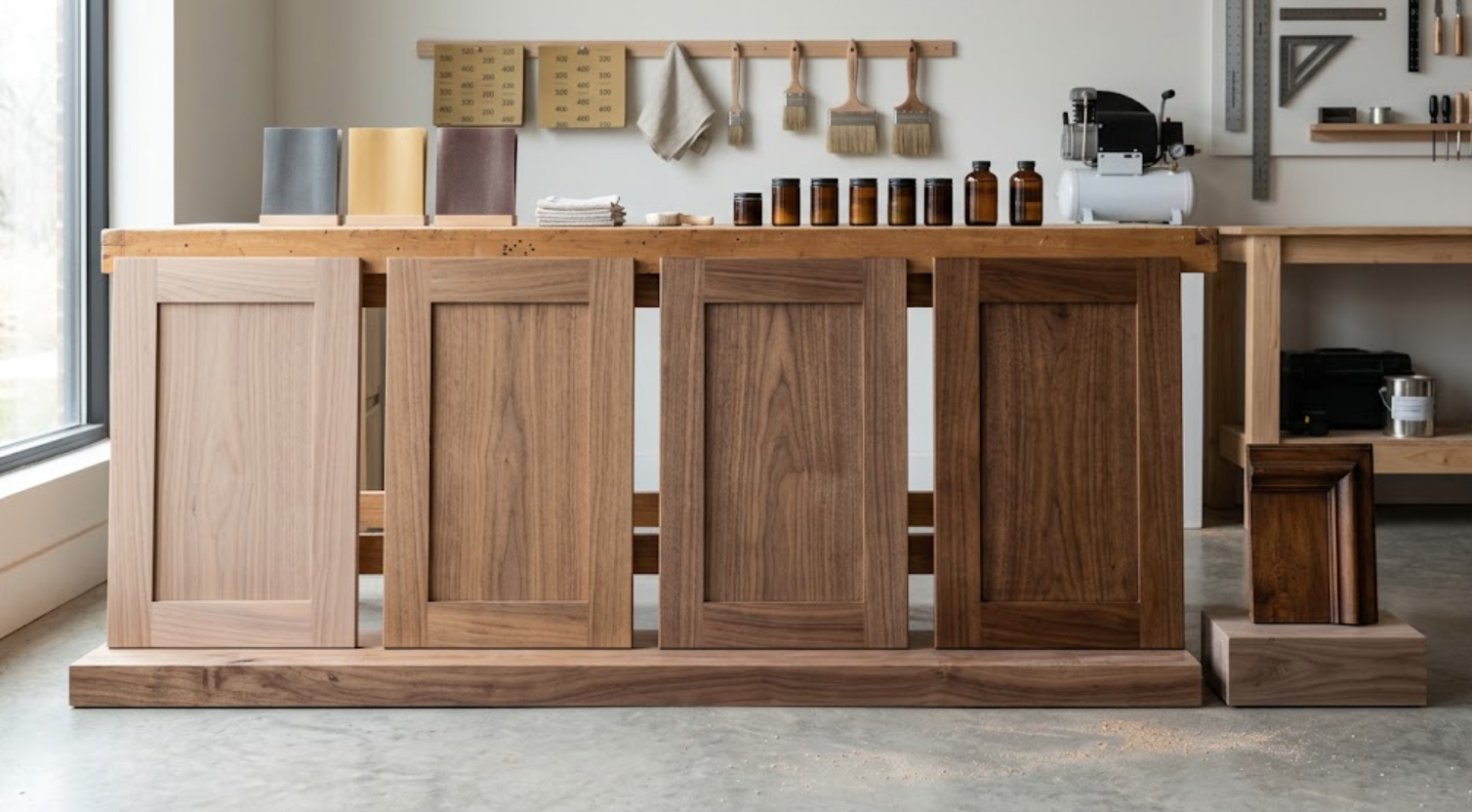
Grabill’s published craftsmanship materials have described hand sanding and edge preparation as part of opening the grain and preparing surfaces for stain, paint, and finish adhesion.
That is easy to overlook when comparing finish samples.
The final color may get the attention.
But preparation helps determine how refined and durable that finish becomes.
Why Is the Top Coat Important?
Grabill repeatedly emphasizes the protective top coat as a major part of its finish system and the long-term durability of its cabinetry.
A luxury kitchen finish has to do more than photograph well.
It encounters:
Hands.
Water.
Steam.
Cleaning.
Daily cooking.
Sunlight.
Repeated contact.
The finish system is therefore both aesthetic and protective.
Can Grabill Match an Existing Finish?
Grabill says it can develop custom colors and match a wide range of reference finishes, including paint, stain, glaze, sheen, existing cabinetry, and other physical references.
This is valuable in projects where a new finish needs to relate closely to something already established.
But custom matching should still be reviewed through physical samples.
Consider:
The reference.
The substrate.
The grain.
The sheen.
The final coating process.
All influence the result.
Why Is Hand Work Still Relevant in Modern Cabinetmaking?
Because machinery creates repeatability.
Craftsmanship makes judgment calls.
A machine can cut accurately.
But a person still evaluates:
The grain.
The fit.
The surface.
The edge.
The finish.
The relationship between one part and the next.
Grabill’s published craftsmanship language combines precision equipment with hand processes such as lumber selection, glue application, sanding, and finish development.
That combination is important.
Fully custom cabinetry does not need to be made entirely by hand to qualify as craft.
The more meaningful question is where human judgment is used to improve the finished piece.
How Does Precision Equipment Support Craftsmanship?
Repeatability.
A complex residential project may contain dozens or hundreds of cabinetry components.
The dimensions need to coordinate.
Door fronts need to align.
Drawer openings need to repeat.
Hardware positions need consistency.
A machine can help achieve that precision.
Then skilled fabrication and finishing determine how those parts come together.
Traditional craft and modern manufacturing are not necessarily opposites.
In premium cabinetry, they can support each other.
What Does Craftsmanship Look Like in Contemporary Cabinetry?
Often, less.
Less visible hardware.
Fewer fillers.
Cleaner reveals.
Larger fronts.
Precise panel relationships.
Better alignment.
Carefully controlled grain.
Contemporary cabinetry can appear simpler than traditional cabinetry while requiring extremely disciplined fabrication.
With fewer decorative elements, the construction itself becomes more exposed.
A large walnut slab panel that is slightly misaligned has nowhere to hide.
Why Are Large Cabinet Panels Particularly Demanding?
Scale magnifies everything.
A small variation across one drawer front may barely register.
Across a full-height appliance panel, it becomes obvious.
Large custom panels require attention to:
Material stability.
Grain.
Panel dimensions.
Hardware requirements.
Adjacent reveals.
Handling.
Installation.
That is why craftsmanship continues through the whole process.
The component cannot simply be beautifully fabricated.
It also has to arrive and install correctly.
How Does Craftsmanship Show Up in Inset Cabinetry?
Through the relationship between the door and frame.
Inset cabinetry puts the door inside the face frame.
That makes the surrounding reveal visible.
If the door is not fitted carefully, the inconsistency is easy to see.
Grabill currently offers both inset and frameless cabinetry and a range of doors that can be specified in either construction, depending on style.
In an inset application, disciplined fit becomes part of the visual design.
What About Frameless Cabinetry?
Frameless cabinetry has its own demands:
Large front surfaces.
Tight reveal patterns.
Broad drawers.
Integrated appliances.
Minimal visual interruption.
Grabill’s custom capabilities allow frameless cabinetry to be developed beyond rigid standardized modules when a project requires unusual proportions or modifications.
The craftsmanship may look different from inset cabinetry.
But the demand for precision remains.
Can Grabill Combine Different Types of Craftsmanship in One Project?
Yes.
Grabill currently features projects that combine frameless and inset cabinetry, custom door modifications, specialty finishes, walnut cabinetry, painted cabinetry, concealed appliances, and custom interior details within one residence.
This is where fully custom work becomes particularly useful.
The project does not need to conform to one single technical expression.
Different rooms and cabinetry elements can require different solutions.
What Does Craftsmanship Mean for Appliance Integration?
It means the appliance should not look like an afterthought.
Panel-ready refrigeration.
Dishwashers.
Ice makers.
Wine refrigeration.
Other integrated equipment.
All introduce technical requirements.
Grabill project examples include custom door and panel modifications developed specifically to conceal appliances and maintain intended profile lines across cabinetry elevations.
That is craftsmanship at the intersection of design and technical coordination.
Why Is a Custom Appliance Panel More Than a Matching Door?
Because the panel has to satisfy two systems:
The appliance.
The cabinetry.
It must work with:
Manufacturer dimensions.
Weight limitations.
Hinges.
Clearances.
Ventilation.
Handles.
Adjacent cabinetry.
The visual elevation.
A panel that looks correct but interferes with the appliance is not successful craftsmanship.
The technical and visual conditions have to resolve together.
How Does Collaboration Affect the Finished Craftsmanship?
Substantially.
Fully custom cabinetry contains more project-specific decisions.
That makes communication between the following parties more important:
Designer.
Cabinetry partner.
Manufacturer.
Builder.
Architect.
Installer.
Grabill explicitly positions collaboration with designers as part of its custom process and states that it works to execute projects according to the project’s specific design requirements.
Craftsmanship therefore begins with fabrication knowledge.
But it depends on good information.
Why Are Detailed Drawings Essential?
Because craftspeople can only build what has been clearly communicated.
Drawings may need to define:
Dimensions.
Door proportions.
End conditions.
Interior configurations.
Custom moldings.
Appliance panels.
Material changes.
Special profiles.
Finish requirements.
A highly custom project contains more opportunity.
It also contains more decisions that need to be documented.
Does Fully Custom Mean Everything Has to Be Unique?
No.
That would usually weaken the design.
Fully custom capability is most effective when used selectively.
The project may use a consistent standard door across most cabinetry.
Then introduce:
One custom hood.
A bespoke island.
A custom finish.
An unusual pantry wall.
Specialized appliance panels.
A project-specific library profile.
The point is not to redesign every component.
The point is to remove limitations where they interfere with the architecture.
What Should Designers Look for When Evaluating Craftsmanship in Person?
Look beyond the overall display.
Open the drawer.
Open the door.
Look at the corner.
Look at the interior.
Look at the back of the door.
Study the finish under side light.
Run your eye along the reveals.
Notice how panels terminate.
Look at how one material meets another.
The questions become more specific:
Do the drawers feel stable?
Are the joints clean?
Are cabinet interiors finished intentionally?
Does the finish have depth?
Are edges refined?
Are doors aligned?
Does the grain make sense across the elevation?
Is the construction appropriate for the scale of the design?
Those observations reveal more than a finish chip ever can.
Why Does This Matter More in a Luxury Residence?
Because the cabinetry often occupies an enormous amount of visual and physical space.
A luxury residence may include cabinetry in:
The kitchen.
Pantry.
Primary bathroom.
Wardrobe.
Bar.
Office.
Library.
Laundry.
Mudroom.
Media room.
Dining room.
When cabinetry extends throughout the home, small differences in quality become repeated hundreds of times.
A refined handle.
A clean reveal.
A well-built drawer.
A consistent finish.
Those details accumulate.
Is Craftsmanship Primarily About Longevity?
Longevity is part of it.
Grabill explicitly frames its cabinetry as being made to endure and emphasizes construction, joints, finish protection, and durability in its current brand materials.
But longevity is not the only measure.
Craftsmanship also affects how the cabinetry feels today.
How quietly the drawer moves.
How refined the material transition looks.
How a door sits in its frame.
How a custom finish responds to light.
How accurately the cabinetry follows the architecture.
Durability and design precision are connected.
Why Is Craftsmanship Hard to Judge From a Photograph?
Because most of the important details are tactile.
A photograph can show:
Color.
Proportion.
Door style.
Overall composition.
But it cannot fully communicate:
Drawer movement.
Material weight.
Interior construction.
Joinery.
Surface feel.
Finish depth.
Hardware action.
That is why seeing custom cabinetry in person can be so valuable during specification.
Inside the Craftsmanship of Fully Custom Grabill Cabinetry
Fully custom craftsmanship is not one single feature.
It is a chain of decisions:
Material selection.
Precision fabrication.
Stable joinery.
Surface preparation.
Door construction.
Drawer construction.
Finish development.
Custom tooling.
Interior detailing.
Technical coordination.
Final fit.
Grabill combines traditional craftsmanship practices with modern fabrication systems, custom design capabilities, specialized finish development, and both inset and frameless cabinetry construction.
The result is not valuable simply because more hand work occurred.
The value comes from what that craftsmanship allows the project to achieve.
A detail can be made more precisely.
A profile can be developed specifically for the architecture.
A finish can be created for the material palette.
An appliance can disappear into the elevation.
An interior can feel as refined as the exterior.
And a custom drawing can become a built object without losing the design logic that made it special in the first place.
That is the role craftsmanship should play in a luxury project.
Not decoration for its own sake.
Precision where precision matters.
Explore Grabill Craftsmanship With Atelier Design Society
Atelier Design Society works with interior designers, architects, builders, homeowners, and other design professionals evaluating fully custom cabinetry for sophisticated residential projects throughout the Bay Area.
Through Atelier, project teams can explore Grabill cabinetry at a more detailed level, including construction, natural woods, door profiles, custom finishes, interiors, custom modifications, and the details that distinguish true custom cabinetry from more standardized solutions.
Bring architectural drawings, preliminary elevations, material references, appliance specifications, custom millwork details, and any unusual cabinetry conditions when available.
The strongest reason to specify fully custom cabinetry is not simply to have something unique.
It is to give the architecture, materials, and details enough freedom to be executed properly.