How to Pair Kitchen Cabinets and Countertops Like a Designer
Cabinetry and countertops are usually selected as separate line items.
Visually, they are not separate at all.
They meet across some of the largest surfaces in the kitchen.
A walnut cabinet sits directly beneath stone.
A painted island changes the way a quartzite reads.
A warm white countertop can make one oak finish feel balanced and another unexpectedly yellow.
A dramatic slab can either become the focal point of the room or compete with equally expressive cabinetry.
That is why designers rarely evaluate cabinets and countertops independently.
The relationship matters more than either material on its own.
And that relationship involves more than matching colors.
You are balancing:
Undertone
Grain
Movement
Contrast
Texture
Sheen
Scale
Architecture
Natural light
The visual hierarchy of the room
A successful pairing does not necessarily mean the cabinet and countertop look similar.
Often, the strongest combinations work because each material is allowed to do something different.
The stone might provide movement while the cabinetry remains quiet.
The cabinetry might introduce warmth while the countertop creates a calm architectural surface.
One material leads.
The other supports.
And the entire combination needs to make sense with everything surrounding it.
Start With the Material That Has the Strongest Personality
Some materials are easier to coordinate than others.
A quiet warm painted cabinet can work with many different stones.
A highly figured natural walnut may narrow the options.
A creamy stone with subtle movement can adapt to several cabinetry finishes.
A dramatic quartzite with strong veining, color variation, and contrast may determine much of the room’s palette.
Identify the material with the strongest visual personality first.
Then build around it.
If the project already has a dramatic stone selected, cabinetry should be evaluated against that exact slab.
If a particular wood species or custom cabinet finish is central to the architectural concept, use that as the anchor instead.
There is no rule that countertops must come first.
There is no rule that cabinetry must come first.
The stronger design element should usually lead.
Why Is Undertone More Important Than Matching Color?
Because two materials can appear to be the same general color and still feel wrong together.
Consider white.
A countertop might read:
Creamy
Gray
Warm beige
Blue-white
Soft ivory
A painted cabinet might also appear white until it is placed directly beside that stone.
Then the difference becomes obvious.
The same problem occurs with wood.
A light oak may lean:
Golden
Neutral
Pink
Brown
Gray
Place it beside a creamy stone and the combination may become beautifully warm.
Place the same oak beside a cool gray countertop and its yellow undertones may suddenly become much more noticeable.
Designers look beyond the color name.
They compare the undertones physically.
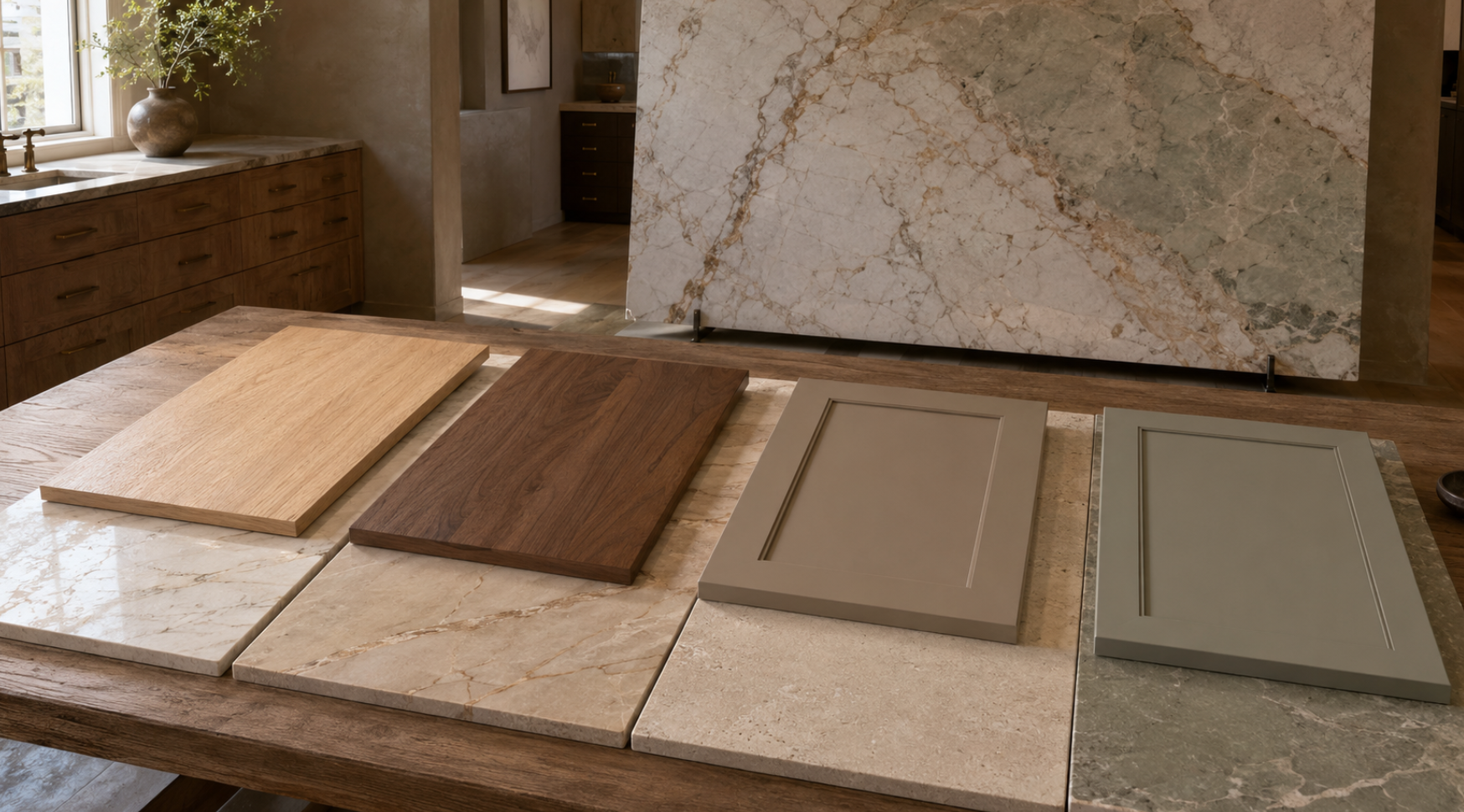
How Do You Pair White Oak Cabinets With Countertops?
White oak is flexible, but it is not neutral in the same way paint can be.
Its grain and undertone remain part of the room.
For a restrained white oak kitchen, creamy natural stone is often an effective direction.
The warmth in the stone can relate to the warmth of the wood without trying to match it exactly.
Consider:
Honed quartzite
Soft limestone
Warm marble
Other natural stones with controlled movement
All can create very different interpretations.
The important question is what the oak finish is doing.
A pale natural white oak behaves differently from a deeper brown stain.
A cerused oak introduces another layer of contrast into the grain.
A warmer stain may need a quieter stone.
Do not specify “white oak and white countertop.”
Specify the exact wood finish against the exact stone.
Should White Oak Be Paired With Cool Gray Stone?
It can be.
But the undertones need careful evaluation.
A cool stone can create deliberate contrast against warm wood.
That can work beautifully in contemporary architecture.
The problem occurs when the contrast looks accidental.
If the oak reads yellow and the stone reads blue-gray, the materials may pull away from each other.
Bring in the surrounding finishes:
Flooring
Plaster
Metal
Paint
Sometimes those materials bridge the temperature difference.
Sometimes they confirm that another stone would work better.
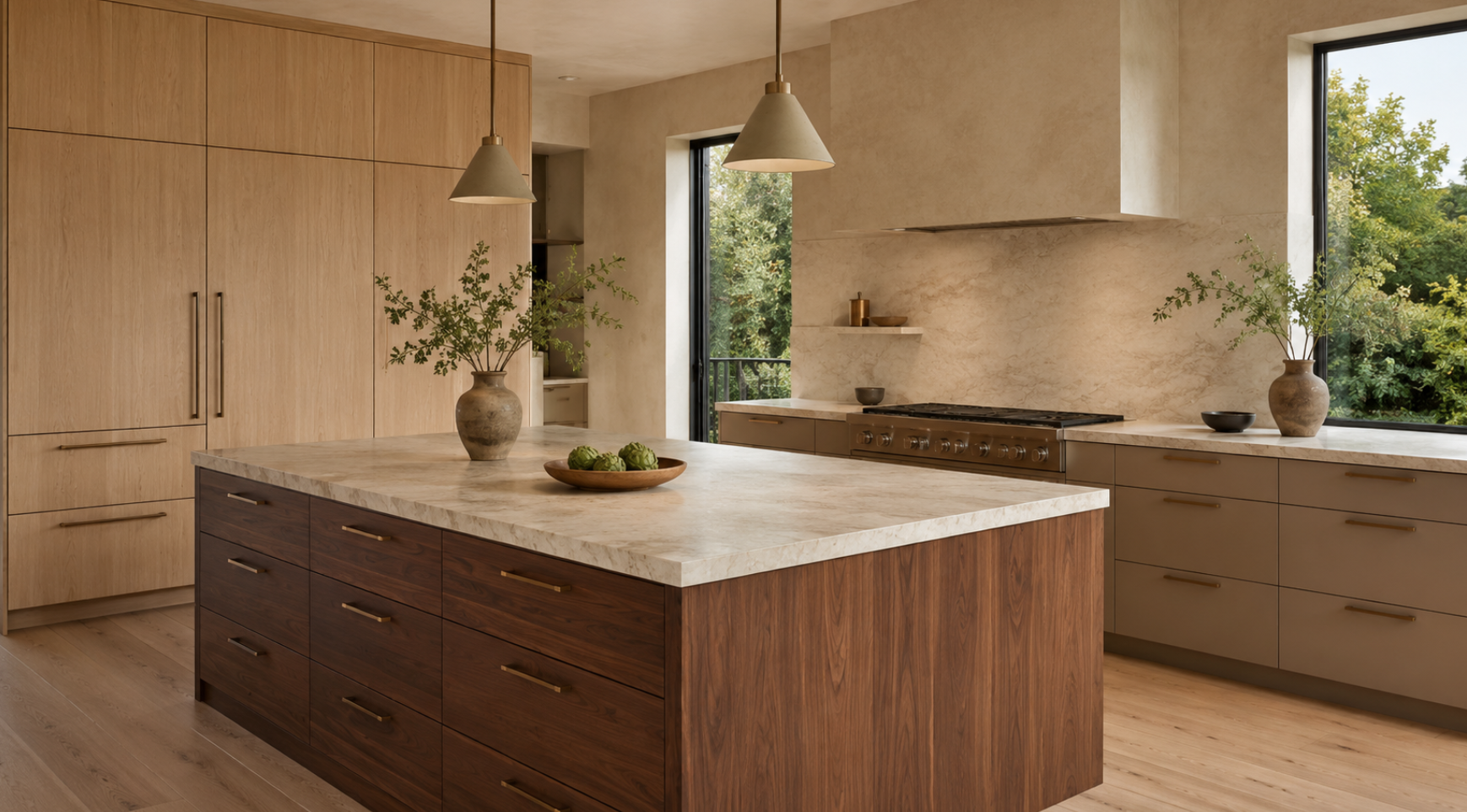
What Countertops Work With Walnut Cabinets?
Walnut already carries considerable visual richness.
It has:
Color
Grain
Depth
Variation
That means the countertop does not always need to add another strong pattern.
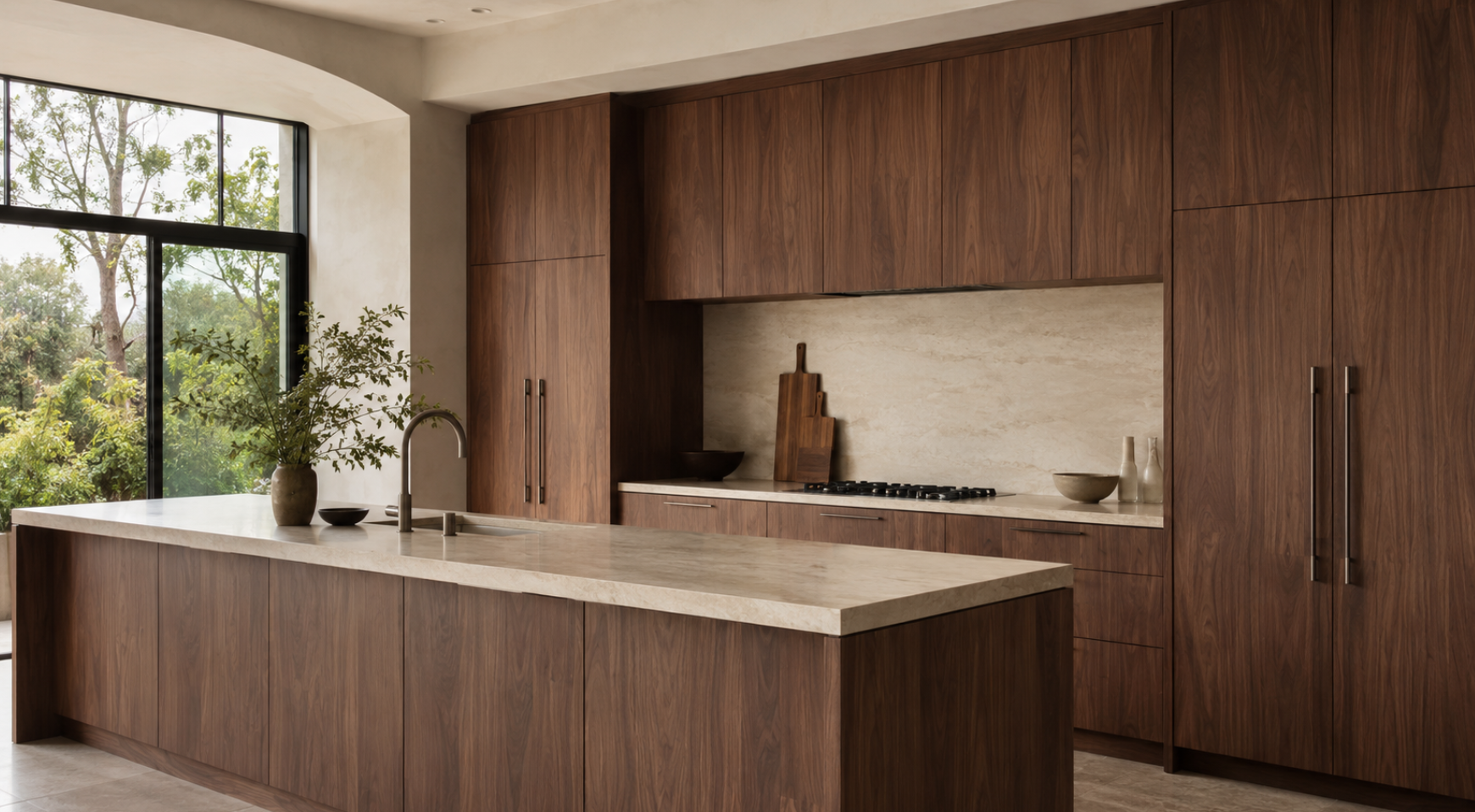
A restrained creamy stone can allow walnut to become the dominant material.
A softly veined quartzite can introduce movement without overwhelming the wood.
A darker stone can create a moodier, more monolithic composition.
The appropriate choice depends on how much walnut exists in the room.
A walnut island is different from an entire kitchen wrapped in walnut cabinetry.
When Should Walnut Be Paired With Dramatic Stone?
When the room has enough scale and visual quiet to support both.
A large contemporary kitchen with restrained architecture may handle:
Rich walnut
A dramatic stone island
Minimal hardware
Quiet plaster
Very little additional pattern
The stone and wood become the two dominant materials.
But if the room already includes expressive flooring, decorative lighting, patterned backsplash material, and multiple metal finishes, adding highly figured walnut and dramatic stone can make the composition unnecessarily busy.
Luxury does not require every material to compete for attention.
How Do You Keep Walnut and Stone From Feeling Too Heavy?
Introduce visual relief.
Perhaps the perimeter cabinetry is painted.
Perhaps the stone is lighter.
Perhaps only the island uses walnut.
Perhaps tall cabinetry is wood while lower cabinetry remains quiet.
Large windows and lighter architectural finishes can also give darker wood room to breathe.
The amount of material matters as much as the material itself.
How Do You Pair Painted Cabinets With Countertops?
Paint gives designers a different type of control.
Natural wood contains inherent grain and variation.
Paint creates a more uniform field of color.
That can make it easier to introduce expressive stone.
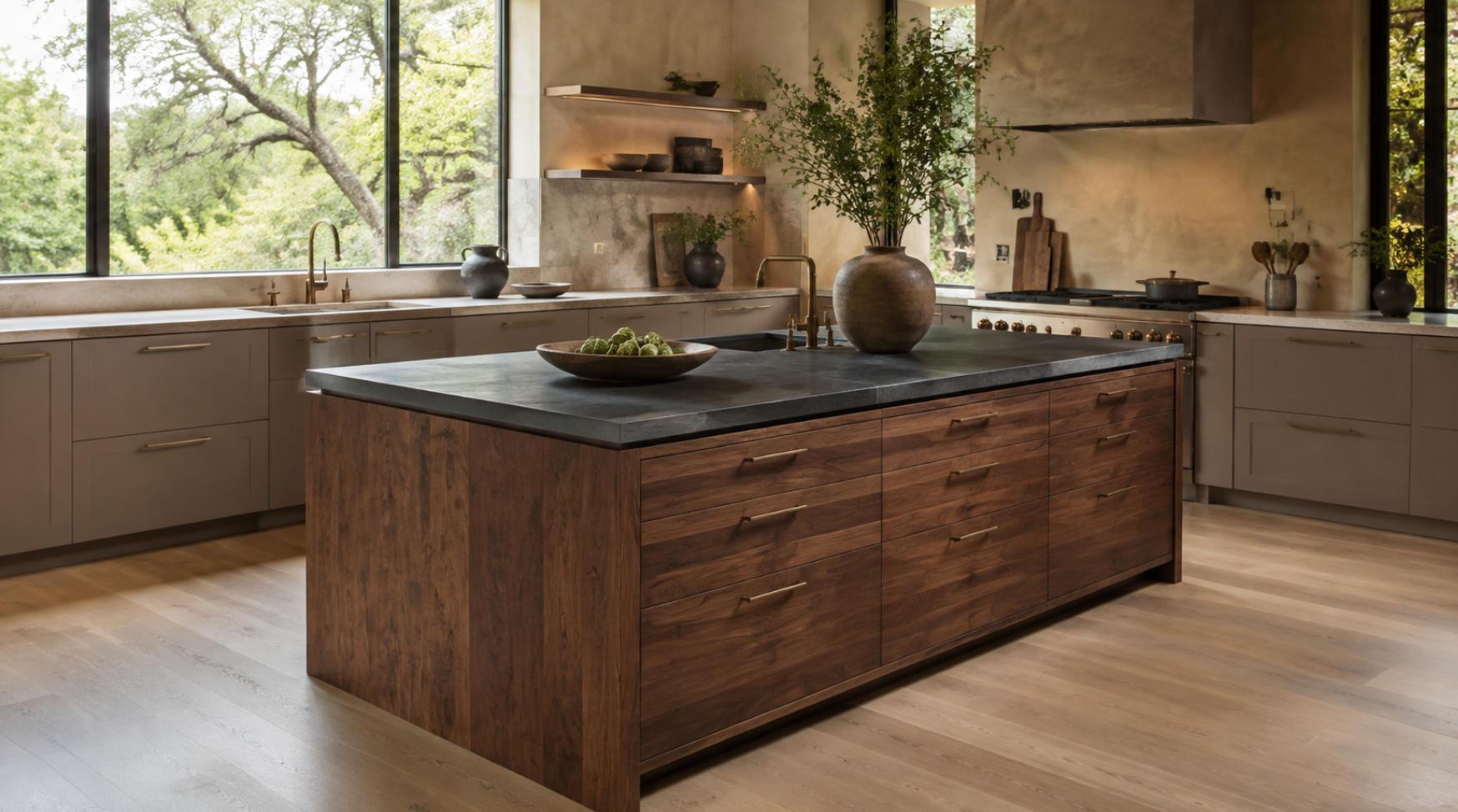
A warm mushroom cabinet might pair beautifully with quartzite containing cream, taupe, and soft gray.
A muted green cabinet could work with a quieter warm stone that allows the color to remain prominent.
Deep charcoal cabinetry may support a lighter countertop with stronger movement.
But the same undertone rules still apply.
The paint should be evaluated directly against the stone.
Should the Cabinet Color Appear in the Countertop?
It can.
It does not have to.
A subtle relationship is often enough.
Perhaps a warm taupe cabinet relates to one minor vein in the stone.
Perhaps a green-gray paint connects with a quiet mineral undertone.
Perhaps creamy cabinetry and stone simply share the same temperature.
The connection should not feel like an attempt to extract one exact color from the slab and reproduce it on the cabinets.
That can make the palette feel overly coordinated.
Materials should relate.
They do not need to match.
What About White Cabinets and White Countertops?
This pairing requires more attention than it appears to.
There are hundreds of versions of white.
If the cabinetry is crisp and cool while the stone is creamy, the stone may suddenly appear yellow.
If the cabinetry is warm ivory and the countertop is blue-white, the cabinets may look dingy.
Compare them physically.
Then look at them in the project’s lighting.
A successful white-on-white kitchen usually relies on subtle differences in:
Temperature
Texture
Sheen
Movement
Depth
Those differences prevent the room from feeling flat.
Can Dark Cabinets Work With Dark Countertops?
Yes.
Contrast is not mandatory.
A tonal kitchen can be extremely sophisticated.
Consider:
Deep brown wood with dark stone
Charcoal cabinetry with charcoal stone
Muted black cabinetry with soapstone-like surfaces
The result can feel monolithic and architectural.
But light becomes particularly important.
Consider:
Large windows
Good task lighting
Integrated cabinetry lighting
Lighter flooring or walls
Those elements can keep a dark palette from feeling visually compressed.
When Should You Create Strong Contrast?
When the architecture benefits from clearly defined volumes.
A dark island beneath pale stone can read as a strong object.
White oak beneath a dark countertop can create a sharper contemporary edge.
Painted perimeter cabinetry with a walnut island can establish hierarchy.
Contrast can help separate:
Island from perimeter
Tall cabinetry from base cabinetry
Kitchen from bar
Furniture-like elements from architectural cabinetry
Use it intentionally.
How Much Stone Movement Should a Kitchen Have?
That depends on how much movement already exists elsewhere.
Cabinetry can be visually quiet.
Or highly expressive.
So can flooring.
Backsplash.
Wall treatments.
Furniture.
If the cabinetry uses broad natural wood grain, an extremely active countertop may create two competing patterns directly beside each other.
If the cabinetry is smooth and painted, the stone has more room to become expressive.
This is one reason designers evaluate the entire palette rather than asking whether a slab is beautiful by itself.
Many slabs are beautiful.
Not every beautiful slab belongs in every kitchen.
What Is the Difference Between Quiet and Dramatic Stone?
Quiet stone tends to have:
More controlled movement
Lower contrast
Fewer dominant veins
A more uniform overall field
Dramatic stone may contain:
Large directional veins
Strong color changes
High contrast
Large areas of movement
Neither is inherently more luxurious.
A quiet stone can be extraordinary because of its subtle color and depth.
A dramatic stone can become the defining visual feature of a room.
The question is what role the countertop should play.
Should a Dramatic Slab Become the Backsplash Too?
Sometimes.
Continuing the countertop material vertically can create a powerful architectural surface.
It can also increase the amount of pattern significantly.
Before deciding, study the full elevation.
A dramatic slab behind a range may become a focal point.
The same stone across every perimeter wall may overwhelm a smaller room.
Scale matters.
Why Should You Look at the Entire Slab?
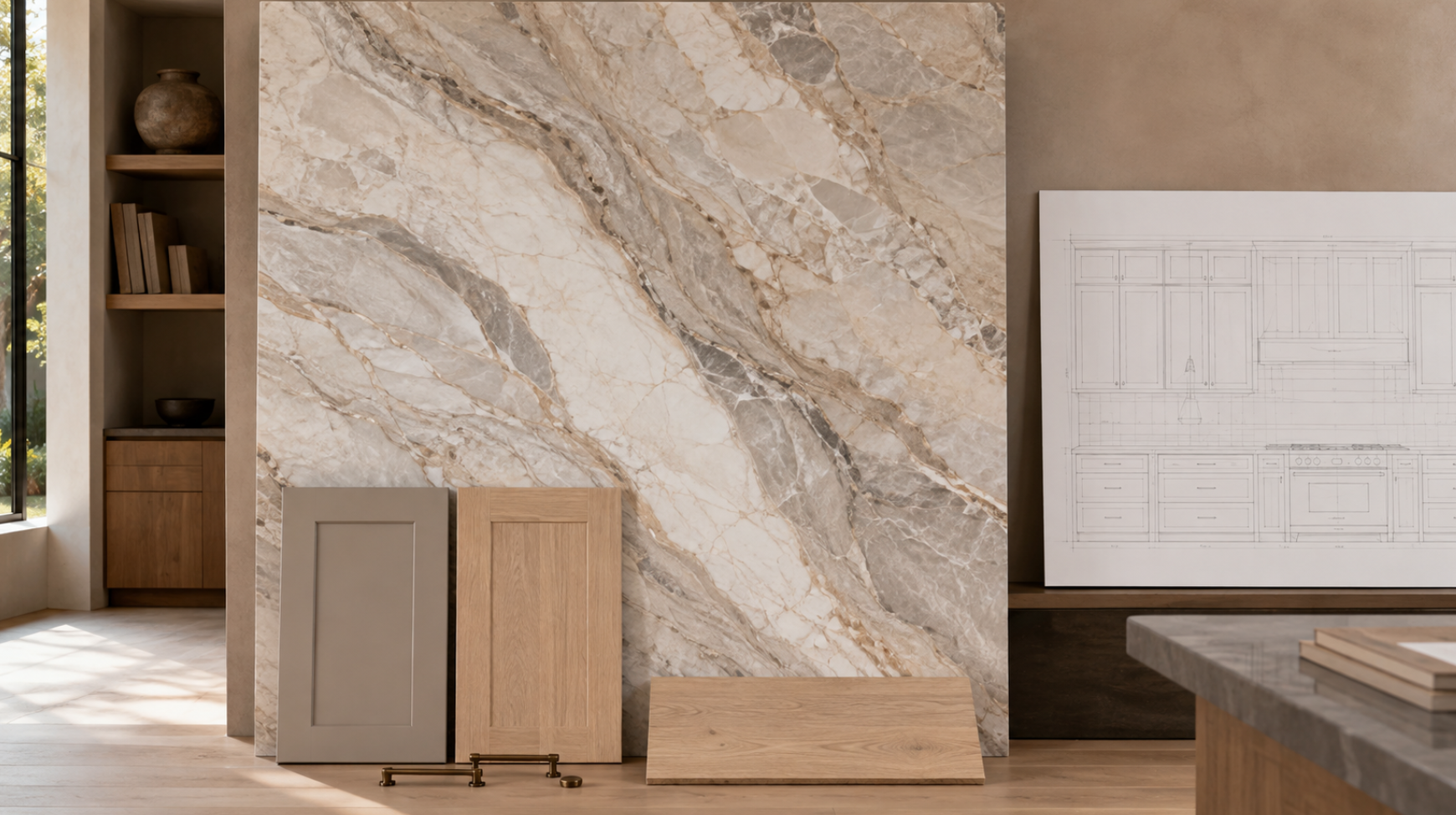
Because a small sample cannot communicate large-scale movement.
A sample might show:
Cream
One gray vein
A small area of warmth
The full slab might contain a dramatic dark section that completely changes the character of the material.
For highly figured natural stone, slab viewing is essential.
The cabinetry finish should then be evaluated with an understanding of the entire stone composition.
What Happens When the Stone Is Bookmatched or Highly Directional?
Then layout becomes part of the design.
The stone fabricator and design team need to consider:
Where major veins land
How seams connect
What appears on the island
How the backsplash relates to the countertop
Whether a waterfall edge continues the movement
The cabinet elevation and slab layout should be studied together.
The countertop is no longer simply a horizontal surface.
It becomes part of the architecture.
Should You Use a Waterfall Edge?
Only when it supports the design.
A waterfall edge increases the amount of stone visible on the island.
That can be effective when the stone is a major material statement.
But it also covers the cabinetry at the island end.
If the cabinetry itself has beautiful wood grain, furniture-like detailing, or an important end-panel treatment, hiding it behind stone may weaken the design.
Ask which material deserves to be seen.
How Does Sheen Affect the Pairing?
Material relationships are not only about color.
A highly polished stone reflects light differently from honed stone.
Glossy cabinetry behaves differently from matte paint.
Acrylic fronts can create another level of reflection.
Natural wood adds texture.
Too many reflective surfaces can make the kitchen feel visually active.
A matte or honed countertop can create a quieter relationship with wood and painted cabinetry.
A polished surface can introduce more formality and luminosity.
The correct combination depends on the desired atmosphere.
Why Is Texture Important?
Because two materials with similar color can still feel distinct through texture.
Imagine:
Warm white painted cabinetry
Honed limestone
Plaster walls
They may all sit within a similar tonal range.
But one is smooth.
One has natural mineral variation.
One has subtle hand-worked texture.
The room gains depth without requiring dramatic color contrast.
This is especially effective in restrained luxury interiors.
How Should Cabinet Hardware Affect the Cabinet-and-Stone Pairing?
Hardware is often the bridge between materials.
Warm bronze can connect walnut to creamy stone.
Dark metal can sharpen pale oak and light quartzite.
Polished nickel can introduce a cooler, more reflective note.
But hardware should not be selected solely to “match” the countertop.
It also needs to coordinate with:
Plumbing
Lighting
Appliances
Architectural metalwork
The cabinetry and stone establish the primary relationship.
Hardware refines it.
What About the Flooring?
Flooring is one of the most commonly ignored elements during cabinet and countertop selection.
That is a mistake.
Wood cabinetry and wood flooring sit in the same field of view.
If both have strong grain and nearly matching colors, they can compete.
If their undertones conflict, the room may never feel resolved.
The countertop can sometimes help bridge them.
For example, a creamy stone may connect a warmer oak floor with a slightly quieter cabinet finish.
Always evaluate all three materials together.
Should Cabinetry Match the Wood Flooring?
Usually, exact matching is unnecessary.
In fact, a slight difference can create more depth.
The woods might share an undertone while differing in:
Species
Grain
Value
Finish
One can be lighter.
One can be richer.
The goal is intentional relationship, not duplication.
How Does Wall Color Affect the Combination?
More than many clients expect.
Cabinetry and countertops do not float in isolation.
A warm plaster wall can make a cool stone feel more pronounced.
A bright white wall may sharpen the difference between creamy cabinetry and pale stone.
A deep wall color may change how walnut reads.
Include the wall finish in the material review.
Even when it seems secondary.
How Does Natural Light Change Cabinet and Countertop Color?
Constantly.
Morning light may make a warm wood feel softer.
Direct afternoon light can intensify yellow or red undertones.
A north-facing kitchen may make the same materials appear cooler.
Artificial lighting changes them again after sunset.
That is why samples should be reviewed in the actual project lighting whenever possible.
A combination that looks perfect under showroom lighting may behave differently at home.
What Should You Do Before Approving the Final Combination?
Create a project-specific material set.
Not a generic mood board.
Use the actual:
Cabinet door
Cabinet finish
Countertop sample
Flooring
Wall finish
Hardware
Backsplash
Then evaluate the combination:
Horizontally
Vertically
In daylight
Under artificial light
From several distances
The goal is to understand how the materials behave as architecture.
Not simply whether they look attractive when stacked on a table.
What Are the Most Common Cabinet-and-Countertop Mistakes?
One is choosing materials individually. A beautiful cabinet finish and a beautiful stone do not automatically create a beautiful combination.
Another is relying on digital images.Screens cannot reliably communicate undertone, grain, finish depth, sheen, or natural variation.
Another is working only with tiny samples. Small samples are useful for initial editing.
They are less useful for understanding larger-scale movement.
Another mistake is adding too many dominant materials. Expressive wood. Dramatic stone.Patterned backsplash. Strong flooring. Statement hardware. All within the same composition. The kitchen may have many expensive materials and still lack hierarchy.
Should You Follow Current Kitchen Color Trends?
Only when they support the architecture and the client’s preferences. Cabinetry and countertops are substantial investments.
They should not depend entirely on a color combination that feels relevant for one season. Natural materials can help. Wood. Stone. Plaster. Metal. These materials have inherent variation and depth that extend beyond a particular trend.
Paint can introduce more specific color, but even then, consider how it relates to the larger residence.
How Do Designers Create a Kitchen That Feels Layered Without Feeling Busy?
By controlling the number of strong moves. Perhaps the kitchen has beautiful walnut cabinetry.
Then the stone remains quiet. Perhaps the stone is extraordinary and dramatic.
Then the cabinetry becomes more restrained. Perhaps the room is largely tonal.
Texture provides the depth. Perhaps the island becomes the contrasting element while the perimeter stays calm.
Layering does not require adding more. It requires giving each material a clear role.
What If You Want to Mix Painted and Wood Cabinets?
Determine the hierarchy first. Which material is primary? Which is secondary? Where does the transition happen?
Architectural boundaries usually create the cleanest changes.
For example:
Wood tall cabinetry with painted lower cabinets
A wood island with painted perimeter cabinetry
Painted kitchen cabinetry with a walnut bar
White oak kitchen cabinetry with a painted pantry
Avoid changing finishes randomly from cabinet to cabinet.
Material transitions should reinforce the architecture.
Should the Countertop Change When the Cabinet Finish Changes?
Sometimes. But it does not have to.
Using one countertop material across painted and wood cabinetry can connect the two finishes.
Alternatively, a different island stone can deliberately emphasize the island as a separate furniture-like element. Both strategies can work. The choice depends on whether the goal is continuity or hierarchy.
What About Countertop Edge Profiles?
The edge affects how the stone relates to the cabinetry. A restrained thin-looking edge can reinforce contemporary cabinetry. A more substantial edge can give a large island additional visual weight.
Detailed profiles can relate to more traditional or furniture-like cabinetry.
The profile should not be chosen independently of the cabinet door. They are adjacent design details.
How Do You Pair Cabinets and Countertops Across an Entire Home?
Establish a material hierarchy. The kitchen may introduce the primary wood. The primary bathroom may reinterpret that wood with another stone.
The bar may use a deeper version of the palette. Secondary bathrooms might use painted cabinetry while maintaining related countertop undertones.
The materials do not need to repeat exactly. They should feel as though they belong to the same residence.
This becomes particularly important in open-plan homes where multiple cabinetry areas can be seen from one location.
How to Pair Kitchen Cabinets and Countertops Like a Designer
Start with relationships. Not isolated samples. Identify the strongest material. Understand the undertones. Decide where visual movement should occur. Balance expressive wood with stone. Balance dramatic stone with quieter cabinetry. Study texture and sheen. Include the flooring.Include the walls. Include the hardware. Look at full slabs. Evaluate physical samples. Study everything under the project’s actual light. Then pull back. The final question is not:
Does this countertop match this cabinet?
It is:
Does this entire material composition support the architecture?
That shift changes the selection process. And it is often what separates a kitchen filled with individually beautiful materials from one that feels completely resolved.
Pair Cabinetry and Surfaces With Atelier Design Society
Atelier Design Society works with homeowners, architects, interior designers, builders, and other design professionals developing cabinetry and material palettes for sophisticated residential projects throughout the Bay Area.
At the Atelier Design Society showroom in Menlo Park, project teams can compare cabinetry materials, natural woods, painted finishes, door styles, hardware, and surfaces together rather than making each decision independently.
Bring stone samples, slab photographs, flooring, plaster or paint references, hardware, architectural drawings, and other project materials when available.
The strongest cabinet-and-countertop pairing is the one that makes sense within the entire room.