Quartzite vs. Quartz: Which Surface Is Right for Your Kitchen?
The names sound similar. The finished slabs can sometimes look similar. Both can create durable, sophisticated countertops. But they are fundamentally different materials. Quartzite is natural stone. Quartz is an engineered surface made using natural quartz mineral combined with pigments and binders.
That difference affects almost everything that follows: variation, pattern, maintenance, heat considerations, fabrication, slab selection, and the amount of predictability a designer has when developing the kitchen palette.
For some projects, the natural movement and individuality of quartzite will be exactly what the architecture needs. For others, the consistency and lower-maintenance qualities of quartz will make more sense. Neither material is automatically the more luxurious choice. The right surface is the one that supports the design and the way the kitchen will actually be used.
What Is Quartzite?
Quartzite is a natural metamorphic stone. It begins as sandstone and is transformed through geological heat and pressure into a much harder material rich in quartz. It is quarried in blocks, cut into slabs, finished, fabricated, and then installed as a natural stone surface.
That means every slab is inherently individual. Veining changes, color changes, and mineral deposits appear in different locations. One area may be relatively quiet while another contains dramatic movement. For designers, this variability is one of quartzite's greatest strengths. It is also one of the reasons the material requires more careful selection.
What Is Quartz?
Quartz countertops are manufactured rather than quarried as finished slabs. Manufacturers combine natural quartz mineral with pigments and binding materials to create engineered slabs.
This allows manufacturers to control:
Color.
Pattern.
Movement.
Background tone.
Veining.
Consistency between slabs.
The result can range from extremely quiet monochromatic surfaces to designs intended to resemble marble, quartzite, or other natural stone. That predictability is an important part of quartz's appeal.
So Which One Looks More Natural?
Quartzite is natural. That does not automatically mean every homeowner will prefer its appearance. Natural stone contains geological variation that engineered surfaces intentionally control.
A quartzite slab may include:
Unexpected mineral coloration.
Veins that change direction.
Small fissures.
Areas of greater translucency.
Variation from one side of the slab to the other.
For someone who values natural material, those characteristics may be exactly what makes the slab extraordinary. For someone seeking a highly consistent countertop across a large kitchen, they may be undesirable. Quartz provides greater visual predictability. The question is whether the project benefits more from individuality or control.
Why Do Designers Love Quartzite?
Because natural stone can introduce something that cannot be completely designed in advance. Geology. The pattern exists before the kitchen. The designer's role is to find the slab that belongs in the project and determine how to use it.
A beautiful quartzite can become:
The island.
The backsplash.
The perimeter countertops.
A full-height range wall.
A bar surface.
A furniture-like stone element.
In a restrained kitchen, the slab itself may provide almost all of the visual movement. That can be particularly effective when paired with simple cabinetry.
Why Does Quartzite Work So Well With Natural Wood Cabinetry?
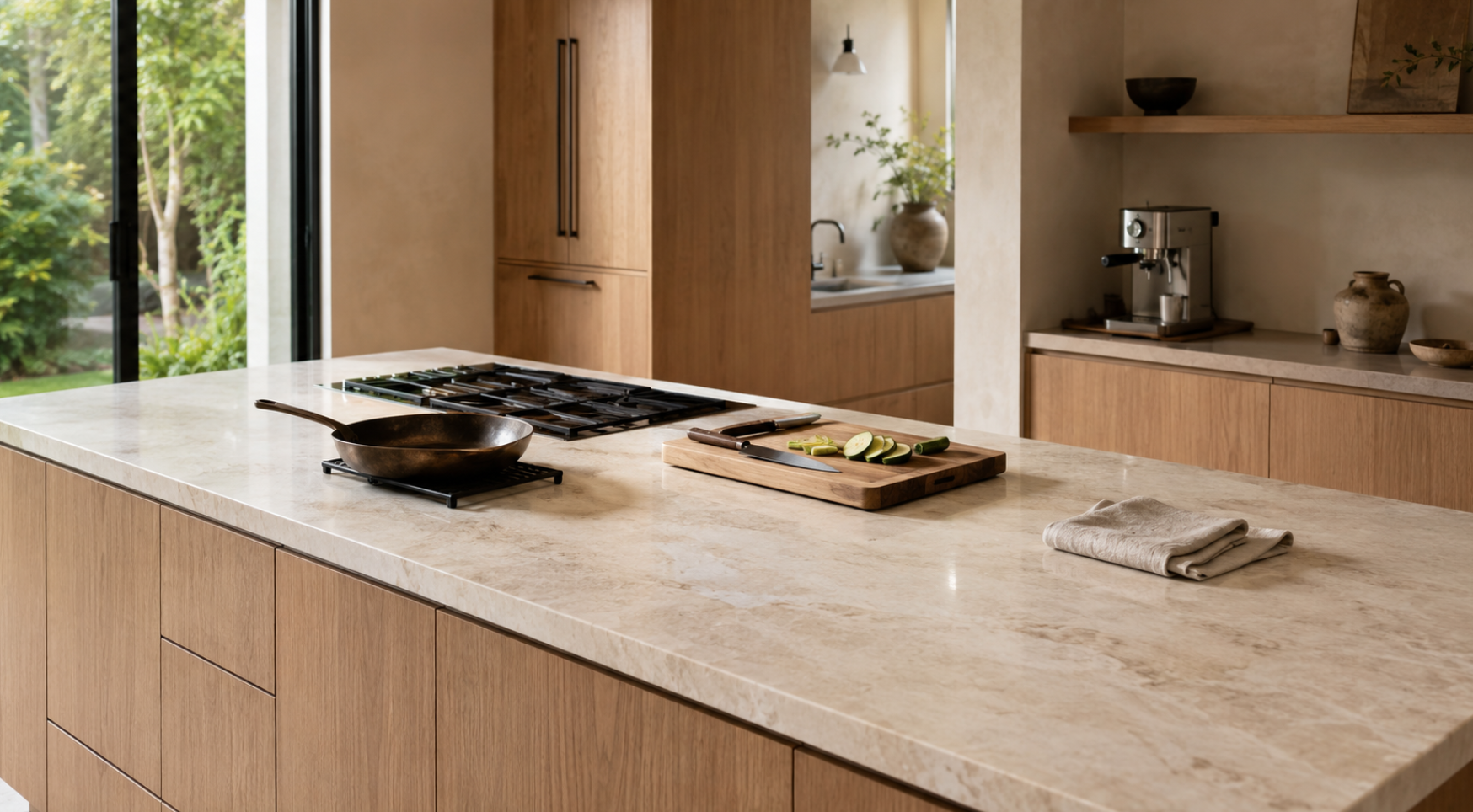
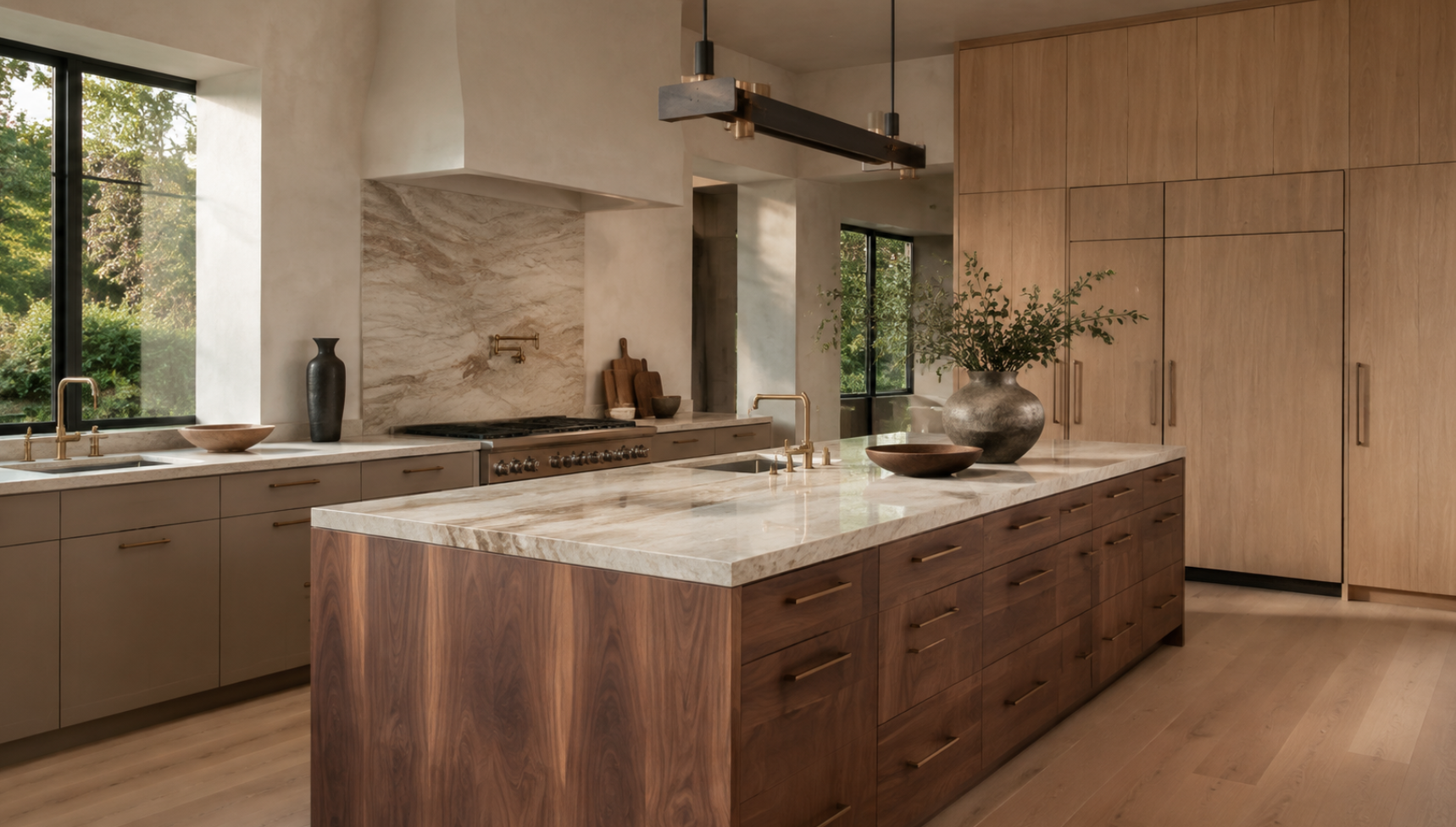
Because both materials contain natural variation, but they express it differently. White oak introduces grain. Walnut introduces richer color and movement. Quartzite introduces mineral veining.
When carefully selected, they can reinforce each other without matching. A warm quartzite might relate beautifully to rift-cut white oak. A quieter creamy slab can give walnut room to remain the dominant material. A more dramatic stone can provide contrast against very restrained slab-front cabinetry. The balance is more important than the individual materials.
Is Every Quartzite Dramatic?
No. Quartzite varies substantially in appearance. Some slabs are highly expressive, while others are relatively quiet.
Many of the stones that attract designers contain pale backgrounds with soft mineral movement, but quartzite can also contain stronger greens, blues, grays, browns, and other colors depending on the minerals present during formation. This is why the category name alone tells you very little about the visual result. The actual slab matters.
Why Should You See Quartzite in Person?
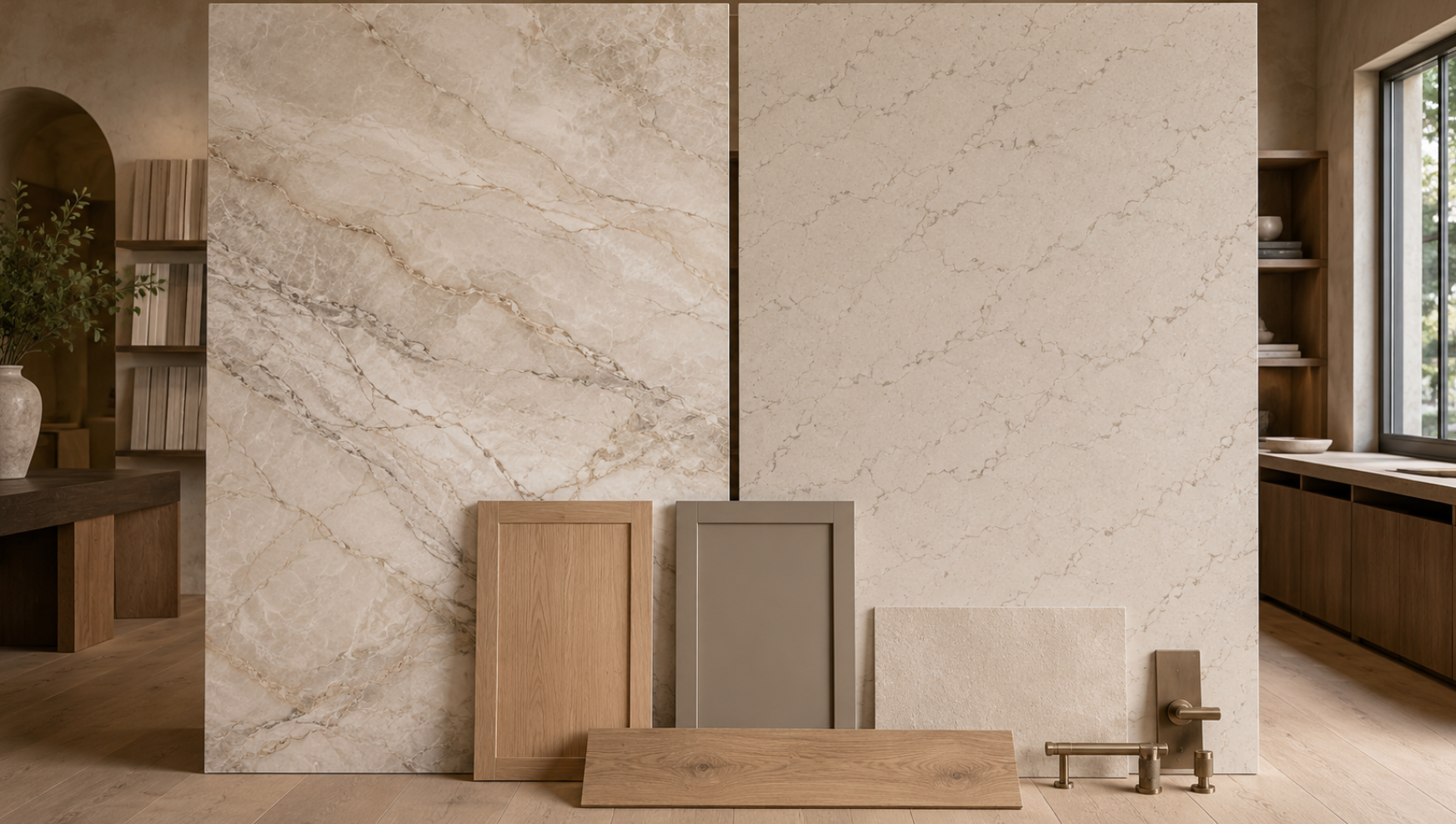
Because a small sample cannot represent a full natural slab. A six-inch piece may show a quiet creamy section, while the full slab may contain a strong diagonal vein several feet away, translucent areas, color concentrations, mineral changes, or fissures.
Those characteristics affect fabrication and the final composition. If quartzite is being considered for a significant kitchen, full-slab viewing should be part of the design process.
What Does Quartz Offer Visually?
Control. Quartz manufacturers can create specific background colors and patterns with greater consistency than naturally quarried stone.
Current premium quartz collections can range from nearly solid surfaces to complex veined designs inspired by natural marble and quartzite. That gives designers another kind of freedom. Instead of searching through natural slabs for the right geological composition, the team can select a designed surface with a known visual direction.
When Is That Consistency Valuable?
In large kitchens, whole-home projects, long perimeter runs, multiple bathrooms, projects where replacement or additional material may be needed, or interiors where another material is already providing considerable movement.
Imagine a kitchen with expressive walnut cabinetry. Perhaps the countertop should be quiet. Quartz can provide a controlled warm surface that supports the wood without introducing another unpredictable pattern. Consistency can be a design feature.
Is Quartzite More Durable Than Quartz?
This question needs more nuance than a simple ranking. Both can perform very well in a residential kitchen. True quartzite is an exceptionally hard natural stone. Quartz is also designed to create a durable countertop surface.
But their vulnerabilities are different. Quartzite is natural stone; its exact porosity, mineral composition, fissures, and other characteristics vary by material. Quartz contains binding resins as part of the engineered slab. Those binders influence how the surface should be treated, particularly around high heat.
So instead of asking only which is “stronger,” ask: What kind of performance matters most to this household?
Is Quartzite Heat Resistant?
Natural quartzite generally handles heat well, but professional stone-care guidance still recommends using trivets or mats on natural stone rather than treating countertops as direct hot-pan surfaces.
That is a good kitchen habit regardless of material. A premium countertop should not need to prove itself by repeatedly receiving cookware directly from a burner or oven.
What About Quartz and Heat?
Quartz deserves more caution around direct heat. Major quartz manufacturers explicitly recommend trivets or hot pads beneath hot cookware and countertop appliances that generate sustained heat. Cambria and Caesarstone both warn that direct or prolonged heat can damage their surfaces.
This matters in appliance planning. Think about:
Air fryers.
Slow cookers.
Electric griddles.
Toaster ovens.
Other countertop appliances that may generate sustained heat.
A trivet is a simple design and use consideration.
Does Quartzite Need to Be Sealed?
Sometimes. But avoid the oversimplified rule that every natural stone requires the same sealing schedule.
The Natural Stone Institute explains that sealing requirements vary by stone and that some natural stones may not require sealing at all. When sealers are used, they act primarily as impregnating repellents that improve stain resistance rather than making stone completely stain-proof.
For quartzite, the appropriate approach should be confirmed with the slab supplier and fabricator. Different stones can behave differently.
Does Quartz Need Sealing?
Premium engineered quartz surfaces are nonporous and do not require sealing. Both Cambria and Caesarstone describe their quartz surfaces as nonporous and designed for low-maintenance everyday care.
That is one of quartz's clearest practical advantages. There is no natural-stone sealing schedule to manage.
Is Quartz More Stain Resistant?
Its nonporous structure gives engineered quartz strong resistance to absorption and staining. Manufacturers such as Cambria specifically identify stain resistance and nonabsorbency as core performance characteristics.
Natural quartzite can also perform very well, especially when the appropriate stone-care recommendations are followed. But because it is natural, performance should be evaluated for the particular slab rather than assumed solely from the category name.
What About Scratching?
True quartzite is extremely hard. Quartz itself is also a very hard mineral, which contributes to the durability of engineered quartz countertops.
Still, neither surface should be treated as a cutting board. Even manufacturers of engineered quartz recommend using a separate cutting surface. Good material care is simpler than repairing an avoidable damaged countertop.
Does Quartzite Etch?
True quartzite is primarily siliceous and generally resistant to common kitchen acids. The Natural Stone Institute notes that siliceous stones are generally resistant to most acids encountered in kitchen settings. Natural-stone specialists also caution that some stones sold commercially as “quartzite” are actually marble or dolomitic marble, which behave very differently around acids.
That distinction is important. If acid sensitivity is a major concern, confirm what the slab actually is. Do not rely only on the marketing name printed on the bundle.
Why Is Quartzite Sometimes Mislabeled?
Commercial stone names do not always correspond precisely to geological classifications. That is one reason designers may hear confusing terms such as “soft quartzite.”
Natural-stone educational resources caution that materials sold under that label may actually be marble or dolomitic marble rather than true quartzite. This is not a minor technical distinction. It changes expectations around hardness and acid resistance.
How Can You Verify a Quartzite?
Work with a knowledgeable stone supplier and fabricator. For important selections, especially when a slab's identity is uncertain, physical testing may also be appropriate.
Natural-stone specialists commonly use hardness and acid-response testing to distinguish true quartzite from softer carbonate stones. A beautiful label is not enough. The material should perform the way the project expects it to perform.
Does Quartz Etch?
Engineered quartz does not behave like marble because it is not a calcium-carbonate natural stone. But that does not mean it is impervious to every chemical.
Quartz manufacturers caution against strong chemicals, aggressive solvents, highly acidic or alkaline cleaners, and abrasive products that can damage or alter the surface. Follow the specific manufacturer's care instructions. “Low maintenance” should not be interpreted as “indestructible.”
Which Surface Is Easier to Maintain?
Quartz generally wins on simplicity. It is nonporous, does not require sealing, and routine cleaning is typically straightforward. For example, Cambria recommends warm water, a soft cloth, and mild soap when needed.
Quartzite may require more awareness of the particular stone, sealing recommendations, and natural characteristics. That does not make quartzite high maintenance in every case. It simply means the material is less standardized.
Is Maintenance Enough Reason to Choose Quartz?
For some households, yes. Consider a kitchen used heavily every day: young children, frequent entertaining, constant food preparation, and clients who do not want to think about natural-stone maintenance. Quartz may provide valuable peace of mind.
A material does not have to be natural to belong in a sophisticated kitchen. Performance can be part of luxury.
When Might Quartzite Be Worth the Additional Care?
When the natural slab is fundamental to the design. There are quartzites whose depth, mineral movement, translucency, and variation cannot be replicated exactly by an engineered pattern.
If that material transforms the room, some clients will happily accept the additional considerations that come with natural stone. The important thing is setting expectations before installation, not after.
How Does Slab Consistency Differ?
Quartzite varies naturally. Quartz is manufactured for greater consistency. That distinction has major design implications.
Imagine a large kitchen requiring:
Two island slabs.
Long perimeter countertops.
Full-height backsplash.
A pantry.
A bar.
With quartzite, the designer needs to understand how multiple slabs relate. Are they from the same block? Do their colors coordinate? Can adjacent veins be composed successfully? With quartz, achieving broad visual consistency is typically more predictable.
Which Material Is Better for a Dramatic Island?
Either, but they create drama differently.
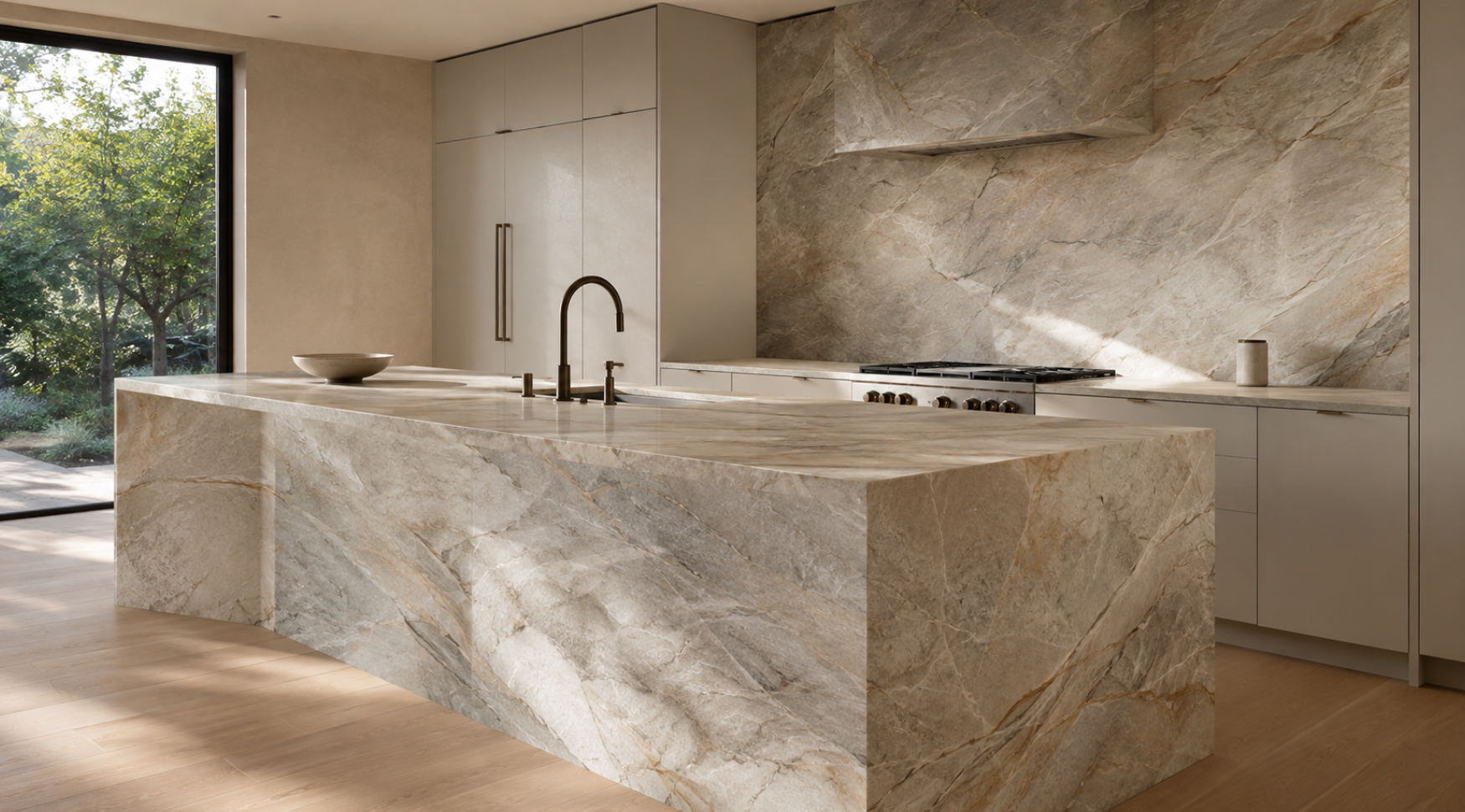
Quartzite provides natural unpredictability. The slab itself becomes an object. One extraordinary vein may determine where the sink goes; another may determine which section becomes the waterfall edge.
Quartz creates a more designed form of drama. The pattern has been intentionally developed by the manufacturer. That can make the result easier to anticipate. The choice depends on whether the project wants geological individuality or controlled expression.
What About Waterfall Islands?
Both materials can be used to create waterfall ends when the selected product and fabrication conditions allow it. But waterfall design should consider pattern continuity.
With natural quartzite, the fabricator may need to carefully plan how the stone is cut so major veins transition from horizontal to vertical surfaces. With quartz, pattern consistency may make planning more predictable, but strong veined designs still require thoughtful layout. A waterfall should feel intentional, not simply like additional stone.
Which Material Works Better for a Full-Height Backsplash?
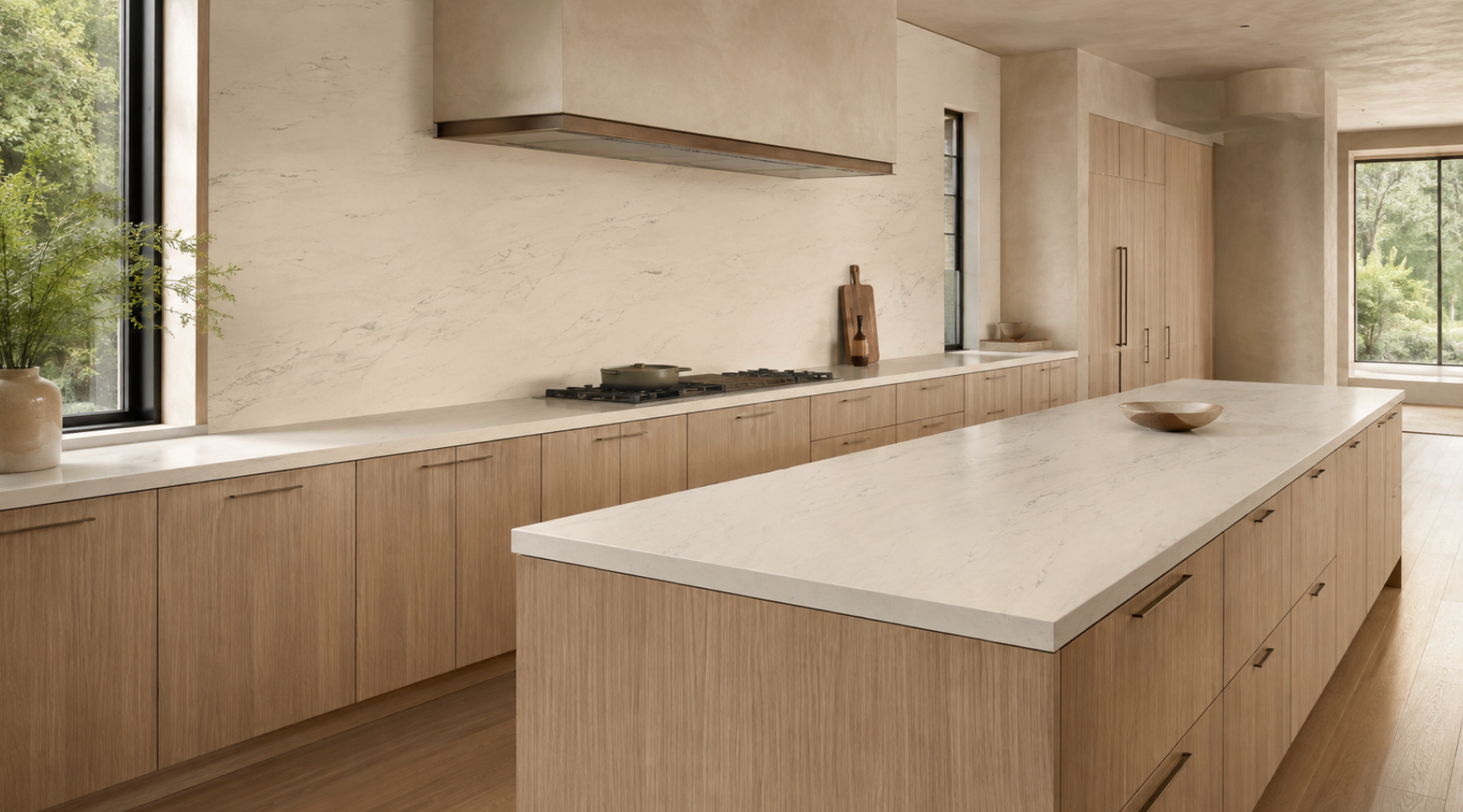
Again, either can work. Quartzite can create extraordinary natural wall surfaces, especially behind a range. But because more slab area becomes visible, vein placement becomes critical.
Quartz can provide a quieter or more controlled result across a large vertical surface. The backsplash decision should be made alongside the cabinetry elevation, not after countertop fabrication.
How Do Seams Affect the Decision?
Every large project has fabrication realities. Slab size, island dimensions, access to the site, pattern, and countertop layout all influence seams.
A heavily veined quartzite may make seam positioning more visually important. A very consistent quartz pattern may be easier to coordinate, although engineered slabs still have dimensions and seam requirements. Ask the fabricator to review the design early, especially for oversized islands.
Is One Material Better for Very Large Islands?
Not categorically. Large islands need to be evaluated based on:
Available slab dimensions.
Required seams.
Structural conditions.
Fabrication.
Edge design.
Sink and cooktop cutouts.
Site access.
The actual material.
This should be resolved with the fabricator rather than relying on generic quartz-versus-quartzite assumptions.
How Do Quartzite and Quartz Pair Differently With Cabinetry?
Quartzite usually introduces more natural variation. That often means the cabinetry should be edited in response. A highly figured quartzite might pair with:
Quiet painted cabinetry.
Restrained white oak.
Simple walnut.
Minimal hardware.
A quiet quartz surface gives the cabinetry more freedom to lead. That can work well with:
Expressive walnut.
Strong custom paint.
Detailed inset cabinetry.
Multiple cabinet finishes.
The surface and cabinetry should share visual responsibility intentionally.
What Works With White Oak Cabinets?
Both materials.
With quartzite, look for undertones that complement the exact oak finish: cream, taupe, warm gray, soft mineral green, or other related natural tones can work beautifully.
With quartz, designers can often select a highly controlled warm-white or subtle-veined surface when they want the oak grain to remain the strongest element. The choice depends on hierarchy.
What Works With Walnut Cabinets?
Walnut already has depth. A quiet quartz can create an extremely controlled contemporary pairing. A restrained quartzite can add natural complexity. A dramatic quartzite can also work, but the architecture should provide enough visual space for both materials.
Walnut plus dramatic stone plus complex cabinetry detailing may become too much. Edit.
What Works With Painted Cabinetry?
Painted cabinetry can support either direction. Quiet paint can provide the perfect background for expressive quartzite. Or the cabinet color can become the primary design element while a restrained quartz provides consistency.
Muted greens, warm mushrooms, deep charcoals, and soft taupes each create a different relationship with the surface. The exact samples need to be viewed together.
Should You Choose the Stone Before the Cabinets?
Sometimes. If you find an extraordinary one-of-a-kind quartzite slab early, it may become the anchor for the entire kitchen palette. The cabinetry can then be developed around it.
With quartz, the sequence may be more flexible because the surface is generally more predictable. But there is no universal order. The cabinetry and countertop should become a coordinated specification as early as possible.
What About Cost?
Neither quartz nor quartzite belongs to one fixed price category. Pricing varies according to:
Material.
Brand.
Slab.
Pattern.
Availability.
Thickness.
Fabrication complexity.
Edge profile.
Cutouts.
Seams.
Installation.
Quartzite fabrication can also be demanding because true quartzite is extremely hard, and natural-stone specialists note that this hardness can increase tooling wear and fabrication effort. Do not assume quartz is always inexpensive, and do not assume every quartzite is automatically more expensive. Price the actual specification.
Is Quartzite Automatically More Luxurious Because It Is Natural?
No. Material origin does not determine design quality. An extraordinary quartzite slab used without regard to pattern placement can look unresolved. A refined quartz surface integrated beautifully with cabinetry can look exceptional.
Luxury comes from:
Material quality.
Proportion.
Fabrication.
Detail.
Restraint.
Coordination.
The material should serve the architecture.
Is Quartz Too Uniform for a Luxury Kitchen?
Not necessarily. Predictability can be exactly what a sophisticated interior needs.
Imagine a kitchen with rich walnut, hand-finished plaster, beautiful bronze, natural oak floors, and sculptural lighting. Adding another highly expressive natural material may not improve the room. A quiet engineered quartz can create visual rest. Understatement can be deliberate.
How Should Sustainability Affect the Decision?
This is a more complicated question than simply labeling one material natural and the other manufactured.
Natural stone involves quarrying, transport, fabrication, and installation. Quartz surfaces involve mineral extraction as well as manufacturing, binders, pigments, fabrication, and transportation. Specific environmental performance also varies significantly by quarry, manufacturer, product, sourcing location, and certification.
If sustainability is a major project priority, compare specific products rather than assuming one entire material category is automatically superior.
What Should You Know About Fabrication Before Choosing?
Bring the fabricator into the conversation early, especially when the project includes:
Large islands.
Waterfalls.
Full-height backsplash.
Integrated sinks.
Unusual edge details.
Complex veins.
Bookmatching.
Multiple slab areas.
Quartzite requires understanding the actual natural slabs. Quartz requires understanding the manufacturer's pattern, slab dimensions, and fabrication requirements. Beautiful material can still be compromised by poor planning.
Why Does Slab Layout Matter So Much With Quartzite?
Because the stone contains an existing composition. Fabrication effectively crops that composition.
The designer and fabricator decide which parts become:
The island.
The backsplash.
The perimeter.
The waterfall.
A major vein can be celebrated or accidentally cut apart. This is where natural-stone design moves beyond selecting a slab. The slab must be composed within the architecture.
What Should You Ask Before Choosing Quartzite?
Start with the actual slab:
Is it confirmed as true quartzite?
How much variation exists?
How porous is this particular stone?
Does the supplier or fabricator recommend sealing?
Are there fissures or mineral characteristics that need discussion?
How many slabs does the project require?
Can they be selected from the same lot or block?
Where should major veins appear?
How will seams be handled?
The answers belong to the individual material.
What Should You Ask Before Choosing Quartz?
Start with the manufacturer:
What is the exact product?
What does the full slab look like?
How consistent is the pattern?
What slab sizes and thicknesses are available?
What are the heat precautions?
What cleaning products are permitted?
What warranty applies?
How should the pattern be laid out at seams and waterfalls?
Even an engineered material should be evaluated as a specific product.
Should You Look at Full Quartz Slabs Too?
Yes. Consistency does not mean a small sample tells the whole story.
Cambria itself recommends viewing full-size slabs because a small sample cannot show all of the design characteristics present in the final slab. This becomes especially important with modern quartz patterns designed to contain broad, dramatic veining.
Small samples are for editing. Full slabs are for final understanding.
Which Is Better for a Busy Family Kitchen?
Quartz may have an advantage when the client prioritizes very straightforward care and no sealing. Its nonporous construction is specifically designed around that convenience.
But a properly selected quartzite can also function beautifully in an active kitchen. The difference is expectation. A homeowner who loves natural stone and accepts its characteristics may prefer quartzite. A homeowner who values maximum predictability may prefer quartz.
Which Is Better for a Showpiece Kitchen?
Either. A showpiece kitchen does not need the most dramatic material available. It needs the most appropriate material.
Quartzite can create a singular natural focal point. Quartz can support exceptionally precise, quiet architecture. One expresses geology; the other offers design control. Both can belong in sophisticated residential work.
Can You Use Quartz and Quartzite in the Same Kitchen?
Yes, and sometimes the combination makes sense.
For example:
Quartzite on the island.
Quartz around the perimeter.
The quartzite becomes the material statement. The quartz provides an easier-to-coordinate secondary surface. Or quartz may appear in a working pantry while quartzite defines the main kitchen. The key is creating hierarchy rather than making the two surfaces compete.
Can They Be Used Across the Same Residence?
Absolutely. A natural quartzite may define the kitchen. Quartz may be used in laundry or utility areas. Another quartzite could appear on a primary bathroom vanity. A consistent quartz surface could extend through secondary bathrooms.
Whole-home material planning does not require every surface to be identical. It requires the finishes to feel related.
Quartzite vs. Quartz: Which Surface Is Right for Your Kitchen?
Choose quartzite when natural material, individual slab character, mineral movement, and geological variation are central to the design. It is particularly compelling when the countertop or backsplash is intended to become one of the defining architectural materials in the room.
Choose quartz when predictable appearance, nonporous performance, no sealing, and straightforward maintenance are priorities. Premium quartz can also provide a quieter visual surface when cabinetry, wood, or other materials already carry the room.
For many projects, the answer becomes obvious only after the surfaces are placed beside the actual cabinetry. That is the most useful comparison, not quartzite versus quartz in isolation, but:
This quartzite with this white oak.
This quartz with this walnut.
This slab against this paint.
This pattern within this elevation.
This surface in this light.
The strongest kitchen material decisions are specific. Because the right surface is not simply the one with the best list of properties; it is the one that performs appropriately while completing the architecture.
Compare Quartzite and Quartz With Atelier Design Society
Atelier Design Society works with homeowners, architects, interior designers, builders, and other design professionals developing premium cabinetry and surface palettes for Bay Area kitchens.
At the Atelier Design Society showroom in Menlo Park, project teams can evaluate cabinetry materials, natural woods, painted finishes, hardware, and countertop directions together while considering how quartzite or quartz will affect the larger kitchen composition.
Bring cabinetry samples, stone references, flooring, paint or plaster, hardware, architectural drawings, and full-slab photographs when available.
The decision becomes much clearer when every material is evaluated as part of the same room.