Marble vs. Quartzite: Understanding the Difference Before You Specify
Marble and quartzite are often considered for the same projects. Both are natural stones. Both can have extraordinary veining. Both can become the defining material in a kitchen. And in some slabs, the visual similarities are strong enough that a client could easily assume they will perform the same way. They do not.
The most important difference is geological. Marble is generally a calcium-carbonate-based metamorphic stone. Quartzite is a silica-rich metamorphic stone formed primarily from quartz-rich sandstone. That distinction affects how each material responds to acids, abrasion, maintenance, and everyday kitchen use. The Natural Stone Institute specifically notes that calcite-based marble is vulnerable to mild acids commonly encountered in kitchens, while siliceous stones are generally more resistant to those acids.
For designers, that means marble versus quartzite should not be reduced to a question of appearance. It is a specification decision. The client needs to understand how the material will age. The fabricator needs to understand exactly what stone is being used. The designer needs to determine whether patina is acceptable. And the material needs to support the way the kitchen will actually function. Sometimes marble is the right answer precisely because of the way it changes. Sometimes quartzite gives a project similar natural depth with a different performance profile. The important thing is knowing the difference before the slab is approved.
Why Are Marble and Quartzite So Often Confused?
Because natural stone names can be complicated. A pale quartzite with sweeping gray veins can resemble marble. A heavily veined marble can have the visual drama many homeowners associate with quartzite. Some commercial stone names can also create confusion because the name used in a showroom does not always explain the stone's geological composition.
That matters because geology determines performance more reliably than appearance. A stone may look like marble and behave like quartzite. Another may be marketed with a quartzite-style name while behaving more like a carbonate stone. The specification should go beyond the label attached to the slab.
What Is Marble?
Marble is a metamorphic stone formed when limestone undergoes heat and pressure. Its mineral composition typically includes significant amounts of calcite or dolomite.
That composition creates many of marble's visual characteristics:
Soft veining.
Cloud-like movement.
Translucency.
Fine crystalline structure.
Color variation created by mineral impurities.
It is also responsible for one of marble's defining performance characteristics: Acid sensitivity. The Natural Stone Institute explains that calcite is vulnerable to mild acids, including substances commonly found in kitchens and bars.
That includes everyday ingredients such as:
Lemon juice.
Vinegar.
Tomatoes.
Wine.
Other acidic foods and liquids.
This does not automatically eliminate marble from a kitchen. It means the client needs to understand what using marble actually involves.
What Is Quartzite?
Quartzite is also metamorphic. But it begins primarily as quartz-rich sandstone rather than limestone. Under intense heat and pressure, the sandstone recrystallizes into a dense stone composed largely of quartz.
That mineral composition gives true quartzite a different performance profile from marble. Quartz is extremely hard. And because quartzite is siliceous rather than calcium-carbonate based, it is generally much more resistant to common kitchen acids than marble. The Natural Stone Institute classifies siliceous stones as generally resistant to most acids encountered in kitchen environments. That is one of the most important technical differences between the two materials.
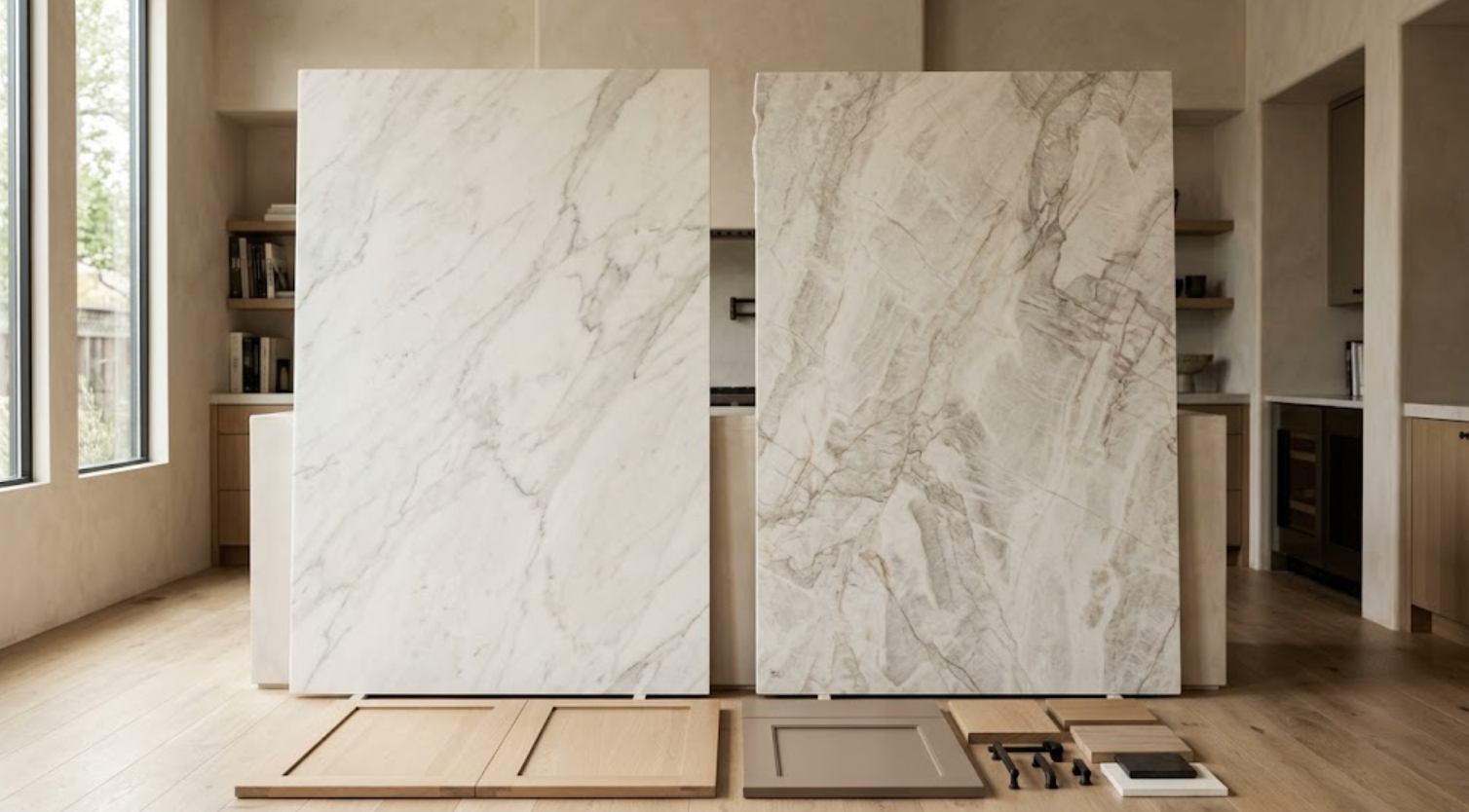
What Is the Biggest Practical Difference Between Marble and Quartzite?
Acid sensitivity. True marble will react with common household acids. The acid reacts with the calcium carbonate in the stone and alters the surface finish. This is called etching.
An etch mark is not the same thing as a stain. A stain involves material being absorbed into the stone. An etch is a physical change to the surface caused by a chemical reaction. The Natural Stone Institute notes that acidic substances can dull or etch calcium-carbonate-based stones, and that sealing does not eliminate this vulnerability. That distinction needs to be explained clearly before marble is specified for a working kitchen.
What Does Marble Etching Actually Look Like?
It depends on the finish and the stone. On polished marble, an etch may appear as:
A dull spot.
A lighter area.
A change in reflectivity.
A visible ring.
On honed marble, the effect may be less immediately obvious because the surface is already matte. But etching can still occur. The important point is that this is not simply dirt that can be wiped away. The stone surface itself has changed. Restoration or refinishing may be required if the client wants the original appearance restored.
Does Sealing Prevent Marble From Etching?
No. This is one of the most important misconceptions to correct.
Sealers are primarily used to improve resistance to absorption and staining. They do not make marble resistant to acid. The Natural Stone Institute explicitly explains that impregnating sealers make stone more stain resistant, not stain proof, and its countertop guidance notes that sealing does not eliminate marble's vulnerability to acidic attack. A sealed marble countertop can still etch from lemon juice. That is chemistry, not a sealing failure.
Does Quartzite Etch?
True quartzite should be far more acid resistant than marble. The Natural Stone Institute has specifically published technical guidance addressing the issue of stones sold as quartzite that etch, including guidance titled “True Quartzite Will Not Etch.”
This is where stone identification becomes important. If a supposed quartzite reacts readily to mild kitchen acids, the material may not actually be true quartzite. It could be marble, dolomitic marble, or another carbonate-rich stone being sold under a commercial quartzite name. That is why designers should not assume performance from the showroom label alone.
Why Does This Matter So Much During Specification?
Because the client may be choosing quartzite specifically to avoid marble's acid sensitivity. If the material has been incorrectly classified, the finished countertop may behave very differently from what the client was promised. That can create a serious expectation problem. If performance is central to the decision, confirm the stone type with a knowledgeable supplier and fabricator before approval.
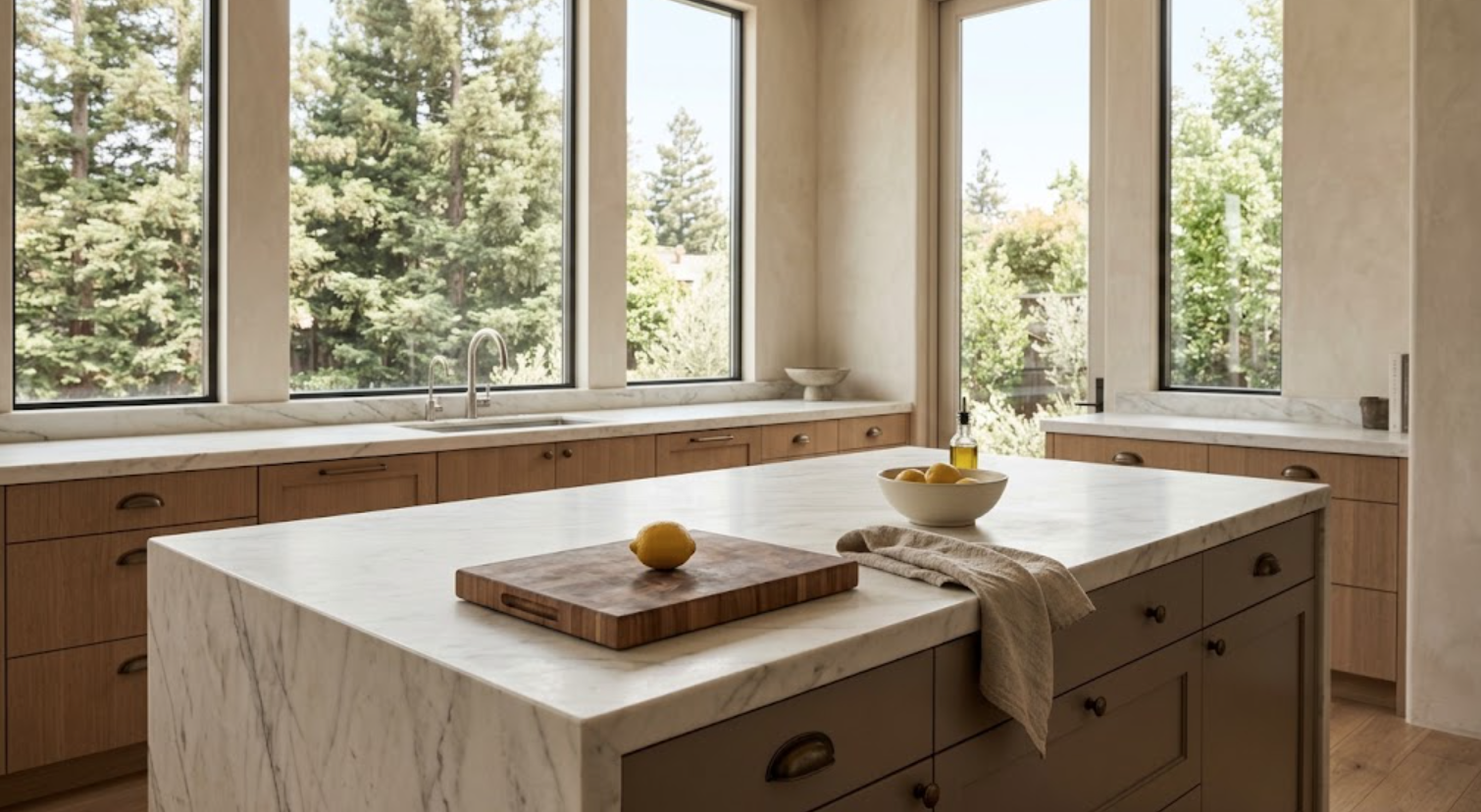
Is Marble Too Delicate for a Kitchen?
Not necessarily. Marble has been used in working kitchens for centuries. But it requires the right client.
Some homeowners expect a countertop to remain visually unchanged. For them, marble may create unnecessary frustration. Others appreciate the way natural material develops evidence of use:
Small etches.
Subtle marks.
Changes in sheen.
A softer patina over time.
For those clients, marble can become more beautiful because it records the life of the room. The material is not inherently inappropriate; the expectation has to be appropriate.
What Kind of Client Is Comfortable With Marble?
Usually someone who sees natural aging as part of the material rather than a defect. They understand that a working surface will change.
They may already appreciate:
Antique wood.
Unlacquered brass.
Natural plaster.
Leather.
Hand-finished materials.
Other surfaces that develop patina.
For that client, marble can feel deeply authentic.
When Is Marble Probably the Wrong Choice?
When the homeowner expects the installed slab to remain visually pristine. If every dull mark will feel like damage, marble may create ongoing dissatisfaction. It may also be less appropriate when the household wants minimal awareness around acidic spills. A busy household can absolutely use marble, but the household needs to understand the tradeoff.
Why Do Designers Still Specify Marble?
Because few natural materials have exactly the same visual character. Marble can have exceptional depth, soft veining, fine crystalline movement, subtle translucency, and a quality of light that can feel difficult to duplicate. Certain varieties have become architectural references precisely because of those characteristics. For some projects, the material is worth accepting on its own terms.
How Is Quartzite Different Visually?
Quartzite can also be extremely expressive, but its visual character often feels more geological. Depending on the material, it may contain:
Long mineral veins.
Layered movement.
Crystalline areas.
Strong directional patterns.
Translucent sections.
Unexpected color.
Quartzite can range from very restrained to extremely dramatic. There is no single quartzite aesthetic.
Can Quartzite Give You the Look of Marble With Better Acid Resistance?
Sometimes. Certain pale quartzites can create the light, elegant, veined character a client associates with marble while providing the acid resistance expected from a true siliceous stone.
But it should not be treated as a direct substitute. Quartzite has its own visual qualities. Its veins may behave differently, its crystalline structure can be more pronounced, and fabrication can be more demanding. And some stones marketed as quartzite may not actually be true quartzite. Specify the material for what it is, not merely because it resembles something else.
Which Material Is Harder?
True quartzite is generally significantly harder than marble because of its high quartz content. That can provide excellent resistance to abrasion. It can also make fabrication more challenging.
Hardness is not automatically an advantage in every part of the process. A very hard stone may require more time, specialized tooling, and greater fabrication expertise. The finished performance and the fabrication process both matter.
Does Harder Mean Indestructible?
No. Natural stone should not be treated as indestructible.
Quartzite can still:
Chip at vulnerable edges.
Contain natural fissures.
Require appropriate support.
Develop damage if fabricated or installed incorrectly.
Be affected by inappropriate chemicals.
The Natural Stone Institute recommends appropriate care for all natural stone and specifically cautions against aggressive acidic or abrasive cleaners, even for siliceous stones. Hardness is one property; it is not immunity from damage.
What About Scratching Marble?
Marble is softer than quartzite. That means abrasion and scratching deserve greater consideration. The Natural Stone Institute's countertop guidance specifically identifies abrasion as a concern with marble, particularly on polished surfaces. That does not mean a marble countertop will immediately become covered in scratches, but it means use habits and finish selection matter.
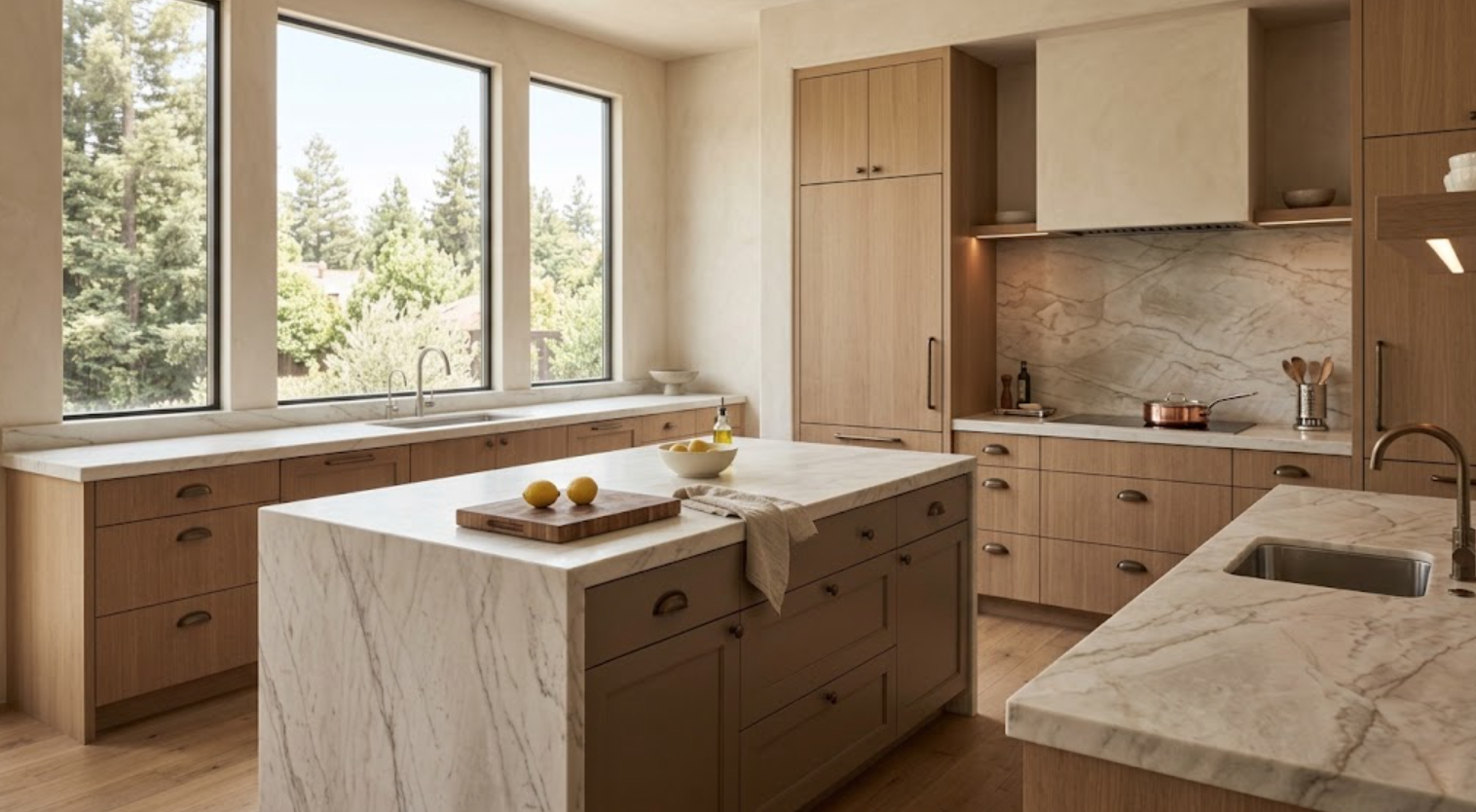
Does Marble Need to Be Sealed?
Often, but the actual recommendation depends on the stone. Natural stone varies in porosity. The Natural Stone Institute notes that some stones may not require sealing, while applying an impregnating sealer is common practice for others. The stone supplier and fabricator should advise based on the selected marble.
If a sealer is used, remember what it is doing: it is reducing absorption. It is not preventing etching.
Does Quartzite Need to Be Sealed?
Again, it depends on the particular stone. Some quartzites are very dense. Others may benefit from an impregnating sealer. The correct specification should be based on the actual material rather than a blanket rule for the category. Consult the supplier and fabricator, and do not assume that sealing turns any natural stone into a maintenance-free surface.
What Is the Difference Between Staining and Etching?
This distinction deserves repeating because it affects material expectations.
Staining occurs when a substance penetrates the stone and causes discoloration. Etching occurs when an acid reacts chemically with acid-sensitive minerals and changes the stone's surface.
A sealer can help reduce absorption; it cannot stop a chemical reaction with calcium carbonate. That is why a marble can be beautifully sealed and still develop a dull ring from citrus.
Which Finish Is Better for Marble, Honed or Polished?
There is no universally better finish. But they behave differently visually.
Polished marble reflects more light, and its color and veining may appear richer. However, etches often become more noticeable because they interrupt the reflective finish.
Honed marble is matte. That can make some surface changes visually less dramatic. For clients who want marble in a high-use kitchen, honed finishes are often worth discussing because the eventual patina can feel more integrated. That does not mean honed marble cannot etch—it can. The difference is primarily visual.
What About Leathered or Textured Finishes?
Depending on the stone and fabricator, textured finishes can create another interpretation. They can emphasize mineral character and reduce reflectivity. But texture also affects:
Cleaning.
Edge appearance.
How the stone feels.
How light interacts with the surface.
Finish should be selected with the same care as the stone itself.
What Finish Works Well for Quartzite?
Honed and polished quartzite can both be effective. A polished finish can emphasize crystalline depth and movement. A honed finish can make a dramatic stone feel quieter and more architectural. The exact result depends heavily on the specific quartzite. A finish sample should be evaluated whenever possible rather than assumed from photographs.
How Do Marble and Quartzite Pair Differently With Cabinetry?
Both can work with natural wood and painted cabinetry, but the stone's role may differ. Marble often brings a softer, classical material reference that can work beautifully with:
Painted inset cabinetry.
Walnut.
White oak.
Furniture-like cabinet details.
Contemporary slab fronts.
Quartzite can feel equally appropriate in traditional or contemporary work, but many quartzites have enough mineral movement to become a stronger architectural statement. The individual slab matters more than the category.
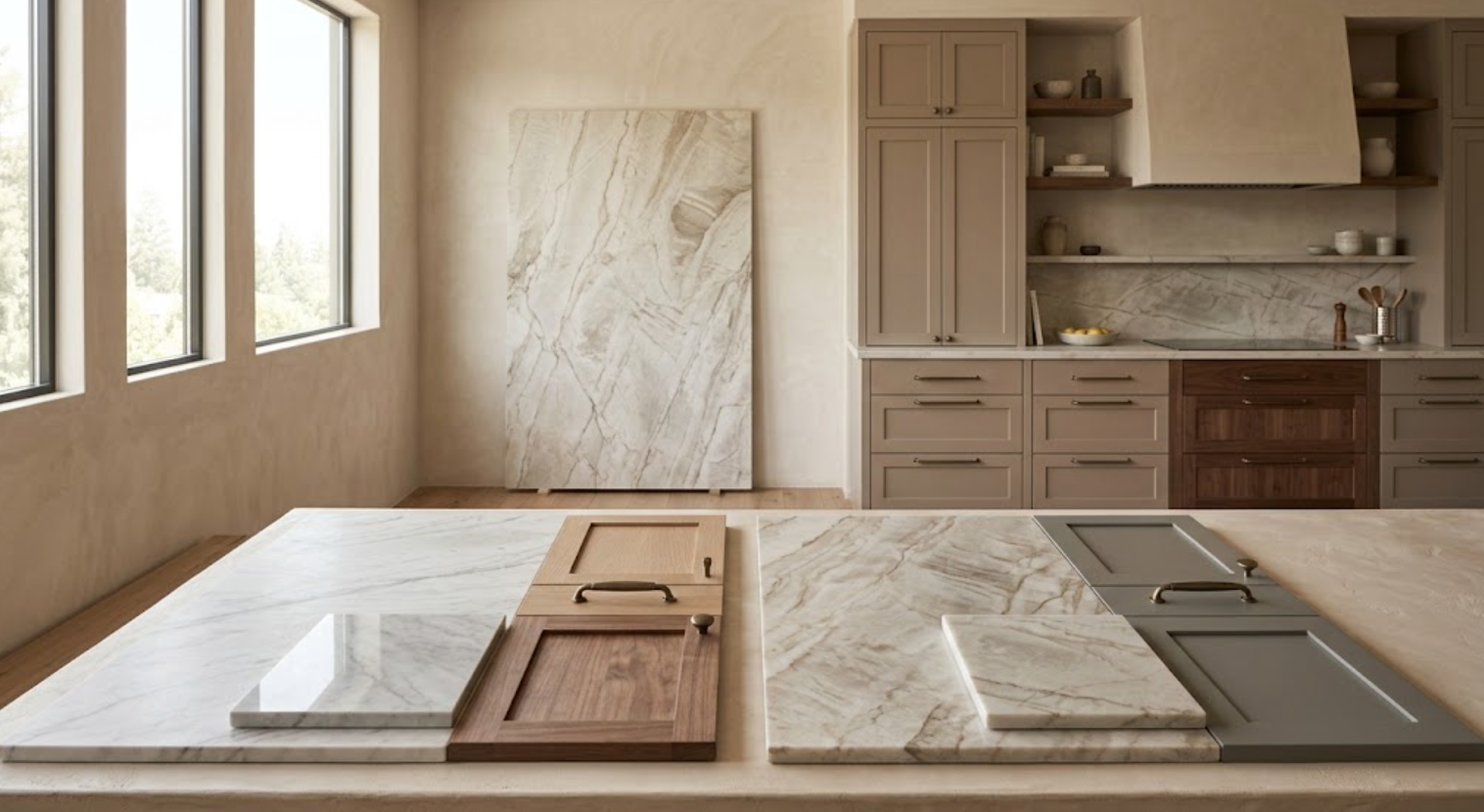
What Works With White Oak Cabinetry?
Both. A creamy marble can create an exceptionally soft relationship with pale oak, feeling quiet, warm, and natural. A pale quartzite can introduce more mineral depth while still relating beautifully to white oak.
Watch the undertones. A very cool gray-veined marble may make warm oak look more yellow. A stone containing cream, taupe, or subtle warmth may create a more integrated palette.
What Works With Walnut Cabinetry?
Walnut already brings considerable visual depth. A softly veined marble can create a classic, sophisticated pairing, providing pale contrast while allowing the wood to remain prominent.
Quartzite can work equally well. A restrained creamy quartzite may support the walnut, while a dramatic quartzite may create a much stronger material composition. If both wood and stone are expressive, keep the surrounding architecture controlled.
What About Painted Cabinetry?
Painted cabinetry gives either stone room to lead:
Warm whites.
Mushroom tones.
Muted greens.
Deep browns.
Charcoals.
All can create different relationships with marble or quartzite. A quiet painted cabinet may be especially effective with a highly figured natural slab because it gives the stone visual space.
Should Marble Always Be Used With Traditional Cabinetry?
No. Marble can be exceptionally effective in modern kitchens. A broad marble island surrounded by clean frameless walnut cabinetry can feel highly contemporary. A single full-height marble backsplash behind minimal slab cabinetry can become an architectural surface. Material history does not dictate aesthetic style; proportion and detailing do.
Can Quartzite Work in a Traditional Kitchen?
Absolutely. Quartzite is not inherently contemporary. Its natural stone character can pair beautifully with inset cabinetry, detailed doors, traditional molding, warm painted finishes, and furniture-like islands. The specific stone and cabinetry determine the expression.
Which Stone Is Better for a Dramatic Island?
Either can be extraordinary. A dramatic marble might create soft sweeping movement and strong architectural elegance. A quartzite may introduce crystalline veins, layered mineral movement, or unusual color.
The more important question is whether the client accepts the performance characteristics associated with that stone. Do not choose marble for its appearance while assuming quartzite behavior, and do not choose quartzite simply because someone says it is “safer” without verifying what the slab actually is.
Why Does Full-Slab Viewing Matter?
Because natural stone is not a repeatable pattern. A small sample may show only one fragment.
The full slab reveals:
Vein direction.
Movement.
Color concentration.
Fissures.
Translucency.
Mineral deposits.
Quiet zones.
Highly active zones.
Those characteristics determine how the slab should be fabricated.
What Should You Look for When Viewing Marble Slabs?
Do not only look for the prettiest section. Study the entire slab:
Where does the movement intensify?
Are there areas you want positioned on the island?
How will the veining relate to seams?
Are there natural characteristics the fabricator needs to discuss?
Are multiple slabs required?
Do they relate well?
The slab needs to become architecture.
What Should You Look for With Quartzite?
The same questions apply, but also pay attention to geological features. Quartzites can contain complex crystalline areas, fissures, and color variation. Ask the supplier and fabricator what is natural to the stone and what may require special fabrication consideration. A visually dramatic slab may require equally thoughtful technical planning.
What About Bookmatching?
Both marble and quartzite may be bookmatched when consecutive slabs allow it. This can create dramatic mirrored compositions on:
Backsplashes.
Feature walls.
Large islands.
Fireplaces.
But natural material is not digitally generated. Bookmatched slabs may create a relationship without producing a perfectly symmetrical computer-like image. The goal should be natural continuity, not artificial perfection.
How Should Vein Direction Relate to Cabinetry?
Intentionally. A strong horizontal vein can reinforce a long island. Vertical movement may emphasize a tall backsplash. Diagonal movement can introduce energy into an otherwise highly ordered cabinet elevation.
Cabinetry provides the grid; stone can either reinforce that geometry or intentionally interrupt it. That relationship should be studied before fabrication.
Should You Use the Same Stone on the Countertop and Backsplash?
Sometimes. Continuing a natural slab vertically can create one of the strongest material moves in the room. This works particularly well behind a range or across a restrained wall.
But more stone is not always better. A highly figured marble or quartzite can become overwhelming when used across every horizontal and vertical surface. Decide where the stone deserves emphasis.
What About Waterfall Edges?
A waterfall can increase the visual importance of the stone. That may be desirable when the island is intended to read as a monolithic object.
But it also conceals cabinetry. If the island has beautiful walnut end panels or furniture-like detailing, allowing the cabinetry to remain visible may produce a stronger result. Do not automatically waterfall an expensive slab simply because it is available.
Which Material Is Easier to Fabricate?
This depends on the specific stone and detail, but quartzite's hardness can make fabrication more demanding. Marble is softer and generally easier to cut, but that softness also requires careful handling to avoid scratching or edge damage.
Complex projects should involve the fabricator early, especially when the design includes:
Oversized islands.
Thin-looking edges.
Integrated sinks.
Waterfalls.
Detailed miters.
Bookmatched slabs.
Large backsplash panels.
Material selection and fabrication are inseparable.
Does Heat Affect Marble and Quartzite?
Natural stone generally tolerates heat well, but the Natural Stone Institute still recommends using trivets or mats on stone surfaces. That is good practice for both marble and quartzite. The question should not be how much abuse a luxury surface can survive; the goal should be to preserve it through sensible everyday use.
What About Cleaning?
For natural stone, use appropriate neutral cleaning products. The Natural Stone Institute recommends neutral stone cleaner, stone soap, or mild liquid dishwashing detergent and warm water for general care, while cautioning against acidic cleaners and abrasive products.
That advice becomes especially important with marble: vinegar should not be used as a marble cleaner, nor should lemon-based acidic cleaning products.
Is Quartzite Lower Maintenance Than Marble?
From the standpoint of acid sensitivity, true quartzite generally provides an advantage. But “lower maintenance” should not become “no maintenance.”
The stone may still require:
Appropriate cleaning.
Sealing if recommended.
Care around edges.
Proper fabrication.
Attention to spills.
The exact care requirements depend on the individual slab.
Can Marble Be Refinished?
Often, yes. Professional stone restorers can address many scratches, etches, and changes in finish through honing, polishing, or refinishing depending on the stone and severity of the issue. The Natural Stone Institute recommends professional restoration for deeper scratches and etched areas requiring refinishing. This is worth discussing with clients: marble changes, but it is also a material that can often be restored.
Does Patina Have to Be a Negative?
No. This is ultimately a design philosophy. Some people view any change as damage. Others see use as part of the material.
An old marble table with subtle wear can have extraordinary character. A hotel bar with years of soft etching can feel richer because of it. A residential kitchen can develop similar depth. But patina should be chosen, not discovered unexpectedly after installation.
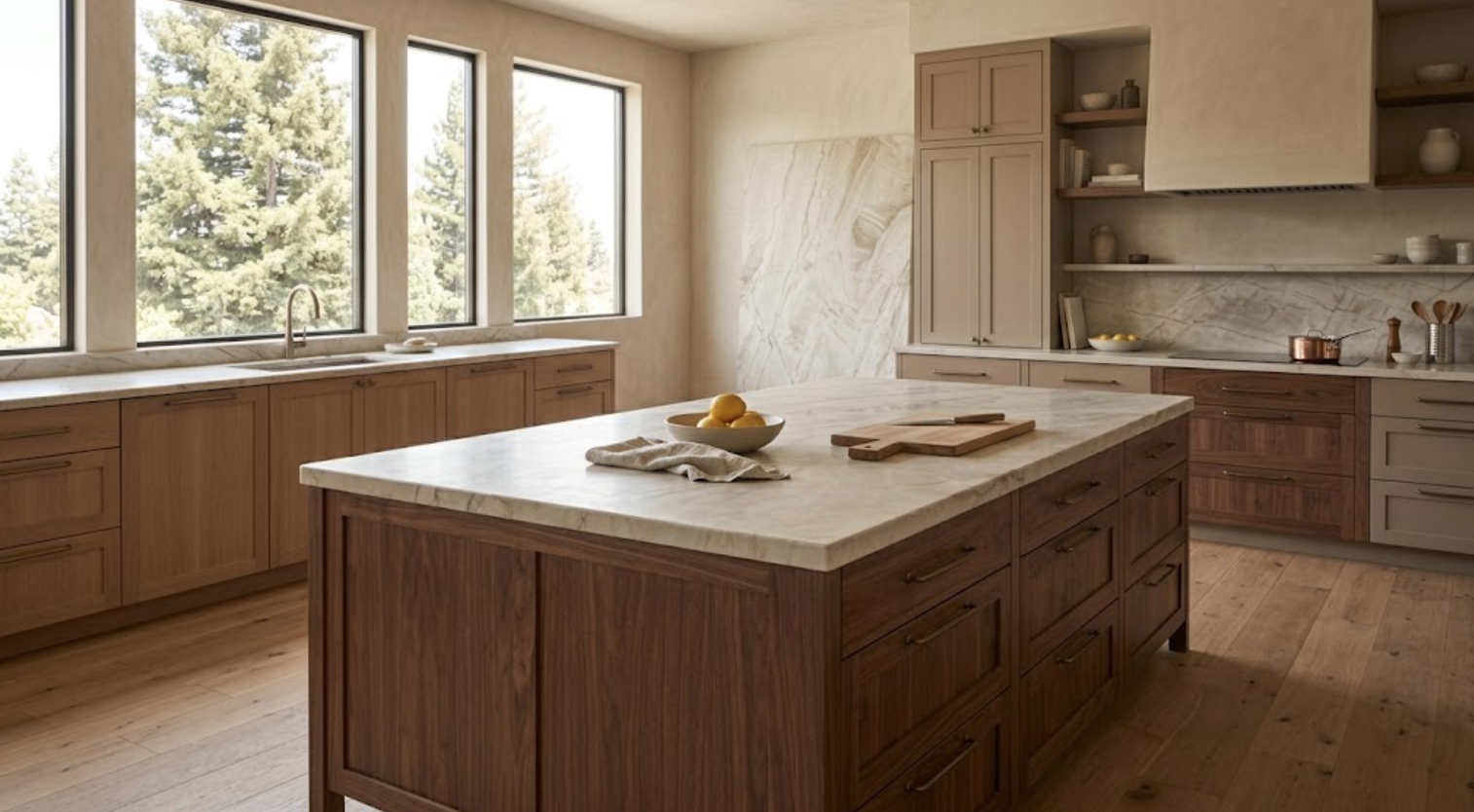
Can Marble and Quartzite Be Used in the Same Kitchen?
Yes. And the difference in performance can actually inform where each material goes.
For example:
Marble on a furniture-like island used primarily for serving and gathering.
Quartzite on a heavily used preparation perimeter.
Or quartzite on the main kitchen work surfaces with marble reserved for a bar or decorative area.
This strategy is not necessary for every kitchen, but it demonstrates an important principle: materials can be assigned according to use rather than forcing one surface to solve every condition.
Should You Use Marble in a Butler's Pantry Instead?
That depends on how the pantry is used. A heavily used prep pantry may expose marble to even more acidic ingredients than the main kitchen. A bar may involve citrus and wine. So calling a space “secondary” does not automatically mean the stone is protected. Look at actual routines.
What About Marble on a Baking Counter?
This is a classic application because marble remains naturally cool and provides a smooth work surface. But the same acid and abrasion considerations remain. For someone who bakes frequently and understands the material, a dedicated marble work area can make both functional and aesthetic sense.
Which Stone Is Better for a Bar?
Think carefully about acids:
Wine.
Citrus.
Cocktails.
These create precisely the conditions that can etch marble. A client who loves the patina may still choose it. A client who wants a more acid-resistant natural stone may prefer true quartzite. Use patterns should influence specification.
What About a Bathroom Vanity?
The decision changes. Kitchen acids may be less relevant, but cosmetics and personal-care products can still affect natural stone. Marble is frequently used successfully in bathrooms because its aesthetic can be particularly effective there. Quartzite can also work beautifully. Again, understand the specific stone and the products used around it.
How Does the Rest of the Home Affect the Choice?
Surface selection should be part of the larger material story. Perhaps marble appears in the primary bathroom while quartzite is used in the kitchen. Perhaps one marble is repeated on a fireplace. Perhaps the kitchen quartzite relates to natural stone elsewhere without repeating exactly. A luxury residence does not need one stone everywhere; it needs intentional relationships.
What Should Designers Explain to Clients Before Specifying Marble?
Explain that it can etch.
Explain what etching is.
Explain that sealing does not stop it.
Explain that scratches and surface wear can occur.
Discuss whether honed or polished is more appropriate.
Show examples of marble that has aged.
Discuss maintenance.
And ask the important question: Will changes in the surface bother you? The answer may matter more than the stone's name.
What Should Designers Explain Before Specifying Quartzite?
Explain that it is natural and variable.
Show the full slab.
Discuss fissures and mineral characteristics.
Confirm the geological classification when performance is important.
Discuss sealing recommendations for the specific stone.
Review fabrication conditions.
Explain that high hardness does not mean indestructibility.
The client should understand what they are buying beyond “it is more durable than marble.”
How Can You Tell Whether the Client Is Choosing for the Right Reason?
Ask what they actually love.
If they say, “I love the softness and depth of this marble, and I am comfortable with it aging,” that is a strong reason to specify marble.
If they say, “I love this quartzite and I want a natural stone that is less vulnerable to kitchen acids,” that can also be a strong reason.
If they say, “I want marble but I need it to stay perfect,” there may be a mismatch.
If they say, “I am choosing quartzite because someone told me every quartzite is maintenance-free,” expectations need adjustment.
What Should Be Verified Before Final Approval?
The actual slab, not simply the stone name.
Confirm:
Stone classification.
Finish.
Thickness.
Sealing recommendations.
Fabrication requirements.
Available slabs.
Vein direction.
Slab sequence.
Potential seams.
Edge details.
Sink and cooktop cutouts.
Support conditions.
What Should Be Verified Before Final Approval?
The actual slab. Not simply the stone name.
Confirm:
Stone classification.
Finish.
Thickness.
Sealing recommendations.
Fabrication requirements.
Available slabs.
Vein direction.
Slab sequence.
Potential seams.
Edge details.
Sink and cooktop cutouts.
Support conditions.
Care recommendations.
The more important the stone is to the architecture, the more detailed the approval should become.
Marble vs. Quartzite: Which Should You Specify?
Choose marble when its particular visual character is essential to the project and the client understands and accepts etching, surface wear, and the possibility of developing patina. Marble can be extraordinary precisely because it does not remain untouched.
Choose true quartzite when the project wants natural stone, geological depth, and substantial hardness while also benefiting from greater resistance to ordinary kitchen acids than calcite-based marble.
But do not make the decision from appearance alone. And do not rely solely on the commercial name attached to a slab.
Understand the geology. Understand the finish. Understand the maintenance. Understand the fabrication. Understand how the homeowner actually lives. Then place the stone beside the cabinetry.
Because the final decision is not simply marble versus quartzite.
It is:
This marble.
This quartzite.
This cabinet finish.
This room.
This household.
This expectation of how the material will age.
That is the level at which a natural stone specification should be made.
Compare Natural Stone and Cabinetry With Atelier Design Society
Atelier Design Society works with homeowners, architects, interior designers, builders, and other design professionals developing premium cabinetry and surface palettes for sophisticated Bay Area residences.
At the Atelier Design Society showroom in Menlo Park, project teams can compare natural stone directions alongside cabinetry materials, natural woods, painted finishes, hardware, flooring, and other architectural finishes while determining how each material should perform within the finished space.
Bring full-slab photographs, stone samples, cabinetry selections, flooring, paint or plaster references, hardware, and architectural drawings when available.
Understanding how a stone looks is only the beginning.
The right specification also accounts for how it will perform, how it will age, and whether those characteristics are appropriate for the client.