How to Select a Countertop That Complements White Oak Cabinetry
How to Select a Countertop That Complements White Oak Cabinetry
White oak cabinetry is often described as neutral. That description can be misleading. White oak has color. It has grain. It has warmth. And depending on how the wood is cut and finished, it can shift from pale and quiet to golden, taupe, gray-brown, or considerably richer.
That means there is no universal “best countertop for white oak cabinets.” A creamy quartzite that looks beautiful with one white oak finish may make another appear unexpectedly yellow. A cool white surface can sharpen the architecture in one kitchen and create an uncomfortable temperature contrast in another. A dramatic natural stone can transform restrained rift-cut cabinetry. Or it can compete with wood that already has substantial movement.
Designers therefore approach the pairing as a material relationship. First understand the specific white oak. Then determine what the countertop needs to contribute:
Warmth?
Contrast?
Movement?
Visual quiet?
Color?
Texture?
The strongest countertop is not simply the stone that looks most impressive in the slab gallery. It is the one that allows the white oak cabinetry, countertop, architecture, and surrounding materials to work as one composition.
Start With the Exact White Oak Finish
Before selecting the countertop, look closely at the cabinetry. Not an inspiration photograph. Not a generic piece of oak. The actual finish being specified.
White oak changes substantially according to:
The cut of the wood.
The stain.
The finish system.
The individual boards.
The grain selection.
Even the sheen.
Natural white oak may have a pale beige or wheat-colored appearance. A warm stain can bring forward golden and brown tones. A cooler finish may reduce some of that warmth and move the cabinetry toward taupe. A deeper stain can make the wood feel richer and more architectural. Each version creates a different starting point for the countertop.
Why Does Rift-Cut White Oak Change the Countertop Decision?
Rift-cut white oak is especially popular in contemporary cabinetry because of its straighter, more linear grain. That controlled grain can make large cabinet elevations feel quieter. On slab doors, it can reinforce vertical or horizontal geometry without introducing excessive visual movement.
Because the cabinetry is already providing natural texture, the countertop can take several directions. It can remain quiet and tonal. It can create deliberate contrast. Or it can become the dominant pattern in the kitchen. The right direction depends on what else is happening in the room.
Should the Countertop Match the White Oak?
No. It should relate to it. Trying to match the countertop exactly to the wood often produces a palette with too little depth.
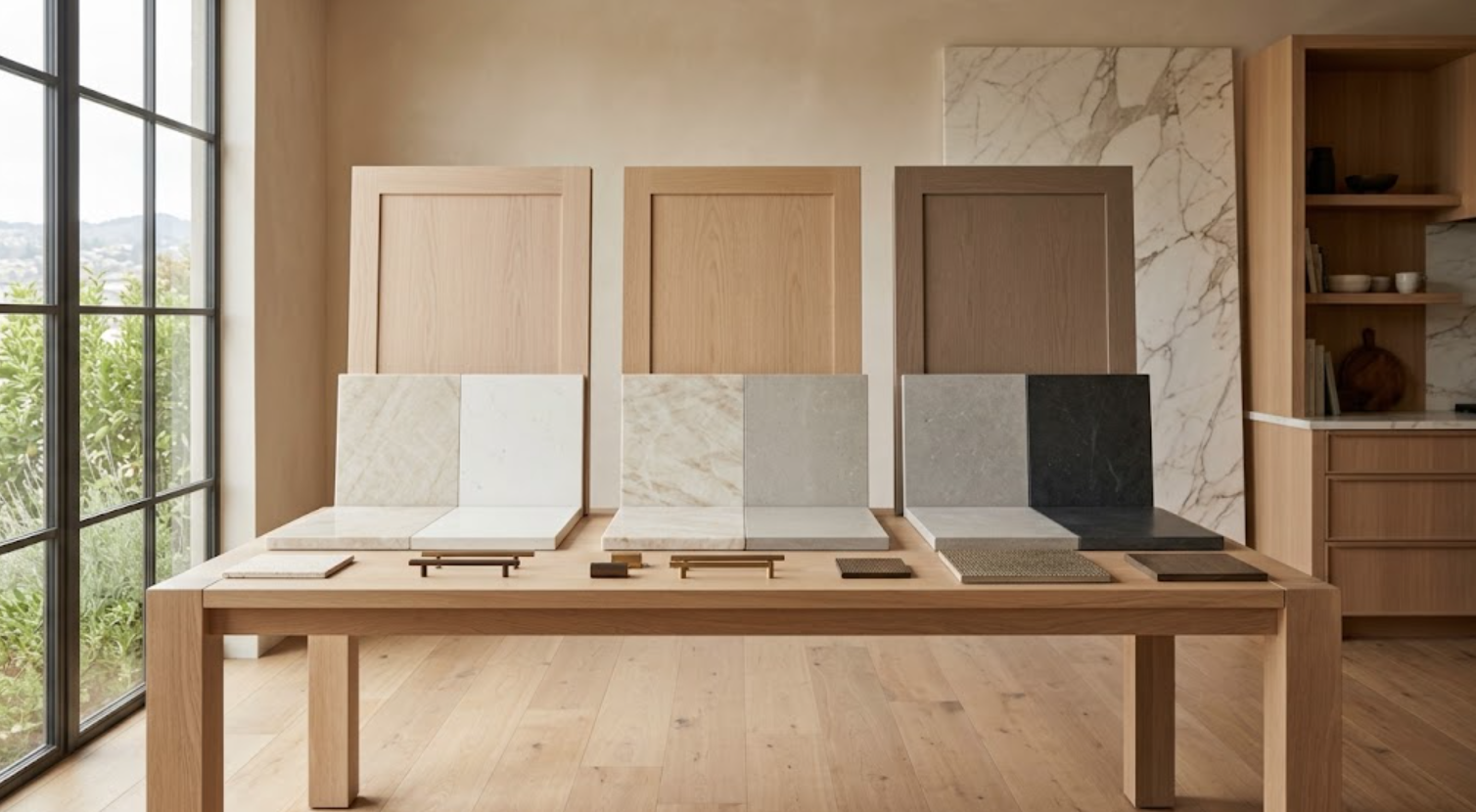
Instead, look for compatible undertones. A warm creamy stone may share some of the warmth of the oak without becoming beige. A pale quartzite might contain soft taupe movement that relates to the grain. A darker stone can create deliberate contrast while still carrying enough warmth to belong beside the wood. Relationship is more useful than matching.
Why Are Undertones So Important With White Oak?
Because white oak reacts strongly to the materials placed around it. A countertop can visually amplify an undertone that seemed insignificant when the cabinet sample was viewed alone.
Place warm oak against a cool blue-white countertop and the wood may suddenly look more yellow. Place the same oak beside a creamy surface and the transition may feel softer. Place it against taupe stone and the brown-gray character of the wood may become more apparent.
This is why color names are not enough:
“White.”
“Cream.”
“Beige.”
“Gray.”
Those categories contain enormous variation. The actual samples need to meet.
What Countertop Colors Usually Work Well With White Oak?
White oak is particularly compatible with nuanced neutrals.
Think:
Cream.
Ivory.
Warm white.
Soft taupe.
Greige.
Warm gray.
Muted brown.
Charcoal.
Certain soft mineral greens.
But these are directions rather than formulas. The exact tone still depends on the cabinet finish. A pale Scandinavian-inspired oak may support a different countertop than a richer stained white oak.
Are Bright White Countertops a Good Choice?
Sometimes. A crisp white countertop can create a sharper contemporary contrast against natural oak. This can work particularly well in minimalist architecture where the design intentionally separates warm wood from clean white planes.
But bright white should be evaluated carefully. If it has a cool or blue undertone, it can exaggerate the yellow or golden characteristics of the wood. The result may feel less integrated than expected. A slightly warmer white often creates a softer transition.
What About Creamy Countertops?
Cream is one of the most natural directions for white oak. It allows the palette to remain light without creating the hard contrast of bright white.
Options include:
Creamy quartzite.
Warm marble.
Limestone.
Warm engineered quartz.
Each can create a different version of that relationship. The challenge is preventing the palette from becoming too uniformly beige. That is where variation in texture, grain, veining, hardware, and value becomes important.
How Do You Keep a White Oak and Cream Kitchen From Feeling Flat?
Do not solve everything with color. Use material differences. White oak has grain. Stone has mineral depth. Plaster has subtle texture. Metal reflects light.
A honed countertop behaves differently from polished stone. A darker bronze or blackened metal can introduce definition. Even within a narrow warm palette, the kitchen can have substantial depth. The design becomes tonal rather than monochromatic.
Which Natural Stones Work Well With White Oak?
There are many possibilities.
Quartzite is one of the most flexible because it is available in a wide range of natural appearances.
Some quartzites have:
Cream backgrounds.
Warm gray movement.
Taupe veins.
Subtle brown mineral deposits.
Soft green-gray coloration.
Other varieties are much more dramatic.
Marble can also create an elegant pairing, particularly when the client understands its sensitivity to acids and the way it may develop patina. Limestone can provide a quieter, more earthy relationship, although its performance characteristics must also be appropriate for the application.
The material category is only the beginning. The individual slab determines the final pairing.
Why Does Creamy Quartzite Work So Well With White Oak?
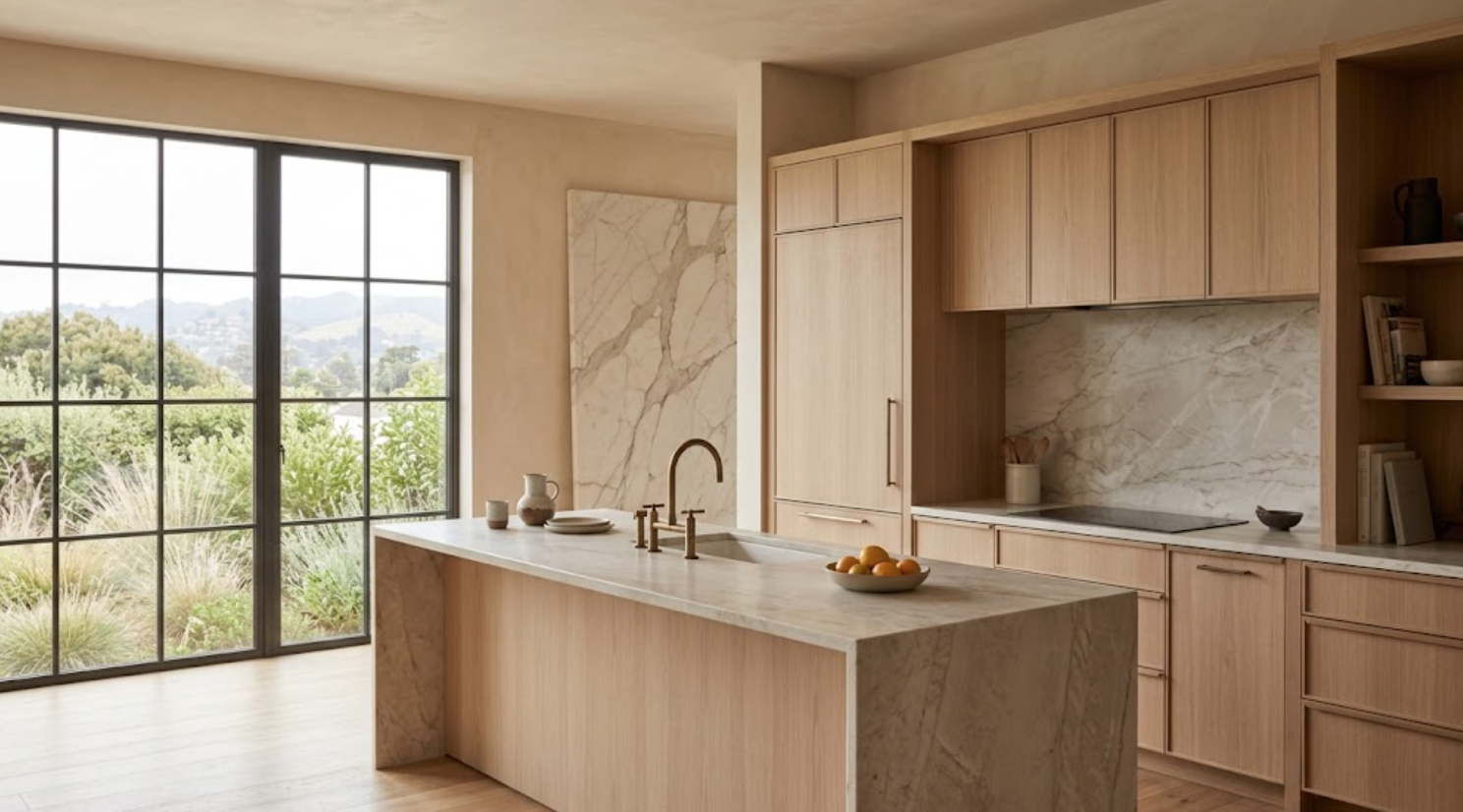
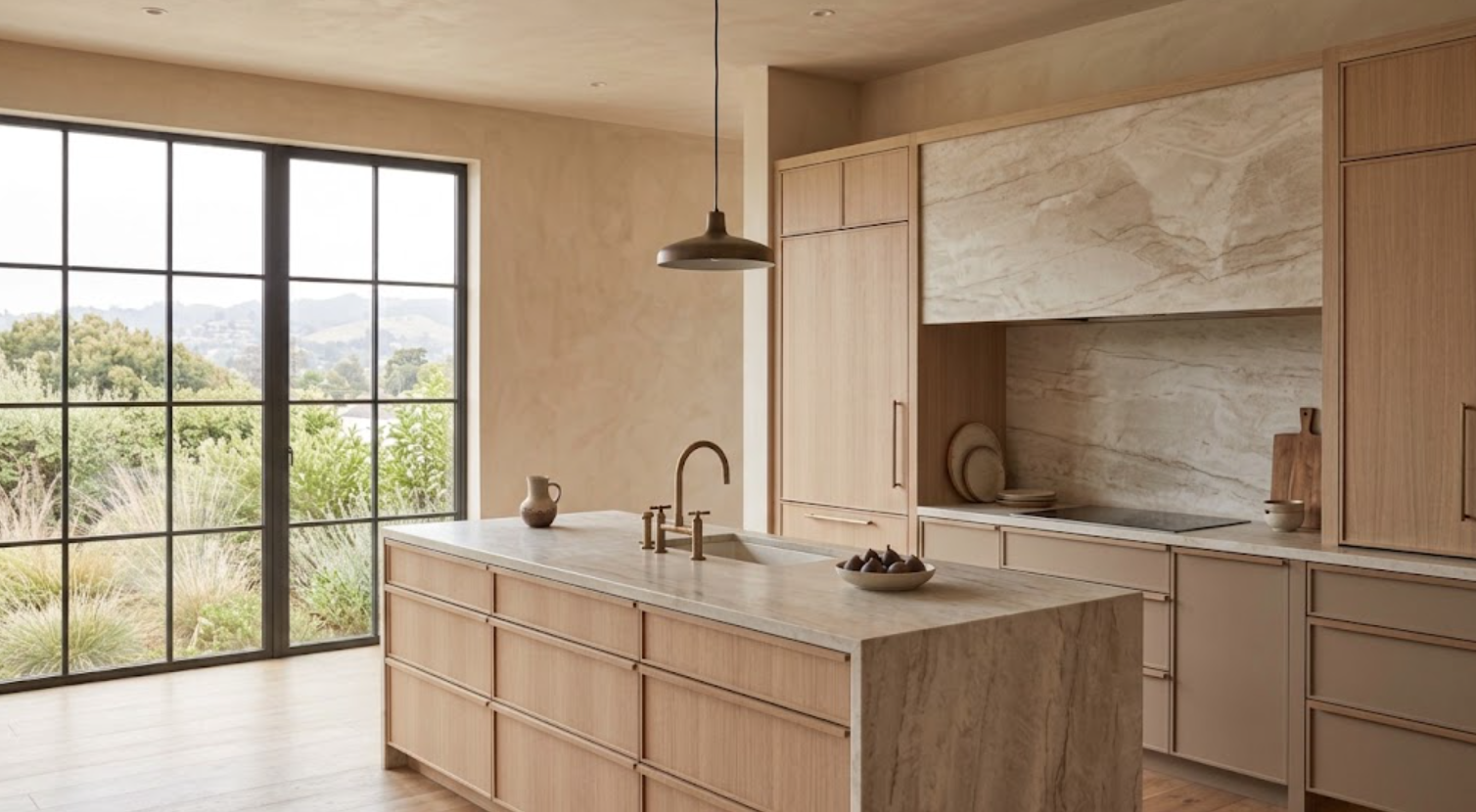
Because the two materials can share warmth without repeating each other. White oak provides linear grain. Quartzite provides mineral movement. The wood feels structured. The stone feels geological. Together, they create contrast through material character rather than extreme color difference.
This is particularly effective in contemporary Bay Area homes where the broader palette may include:
Warm plaster.
Natural flooring.
Bronze.
Large windows.
Soft daylight.
The result can feel quiet without becoming plain.
Should You Choose a Quiet or Dramatic Countertop?
Ask what the cabinetry is already doing. A very restrained rift-cut oak elevation may be able to support a dramatic stone. A more expressive oak with visible grain variation may benefit from a quieter surface.
Then consider the rest of the room:
Does the flooring have movement?
Is there a dramatic plaster treatment?
Are there sculptural light fixtures?
Can the backsplash be seen from several adjoining rooms?
How visually complex is the architecture?
The countertop does not exist alone.
When Should the Countertop Become the Focal Point?
When the architecture gives it room.
Imagine a kitchen with:
Simple white oak slab cabinetry.
Minimal hardware.
Quiet flooring.
Warm plaster.
Few decorative objects.
A dramatic quartzite island can become extraordinary in that setting. The stone creates movement against the disciplined grain of the oak. But the same slab might overwhelm a kitchen already containing several expressive materials. A focal point needs visual space around it.
How Much Veining Is Too Much?
There is no universal amount. Instead, compare the scale of the stone movement to the scale of the cabinetry.
Broad white oak cabinet walls create geometry. Large sweeping stone veins can intentionally interrupt that order. Small busy veining may introduce a different kind of visual texture.
The question is whether the two patterns cooperate. If your eye cannot decide whether to follow the wood grain or the stone pattern, the combination may need editing.
Should Stone Veins Match the Color of the Oak?
Not exactly. A subtle relationship can be useful. A quartzite with warm taupe or soft brown movement may naturally connect to white oak. But selecting a slab because one vein is exactly the same beige as the cabinet can feel overly literal. The stone should have its own identity.
What If You Want a Very Quiet Kitchen?
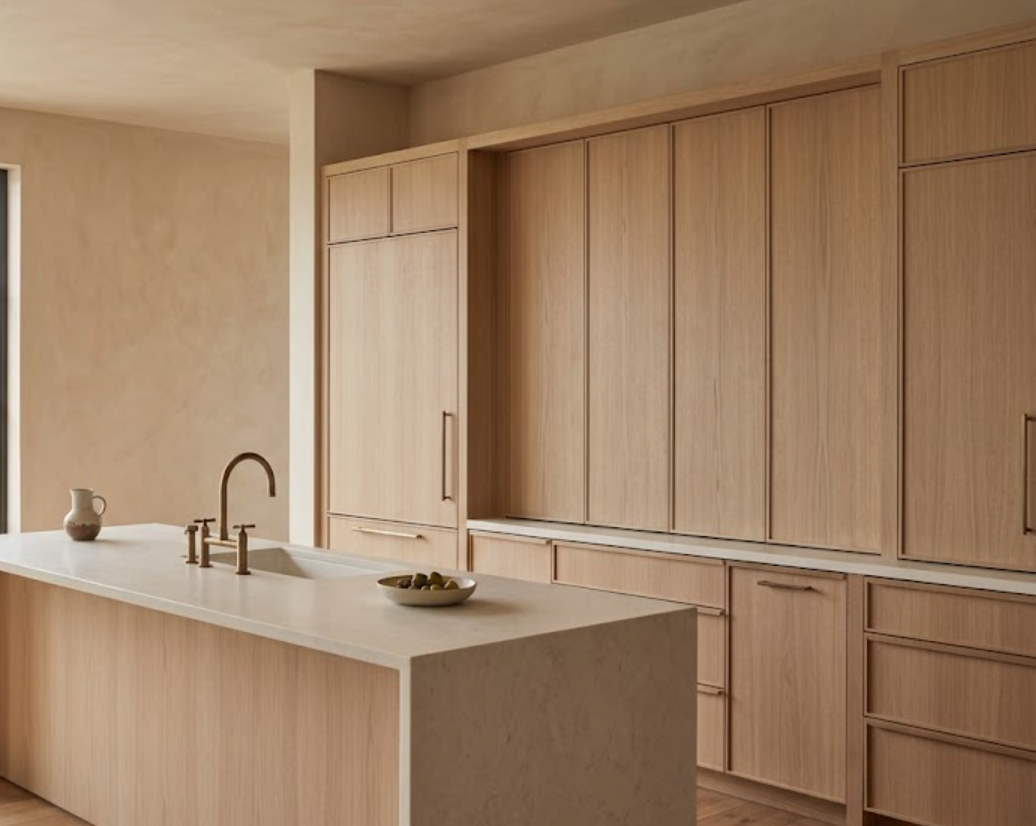
Then consider reducing stone movement. A warm white engineered quartz can allow the cabinetry to carry most of the visual texture. A very quiet natural stone can do the same.
This approach works particularly well when the white oak has been carefully selected and grain-matched. The cabinetry becomes the architecture. The countertop becomes a calm horizontal plane.
Is Quartz a Good Countertop for White Oak Cabinets?
Yes. Engineered quartz can be especially useful when visual consistency is a priority.
It allows the designer to select a controlled:
Background tone.
Vein color.
Pattern.
Level of movement.
That predictability can be valuable when a large amount of white oak already exists in the room. The quartz can support the wood rather than introducing another highly variable natural material.
What Quartz Colors Work Best?
Warm whites and restrained warm neutrals are useful starting points. But avoid choosing from a digital image alone.
The white oak sample should be placed directly against the quartz. Some quartz surfaces that appear warm online can read cooler in person. Others contain gray veins that become much more prominent at full slab scale. Always review the actual product.
When Is Quartz Better Than Quartzite for White Oak?
When the design needs greater visual consistency.
Perhaps the kitchen contains a long perimeter:
A large island.
A pantry.
A coffee bar.
Multiple secondary surfaces.
If the goal is to maintain one controlled countertop language across all of them, quartz can simplify the material composition. It can also be useful for households prioritizing nonporous surfaces and straightforward maintenance. The decision is not about which material is inherently more sophisticated. It is about what the project needs.
Can Dark Countertops Work With White Oak?
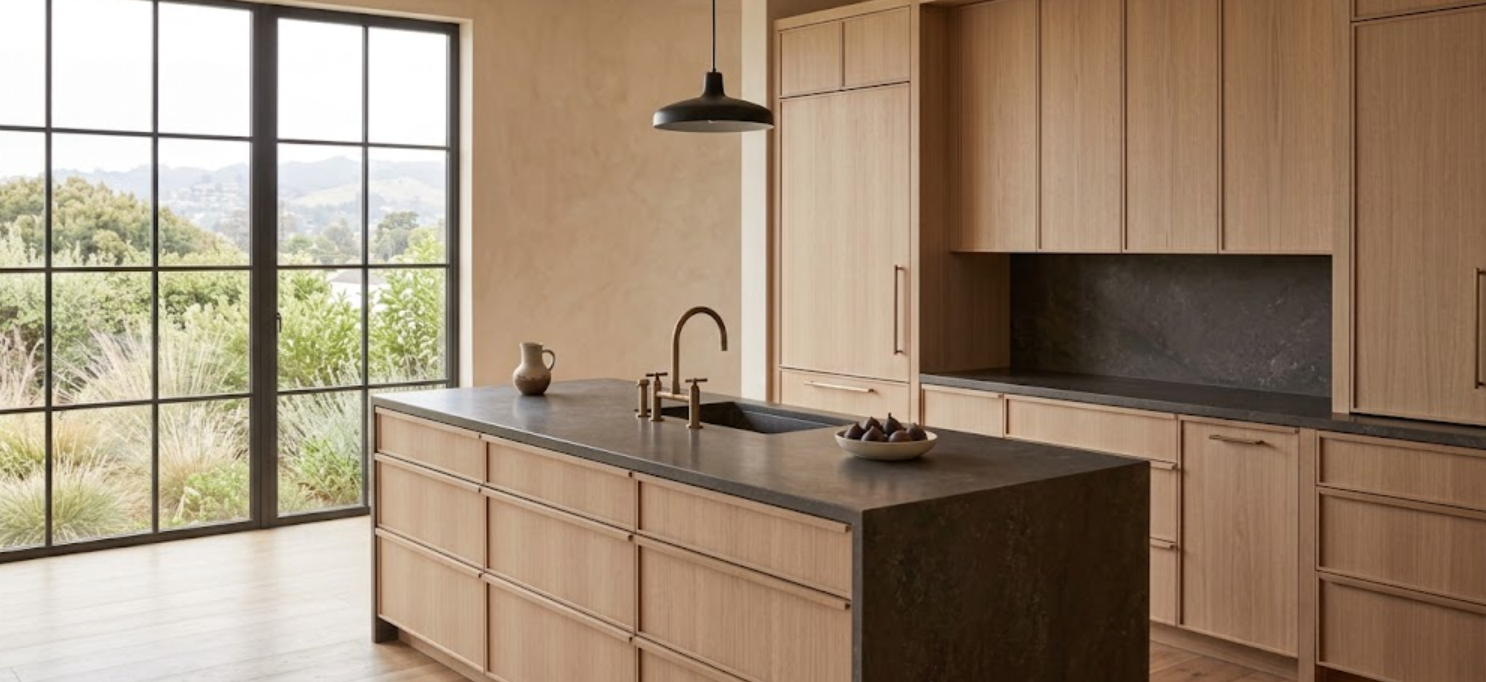
Very well. White oak does not have to be paired with another pale material. A deeper countertop can create strong architectural contrast:
Charcoal.
Deep brown.
Graphite.
Soft black.
Dark soapstone-like surfaces.
These can ground pale cabinetry and give the kitchen more visual weight. The combination can feel particularly effective in contemporary architecture.
When Does Dark Stone Work Best?
When the room has enough light. Large windows help. So does a lighter floor or wall finish.
A dark countertop on a large island can create a strong horizontal plane without making the entire room dark. Alternatively, using deeper stone only on the perimeter can allow a lighter island to remain visually prominent. Consider how much dark material is actually visible.
Should the Dark Stone Be Black?
Not necessarily. Pure black can create a sharp contrast. But softer charcoal, deep brown, or warm graphite may relate more naturally to white oak.
Look for undertones. A brown-black stone may connect to the warmth of the wood. A blue-black surface can create a cooler, more graphic effect. Both can work. They simply produce different rooms.
What About Soapstone?
Soapstone can create a particularly tactile pairing with white oak. Its darker, quieter character can provide contrast without the visual activity of heavily veined stone.
But soapstone has its own performance and aging characteristics. It can scratch and develop patina. Some homeowners value that. Others prefer a surface that changes less visibly. As with every natural material, understand how it behaves before specifying it.
Can You Pair White Oak With Gray Countertops?
Yes, but gray requires careful evaluation. “Gray” can mean:
Warm taupe-gray.
Green-gray.
Blue-gray.
Charcoal.
Silver.
A warm gray can create a sophisticated bridge between oak and other neutral materials. A cool blue-gray can intentionally contrast with the wood. But if the relationship is not deliberate, the countertop may make the cabinetry look unexpectedly yellow. Gray is not automatically neutral.
What About Green Stone?
Muted green natural stone can be exceptional with white oak. Both materials reference natural color without feeling decorative.
A gray-green quartzite or restrained green stone can create a richer palette while maintaining the warmth and calm often associated with white oak interiors. This works particularly well when the rest of the room remains controlled:
Warm plaster.
Bronze.
Quiet flooring.
Simple cabinetry.
Let the green be intentional.
How Should You Pair White Oak With Marble?
Carefully, but not because the materials conflict visually. They often look beautiful together. A warm white or creamy marble can create a soft, timeless relationship with oak.
The larger consideration is performance. Marble is acid sensitive and can etch from common kitchen substances. If the client understands and accepts patina, marble may be completely appropriate. If they expect a pristine surface, another material may be better. Do not allow an attractive pairing to override lifestyle requirements.
Does Honed Stone Look Better With White Oak?
Often, but not always. Honed stone has a matte surface that can relate beautifully to the tactile quality of natural wood. The result often feels quieter.
A polished stone introduces more reflection, which can create contrast and make the stone feel more luminous. The choice depends on the atmosphere. A highly restrained contemporary kitchen may benefit from honed surfaces, while a more formal interior may use polish deliberately. Neither is universally superior.
How Should the Countertop Relate to White Oak Flooring?
This is where the material palette becomes more complicated.
If the kitchen has:
White oak cabinets.
White oak flooring.
And a warm stone countertop.
The entire room can become too similar if the values are not differentiated.
The cabinetry and flooring do not need to match. In many cases, they should not. One can be lighter. One can be richer. One can have a different finish. Then the countertop can help create separation between the wood surfaces.
Should White Oak Cabinets Match White Oak Floors?
Exact matching is rarely necessary. Natural wood will vary anyway. Instead, coordinate undertones. A slightly lighter cabinet against a richer oak floor can create depth. Or pale flooring can support a somewhat deeper cabinet finish. What matters is that the difference looks deliberate. Near-matches can sometimes be more difficult than obvious differences.
What If the Kitchen Has Wood Ceilings Too?
Then the countertop may need to provide more visual relief. Three major wood surfaces can become heavy.
A light stone can create breathing room. A deeper contrasting stone can introduce definition. Painted cabinetry might also be incorporated somewhere in the composition to break up the amount of wood. Always consider the total quantity of each material.
How Does Hardware Affect the Pairing?
Hardware can help connect wood and stone:
Bronze often reinforces the warmth of white oak.
Blackened metal can create sharper definition.
Nickel or stainless finishes can introduce a cooler note.
But hardware should not be chosen only for the cabinet-and-countertop relationship. It also needs to coordinate with plumbing, lighting, appliances, and architectural metal. The countertop and cabinetry establish the larger material story; hardware refines it.
What About the Backsplash?
The backsplash can either simplify or complicate the pairing.
One option is to continue the countertop material vertically. This creates continuity, which works especially well with beautiful natural stone when the slab layout has been carefully considered.
Another option is a quieter backsplash:
Plaster.
Tile.
Another restrained surface.
That can be useful when the countertop already has substantial movement. Do not automatically add another patterned material between the cabinets and countertop.
When Should You Continue the Countertop Up the Wall?
When the stone deserves more visual presence. A full-height quartzite backsplash behind the range can create a strong architectural focal point. With white oak cabinetry surrounding it, the stone can feel framed by wood.
But study the slab first. The section used vertically should be intentionally selected. Vein placement matters.
Should You Use a Waterfall Edge With White Oak Cabinets?
Only if you want the stone to dominate the island end. A waterfall covers the cabinet end panel. If the white oak has beautiful grain and the island is intended to feel furniture-like, leaving the wood visible may be more effective. If the stone is the primary feature, the waterfall may make sense. Ask what you are covering before deciding to cover it.
How Thick Should the Countertop Look?
Countertop thickness affects the perceived weight of the cabinetry. A thin-looking edge can reinforce clean contemporary white oak cabinetry. A thicker edge can give a large island more visual mass.
The appropriate proportion depends on:
Island size.
Cabinet door style.
Architecture.
Stone.
Edge construction.
Do not select thickness independently of the cabinetry elevation.
Why Does Island Size Matter?
Because stone movement is perceived differently across a large uninterrupted surface. A dramatic quartzite on a small perimeter section may show only part of its character. On a ten-foot island, it can become a major composition. Likewise, a very quiet countertop across a substantial island can create an intentionally monolithic surface. Consider the amount of stone that will actually be visible.
How Should the Stone Be Viewed Before Approval?
At full slab scale whenever possible.
Small samples are useful for evaluating:
General color.
Basic texture.
Finish.
Approximate undertone.
They cannot show:
Full vein movement.
Large mineral changes.
Quiet areas.
Dramatic areas.
Slab-to-slab variation.
For natural stone, the actual slab is part of the design.
Should the White Oak Sample Go to the Stone Yard?
Yes, when practical. Take the cabinet finish with you. Do not rely on memory. Do not rely solely on a photograph. Hold the actual cabinet sample against the slab. Then step back. Look at the materials from several feet away. The relationship can change dramatically with distance.
Why Should You Also Bring the Flooring?
Because a countertop that works beautifully with the cabinetry may conflict with the floor.
The stone selection should ideally be evaluated with:
Cabinetry.
Flooring.
Paint or plaster.
Hardware.
Other major architectural finishes.
This is especially important in open-plan homes where the kitchen may be visible from several surrounding rooms.
What About Lighting?
Review the samples under more than one light source:
Natural daylight.
Warm interior light.
Task lighting.
The materials will shift. White oak can appear considerably warmer under certain artificial lighting. A stone with subtle green or gray undertones may change too. The goal is not to find materials that look identical at every hour. It is to make sure their relationship remains intentional.
What Is the Most Common Mistake With White Oak Countertops?
Choosing a countertop because it looked beautiful in another white oak kitchen.
The other kitchen may have:
A different oak finish.
Different windows.
Different flooring.
Different orientation.
Different lighting.
Different stone batch.
Different wall color.
White oak is not one standardized color. Neither is natural stone. Use inspiration to establish direction. Use physical materials to make the specification.
Another Common Mistake: Too Much Warmth
White oak.
Cream stone.
Beige plaster.
Oak flooring.
Brass hardware.
Warm lighting.
Each may be beautiful individually. Together, the room can drift too far into yellow or beige.
Introduce something that provides definition:
A cooler mineral note.
A deeper bronze.
A subtle gray vein.
A contrasting paint.
A slightly cooler plaster.
Warmth is most effective when it has something to push against.
Another Common Mistake: Overcorrecting With Cool Gray
The opposite happens too. A designer may worry that white oak is becoming too warm and choose a strongly cool countertop. Now the contrast makes the oak appear even more yellow. Instead of neutralizing the warmth, the stone emphasizes it. A more nuanced taupe, warm gray, or mineral tone may create the balance the project actually needs.
Another Common Mistake: Choosing Too Much Pattern
White oak already has pattern. It is grain.
Add:
Highly veined stone.
Strong floor variation.
Decorative tile.
Prominent hardware.
Sculptural lighting.
The room can quickly lose hierarchy. Decide where the eye should go. Everything else should help it get there.
What If You Want to Mix White Oak and Painted Cabinetry?
Then the countertop can become the connector.
Imagine white oak tall cabinetry with mushroom-painted lower cabinets. One creamy quartzite used across both can unify the two. Or white oak perimeter cabinetry might surround a painted island. Again, one countertop material can connect the composition.
This is often more effective than introducing a new stone every time the cabinetry finish changes.
Can the Island Use a Different Countertop?
Yes. But give the change a reason.
Perhaps the perimeter is quiet engineered quartz while the island uses dramatic quartzite. The island becomes the focal point. Or the perimeter uses pale stone while the island receives a darker honed surface. The contrast establishes the island as a separate volume.
Avoid changing stone simply to create more variety.
What If the White Oak Is Only on the Island?
Then the countertop relationship becomes even more important.
A white oak island can function like a piece of furniture within a painted kitchen. The stone can either reinforce that distinction or connect it back to the perimeter. Using the same countertop throughout creates continuity. Using a different island stone creates stronger hierarchy.
Both can work.
What If the White Oak Is on the Tall Cabinetry?
This is one of the strongest contemporary applications.
Large oak cabinet walls can read almost like architectural paneling. Because those surfaces are vertical and visually dominant, the countertop can remain quieter. A restrained perimeter surface prevents the room from becoming overloaded with material movement.
What If the White Oak Is Very Pale?
Be careful with other pale materials. If everything has nearly the same value, the room can lose definition.
Texture can help. So can subtle contrast:
A slightly deeper stone.
Warm bronze.
A mushroom-painted island.
A darker interior cabinet detail.
The room does not need dramatic contrast. It needs enough differentiation to remain legible.
What If the White Oak Is Darker?
A richer stain opens other possibilities.
Lighter stone can create more contrast. Cream and ivory become particularly effective. Certain warm grays can also work.
The stronger cabinet color may mean the countertop should become more restrained. Again, hierarchy.
Should You Select Countertops Before Finalizing the Cabinet Finish?
Ideally, develop them together.
You may have a general cabinetry direction first:
White oak.
Natural.
Rift-cut.
Warm.
But before the finish is fully approved, place it beside the likely countertop direction.
The stone may reveal that the oak needs to be:
Slightly warmer.
Slightly quieter.
Less gray.
Less golden.
Material selection is iterative.
How Do Designers Make the Final Decision?
They stop looking at the countertop by itself. Instead, they build the room:
Cabinet sample.
Stone.
Floor.
Wall.
Hardware.
Backsplash.
Then they ask:
What is dominant?
What is supporting?
Are the undertones intentional?
Is there enough contrast?
Is there too much contrast?
Where is the movement?
What happens in natural light?
What happens at night?
Does the palette support the architecture?
That is a more reliable process than asking which stone is currently popular with white oak.
How to Select a Countertop That Complements White Oak Cabinetry
Start with the exact white oak. Understand its undertone. Understand its grain. Decide whether the cabinetry or countertop should carry more visual movement.
Then evaluate the surface according to the entire room:
Choose creamy natural stone when you want a warm, layered relationship.
Consider restrained quartz when the oak should remain the dominant architectural material.
Use dramatic quartzite when the room has enough visual quiet to support it.
Explore darker stone when the design needs contrast and weight.
Approach marble with an understanding of how it performs and ages.
And always evaluate the countertop beside the cabinetry, flooring, walls, and hardware before final approval.
White oak is versatile. But versatility does not mean every surface works equally well with it. The best pairing happens when the stone responds to the specific wood in front of you. Not to the idea of white oak.
Pair White Oak Cabinetry and Surfaces With Atelier Design Society
Atelier Design Society works with homeowners, architects, interior designers, builders, and other design professionals developing premium cabinetry and surface palettes for sophisticated Bay Area kitchens.
At the Atelier Design Society showroom in Menlo Park, project teams can compare white oak cabinetry finishes alongside natural stone, engineered surfaces, hardware, flooring, and other architectural materials while evaluating undertone, grain, movement, contrast, and the larger kitchen design.
Bring stone references, flooring, paint or plaster, hardware, architectural drawings, and other project materials when available.
A countertop should do more than look attractive beside white oak.
It should complete the material composition around it.