How to Choose Kitchen Cabinets for a Luxury Home
Choosing kitchen cabinets for a luxury home can become surprisingly complicated. There are:
More materials.
More finishes.
More door styles.
More manufacturers.
More opportunities for customization.
And usually more parts of the project that need to coordinate with the cabinetry.
That does not mean the best kitchen is the one with the most options. In many of the strongest luxury kitchens, the cabinetry feels remarkably simple.
The proportions are right.
The materials belong in the house.
Storage works naturally.
Appliances are integrated intentionally.
And details that could easily become distracting have been resolved quietly.
For homeowners planning a high-end kitchen, the question is not simply which cabinets look the most luxurious. A better question is: Which cabinetry makes the most sense for this home?
Should You Start With Cabinet Style or Kitchen Layout?
Start with the layout. A beautiful cabinet door cannot solve a poorly planned kitchen.
Before choosing wood species, paint colors, or hardware, understand how the room needs to function.
Consider:
Where food is prepared.
Where cookware is stored.
How groceries enter the kitchen.
Where the refrigerator belongs.
How the pantry is used.
Where dishes are unloaded from the dishwasher.
Whether multiple people cook at the same time.
How guests move through the room.
Whether the kitchen opens into living or dining spaces.
How the island will actually be used.
These decisions establish the architecture of the cabinetry. Once that works, the visual decisions become easier.
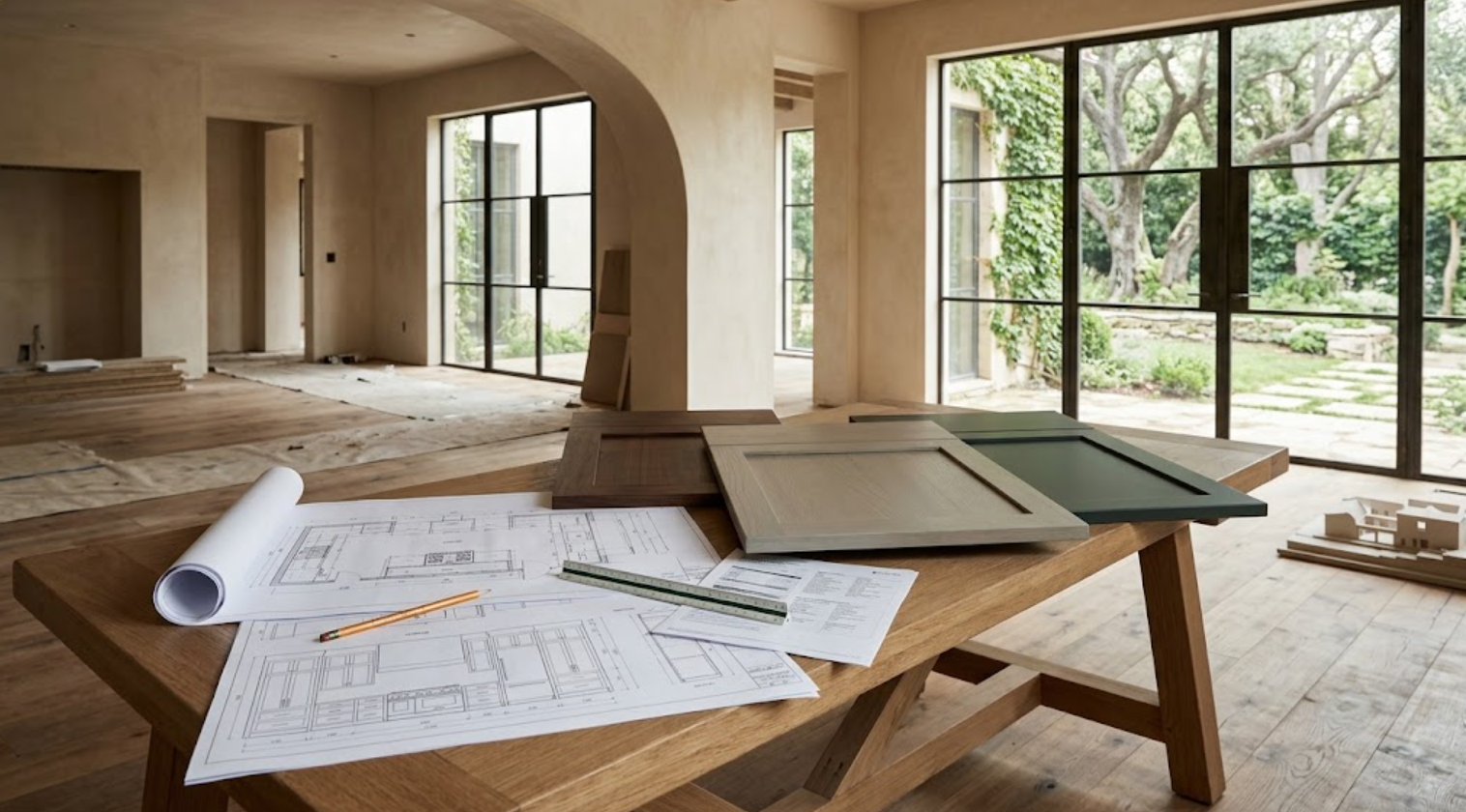
What Level of Cabinetry Do You Actually Need?
Luxury cabinetry exists across a spectrum.
There are premium semi-custom systems with extensive finish, sizing, and storage options. There are highly customizable cabinetry lines that allow greater dimensional and material flexibility. And there is fully bespoke cabinetry developed specifically around a project.
The most expensive or customizable option is not automatically the best one. Start by identifying where the project requires flexibility.
Does the architecture work with established cabinet dimensions?
Are there unusual wall or ceiling conditions?
Are appliances highly integrated?
Is a particular finish required?
Does cabinetry need to align precisely with windows or architectural openings?
Are there specialized storage requirements?
If a premium cabinetry system can resolve the room beautifully, additional customization may add little value. If the architecture repeatedly requires exceptions, greater customization becomes much more meaningful.
How Can You Tell if Cabinet Construction Is High Quality?
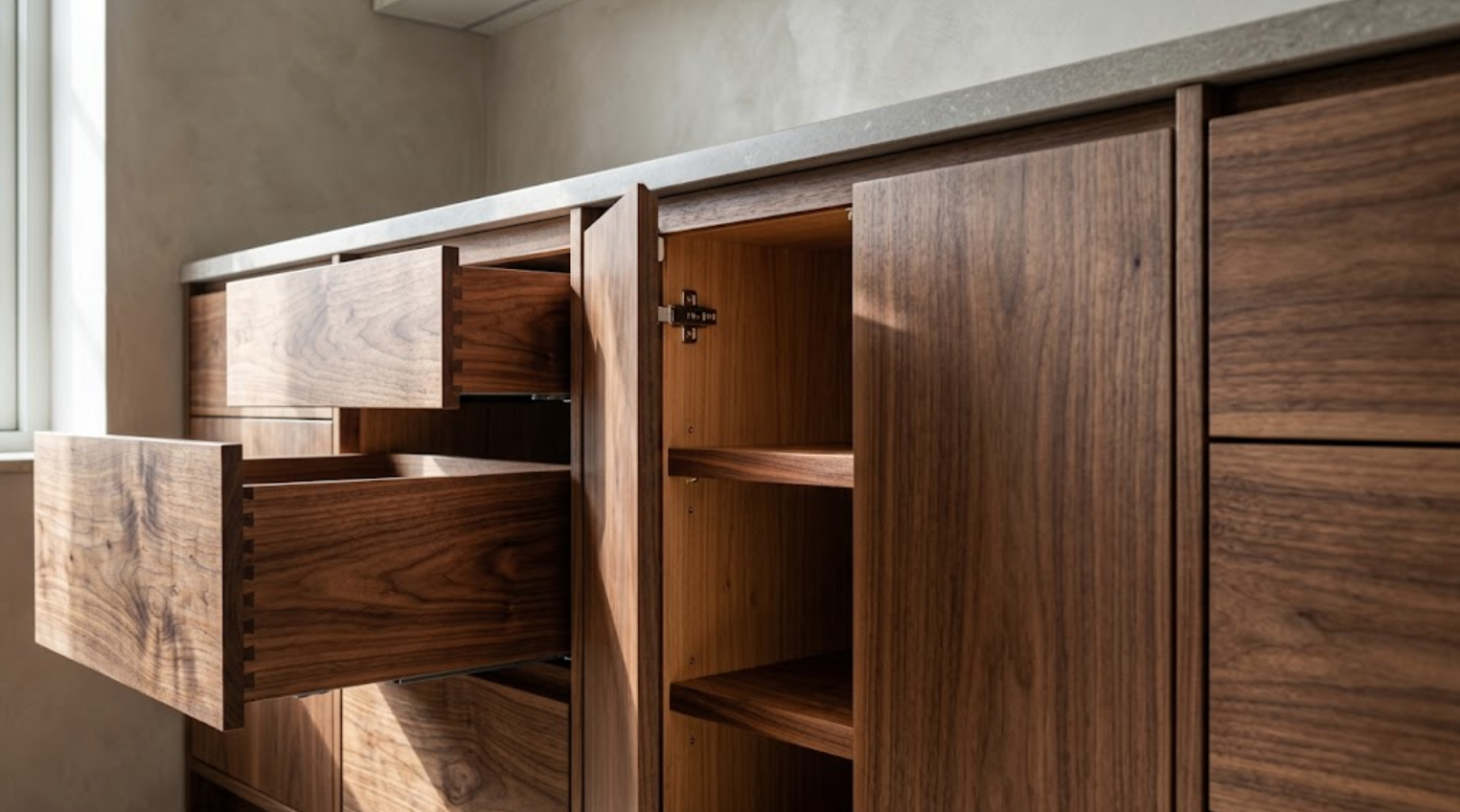
Look beyond the exterior.
Open the cabinet.
Pull out the drawers.
Look at the interior edges.
Study how shelves are supported.
Feel how the drawer operates.
Look at the hinges.
Inspect the finished ends.
Pay attention to the consistency of gaps between doors and drawers.
Premium cabinetry should remain convincing when it is open. Construction quality is not always dramatic. Often, you notice it through consistency.
The drawer closes correctly.
The doors align.
Interior surfaces feel finished.
Edges are clean.
Hardware operates smoothly.
Everything feels considered.
Should You Choose Custom or Semi-Custom Kitchen Cabinets?
It depends on the project. Premium semi-custom cabinetry can provide extensive flexibility and work beautifully in many luxury kitchens.
Custom cabinetry becomes valuable when the architecture or design direction requires something more specific. For example:
A cabinet needs a nonstandard depth.
A tall elevation needs unusual proportions.
Cabinetry must wrap around a window.
An appliance requires a highly specific panel condition.
The project needs a custom paint or stain.
Cabinetry needs to align precisely with another architectural element.
Storage needs cannot be resolved within standard configurations.
The important distinction is not the label. It is what the cabinetry system allows the design to accomplish.
How Should Architecture Influence Cabinet Selection?
Significantly. Kitchen cabinetry occupies too much of the room to ignore the architecture around it.
Look at:
Ceiling height.
Window proportions.
Door openings.
Existing millwork.
Flooring.
Wall thickness.
Sightlines.
Adjacent rooms.
Natural light.
A contemporary home with expansive glazing may benefit from quieter cabinetry with long, clean elevations. A more traditional residence may support framed doors, inset construction, or additional architectural detail. A remodeled home may require cabinetry to work around existing conditions rather than replacing them.
The cabinetry should look like it belongs to the building. Not like the building was simply a place to install it.
What Cabinet Door Style Works Best in a Luxury Kitchen?
There is no single luxury door style.
Slab cabinetry can feel exceptionally refined when material quality, grain, alignment, and reveals are executed well.
Shaker cabinetry can feel sophisticated when proportions are restrained.
Narrow-frame doors can provide architectural detail without becoming visually heavy.
Inset cabinetry can introduce another level of precision and shadow.
Instead of asking which door style is most luxurious, ask what level of visual detail the room needs.
If the stone is highly expressive, quieter cabinetry may create balance. If the material palette is restrained, a subtle door profile may add useful depth.
The door should support the composition.
Should You Choose Painted or Stained Cabinetry?
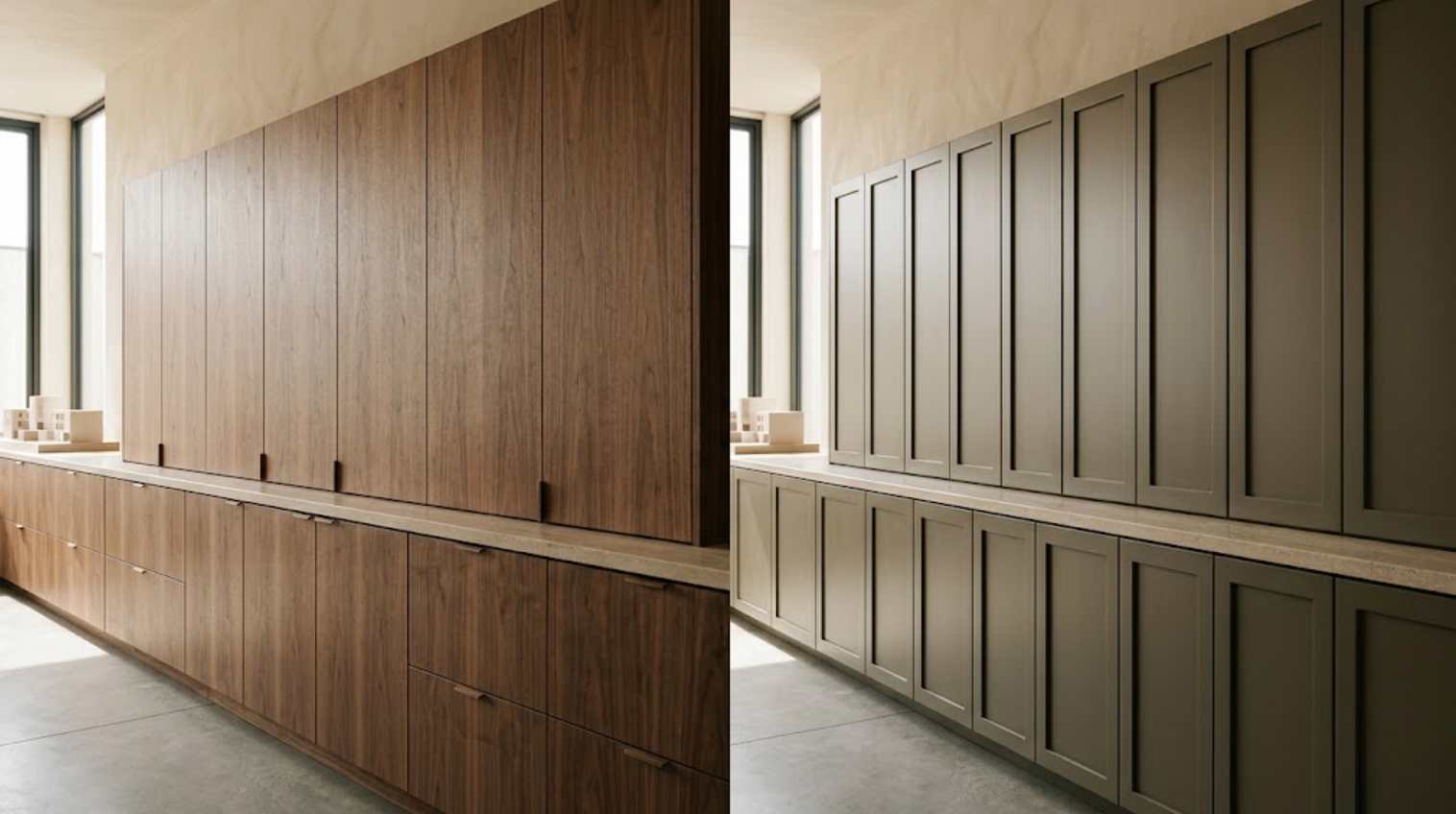
Both can work beautifully. Paint creates a controlled field of color. Stain allows the character of the wood to remain visible.
The decision should consider the rest of the room. If the flooring already introduces significant wood, another wood species on the cabinetry may need careful coordination. If the stone contains dramatic movement, painted cabinetry may provide visual relief. If the architecture is quiet and the countertop restrained, natural walnut or white oak may become the material that gives the kitchen depth.
Also consider how the finish will age. Natural wood contains variation. Painted cabinetry may show wear differently. Neither characteristic is necessarily negative. The homeowner simply needs to understand the material being selected.
Which Woods Work Well for Luxury Kitchen Cabinets?
Walnut and rift-sawn white oak are two common choices, but they create very different results.
Walnut tends to feel warmer and richer. Its grain and tonal variation can become an important part of the design. Rift-sawn white oak generally creates a lighter, more linear appearance.
But species is only the beginning:
Cut.
Veneer selection.
Stain.
Sheen.
Grain matching.
Adjacent flooring.
Natural light.
All influence the finished result. A small sample can only tell you so much. For natural wood cabinetry, larger samples and full-scale displays provide much more useful information.
How Much Natural Wood Variation Should You Expect?
Some. And that is part of the material.
Natural wood is not a printed surface. Two walnut doors may contain different grain patterns or tonal variations. White oak can vary too.
The important question is how that variation is managed across the cabinetry. Grain direction should be considered. Veneer sequencing may matter on important elevations. Panels should feel intentionally composed.
Trying to remove every sign of natural variation can eliminate part of what makes real wood compelling.
How Should Cabinetry Work With Countertops?
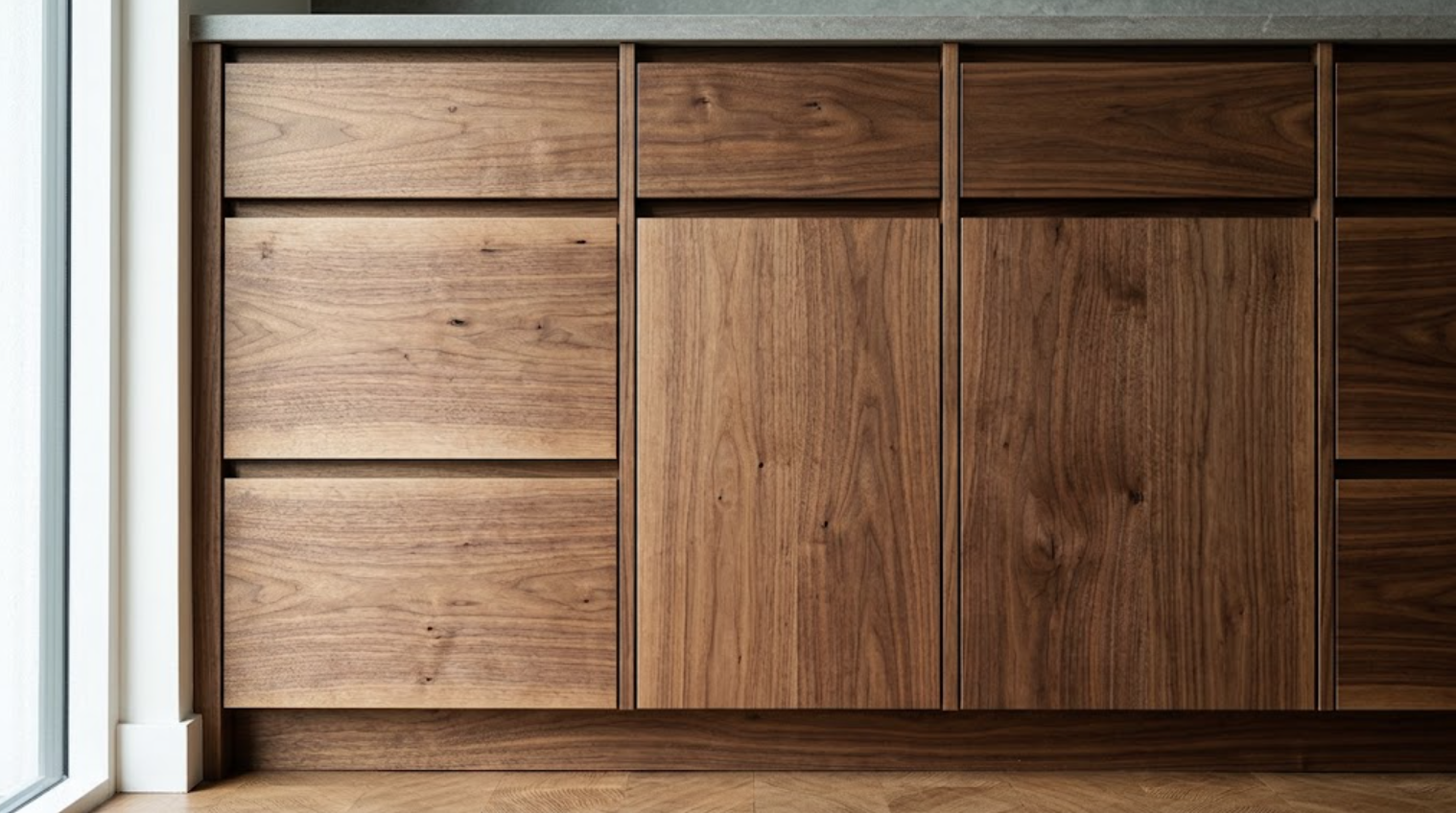
As a material relationship. Do not select cabinetry and stone independently simply because you like both. Place them together.
A richly figured walnut beside highly active quartzite may be beautiful, but both materials may compete for attention. A quieter stone can allow natural cabinetry to lead. Conversely, painted cabinetry can provide a calm backdrop for an expressive natural surface.
Also consider:
Countertop thickness.
Edge profile.
Backsplash material.
Waterfall conditions.
Stone seams.
Cabinet end panels.
The transition between the countertop and cabinetry is repeated throughout the room. It deserves attention.
How Important Are Cabinet Proportions?
Extremely. A luxury kitchen can use exceptional materials and still feel awkward if the cabinetry proportions are unresolved.
Look at the entire elevation. Not just individual cabinets.
How wide are the doors?
How tall are the drawers?
Where do horizontal lines occur?
Do appliance panels align with adjacent cabinetry?
What happens above wall ovens?
How are very tall cabinets divided?
Where does cabinetry stop?
These relationships create visual rhythm. The goal is not perfect symmetry. It is intentional composition.
Should Kitchen Cabinets Go to the Ceiling?
Sometimes. Ceiling-height cabinetry can create a strong architectural effect and eliminate unused space. But it should not be automatic.
Very tall ceilings may require a different strategy:
An upper storage zone.
A horizontal break.
A shadow gap.
A change in material.
Or cabinetry intentionally stopping below the ceiling.
Trying to fill every vertical inch can make cabinetry feel heavier rather than more luxurious. The ceiling condition should be designed.
How Should Appliances Affect Your Cabinet Choice?
Early and significantly. The cabinetry system needs to accommodate the actual appliances being specified.
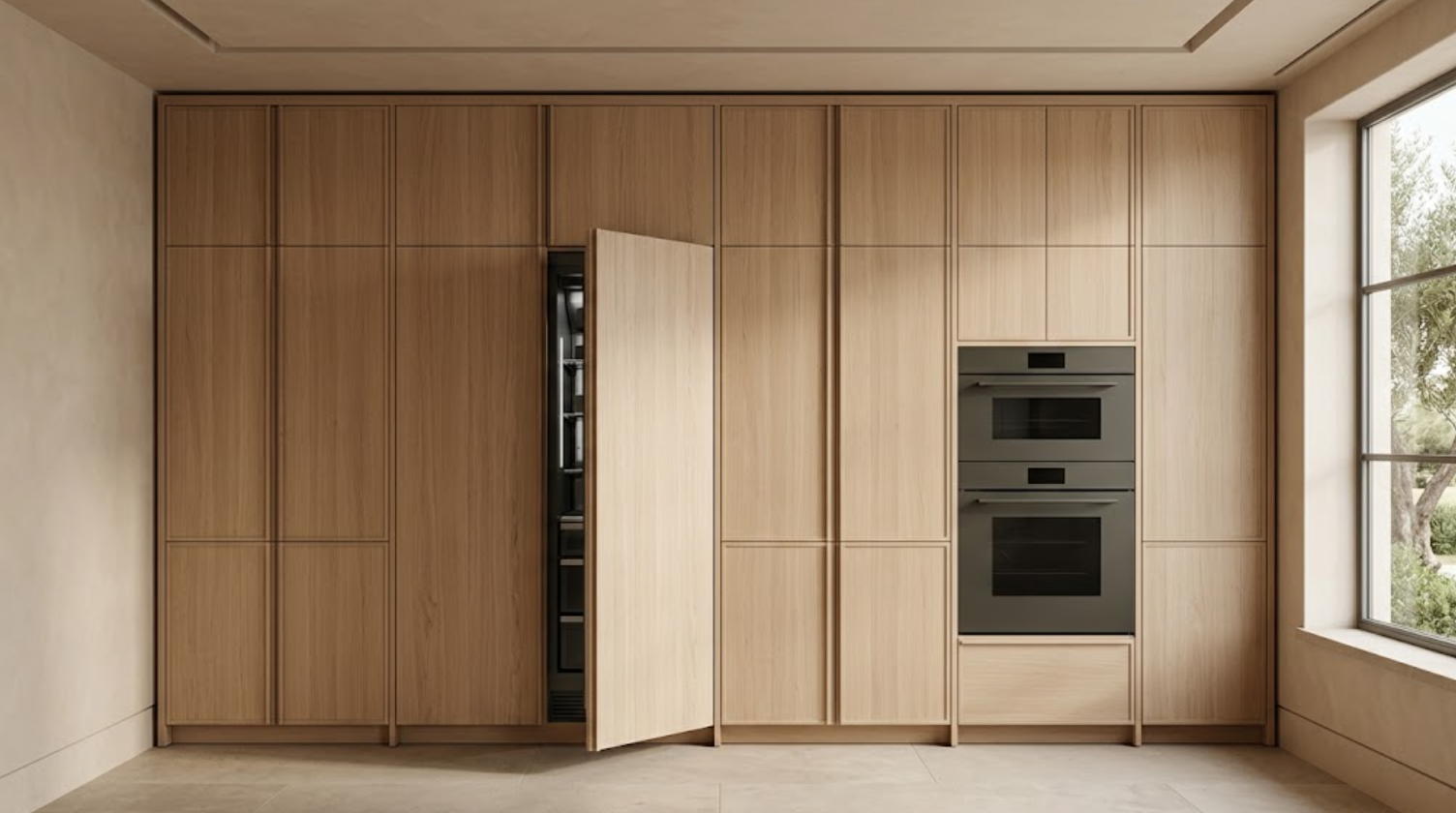
Panel-ready refrigeration requires precise panel construction, clearances, ventilation, and door swing. Wall ovens affect tall cabinet proportions. Ranges affect adjacent drawer widths. Dishwashers influence panel dimensions. Coffee systems and beverage refrigeration create additional conditions.
If appliances are selected after cabinetry has been substantially designed, compromises may follow. The two should develop together.
How Should You Plan Cabinet Storage?
Start with inventory. What actually needs to live in the kitchen?
Cookware.
Everyday dishes.
Serving pieces.
Food.
Small appliances.
Coffee equipment.
Spices.
Baking supplies.
Recycling.
Wine.
Pet supplies.
Then decide where those items are most useful. Storage should follow activity.
Pots and pans near the cooking zone.
Dishes near the dishwasher.
Coffee supplies near the coffee equipment.
Waste near prep and cleanup areas.
Frequently used appliances where they can be accessed without moving several other items.
Custom interiors are useful when they solve specific needs. They are less useful when they are added simply because they are available.
What Cabinet Details Are Worth Paying Attention To?
The ones you will see repeatedly:
Reveals between doors.
Drawer alignment.
Grain direction.
Finished ends.
Door thickness.
Interior finishes.
Hardware placement.
Cabinet-to-wall transitions.
Toe kicks.
Panels around appliances.
How cabinetry meets stone.
These details can seem small individually. Across an entire kitchen, they become the visual language of the cabinetry.
How Should Hardware Be Selected?
After understanding the cabinetry. Hardware changes both appearance and use.
A substantial pull on a slab door creates a different effect from integrated hardware. A small knob on framed cabinetry changes the visual rhythm differently from a long pull.
Hardware finish also needs to relate to:
Plumbing fixtures.
Lighting.
Appliances.
Stone.
Other metals in adjacent spaces.
Every metal does not need to match. But the relationships should feel deliberate.
And before making a final decision, use the hardware. A beautiful pull that is uncomfortable every day is not a successful choice.
Should All Kitchen Cabinetry Match?
Not necessarily. Mixing cabinetry finishes can help establish hierarchy.
Perhaps the tall cabinet wall is walnut while the island is painted. The perimeter might be painted while the island uses white oak. A pantry could introduce a variation.
The important thing is to avoid creating several unrelated focal points. One material should usually lead. Other materials can support it.
This creates complexity without visual noise.
What About Cabinetry Visible From Other Rooms?
Treat it as part of those rooms too.
Open-plan kitchens are not experienced only from inside the kitchen. An island may be visible from the living room. A tall cabinet wall may become part of the dining room view. The back of an island may need to feel more furniture-like because it faces a living area.
Material decisions should therefore be evaluated from multiple sightlines. The cabinetry belongs to the architecture around the kitchen as much as it belongs to the kitchen itself.
How Do You Choose Cabinets That Will Still Look Good Years From Now?
Avoid making every major decision around the same trend.
Trends can be useful. They introduce new materials, proportions, and ideas. But a kitchen becomes more durable aesthetically when its primary decisions come from the house:
Architecture.
Proportion.
Natural light.
Material quality.
Function.
If those fundamentals are strong, smaller elements can change over time without requiring the entire kitchen to be reconsidered.
How Much Should You Budget for Luxury Kitchen Cabinets?
There is no universal number.
Cost depends on:
Cabinet quantity.
Manufacturer.
Construction.
Materials.
Finish.
Door style.
Interior accessories.
Hardware.
Customization.
Appliance integration.
Installation.
Project complexity.
A smaller highly bespoke kitchen may cost more than a much larger kitchen using a premium cabinetry system with fewer modifications.
The most useful cabinetry budget comes from actual plans and specifications. Not a generic price per linear foot.
Should You See Cabinets in Person Before Choosing?
For a significant cabinetry investment, yes, when possible. Full-scale cabinetry reveals information that photographs and small samples cannot.
Open the drawers.
Look at the interiors.
Feel the hardware.
Study the door thickness.
Look at the reveals.
Compare natural wood across several fronts.
Stand back and look at an entire elevation.
Then move closer and inspect the details.
Both views matter.
What Should You Bring to a Cabinetry Showroom?
Bring information about the actual project:
Architectural plans if available.
Appliance specifications.
Room photographs.
Flooring or stone samples already selected.
Inspiration images.
And a list of problems the cabinetry needs to solve.
Maybe the pantry does not work. Perhaps the refrigerator feels too prominent. You need more useful drawers. The kitchen opens directly into the living room. An existing window needs to remain.
Those conditions make the showroom conversation more productive than arriving with only a preferred cabinet color.
How Do You Choose the Right Cabinetry Partner?
Look for someone who can discuss more than finishes.
A cabinetry partner should be able to understand:
Architecture.
Appliances.
Storage.
Materials.
Construction.
Dimensions.
Installation.
Coordination.
They should also be able to work with the project’s architect, interior designer, builder, and other trades when needed.
Ask:
How are plans developed?
How are dimensions verified?
How are appliance specifications coordinated?
What can be customized?
How are finishes approved?
How is installation handled?
Luxury cabinetry is a product. But it is also a process. Both matter.
How to Choose Kitchen Cabinets for a Luxury Home
The best kitchen cabinets are not necessarily the most expensive, the most customized, or the most visually dramatic. They are the ones that make sense:
For the architecture.
For the room.
For the appliances.
For the materials.
For the household.
For the budget.
And for the way the kitchen will actually be used.
Start with the room. Understand what the cabinetry needs to accomplish. Then evaluate construction, materials, finishes, proportions, storage, and customization within that context.
When those decisions are made in the right order, cabinetry stops feeling like something selected for the kitchen. It becomes part of the kitchen itself.
Explore Luxury Kitchen Cabinetry With Atelier Design Society
Atelier Design Society works with homeowners, interior designers, architects, builders, and other design professionals planning premium and custom kitchen cabinetry throughout Menlo Park and the Bay Area.
At the Atelier Design Society showroom in Menlo Park, you can compare cabinetry at full scale, evaluate construction, woods, painted finishes, door styles, hardware, storage, appliance integration, and different levels of customization.
Bring your plans, appliance information, material ideas, and the questions your kitchen still needs to solve.