How to Mix Wood and Painted Cabinetry in One Kitchen
Mixing wood and painted cabinetry can make a kitchen feel more layered, more architectural, and more specific to the home.
It can also go wrong quickly.
If every cabinet zone uses a different finish, the room can feel fragmented. If the wood is too active and the paint color is equally strong, the materials may compete. If the island changes finish simply because it is the island, the result can feel formulaic rather than intentional.
The strongest kitchens do not mix materials randomly. They assign each material a role:
Natural wood may provide warmth.
Paint can create visual calm.
Stone may become the focal surface.
A tall cabinet wall can carry one material while the island or perimeter uses another.
The point is not to create contrast everywhere. It is to build hierarchy.
For homeowners, architects, and interior designers considering wood and painted kitchen cabinetry, the most useful question is not:
“Can these two finishes go together?”
It is:
“What should each finish contribute to the room?”
Why Mix Wood and Painted Cabinets in the First Place?
Because one material can do something the other cannot.
Natural wood brings grain, variation, texture, and warmth. Paint introduces more controlled color and can quiet an elevation.
Used together, they allow the cabinetry to perform different visual roles within the same kitchen.
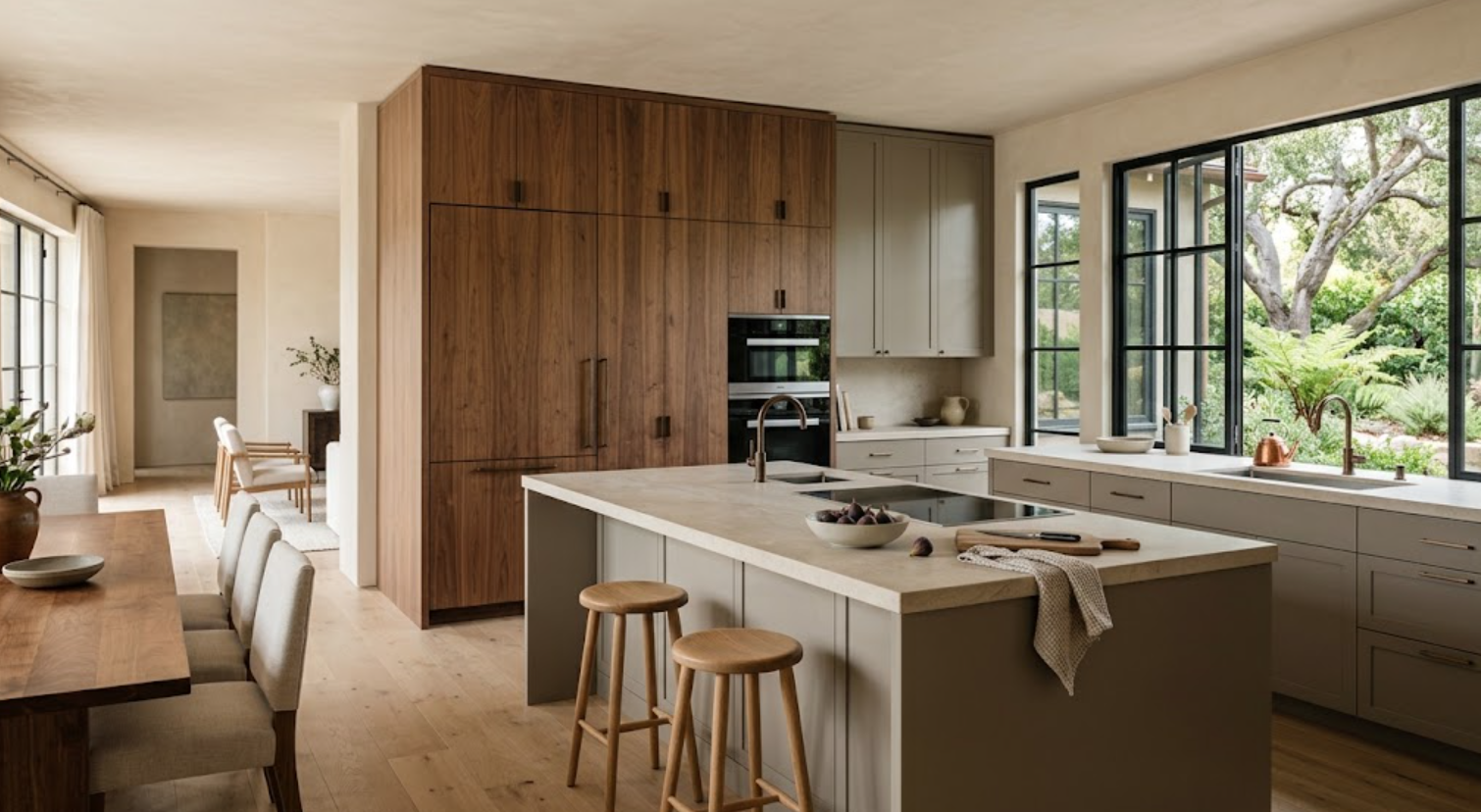
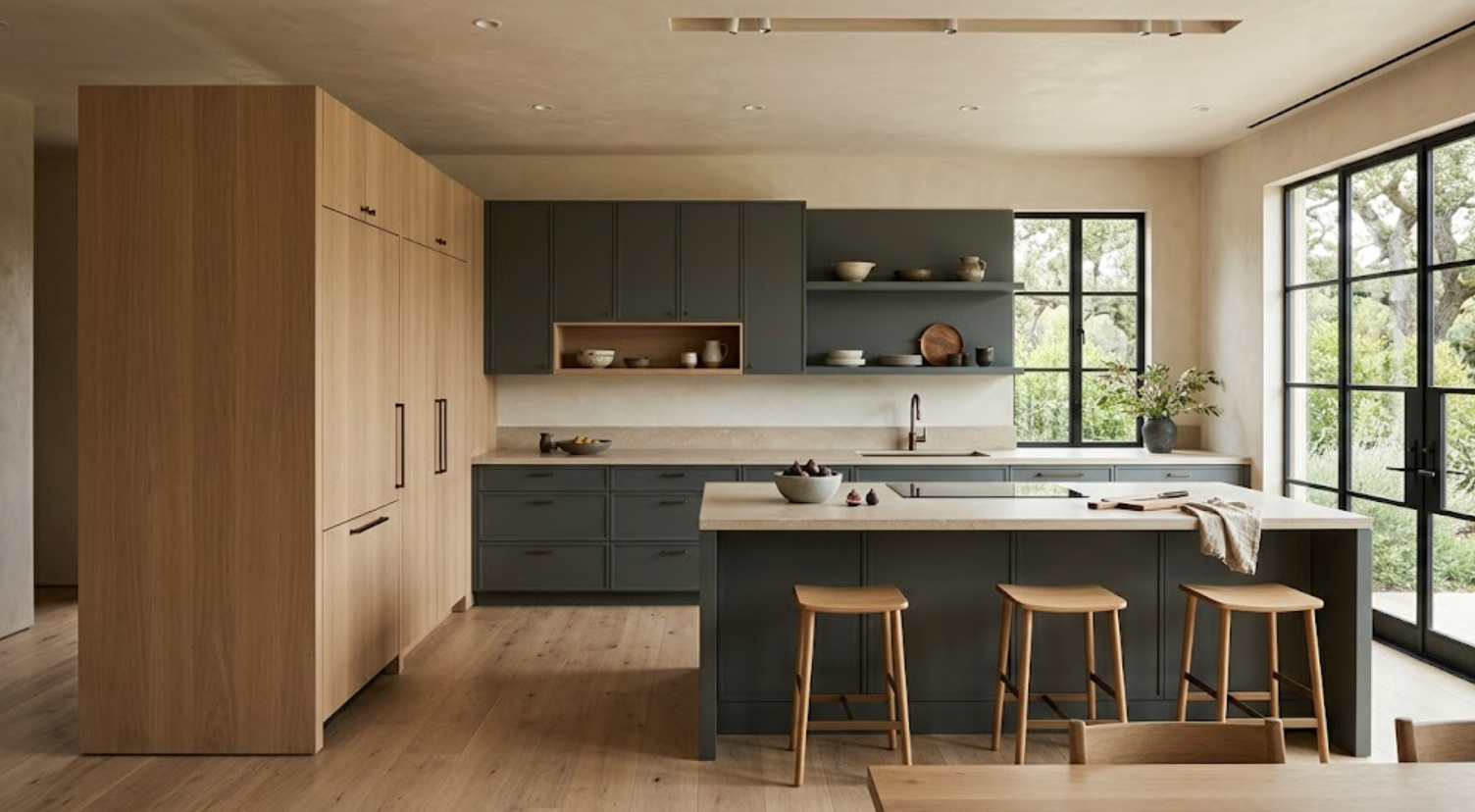
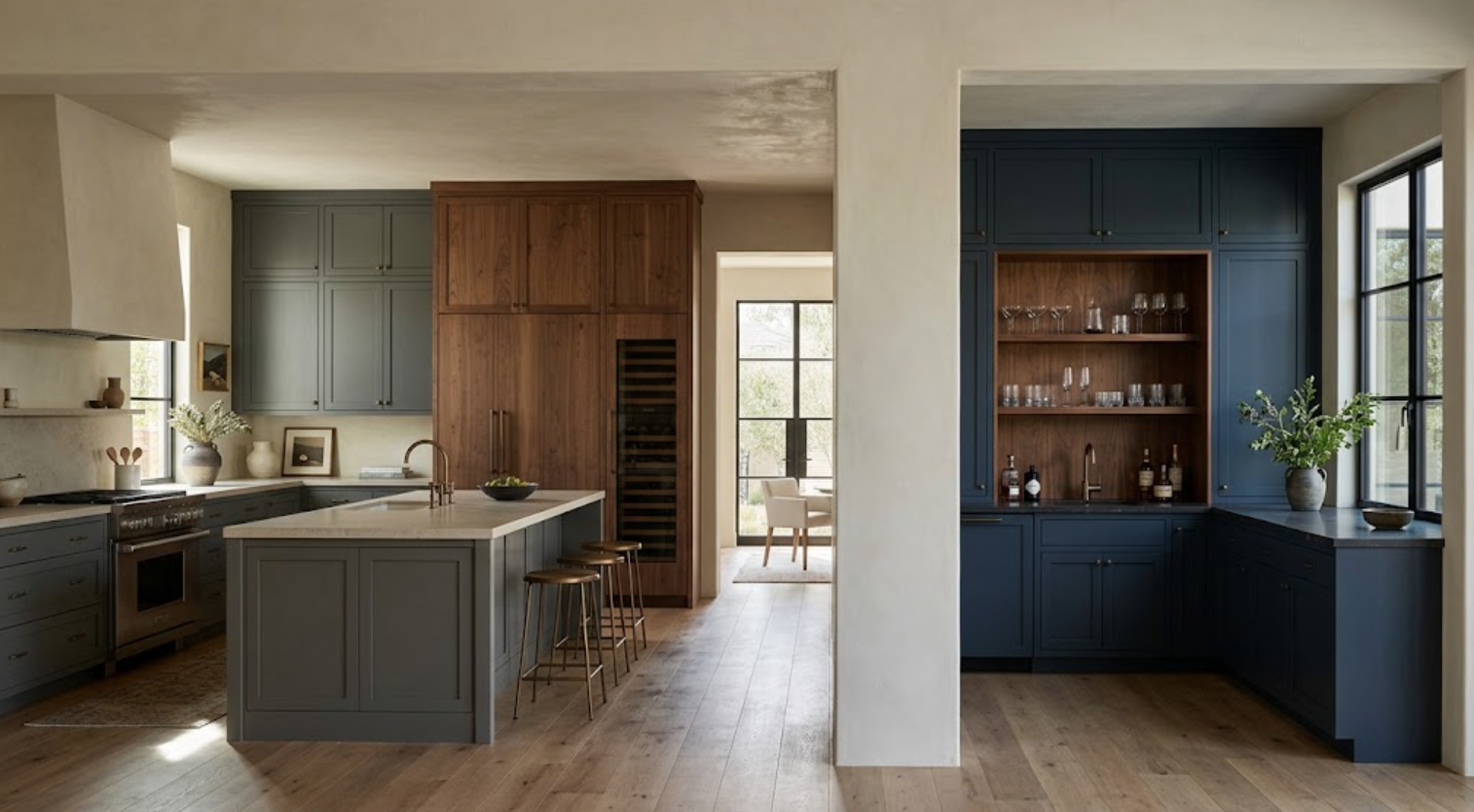
For example, a tall walnut wall can anchor the room while painted lower cabinetry keeps the working area lighter. A painted perimeter can become the background while a white oak island creates a more furniture-like focal point.
A mostly painted kitchen can use wood only inside a bar, niche, or appliance station to introduce warmth without allowing wood grain to dominate the entire space.
This can also be useful when the architecture already contains natural wood. If the floors, beams, or windows are wood, painted cabinetry may create necessary separation.
The mix should solve a visual or architectural problem. Not simply create variety.
Which Material Should Be Dominant?
Usually one.
The kitchen becomes easier to read when one cabinetry material establishes the primary visual field and the second material supports it.
This does not necessarily mean one has to cover dramatically more square footage. Dominance can come from placement.
A walnut wall may occupy less area than the painted perimeter but still become the strongest visual element because it is full height and highly visible. Likewise, a painted kitchen can remain dominant while a wood island acts as a focused accent in the center of the room.
Ask what you want the eye to notice first:
The cabinetry?
The stone?
The architecture?
The view?
If walnut is already visually rich, painted cabinetry can step back. If the wood is a quiet rift-sawn white oak, the paint might carry more color.
The hierarchy should be intentional.
Should the Island Be the Contrasting Material?
It can be. But it does not have to be.
The island is an obvious place to change material because it is physically separated from the perimeter. That can work well.
A natural wood island can feel more furniture-like within an open-plan kitchen. A painted island can break up a room dominated by wood.
The problem is treating contrast as a default rule.
If every kitchen uses one finish on the perimeter and another on the island, the design can begin to feel predictable.
Sometimes the stronger move is to use the same finish on the island and perimeter while changing the tall cabinetry wall. Or to keep most cabinetry painted and introduce wood only in one architectural volume.
The contrasting material should go where it improves the composition. Not automatically where convention puts it.
How Do You Decide Where the Wood Should Go?
Look for architectural volumes.
Tall cabinetry is one of the strongest opportunities.
A full-height walnut or white oak wall can create a defined material zone around refrigeration, pantry storage, or integrated appliances.
Wood can also work well on an island, especially when the island is visible from adjacent living spaces.
Open niches are another useful option. A painted cabinetry wall can contain one walnut-lined niche for coffee, display, or a bar. This introduces warmth without changing the entire elevation.
The same applies to interiors. A painted appliance cabinet with a natural wood interior creates material depth when opened while remaining visually quiet when closed.
These strategies usually feel more intentional than alternating finishes cabinet by cabinet.
Which Woods Work Best With Painted Cabinetry?
Many can work. The more important consideration is the visual character of the wood.
Walnut
Walnut creates richer contrast.
It works well when the painted cabinetry is muted and the room needs warmth or depth.
Because walnut has stronger tonal variation, it usually benefits from surrounding materials that are quieter.
Rift-Sawn White Oak
Rift-sawn white oak creates a lighter, more linear effect.
It can work beautifully with deeper paint colors because the contrast does not become overly heavy.
Other White Oak Cuts
Plain-sawn white oak introduces more grain movement.
That may be desirable in a kitchen where the wood needs to feel more expressive.
The wood should be selected for the room. Not because one species is considered more luxurious.
What Paint Colors Work Best With Natural Wood?
Start with undertones. Not names.
A paint marketed as warm gray may become noticeably green beside walnut. A taupe can look pink next to some oak finishes. A deep charcoal may pull blue under cool natural light.
The actual wood changes how the paint is perceived. That is why physical samples matter.
Common pairings can include:
Warm mushroom.
Muted olive or mineral green.
Soft taupe.
Warm gray.
Deep charcoal-brown.
Muted blue-gray.
Off-white.
But the surrounding materials matter too:
Stone.
Flooring.
Plaster.
Metal.
Natural light.
A paint color should be selected within the entire palette. Not independently.
How Should You Evaluate the Wood and Paint Together?
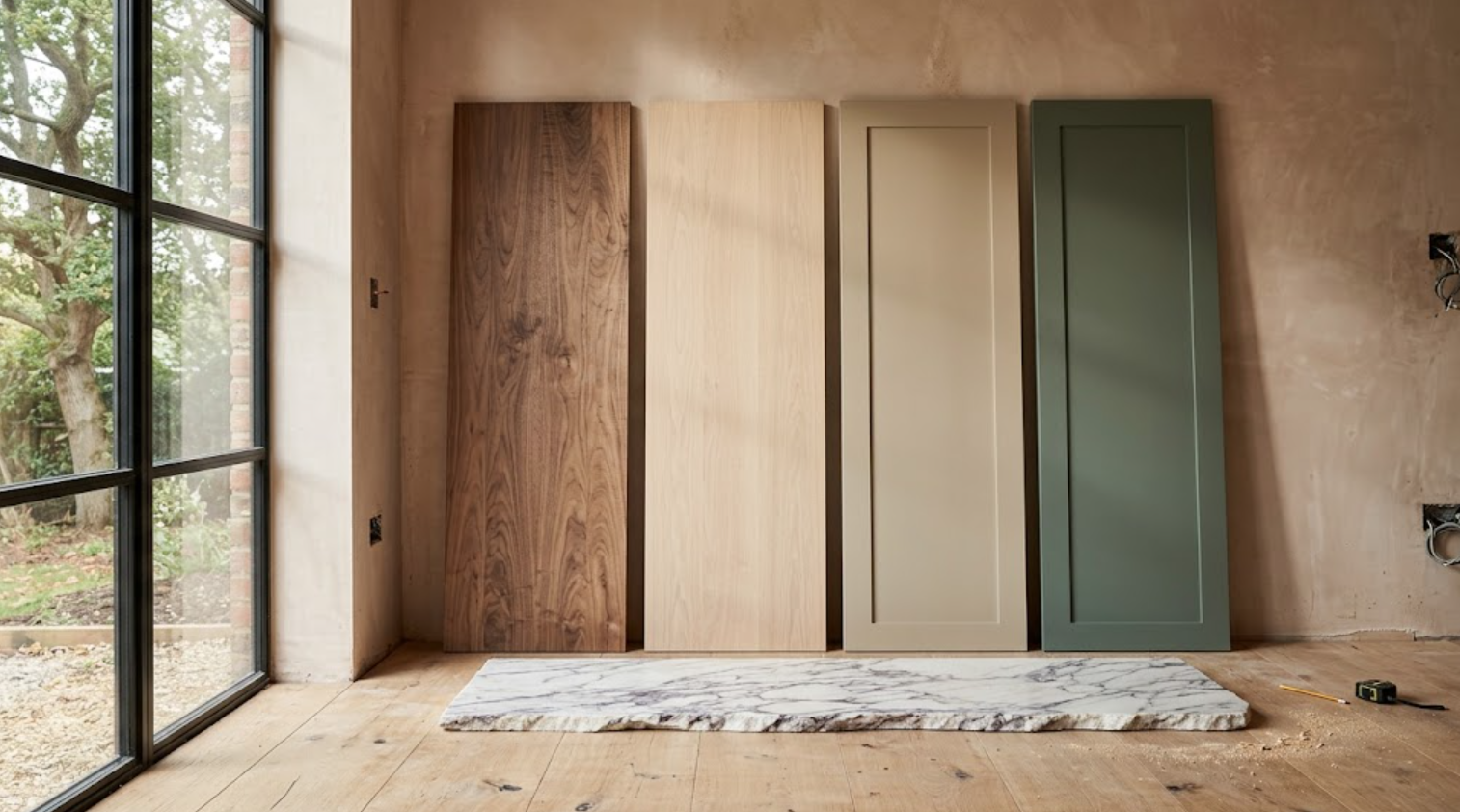
Vertically. At full scale whenever possible.
Cabinet doors are installed vertically, so laying small samples flat on a table gives incomplete information.
Stand them up. Place the wood and paint beside one another. Move them toward natural light. Put the stone nearby. Look at the flooring beneath them. Then step back.
A paint color that appears subtle on a sample may occupy most of the kitchen. A wood sample that seems quiet may become much more expressive across twenty cabinet fronts.
Scale changes perception.
How Do You Mix Cabinetry Without Making the Kitchen Look Busy?
Limit the number of major ideas.
Two cabinetry finishes are often enough. Then let stone, flooring, hardware, and architecture support them.
If the kitchen has wood cabinetry, painted cabinetry, dramatic stone, patterned tile, multiple metals, and several door styles, the visual hierarchy can disappear.
Ask which elements are doing the most visual work.
If the walnut is expressive, keep the painted cabinetry restrained. If the paint color is deep and distinctive, a quieter white oak may work better than highly varied wood. If the stone is the focal point, both cabinetry finishes may need to become calmer.
Also avoid over-separating zones.
The kitchen still needs to read as one room. Material changes should reinforce the architecture rather than divide it into unrelated pieces.
Can You Mix Door Styles Too?
Yes, but carefully.
Changing both material and door style creates a larger contrast. That can be useful if there is a clear reason.
For example, painted perimeter cabinetry might use a narrow-frame door while a walnut tall cabinet volume uses slab doors. This can help differentiate the architectural roles of the two materials.
But if the island, perimeter, pantry, and tall wall all use different finishes and different door profiles, the kitchen can become fragmented quickly.
Usually, one variable should remain consistent.
Perhaps the door style changes but hardware remains related. Or materials change while reveal widths and cabinet proportions stay consistent.
Continuity should still be visible.
How Should Hardware Connect Wood and Painted Cabinetry?
Hardware can act as a bridge.
Using the same metal family across both materials can help the room feel coherent.
That does not mean every pull needs to be identical.
A large walnut appliance panel may require a substantial pull. A small painted drawer may use a shorter version.
The form and scale can change. The metal tone creates continuity.
Bronze can add warmth to both painted and natural wood cabinetry. Nickel can create a cooler, more precise relationship.
Integrated pulls may work on slab cabinetry while decorative hardware appears on framed painted doors.
Again, the relationship matters more than exact repetition.
What About Integrated Appliances?
This is where material placement becomes especially important.
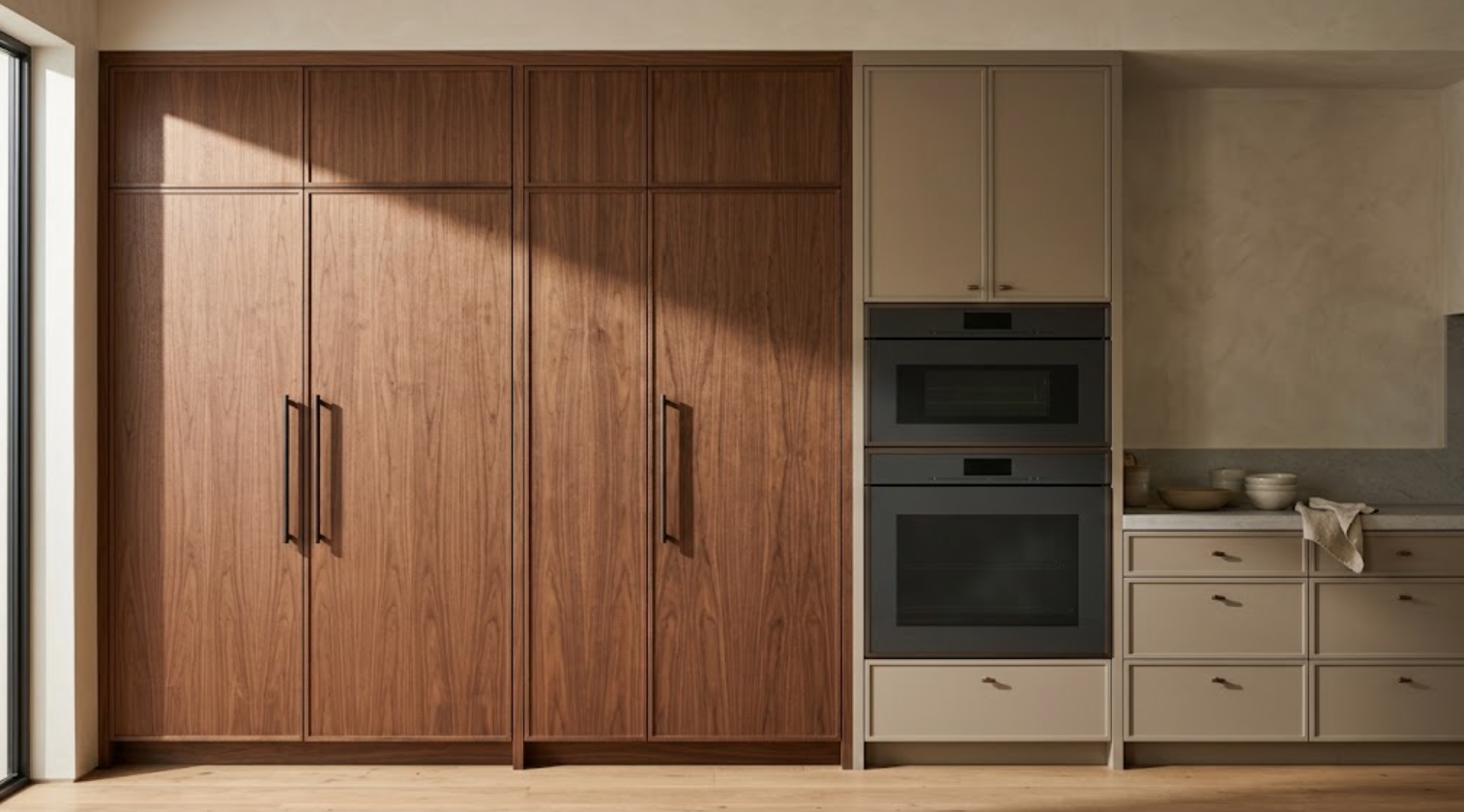
A refrigerator hidden behind matching wood panels can turn an appliance wall into one architectural volume. If the surrounding cabinetry is painted, the wood becomes even more distinct.
The opposite can work too.
A mostly wood kitchen may use painted tall cabinetry to contain appliances and reduce the amount of visible grain.
Appliance panels need to be coordinated with the surrounding cabinet dimensions:
Grain direction.
Hardware.
Reveal widths.
Ventilation.
Door swing.
Material hierarchy should never interfere with appliance function.
How Should the Countertop Work With Two Cabinetry Finishes?
The countertop often becomes the material that visually connects them.
Using one stone across wood and painted cabinetry can create continuity.
For example, a warm honed quartzite may sit comfortably over painted perimeter cabinets and continue onto a walnut island. The shared stone tells the eye that both cabinetry finishes belong to the same kitchen.
You can also use different surfaces, but that creates another layer of complexity.
If the cabinetry already contains significant contrast, one consistent surface may be enough.
Look closely at undertones. A stone that works beautifully with walnut may make the painted cabinetry appear unexpectedly cool.
The materials should be evaluated together.
How Should Wood Cabinetry Relate to Wood Flooring?
Avoid accidental almost-matches.
If the floor is oak and the cabinetry is another oak finish, compare them directly. They may differ in cut, tone, finish, and grain.
Sometimes clear contrast is stronger.
A lighter white oak cabinet can sit above a deeper floor. Walnut cabinetry can contrast intentionally with oak flooring. Painted cabinetry can also provide separation between two different wood materials.
The goal is not to make every wood identical. It is to make the differences look intentional.
Can the Same Wood Repeat Elsewhere in the Home?
Yes.
And this is one of the strongest reasons to use wood selectively in the kitchen.
A walnut cabinet wall can establish a material that later returns in a bar. A home office can use walnut shelves. A bathroom vanity might have walnut drawer interiors. A media built-in can use one walnut-lined niche.
This allows the wood to become part of a whole-home language without covering every surface.
Painted cabinetry can change from room to room while the wood creates continuity.
How Much Wood Is Too Much Wood?
This depends on what else is already happening in the house.
Look at:
The flooring.
Ceilings.
Doors.
Window frames.
Furniture.
Architectural millwork.
A kitchen may contain beautiful walnut cabinetry, but if the floor, ceiling, furniture, and adjacent walls are also wood, the room can become visually dense.
In that situation, painted cabinetry can create relief.
The opposite is also true. A home with plaster walls, stone flooring, and minimal wood may benefit from a larger natural cabinetry volume.
The correct amount of wood depends on context. Not a percentage.
How Do You Choose Which Material Goes on the Upper Cabinets?
You may not need many upper cabinets at all.
If upper cabinetry is part of the design, consider its visual weight.
Natural wood on both upper and lower cabinetry can make a wall feel more substantial. Painted uppers can visually lighten a kitchen with wood lower cabinetry.
Alternatively, keeping the entire elevation in one material may create a stronger architectural statement.
Open shelving can introduce another material, but it should be used carefully.
The question is not which material is “lighter.” It is how the entire elevation should read.
Can a Painted Kitchen Use Wood Only on the Inside?
Yes.
This is an effective strategy when the architecture needs a quiet exterior.
A painted appliance station can reveal a walnut interior when opened. Glass cabinetry can use a natural wood interior. A bar can be painted outside and wood-lined inside. Drawer boxes can introduce another subtle layer.
This creates material richness that is experienced through use rather than displayed everywhere.
It can be particularly effective in whole-home cabinetry because the same interior wood can repeat across several rooms while exterior colors change.
How Do You Keep a Two-Tone Kitchen From Feeling Trendy?
Design the material changes around architecture rather than a formula.
If the island is wood only because “two-tone kitchens have wood islands,” the decision may feel tied to a trend.
If the island is wood because it faces the living room and needs to read more like furniture, the decision has an architectural reason.
If walnut surrounds the integrated appliances because those elements form one tall volume, the change has logic.
If painted cabinetry appears beneath windows because the room needs visual quiet there, the material is responding to the architecture.
Choices rooted in function and architecture tend to age more naturally than choices based only on a recognizable aesthetic formula.
Should You Mix Wood and Painted Cabinetry in a Small Kitchen?
You can.
The key is keeping the material transitions simple.
A small kitchen with several alternating finishes can feel fragmented. One strong wood volume paired with painted cabinetry can work better.
For example:
A walnut pantry and refrigerator wall with painted lower cabinetry elsewhere.
A painted kitchen with one white oak island.
Keeping the stone consistent can also help connect the materials.
In smaller rooms, visual clarity matters. Use contrast strategically.
What About a Large Kitchen?
Larger kitchens can support more material variation, but they also create more opportunities for repetition.
A long wall of one wood can become visually heavy. Breaking it with a painted zone may help.
Conversely, using too many different finishes across a large kitchen can make it feel like several separate kitchens.
Think in volumes:
Tall storage.
Working perimeter.
Island.
Pantry.
Bar.
Assign materials to those larger components. That creates structure.
What Should You Look at Before Finalizing the Combination?
Look at the full elevation. Not just the samples.
Where does the material change?
Does it align with an architectural break?
Does the wood feel concentrated or scattered?
Does the paint support the stone?
How does the island look from the living room?
Does the wood relate to the flooring?
Are hardware and reveals consistent?
How do integrated appliances affect the composition?
If possible, review the kitchen in elevations or 3D.
Material changes that look good on a sample board can feel very different when repeated across an entire room.
How to Mix Wood and Painted Cabinetry in One Kitchen
The best mixed-material kitchens do not look mixed for the sake of being mixed. They look organized.
One material creates warmth. Another creates calm. The stone connects them. Hardware repeats. Cabinet proportions remain consistent. Material changes follow architectural volumes.
Natural wood appears where its grain and warmth add value. Paint appears where the room needs greater visual control.
That is the difference between a kitchen that simply uses two cabinet finishes and one where the materials actually work together.
The goal is not contrast. It is hierarchy.
Explore Wood and Painted Cabinetry With Atelier Design Society
Atelier Design Society works with homeowners, interior designers, architects, builders, and other design professionals planning premium and custom cabinetry throughout Menlo Park and the surrounding Bay Area.
At the Atelier Design Society showroom in Menlo Park, you can compare full-size natural wood and painted cabinetry finishes, door styles, construction, stone, hardware, and full-scale installations to understand how different materials behave together.
Bring flooring, stone, paint, or other project materials when possible.
Seeing them beside cabinetry in real light can make it much easier to determine which material should lead, where the transition should happen, and whether the combination supports the architecture of the room.