White Oak Kitchen Cabinets: Why Designers Continue to Specify Them
White oak has become one of the most recognizable materials in high-end residential cabinetry.
But its staying power is not simply because it photographs well.
Designers continue to specify white oak because it can do several things at once:
It introduces warmth without the visual weight of a darker wood.
It brings natural grain into a room without automatically making the cabinetry feel rustic.
It works with both slab and framed door styles.
It can sit comfortably beside plaster, stone, metal, painted cabinetry, and a wide range of flooring.
Depending on how the wood is cut and finished, the same species can support very different architectural directions.
That flexibility is a major reason white oak continues to appear in contemporary kitchens, transitional remodels, custom homes, and whole-home cabinetry projects.
For homeowners, architects, and interior designers considering white oak kitchen cabinets, the important question is not simply whether white oak is popular.
It is understanding what kind of white oak is being specified, how it will be finished, how much natural variation to expect, and whether the material actually supports the architecture of the room.
Why Is White Oak So Popular in High-End Kitchen Design?
White oak offers a useful balance between warmth and restraint.
Compared with walnut, it generally feels lighter. Compared with painted cabinetry, it introduces more visible natural variation. Compared with more expressive cuts of oak, certain selections can feel considerably quieter.
That makes it adaptable.
A designer can use white oak across a large cabinetry wall without necessarily making the room feel dark. It can create contrast against painted cabinetry without becoming visually disconnected.
It can also work well in homes where natural light and exterior views are important because the material tends to respond visibly to changing daylight.
Another reason designers continue to use it is that white oak does not depend on decorative detailing to create character.
On a simple slab door, the grain itself can provide enough visual interest. On a narrow-frame or Shaker-style door, the wood adds another layer without eliminating the architectural profile.
The material is versatile because it can either lead the room or remain relatively quiet.
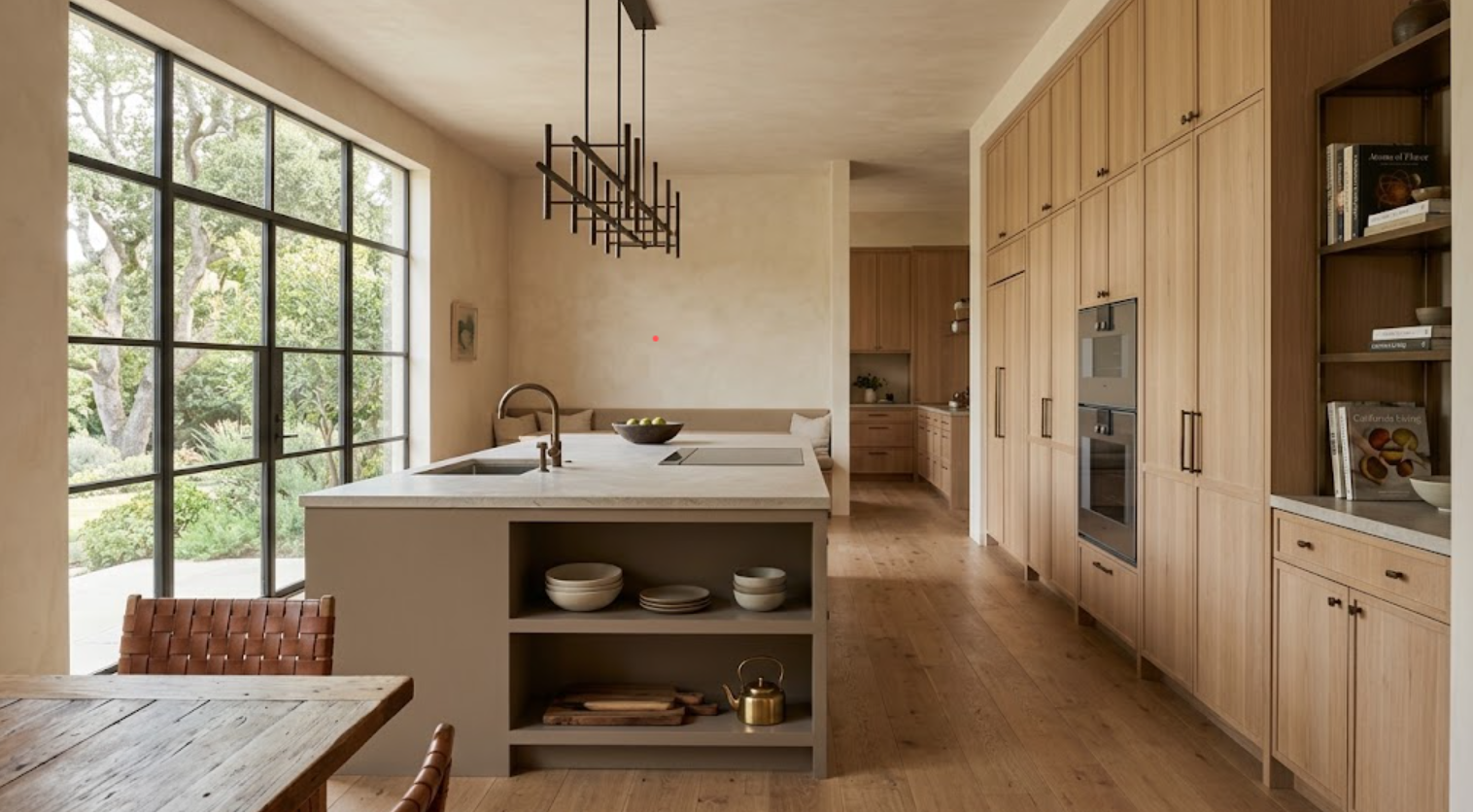
Is All White Oak Cabinetry the Same?
No.
This is one of the most important things to understand.
“White oak” describes the species. It does not tell you exactly what the finished cabinetry will look like.
The appearance can change significantly depending on:
How the wood is cut.
Whether solid wood, veneer, or a combination is used.
Grain selection.
Natural color variation.
Stain.
Clear coat.
Sheen.
Panel sequencing.
Door construction.
Lighting.
Plain-sawn white oak tends to show more cathedral grain and movement. Rift-sawn white oak generally creates a straighter, more linear appearance. Quarter-sawn oak has another grain character and may show more visible medullary rays.
Those differences matter because cabinetry uses a large amount of material.
A grain pattern that feels subtle on one small sample can become one of the strongest visual elements in the room once it is repeated across tall doors, drawers, appliance panels, and finished ends.
Why Do Designers Often Specify Rift-Sawn White Oak?
Because it can make natural wood feel more architectural.
Rift-sawn white oak tends to create a straighter, more consistent grain pattern than plain-sawn material.
That can be particularly effective on slab cabinetry.
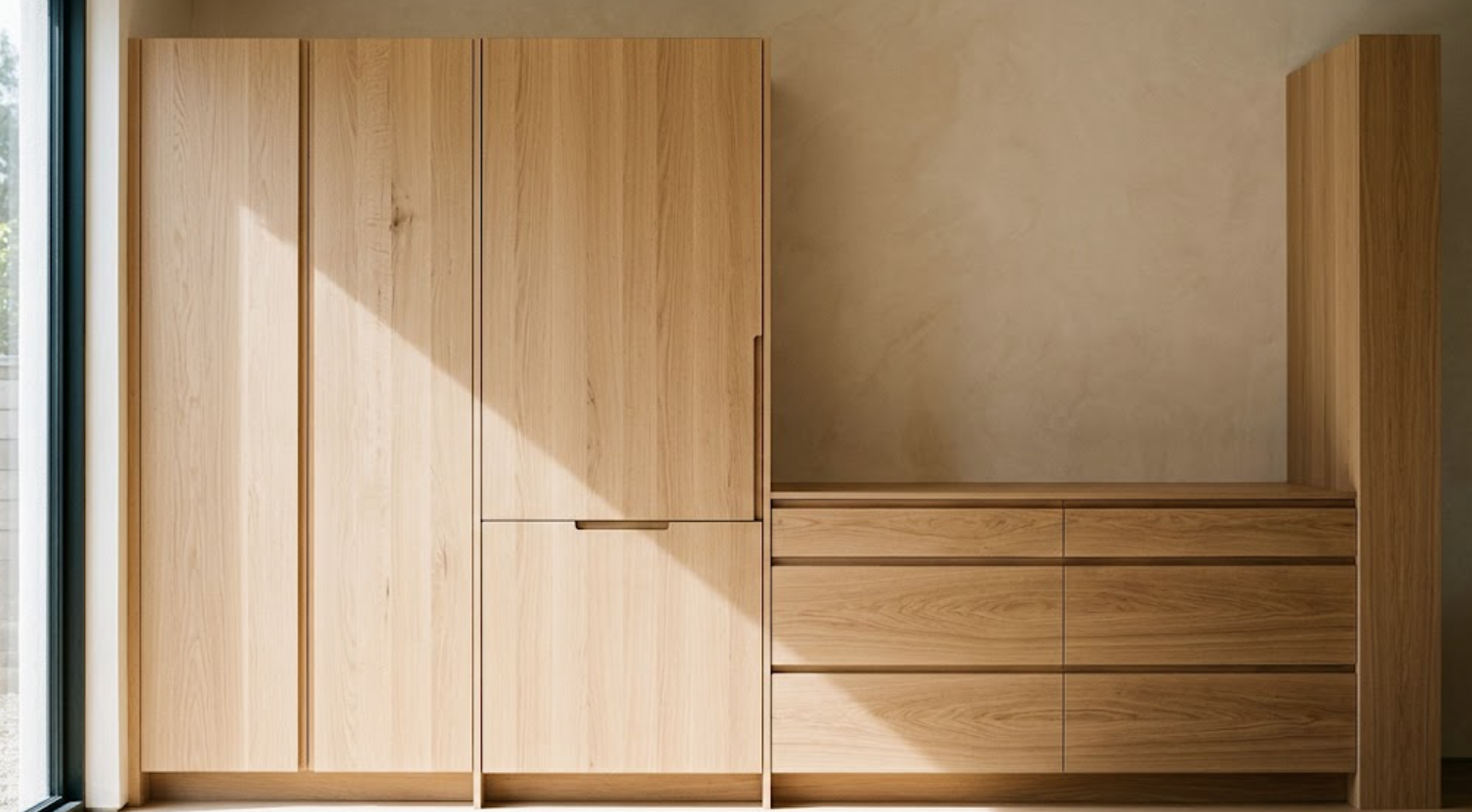
Vertical grain across tall doors can emphasize height. Horizontal grain across wide drawers can reinforce long, clean lines. Across an integrated refrigerator wall, the material can create a calm continuous surface.
This is useful in contemporary interiors where designers want visible natural wood but do not want the cabinetry to become visually busy.
It can also help when the kitchen already contains another expressive material, such as quartzite.
The oak contributes texture. The stone can carry more of the movement.
That division of roles often creates a stronger material hierarchy.
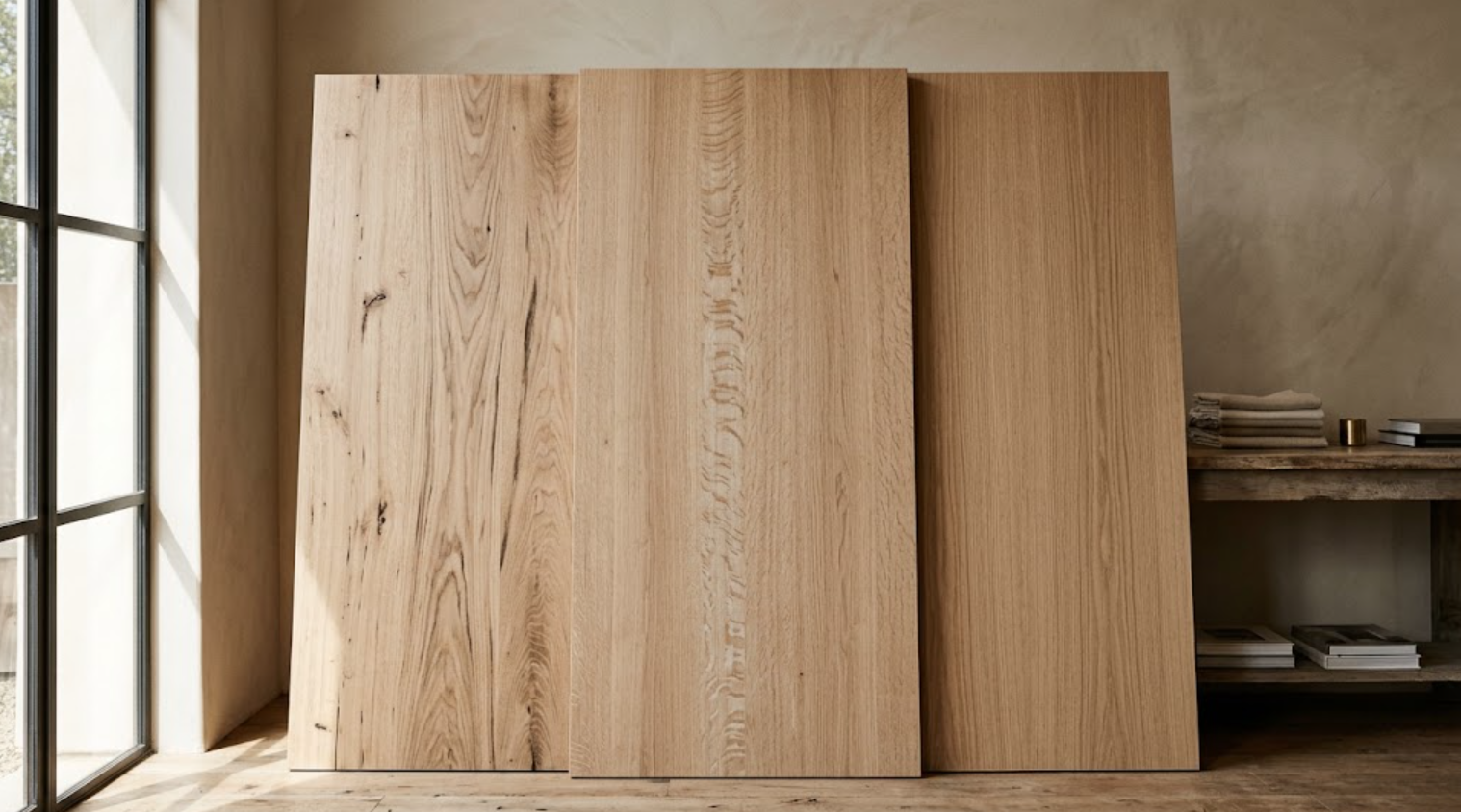
What Finish Works Best on White Oak Cabinets?
There is no universal finish.
The right finish depends on what the design needs the oak to do.
A clear or lightly toned finish can preserve much of the natural appearance. A pale finish can reduce some warmth and create a quieter effect. A slightly warmer stain can help the cabinetry relate to flooring or other woodwork. A deeper stain can move white oak into a completely different visual category.
The challenge is avoiding a finish that fights the material.
For example, aggressively gray stains can flatten or mute some of the natural warmth that makes white oak appealing. That may be intentional in a particular design. But it should be a deliberate choice.
The same is true of heavily yellow or orange finishes.
White oak can become much warmer once a topcoat is applied. A raw sample should never be assumed to represent the final cabinetry.
Finished samples matter. And they should be evaluated vertically, in the actual lighting conditions whenever possible.
How Does White Oak Change Under Natural Light?
Considerably.
White oak is particularly responsive to its surroundings.
In cooler morning light, it may appear relatively neutral. In warm afternoon sun, golden undertones can become more visible. Next to cool gray stone, the wood can appear warmer. Beside warm plaster, it may feel more subdued.
Flooring can also change the way the cabinetry is perceived.
This matters in Bay Area homes with significant natural light or strong indoor-outdoor connections.
Cabinetry is not viewed under one fixed lighting condition. It changes throughout the day.
That is why designers often evaluate samples near windows, beside stone, and against flooring rather than relying entirely on showroom lighting.
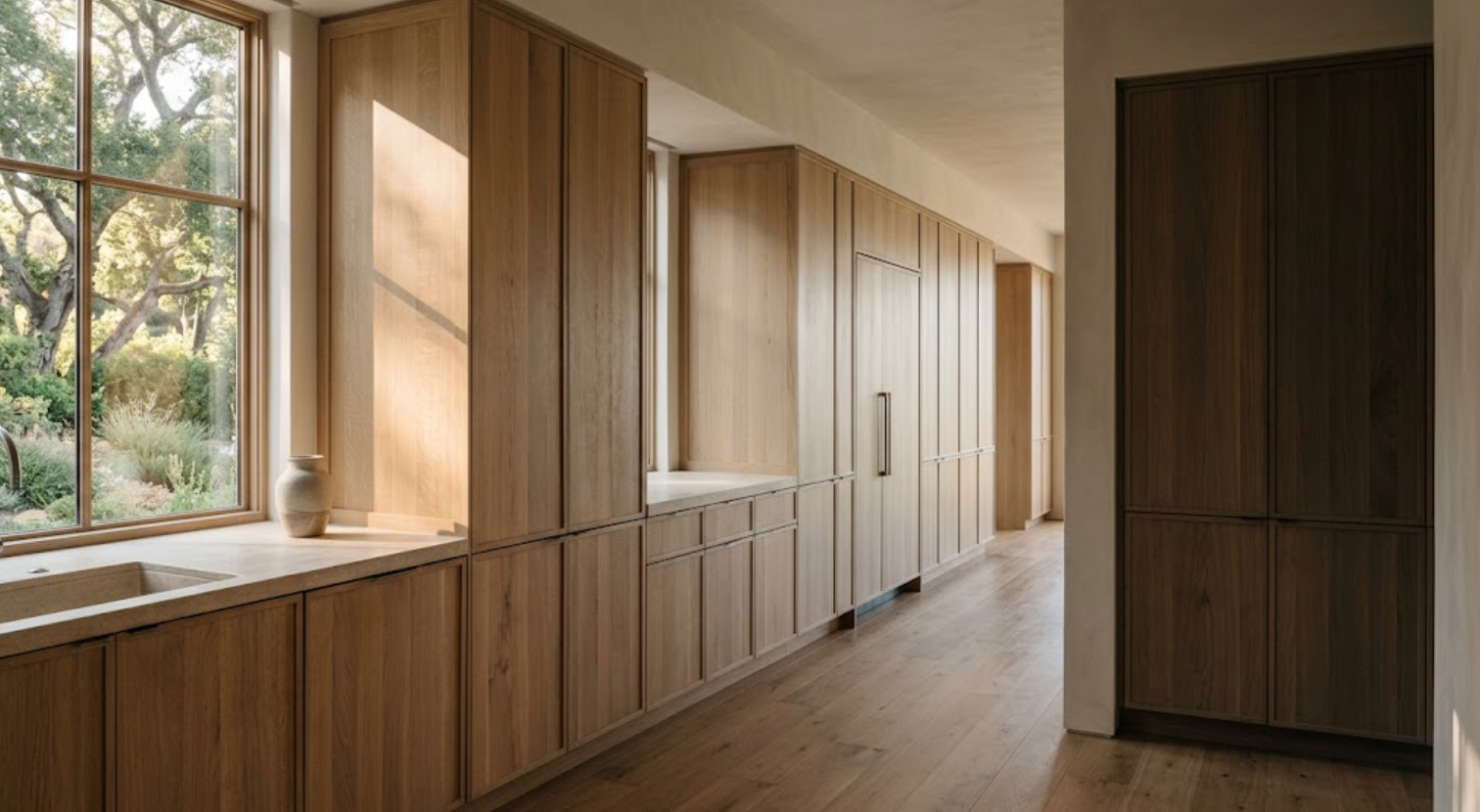
Does White Oak Work Better With Slab or Framed Cabinet Doors?
Both.
But they use the material differently.
Slab doors give the wood the largest uninterrupted surface. That makes grain direction, veneer selection, and natural variation especially important.
A slab white oak wall can feel very quiet if the grain is linear and the reveals are controlled.
Framed doors introduce another layer of visual detail. A narrow-frame profile can create subtle shadow while still allowing the grain to remain visible. A more substantial Shaker profile can make the cabinetry feel more transitional or furniture-like.
The architecture should help determine the direction.
A highly contemporary residence may benefit from broad slab panels. An established home with more architectural detailing may support a restrained framed door.
There is no rule that white oak needs to look minimalist. The species can support several design languages.
How Much Natural Variation Should You Expect?
More than a digital rendering usually suggests.
Natural wood varies. That includes white oak.
Even when the grain is relatively controlled, boards and veneers may differ in color, density, mineral character, and grain pattern.
That variation is not automatically a defect. It is part of the material.
The important question is how the variation is managed.
A broad cabinetry elevation should feel composed rather than random. Grain direction should be considered. Important appliance panels should relate to adjacent doors. Wide drawer banks may benefit from intentional sequencing. Finished end panels should feel connected to the elevation.
The goal is not artificial uniformity. It is controlled natural variation.
How Should Grain Direction Be Planned?
Before fabrication.
This is especially important with slab cabinetry.
Vertical grain can create height across tall pantry or refrigerator panels. Horizontal grain can reinforce wide drawer banks. Changing grain direction can also help separate different architectural zones.
But it needs a reason.
If some doors run vertically, others horizontally, and adjacent panels change direction without logic, the elevation can become unnecessarily active.
For a material as linear as rift-sawn white oak, the grain lines effectively become part of the architectural drawing.
They deserve the same level of attention as cabinet proportions.
What Countertops Pair Well With White Oak Cabinetry?
Many surfaces can work.
The better question is what role the countertop should play.
If the white oak is relatively quiet, a more expressive quartzite can become the focal material. If the oak has warmer movement or the architecture already contains several natural materials, a quieter stone may create better balance.
Honed limestone-like surfaces can make white oak feel warm and architectural. Quartz can create a cleaner, more controlled field. Quartzite can introduce natural movement.
The undertones matter.
A very cool stone may make the oak appear significantly warmer or more yellow. A warm cream stone may soften that contrast.
Material samples should be placed together at scale. The relationship is easier to understand physically than through separate digital images.
What Paint Colors Work With White Oak?
White oak can support a broad palette. But the undertones need to be considered:
Warm mushroom.
Mineral green.
Soft taupe.
Charcoal.
Muted blue-gray.
Warm off-white.
These can all work depending on the specific oak finish, stone, flooring, and lighting.
A designer may use paint to create contrast.
For example, white oak tall cabinetry paired with a darker painted island. Or painted perimeter cabinetry with a white oak island.
The important part is hierarchy.
Using multiple cabinetry materials can create depth. Using too many unrelated materials can make the room feel fragmented.
Should White Oak Cabinets Match White Oak Flooring?
Not necessarily.
In fact, exact matching can be difficult.
The flooring may use:
A different cut.
A different stain.
A different finish.
Different board widths.
More variation.
More knots.
A floor and cabinetry described as “white oak” can still look significantly different.
That is not always a problem. Contrast can work beautifully.
Light white oak cabinetry over a slightly deeper floor may create separation. Painted cabinetry can act as a buffer between wood surfaces.
If cabinetry and flooring are intended to feel closely related, compare the actual samples directly.
Do not rely on the species name alone.
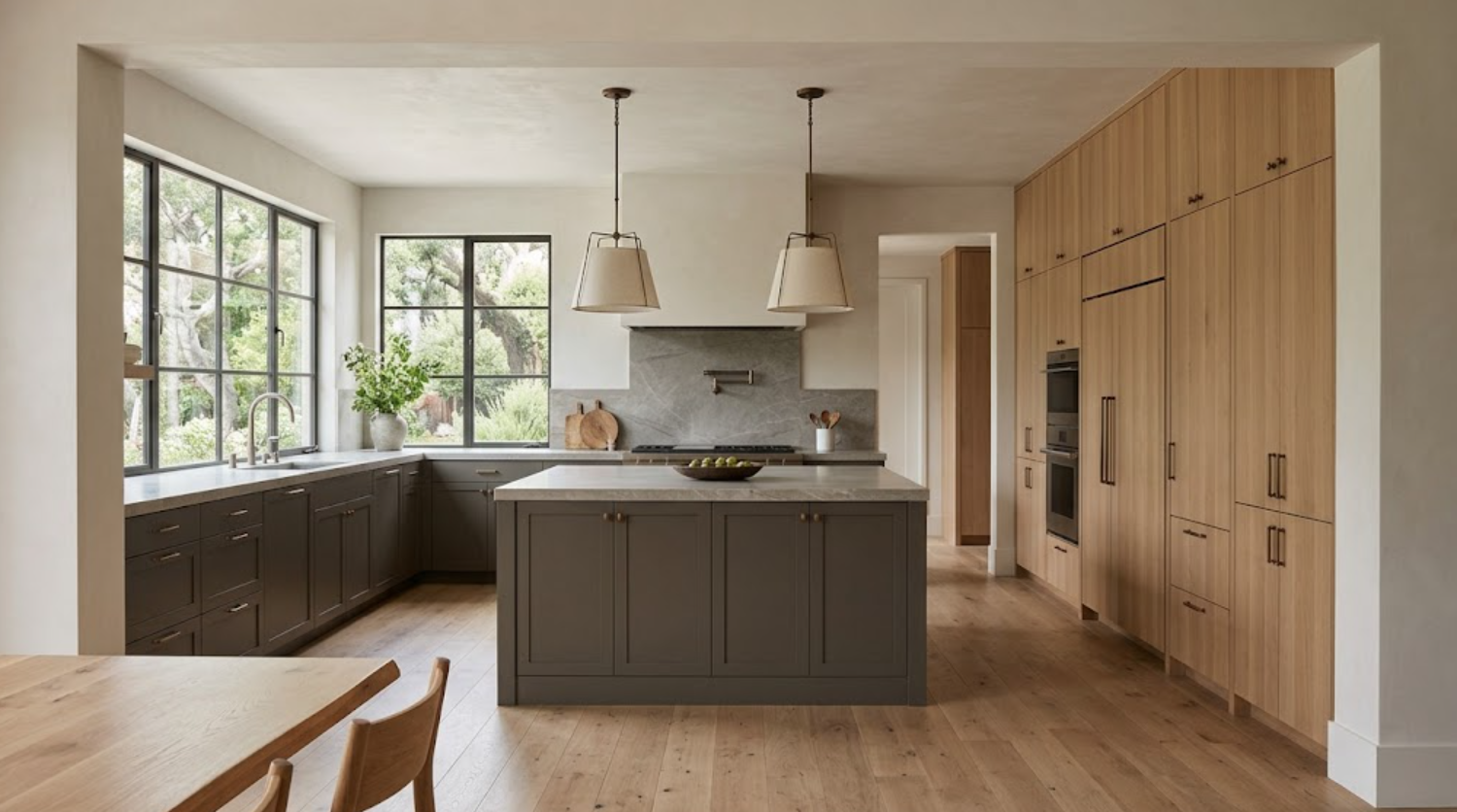
Does White Oak Work With Integrated Appliances?
Very well.
Large white oak panels can conceal refrigeration and allow the grain to continue across a tall cabinetry wall.
This can create an especially quiet architectural effect.
But appliance integration requires precise planning:
Panel dimensions.
Ventilation.
Door swing.
Hinge clearances.
Hardware.
Adjacent cabinet widths.
Grain direction.
All need to be coordinated.
If a refrigerator panel sits beside a pantry door, those surfaces need to feel related even though one is attached to an appliance and the other is not.
The cleaner the final wall appears, the more technical work usually happened before installation.
Can White Oak Be Used Throughout an Entire Home?
Yes, but that does not mean it should cover every cabinet.
Whole-home continuity usually works better through controlled repetition.
A white oak kitchen can establish the primary wood language. The same material might appear in a bathroom vanity. A wardrobe could use white oak interiors with painted exteriors. A home office may use white oak shelving inside darker cabinetry. A bar could combine white oak with glass and a deeper stone.
This creates continuity.
Repeating the exact same white oak door and finish in every room can become monotonous.
The strongest whole-home cabinetry strategy usually allows the material to change roles.
Is White Oak a Trend?
White oak is certainly prominent in current residential design.
That does not mean the material itself is inherently trendy.
Oak has been used in architecture, furniture, flooring, and cabinetry for a very long time.
What can date is a particular treatment:
An aggressively pale finish.
A very specific door profile.
A heavily repeated combination of white oak, one particular stone, and one particular hardware style.
The material itself has much more range.
A white oak kitchen can feel contemporary today and still age well if the proportions, finish, construction, and relationship to the house are thoughtful.
Designing around the architecture generally gives a material more longevity than designing around a trend image.
How Do You Keep White Oak From Looking Too Generic?
Use it specifically.
Do not select “light oak kitchen” as the entire concept.
Decide:
What kind of oak.
What cut.
What grain direction.
What finish.
Where it appears.
What it is paired with.
How the cabinetry is constructed.
How appliances are integrated.
How the cabinet elevations are proportioned.
How it meets walls and stone.
That specificity separates a carefully designed white oak kitchen from one that simply follows a familiar aesthetic.
The material should respond to the project. Not the algorithm.
What Should You Look for When Comparing White Oak Cabinetry in Person?
Look beyond color:
Study the grain.
Ask which cut is being shown.
Look at several doors together.
Open cabinets.
Examine edge treatment.
Look at finished end panels.
Compare interior and exterior materials.
Notice sheen.
Move the sample toward natural light.
Put it beside the stone.
Compare it with flooring.
If integrated appliances are part of the project, look at full-height panels.
A small sample can help begin the conversation. It should not be the entire conversation.
What Should You Ask Your Cabinetry Partner?
Ask how the white oak is specified:
Is it plain-sawn, rift-sawn, or another cut?
Where is solid wood used?
Where is veneer used?
How is grain direction controlled?
Can veneer sequencing be specified?
What level of color variation should be expected?
Which finishes are available?
Can stains be customized?
How are integrated appliance panels handled?
How should the finished cabinetry be maintained?
These questions make the material more predictable without trying to remove the natural variation that gives it character.
White Oak Kitchen Cabinets: Why Designers Continue to Specify Them
Designers continue to use white oak because it can adapt.
It can be quiet or expressive. Contemporary or transitional. Natural or more heavily finished.
It can dominate a large architectural wall or appear only as an accent. It can sit beside expressive stone or support a restrained palette. And it introduces the depth of natural wood without necessarily making a kitchen feel heavy.
But white oak works best when the specification goes beyond the species name:
The cut matters.
The finish matters.
Grain direction matters.
Natural variation matters.
Lighting matters.
The surrounding materials matter.
The amount of white oak used in the room matters.
That is what makes the material worth specifying carefully.
Not because white oak is automatically luxurious. Because when it is selected and detailed well, it gives designers considerable control over warmth, texture, and architectural character.
Explore White Oak Cabinetry With Atelier Design Society
Atelier Design Society works with homeowners, architects, interior designers, builders, and other design professionals planning premium and custom cabinetry throughout Menlo Park and the surrounding Bay Area.
At the Atelier Design Society showroom in Menlo Park, you can compare full-size natural wood cabinetry, different white oak grain directions and finishes, painted cabinetry, hardware, construction, and complementary surfaces in person.
For a kitchen considering white oak, bring stone, flooring, paint, and other material samples when possible.
Seeing the materials together at full scale can make it much easier to determine which version of white oak actually belongs in the project.