Kitchen Cabinet Trends We Believe Will Actually Last
Kitchen cabinet trends move fast. One year, everything is bright white. Then natural oak takes over. Hardware disappears. Hardware gets bigger. Upper cabinets vanish. Fluted details appear everywhere. Islands become darker. Then lighter. Then more furniture-like.
Some of those ideas are useful. Others are simply visual signatures of a moment.
For homeowners, designers, and architects planning a high-end kitchen, the challenge is not avoiding trends completely. That usually produces rooms that feel overly cautious.
The better goal is identifying which ideas are rooted in good design principles, not just current styling.
Trends with staying power usually do at least one of three things well:
They improve function.
They respond to architecture.
They make materials feel more honest.
Those are the ideas most likely to survive after the current aesthetic cycle changes.
Here are the kitchen cabinetry trends we believe have a much better chance of lasting.
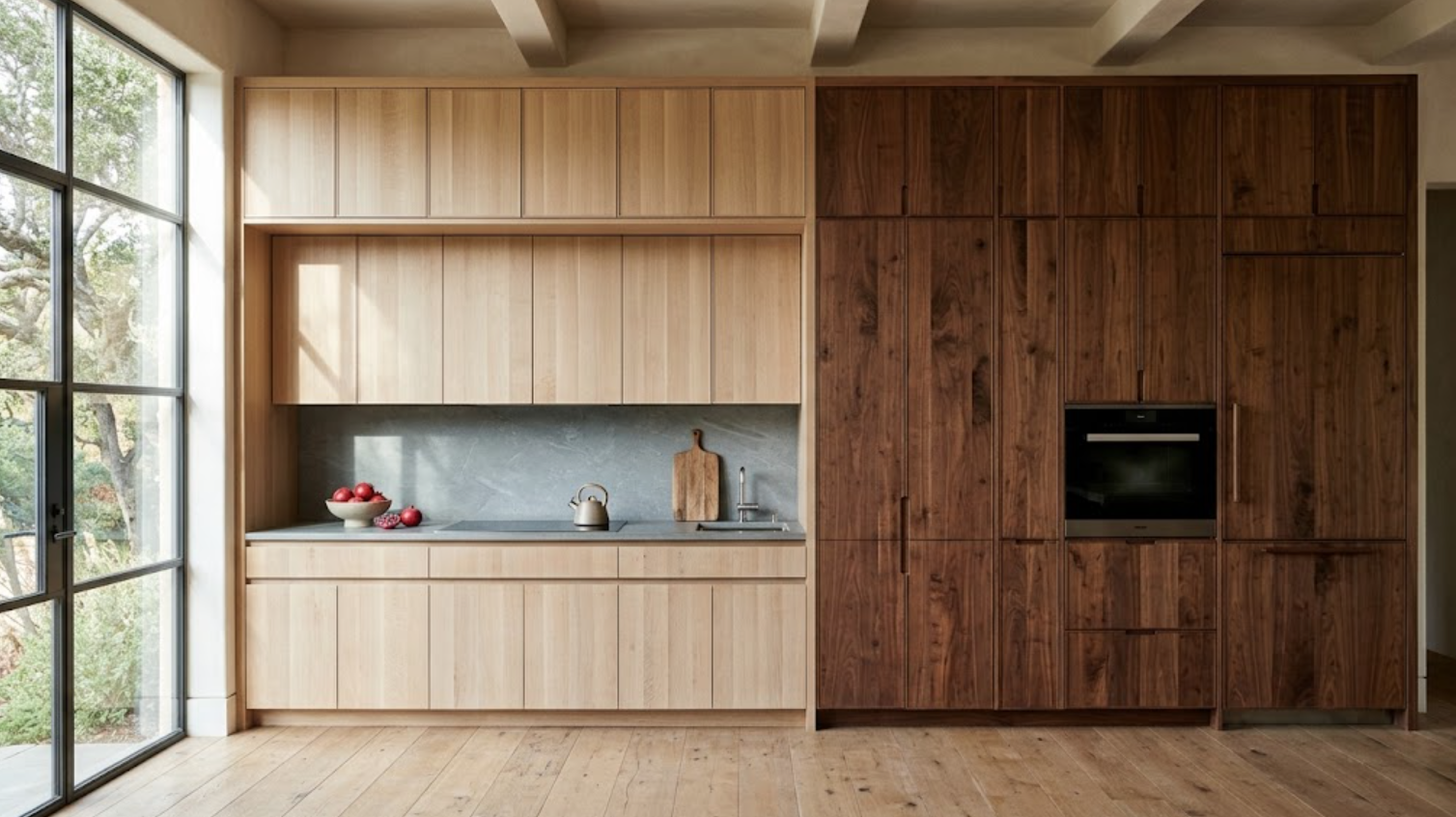
1. Natural Wood Cabinetry With Visible Grain
Natural wood is not new. What has changed is how it is being used.
For years, many kitchens moved toward highly uniform painted cabinetry. Natural wood often appeared in smaller amounts or in very heavily stained finishes.
Now designers are allowing wood to look more like wood again:
Walnut.
White oak.
Rift-sawn oak.
More visible grain.
More tonal variation.
Less pressure to make every panel look identical.
That shift has longevity because it is not really about a trend. It is about material honesty.
Natural wood ages differently from paint. It reacts to light. It develops character. It introduces texture without requiring decorative detailing.
The part that may date is the exact finish. A very pale, aggressively desaturated oak can become associated with a specific design era.
The broader idea of using well-selected natural wood is much more durable.
2. Mixed Cabinetry Finishes With Clear Hierarchy
The two-tone kitchen is not going away. The formula might.
White perimeter cabinets with a wood island can become visually predictable when repeated too often.
What has more staying power is the broader principle of using different cabinetry finishes for different architectural roles:
A tall walnut appliance wall.
Painted working cabinetry.
A white oak island.
A painted bar with a natural wood interior.
This works because the material change helps organize the room.
One finish becomes dominant. Another supports it. The kitchen gains depth without becoming busy.
That principle is flexible enough to survive changing color preferences.
The exact woods and paint tones will evolve. The strategy of using material hierarchy probably will not.
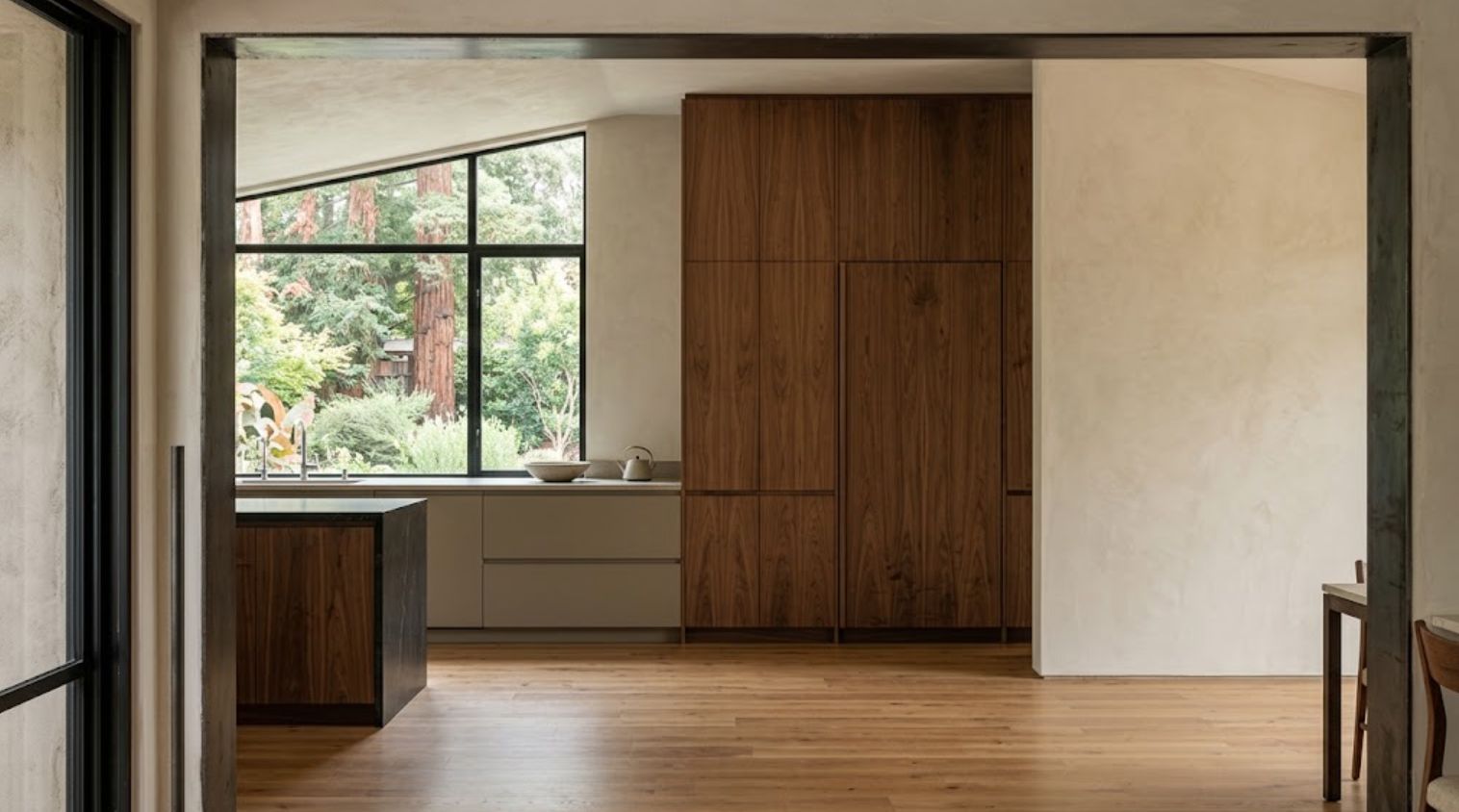
3. Cabinetry That Looks More Architectural
This may be one of the strongest long-term directions.
Cabinetry is increasingly being designed as larger volumes rather than individual boxes.
Tall appliances disappear within one continuous wall. Pantry cabinetry aligns with architectural openings. Lower cabinets run beneath windows. Cabinetry stops deliberately rather than filling every surface.
This has staying power because it improves how the kitchen relates to the house.
The goal becomes less:
“What cabinet style should we choose?”
And more:
“What should this wall become?”
That is a much more architectural question. It also tends to produce quieter rooms:
Fewer arbitrary changes.
Cleaner transitions.
More intentional negative space.
4. Fewer Upper Cabinets
Upper cabinets are not disappearing entirely. And they should not.
But the idea that every available wall needs a row of uppers is becoming less automatic.
This is likely to last because many kitchens simply feel better when storage is concentrated elsewhere.
Tall pantry cabinetry can replace some upper storage. Wide drawers can make lower cabinetry more useful. A separate pantry can absorb food storage.
That can free important walls for:
Windows.
Art.
Stone.
Plaster.
Views.
Architectural lighting.
Reducing upper cabinetry can also improve sightlines in open-plan homes.
But this only works if the storage strategy is good. Removing cabinets just to create a cleaner photograph can make the kitchen frustrating to use.
The lasting trend is not fewer cabinets. It is better allocation of storage.
5. Wide Drawers Instead of Lower Door Cabinets
This is less glamorous than a new wood finish. It may be more important.
Wide drawers are increasingly replacing traditional lower cabinets with doors and fixed shelves.
The reason is practical:
You can see more.
You can reach more.
Heavy cookware is easier to access.
Dishes can be stored lower.
Deep storage becomes more useful because items are brought toward you instead of requiring you to reach into the back.
This has a good chance of lasting because it improves everyday function.
Drawer proportions still matter. Not every lower cabinet should become one enormous drawer.
But the broader move toward more useful base-cabinet storage is not purely aesthetic.
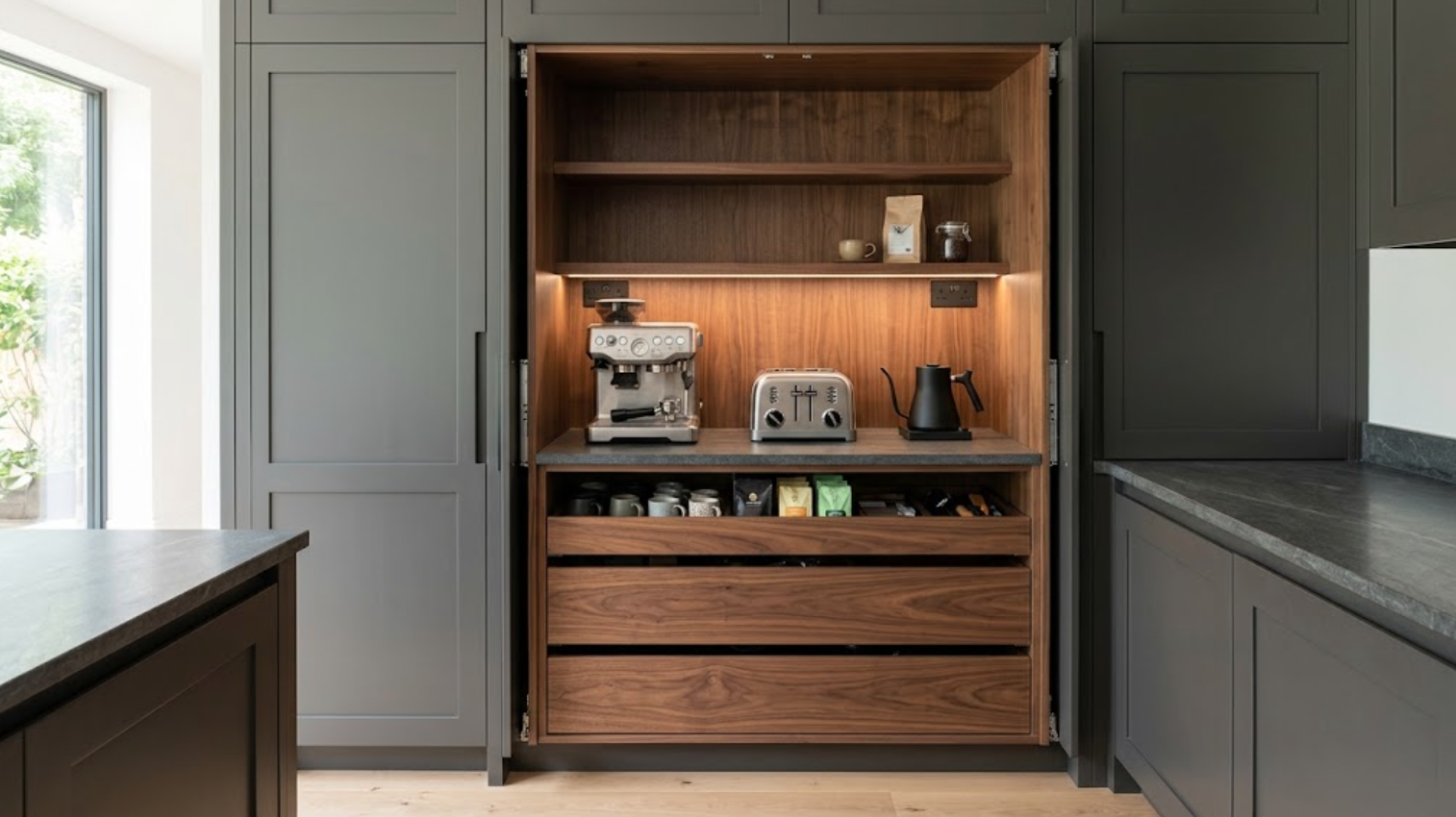
6. Concealed Appliance Stations
Small appliances are not disappearing. If anything, kitchens contain more of them:
Coffee machines.
Toasters.
Blenders.
Air fryers.
Mixers.
Charging devices.
That is why concealed appliance storage has become more relevant.
Pocket-door cabinetry can allow frequently used appliances to remain plugged in and accessible while reducing countertop clutter when they are not in use.
This trend should last because it solves a real problem. But good execution matters:
The cabinet needs adequate depth.
The doors need somewhere to retract.
Power needs to be integrated.
Ventilation may matter.
Interior surfaces need to handle actual use.
A poorly planned appliance garage becomes a cabinet nobody wants to use. A well-planned one can fundamentally improve the kitchen.
7. Quieter Hardware
This does not mean hardware-free kitchens will dominate forever.
The lasting idea is reducing unnecessary visual noise.
On broad slab cabinetry, oversized hardware can interrupt the material. That has led to more use of:
Integrated pulls.
Edge pulls.
Restrained linear hardware.
Smaller hardware where appropriate.
Push systems in selective locations.
But completely concealed hardware is not always the best answer.
A large refrigerator panel still needs something comfortable and mechanically appropriate. A drawer used every day should be easy to open.
The trend with staying power is hardware that supports the cabinetry instead of becoming the primary design feature.
8. More Complex Painted Colors
Bright white cabinetry will never disappear completely. It is too versatile.
But the shift toward more nuanced painted finishes has a strong reason behind it:
Warm gray.
Mushroom.
Taupe.
Mineral green.
Clay.
Deep charcoal.
Muted blue-gray.
These colors can interact more naturally with wood, stone, plaster, and surrounding architecture. They also create depth without requiring decorative cabinet profiles.
The exact colors will change.
“Sage green” can absolutely date as a trend when used everywhere in the same way.
What is likely to last is the idea of treating cabinetry color as part of a sophisticated material palette rather than defaulting automatically to white.
9. White Oak, But More Thoughtfully
White oak is everywhere. That alone makes people wonder when it will disappear.
The material itself probably will not. Oak has been used in architecture and furniture for centuries.
What will change is the treatment.
Very pale, washed-out white oak paired with the same beige stone and cream walls everywhere may eventually read strongly as one period.
More thoughtful white oak is different:
Rift-sawn.
Natural variation.
Warmer finishes.
Deeper stains.
Used selectively rather than across every surface.
Paired with stronger paint colors.
Combined with walnut or metal.
The lasting trend is not “light oak kitchen.” It is natural oak used with specificity.
10. Natural Stone Used More Selectively
For several years, the trend has been toward increasingly dramatic stone:
Large movement.
Bookmatched slabs.
Full-height backsplashes.
Waterfall islands.
Stone everywhere.
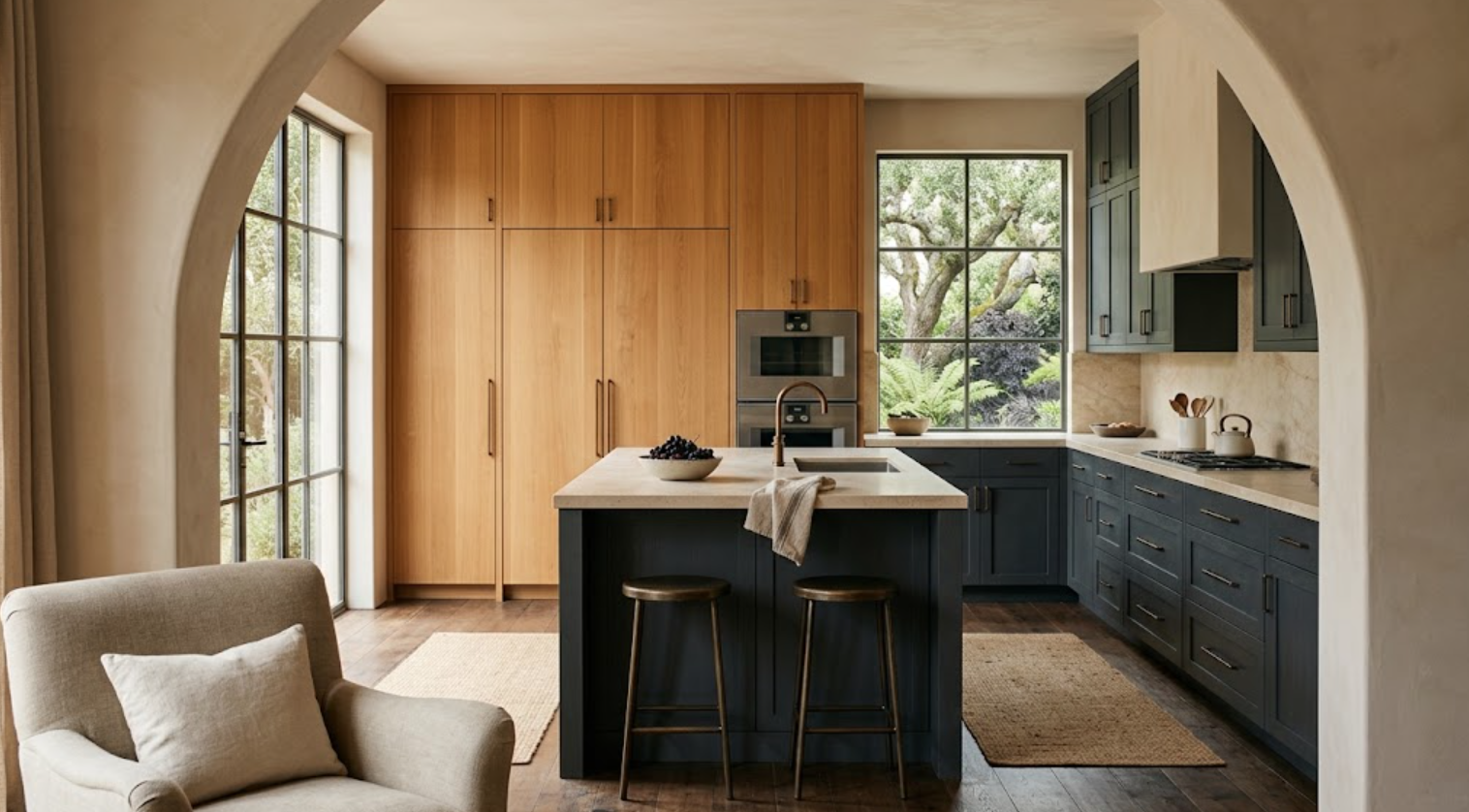
Beautiful stone is not going away. But using it more selectively may have greater staying power.
A highly expressive slab becomes more powerful when it has room to matter.
Perhaps it appears on the island and the perimeter remains quiet. Maybe the backsplash is plaster rather than another slab. A subtle stone might cover more surfaces while cabinetry carries the visual character.
The durable idea is hierarchy. Not maximum stone.
11. Cabinets That Continue Beyond the Kitchen
Whole-home cabinetry is becoming a larger part of residential design.
The kitchen may establish the material language. Then related cabinetry appears in:
Bars.
Home offices.
Bathrooms.
Wardrobes.
Laundry rooms.
Mudrooms.
Media spaces.
Dining rooms.
This is likely to last because open-plan homes and larger remodels benefit from continuity.
But the rooms should not match exactly.
A walnut kitchen can relate to a painted bar with walnut interiors. A bathroom can shift to white oak. A home office can use a deeper paint.
The lasting idea is continuity without repetition.
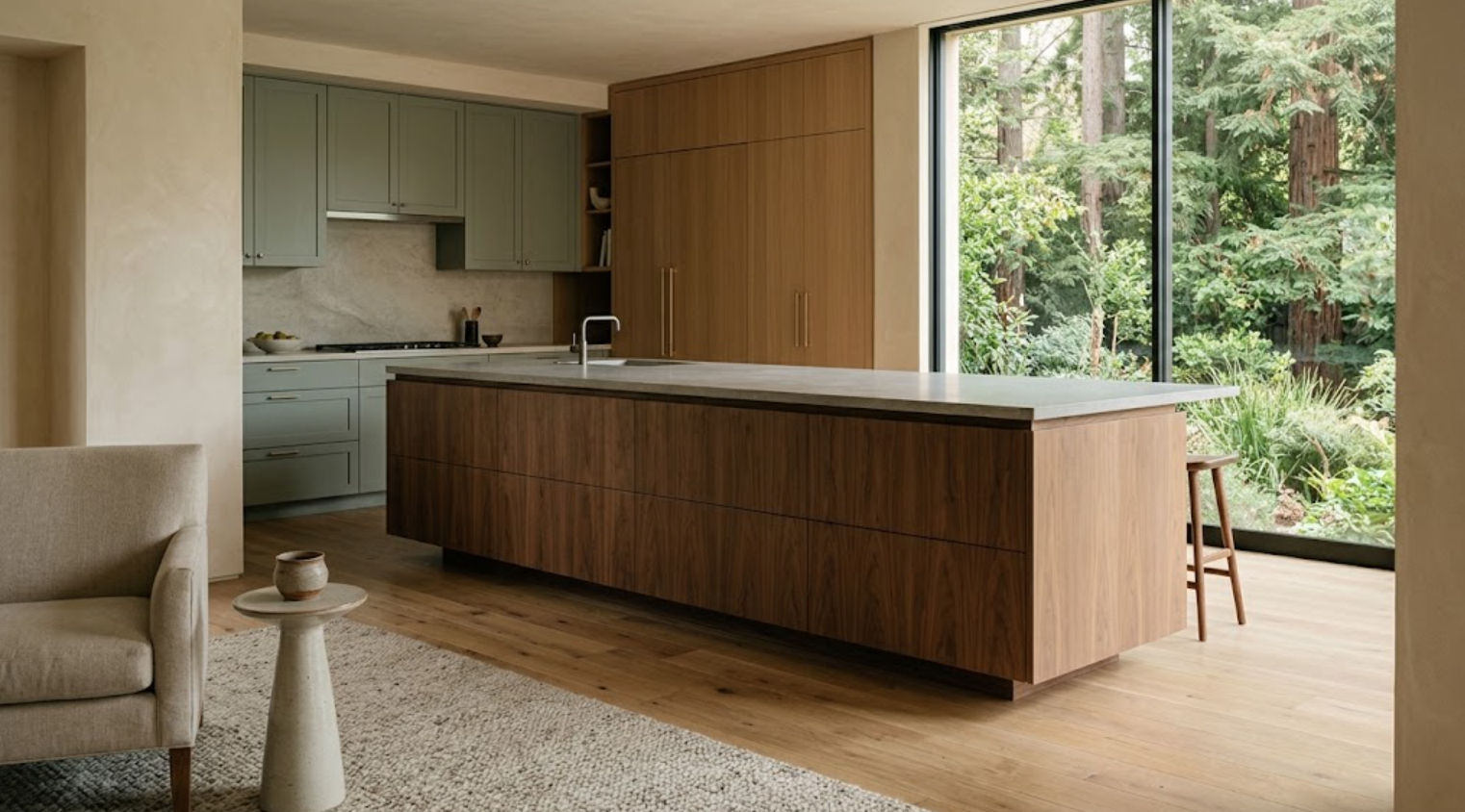
12. More Furniture-Like Islands
The island increasingly has to work from two directions.
Inside the kitchen, it is storage and workspace. From the living or dining room, it may be one of the largest visible pieces in the space.
That has led designers to treat the outer elevation more like furniture:
Broader panels.
Fewer visible cabinet divisions.
More intentional material.
Recessed bases.
Quieter hardware.
This is likely to continue because kitchens remain closely connected to surrounding living spaces.
The island is no longer viewed only as kitchen cabinetry.
What About Fluted and Reeded Cabinetry?
These details can be beautiful. They can also become very date-specific when used everywhere.
A reeded panel on one bar. A fluted island detail. Textured glass inside upper cabinetry.
These can add useful depth.
The more durable strategy is restraint. Use texture where it has a clear architectural role.
Avoid turning every cabinet front into a decorative feature simply because the treatment is popular.
Texture works best as emphasis.
Are Open Shelves Going Away?
Probably not completely.
But the era of automatically replacing upper cabinets with two floating wood shelves on every kitchen wall may soften.
Open shelves can work when they have a purpose:
Daily dishes.
A small collection.
Architectural display.
A break in a cabinetry elevation.
They work less well when they exist mainly to hold decorative objects that need to be styled constantly.
A shelf is not automatically more modern than a cabinet.
The decision should come from use and composition.
What About Dark Kitchens?
Dark cabinetry will continue to appear. The treatment will change:
Deep walnut.
Charcoal paint.
Dark olive.
Brown-black.
Smoked oak.
These materials can create extraordinary rooms when there is enough natural light and surrounding contrast.
A dark kitchen becomes difficult when every surface is equally heavy.
The more durable approach is balance:
Dark tall cabinetry with lighter plaster.
A dark island with natural wood.
Deep painted cabinetry with warm stone.
Again, hierarchy matters.
Are Handleless Kitchens Timeless?
Not automatically.
Handleless cabinetry can create a very clean effect. Integrated pulls and touch-latch systems can reduce visual interruption.
But function matters.
A touch system on a frequently used refrigerator panel may not make sense. Certain integrated pulls can become uncomfortable if the profile is too shallow.
The lasting principle is not “no handles.” It is appropriate hardware.
Some cabinetry should disappear. Some doors benefit from a real pull.
Which Trends Are Most Likely to Date Quickly?
Usually the ones that are easiest to identify in one sentence:
“White oak and beige everything.”
“Green Shaker cabinets with brass.”
“Black island, white perimeter.”
“Fluted panels everywhere.”
“Open shelves instead of uppers.”
“Waterfall stone on every island.”
None of those elements is inherently wrong. They become fragile when the entire kitchen depends on the formula.
Use an idea because it works for the house. Not because the combination currently signals luxury.
How Do You Tell the Difference Between a Trend and a Lasting Design Idea?
Ask why it works.
If the answer is mostly:
“Because this is what kitchens look like right now,”
It is probably trend-driven.
If the answer is:
It improves storage.
It responds to the architecture.
It reduces visual clutter.
It uses a material honestly.
It improves sightlines.
It makes the kitchen easier to use.
It creates better continuity with adjacent rooms.
Then the idea has a stronger foundation.
A lasting kitchen can still look current. It simply does not depend entirely on currentness.
Should You Avoid Trends Altogether?
No. That can produce kitchens with very little personality.
Trends expose designers and homeowners to new ideas:
New material combinations.
Different cabinet proportions.
Better storage mechanisms.
New hardware.
New construction capabilities.
The goal should be editing.
Take the parts that make sense. Leave the rest.
A trend becomes useful when it improves the project.
What Should Be Trend-Forward and What Should Be More Permanent?
Think about how difficult something is to change.
Cabinet construction is highly permanent.
Cabinet material is highly permanent.
Stone is relatively permanent.
Major architectural detailing is permanent.
Those decisions should have a strong relationship to the house.
Decorative hardware can change.
Stools can change.
Lighting can change.
Paint outside the cabinetry can change.
Accessories can change.
If you want to take a larger design risk, consider placing it in something that does not require rebuilding the kitchen to update later.
Kitchen Cabinet Trends We Believe Will Actually Last
The kitchen cabinetry ideas with the strongest chance of lasting are not the flashiest ones:
Natural materials.
Thoughtful wood grain.
Mixed finishes with clear hierarchy.
More architectural cabinetry.
Useful drawers.
Concealed but functional appliance storage.
Quieter hardware.
More nuanced color.
Integrated appliances.
Furniture-like islands.
Whole-home continuity.
Strategic negative space.
These ideas have longevity because they solve real design problems.
The exact expression will change. White oak will get warmer or darker. Paint colors will shift. Hardware shapes will evolve. Stone preferences will change.
But kitchens that respond to architecture, function, material quality, and the people using them will continue to feel relevant.
That is a better goal than trying to predict which cabinet color will still be trending five years from now.
Explore Lasting Cabinetry Ideas With Atelier Design Society
Atelier Design Society works with homeowners, interior designers, architects, builders, and other design professionals planning premium and custom cabinetry throughout Menlo Park and the surrounding Bay Area.
At the Atelier Design Society showroom in Menlo Park, you can evaluate natural woods, painted cabinetry, full-scale installations, hardware, storage systems, appliance integration, and different cabinetry construction approaches in person.
That makes it easier to separate the ideas that genuinely improve your kitchen from the ones that simply look familiar right now.