Library Cabinetry: Bringing Architectural Character Into the Home
A home library can be much more than a room with bookshelves.
When the cabinetry is designed well, it can change the architecture of the space. It can:
Make a wall feel deeper
Create rhythm
Frame a doorway
Wrap a window
Introduce warmth through natural wood
Add visual weight to a room that otherwise feels too open
Create storage that feels permanent rather than added later
That is the difference between placing shelving in a room and designing library cabinetry as part of the house.
For custom homes and major remodels, library cabinetry can also connect several functions at once:
Books
Display
Closed storage
Media
A writing desk
Reading areas
Art
Architectural openings
The goal is not to cover every wall with shelves.
It is to use cabinetry to give the room structure, character, and a sense of permanence.
What Makes Library Cabinetry Feel Architectural?
Usually, it is the relationship between the cabinetry and the room.
Built-in library cabinetry should not feel like freestanding bookcases pushed against a wall.
It should respond to:
Ceiling height
Window placement
Doorways
Wall depth
Baseboards
Flooring
Lighting
Adjacent rooms
The cabinetry may extend to the ceiling, or it may stop intentionally below it. It may frame an opening or create deeper end panels that give the shelving more visual weight.
The proportions matter. So do the transitions.
The way the cabinetry begins and ends can have as much impact as the shelving itself.
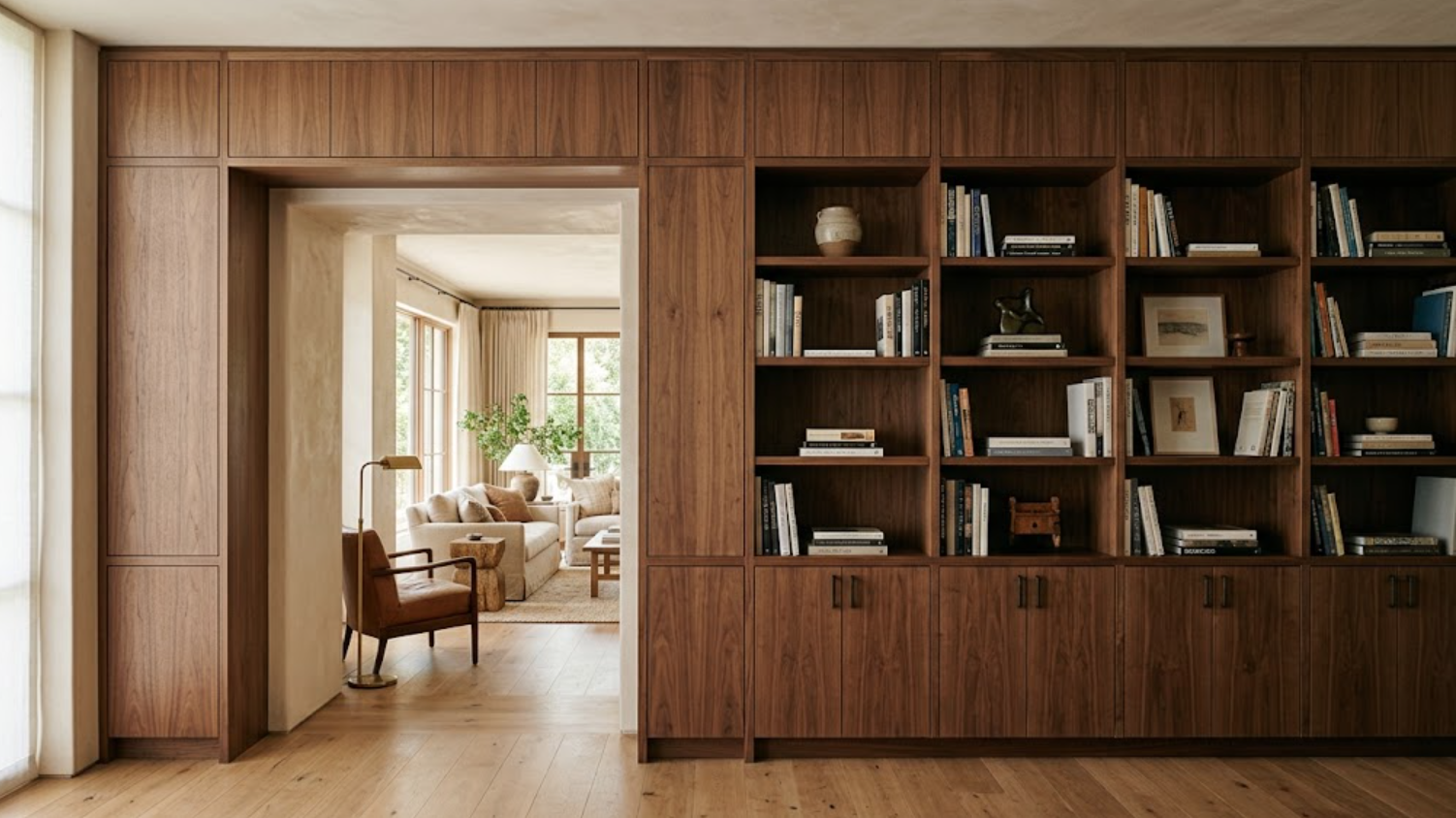
Should Library Cabinetry Reach the Ceiling?
Sometimes.
Full-height cabinetry can create a strong architectural effect. It can make the room feel more permanent and provide useful upper storage.
But it should not be automatic.
In a room with very tall ceilings, taking cabinetry all the way up may make the wall feel too heavy. Stopping below the ceiling can create breathing room.
A plaster band above the cabinetry may help maintain the architecture of the room.
In other spaces, cabinetry that reaches the ceiling may be exactly what creates the intended scale.
The decision should come from the proportions of the room, not from the assumption that more cabinetry is always better.
How Deep Should Library Shelving Be?
Deep enough for the actual collection.
Most books do not require extremely deep shelves, but some do:
Large art books
Architecture volumes
Binders
Objects
Boxes
The cabinetry should be dimensioned around what will actually be stored.
If shelves are too deep, books can look lost. If they are too shallow, larger volumes will project awkwardly.
Lower cabinetry can be deeper than the open shelves above. That can create useful closed storage while keeping the upper section visually lighter.
Depth should also relate to circulation.
A large built-in library wall can consume significant floor area if it is overbuilt.
How Much Open Shelving Should a Library Have?
Not necessarily all of it.
A library can still be a library with closed cabinetry. In fact, lower closed storage often makes the room feel calmer.
Books remain visible where they matter. Less attractive items can disappear below:
Media equipment
Files
Games
Office supplies
Extra objects
The balance between open and closed cabinetry can give the wall more structure.
It also prevents every shelf from needing to be perfectly styled.
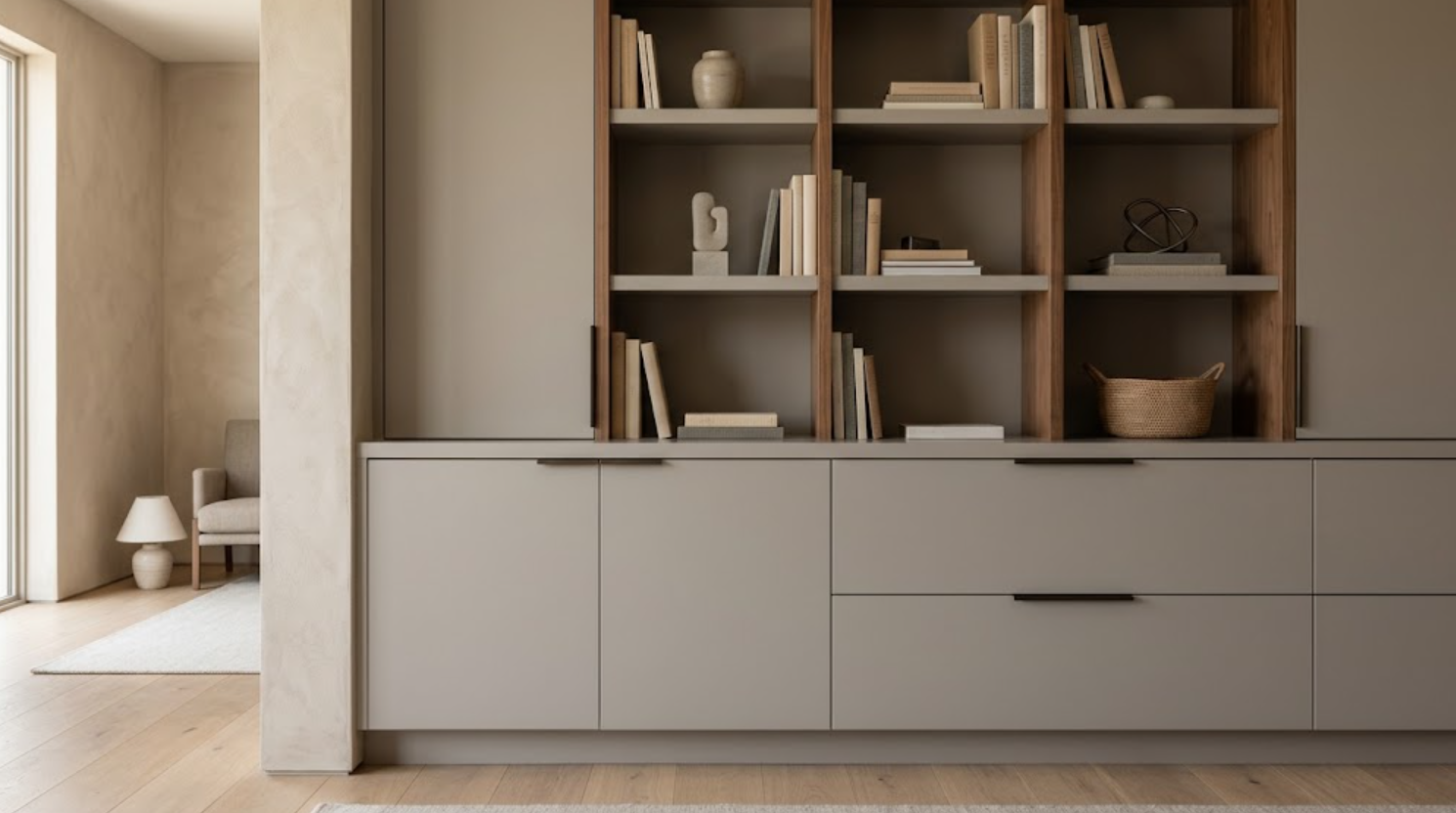
Should Library Shelving Be Symmetrical?
Not necessarily.
Symmetry can create formality. That may be appropriate in a traditional or highly ordered room.
But asymmetry can feel more natural in contemporary architecture.
One side may frame a doorway. Another may wrap a window. A built-in desk may interrupt the shelving. Closed cabinetry may occupy more space on one side. A reading niche may create a larger opening.
What matters is balance.
The wall should feel intentional. It does not need to be mirrored.
How Can Cabinetry Frame a Window?
Very effectively.
A window can become one of the strongest organizing elements in a library.
Cabinetry can:
Stop on each side of it
Wrap beneath it
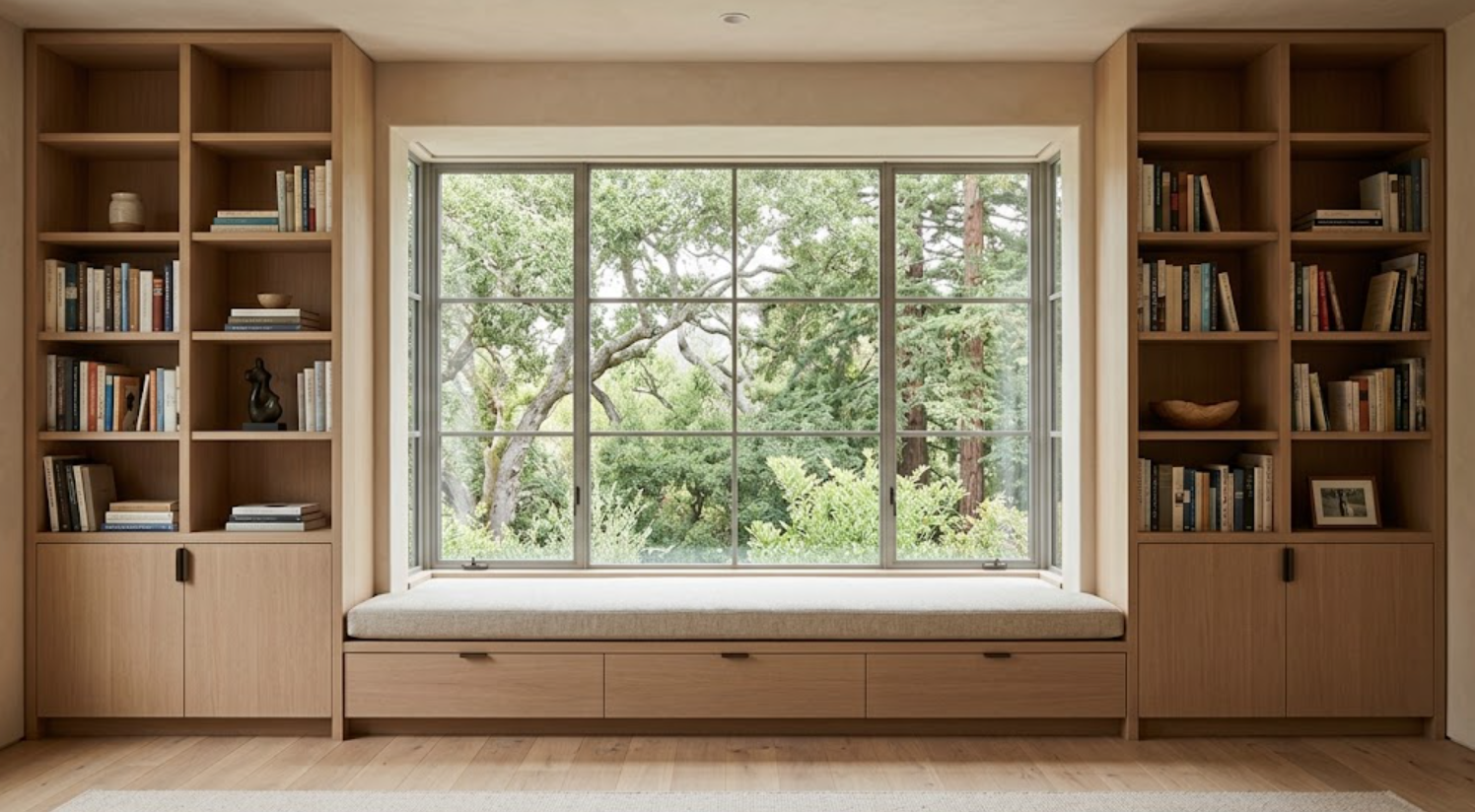
Create a built-in seat
Frame the opening with deep finished panels
This allows natural light to become part of the composition.
A window seat can also create a dedicated reading area.
But the cabinetry needs to respect:
Window trim
Heating or cooling
Floor vents
Electrical
Shade pockets
Curtains
Structural conditions
The goal is to make the window feel integrated rather than crowded.
Can a Window Seat Be Part of the Library Cabinetry?
Yes, and it can make the room more usable.
A built-in bench can create:
Reading space
Additional storage
A visual break in a long wall of shelving
The seat can include drawers below, lift-up storage, or simply remain visually light.
The dimensions matter:
Seat height
Depth
Back support
Cushion thickness
Window sill height
A window seat should be comfortable enough to use, not just attractive in photographs.
What Materials Work Best for Library Cabinetry?
Natural wood is an obvious choice.
Walnut can create depth and warmth. White oak can feel lighter and more contemporary. Painted cabinetry can make the room quieter.
A combination can work particularly well:
Painted lower cabinetry
Natural wood shelves
Natural wood full-height cabinetry with plaster around it
The strongest material choice depends on the architecture.
A library does not need to feel dark to feel substantial. Likewise, it does not need ornate millwork to feel permanent.
Material quality and proportion can create character without decorative excess.
Should the Library Match the Kitchen Cabinetry?
Not exactly, but the rooms can relate.
If walnut is already used elsewhere, the library might continue it. If the kitchen is lighter, the library could use a deeper tone from the same wood family.
Hardware can repeat. The same narrow reveal language can continue.
The library should still have a different composition.
Kitchen cabinetry is driven by appliances and work zones. Library cabinetry can be:
More vertical
More open
More rhythmic
The material language can connect while the architecture changes.
Can Dark Library Cabinetry Work?
Yes. Very well.
A library is one of the spaces where darker cabinetry can feel appropriate:
Deep charcoal
Muted green
Warm brown
Dark walnut
These can create a more intimate atmosphere.
But the room still needs balance:
Natural light
Warm plaster
Lighter flooring
Open wall area
A large window
These elements prevent the cabinetry from becoming oppressive.
The goal is depth, not darkness for its own sake.
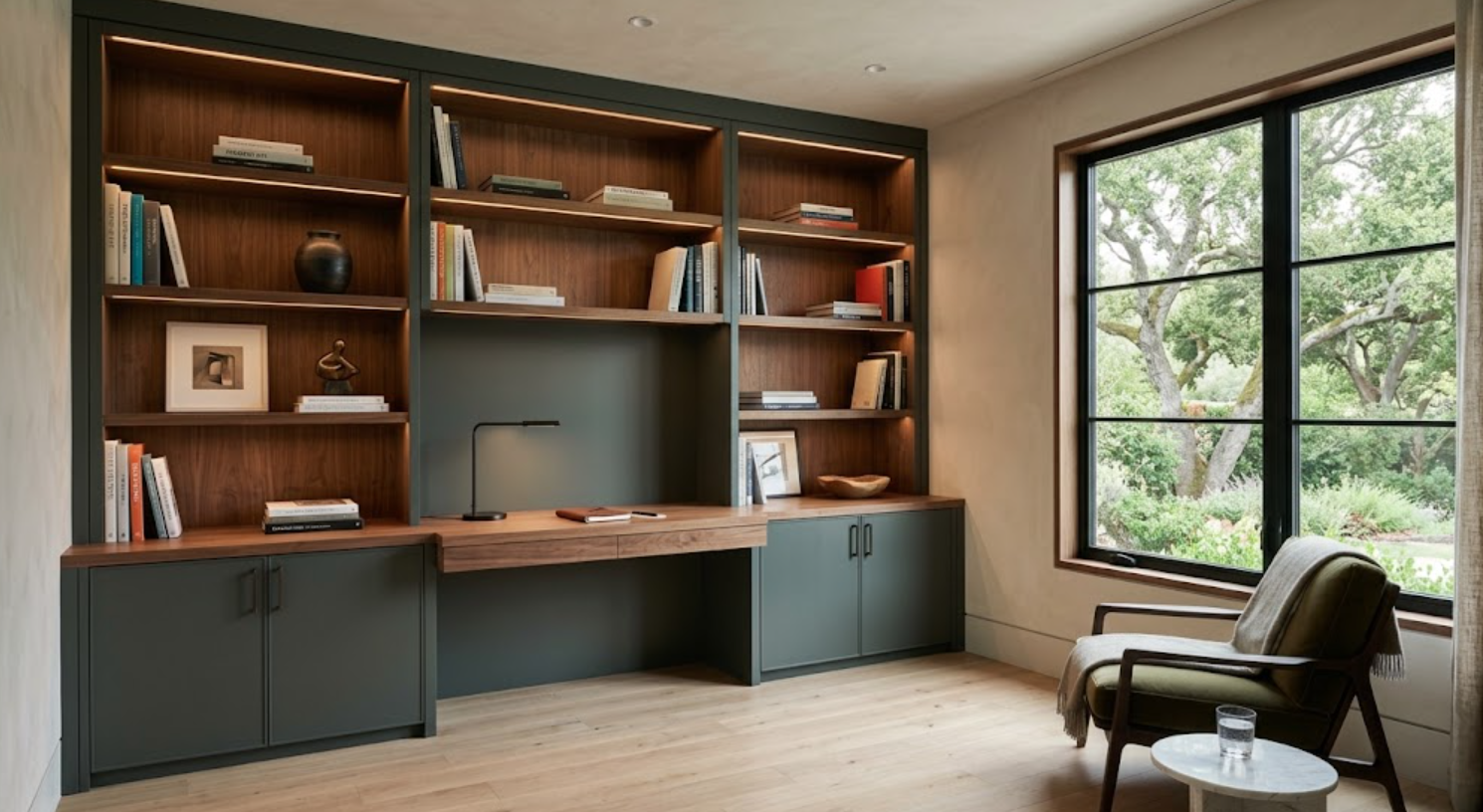
Can a Library Include a Desk?
Yes.
A built-in desk can make the room more versatile.
It may support:
Reading
Writing
Laptop work
Research
Homework
Administrative tasks
The desk can be integrated into the shelving wall, or it can sit beneath a window. A freestanding desk can also work.
The best solution depends on how formal or flexible the room should be.
If the desk is integrated, power and lighting should be planned early. The work surface should be deep enough to function comfortably, and the chair needs enough clearance.
The desk should feel like part of the cabinetry, not an awkward opening created between shelves.
How Should Lighting Be Designed in a Library?
In layers:
Ambient room lighting
Integrated shelf lighting
Reading lights
Decorative fixtures
Task lighting at a desk
The cabinetry can support several of these.
Linear lighting can wash shelves. Integrated lighting can illuminate darker niches. A picture light may highlight art.
But lighting should not turn every shelf into a display case. Books do not all need to glow.
Some shadow helps create depth.
The room should feel comfortable to read in, not staged like a showroom.
Should the Shelves Have Integrated Lighting?
Only where it adds value.
Integrated lighting can be especially useful in:
Dark cabinetry
Deep niches
Display sections
Desk areas
Glass-front cabinets
But full lighting on every shelf can become visually repetitive.
Selective lighting creates more hierarchy. It also reduces the commercial-display feeling.
The strongest library walls often have quieter zones alongside illuminated ones.
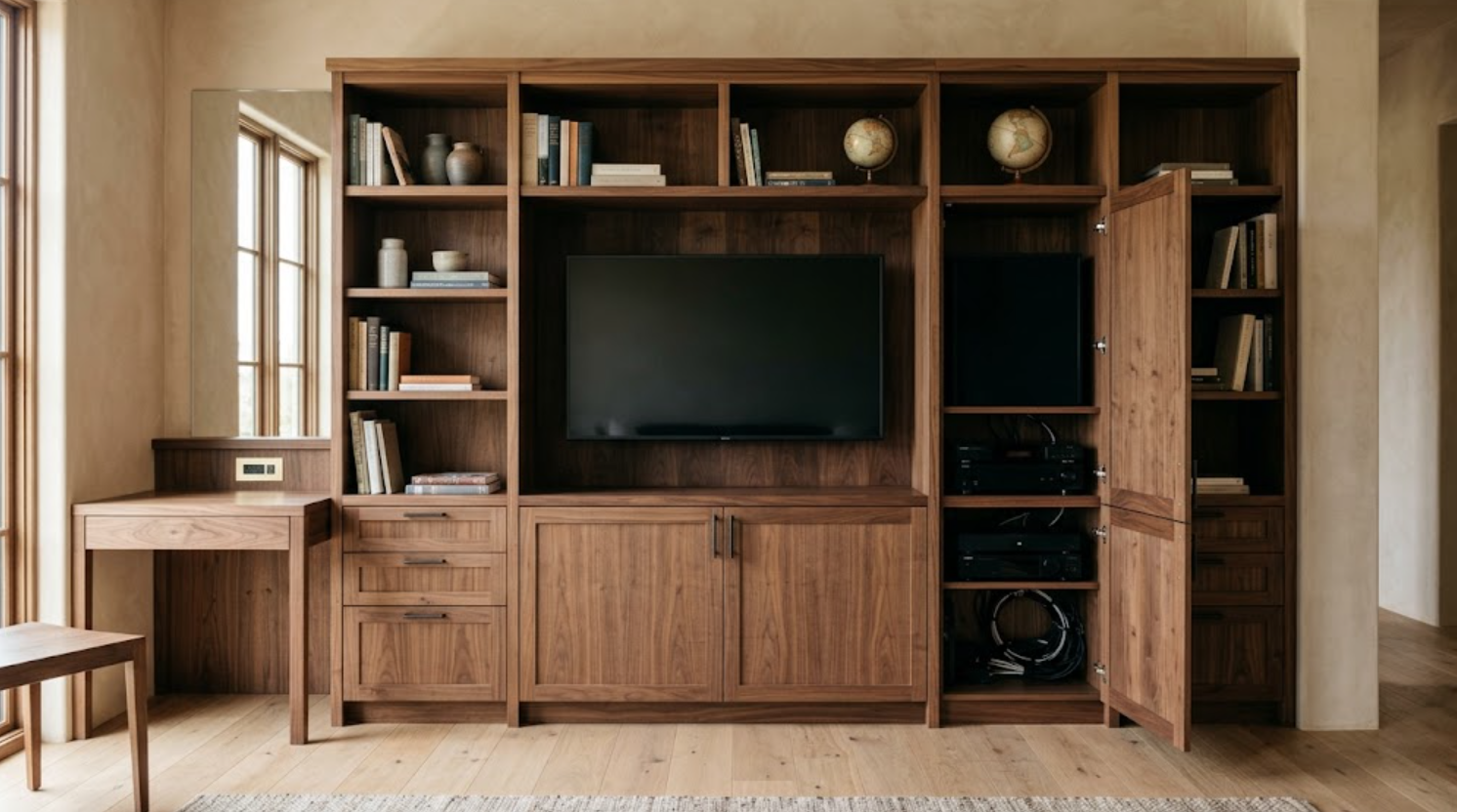
How Can Library Cabinetry Hide Technology?
Very effectively.
Library cabinetry can integrate:
Televisions
Routers
Speakers
Charging
Media equipment
A television can sit inside a recessed central bay. Doors may conceal it when it is not in use. Speakers can be incorporated discreetly.
Equipment can sit behind ventilated cabinetry. Charging can be built into drawers.
The key is technical coordination:
Power
Ventilation
Cable routing
Service access
Those conditions need to be understood before the cabinetry is built.
Can Library Cabinetry Work in an Open Living Space?
Yes. It can be especially useful there.
A library wall can give an open room more definition. It can create one strong architectural plane.
It may:
Sit behind a seating area
Frame a fireplace
Define a transition between living and dining spaces
Create a quieter reading zone within a larger room
The cabinetry can provide character without requiring a separate library room.
In these situations, closed storage becomes particularly useful because the cabinetry is constantly visible.
What About Fireplace Integration?
A fireplace can become a natural center point.
Library cabinetry may flank it, wrap it, or stop short of it.
The relationship needs to be considered carefully:
Fireplace material
Mantel condition
Television
Heat
Clearances
Ventilation
Cabinet depth
A fireplace should not simply be inserted into the middle of a bookshelf wall without coordination.
The cabinetry and fireplace should feel like one architectural composition.
Should Every Shelf Be Adjustable?
Not necessarily.
Adjustable shelves are practical, but fixed shelves can create stronger architectural rhythm.
A combination often works well.
Some fixed shelves establish proportion. Adjustable shelves provide flexibility for the actual collection.
If the cabinetry is primarily for books, adjustability may be useful. If certain niches are designed around art or specific objects, fixed dimensions can make the composition stronger.
The system should support both flexibility and visual order.
How Should Books Be Organized?
According to the homeowner.
There is no single correct system:
By subject
Author
Size
Collection
Frequency of use
Aesthetic arrangement
The cabinetry should support the collection rather than forcing it into identical cubbies.
Different shelf heights may be required. Large art and architecture books may need deeper shelves. Small paperbacks need less.
If the collection is substantial, inventorying approximate sizes before the final cabinetry design can improve the result.
How Do You Keep a Library From Feeling Too Busy?
Leave space.
This is one of the most important design decisions.
Not every shelf needs to be full. Not every wall needs cabinetry. Not every object needs to be displayed.
Negative space allows the cabinetry itself to become visible. It also gives books and objects more presence.
Closed storage helps. So does limiting materials.
A library with one strong wood, warm plaster, restrained hardware, and a carefully organized collection can feel richer than a room with excessive decorative millwork and objects.
How Does Library Cabinetry Add Character to a New Home?
By introducing depth and permanence.
New construction can sometimes feel visually flat before furniture and materials accumulate.
Library cabinetry changes that:
Deep shelves create shadow.
Wood introduces grain.
Vertical divisions create rhythm.
Built-ins establish scale.
A window seat creates a specific use.
A framed opening creates transition.
Those architectural effects can make a new room feel more settled.
The character comes from how the cabinetry shapes the space, not from trying to make new construction look artificially old.
Can Library Cabinetry Work in Contemporary Architecture?
Absolutely.
Architectural character does not require traditional detailing.
Contemporary library cabinetry may use:
Slab doors
Minimal reveals
Rift-sawn white oak
Walnut
Integrated pulls
Broad open shelving
Plaster
Concealed lighting
The character comes from proportion, material, and integration, not moldings.
A very minimal library can still feel substantial when the cabinetry has enough depth and responds carefully to the architecture.
What Should Be Planned Before Construction?
The overall library wall:
Cabinet depth
Open versus closed storage
Desk location
Media
Lighting
Electrical
Windows
Doorways
Any integrated seating
Fireplace relationships
If cabinetry will reach the ceiling, ceiling conditions should be coordinated.
If it wraps a window, shade pockets and trim need to be understood.
If the room includes a desk, power and data should be located appropriately.
The visible finish can continue developing later. The architectural relationships should not.
When Should a Cabinetry Partner Become Involved?
Before the room is fully resolved.
For new construction, library cabinetry can be developed while architectural plans are still flexible.
For a remodel, planning should happen before electrical and wall conditions are finalized.
Cabinetry can affect:
Wall dimensions
Door placement
Window relationships
Electrical
Lighting
Media
HVAC
Floor transitions
A cabinetry partner can help determine which parts of the room need to respond to the built-in early.
That is especially important when the library cabinetry is intended to shape the architecture rather than simply fill an empty wall.
Library Cabinetry: Bringing Architectural Character Into the Home
A library becomes memorable when the cabinetry does more than hold books.
It gives the room:
Structure
Depth
Rhythm
Warmth
Function
A wall of shelving can frame a doorway. A window can become a reading niche. Closed cabinetry can absorb everyday storage.
A desk can make the room productive. Media can disappear. Materials can connect the library to the rest of the residence.
The cabinetry can make the room feel established even in a newly built home.
The goal is not to create the largest possible bookshelf. It is to create architecture that happens to store books.
That is what gives a library lasting character.
Explore Custom Library Cabinetry With Atelier Design Society
Atelier Design Society works with homeowners, architects, interior designers, builders, and other design professionals planning premium cabinetry for libraries, home offices, media spaces, kitchens, wardrobes, bars, bathrooms, and other whole-home applications throughout Menlo Park and the surrounding Bay Area.
At the Atelier Design Society showroom in Menlo Park, project teams can compare natural woods, painted cabinetry, cabinet construction, hardware, shelving, interior storage, and full-scale applications while developing library cabinetry that responds to both the architecture and the way the room will be used.
For a library project, bring architectural plans when available.
It is also useful to understand the approximate book collection, display needs, media requirements, and whether the room should include a desk, seating, or other functions.
Those decisions can shape the cabinetry long before the final finish is selected.