Shaker vs. Slab Cabinets: Choosing the Right Door Style
Cabinet doors occupy more visual space in a kitchen than almost almost any other cabinetry detail.
That makes the choice between Shaker and slab doors feel like a style decision. One may seem more traditional. The other may look more contemporary. It is easy to choose based on an inspiration image and move on.
But the difference goes further than appearance. Door style affects how light and shadow move across the cabinetry, how noticeable the wood grain or painted finish becomes, how hardware reads, how the cabinetry relates to the architecture, and even how much visual activity a large wall of cabinets introduces into the room.
For homeowners and design professionals planning custom cabinetry in Menlo Park and throughout the Bay Area, the better question is not simply “Which door style do I like?” It is “Which door style makes sense for this home?”
What Is a Shaker Cabinet Door?
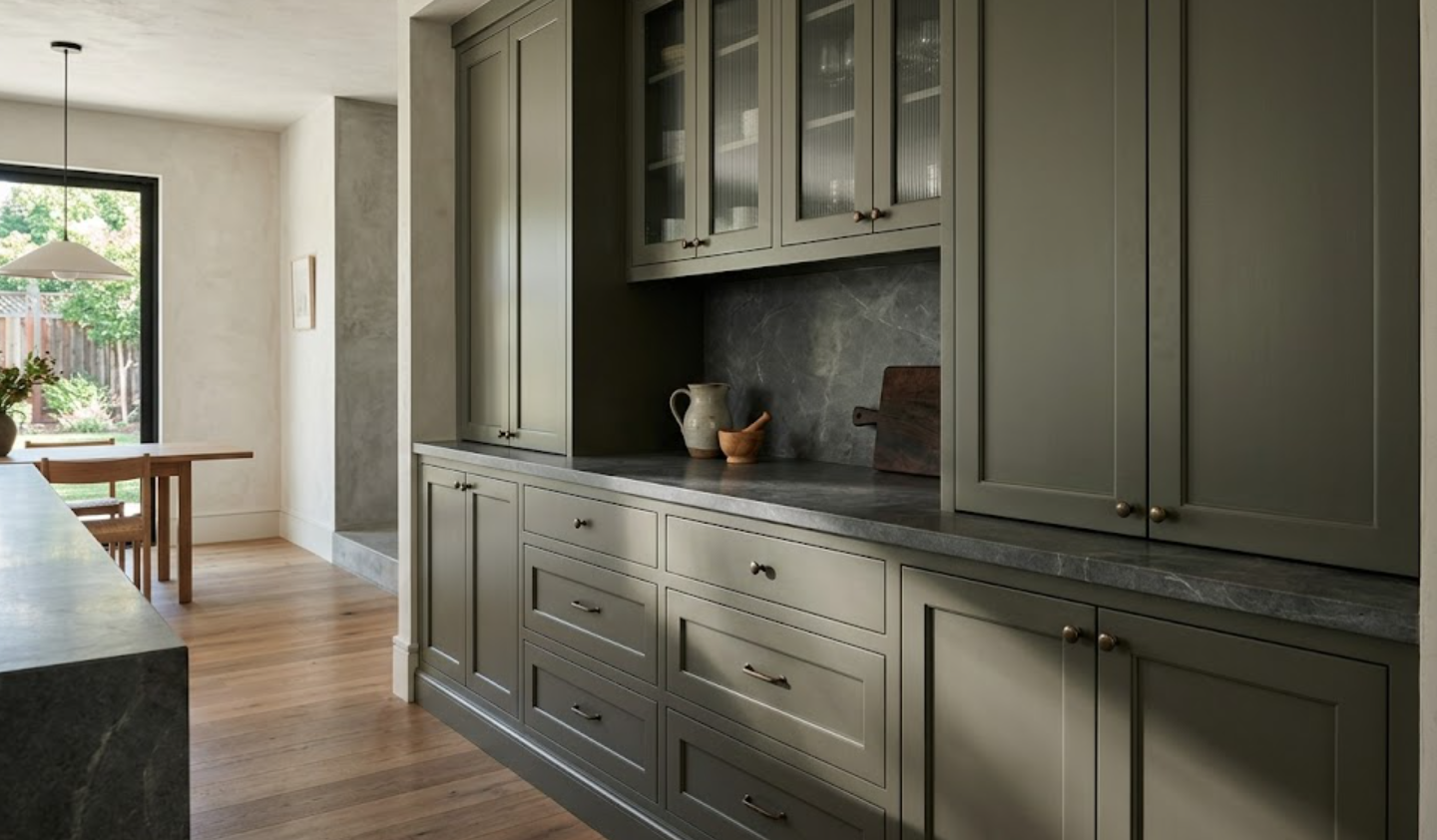
A Shaker-style cabinet door uses a frame surrounding a recessed center panel.
The basic idea is simple, but the proportions can vary considerably. Rails and stiles can be narrow or substantial. The center panel can sit at different depths. Edge details can be crisp and minimal or more traditional.
Those differences matter. A narrow-frame Shaker door in a muted painted finish can feel restrained and contemporary. A more substantial frame in natural wood can introduce greater visual depth and a stronger furniture-like quality.
That versatility is one reason Shaker cabinetry appears in homes with very different architectural styles.
The name of the door style does not determine the final look. Proportion, material, finish, hardware, and surrounding architecture do.
What Is a Slab Cabinet Door?
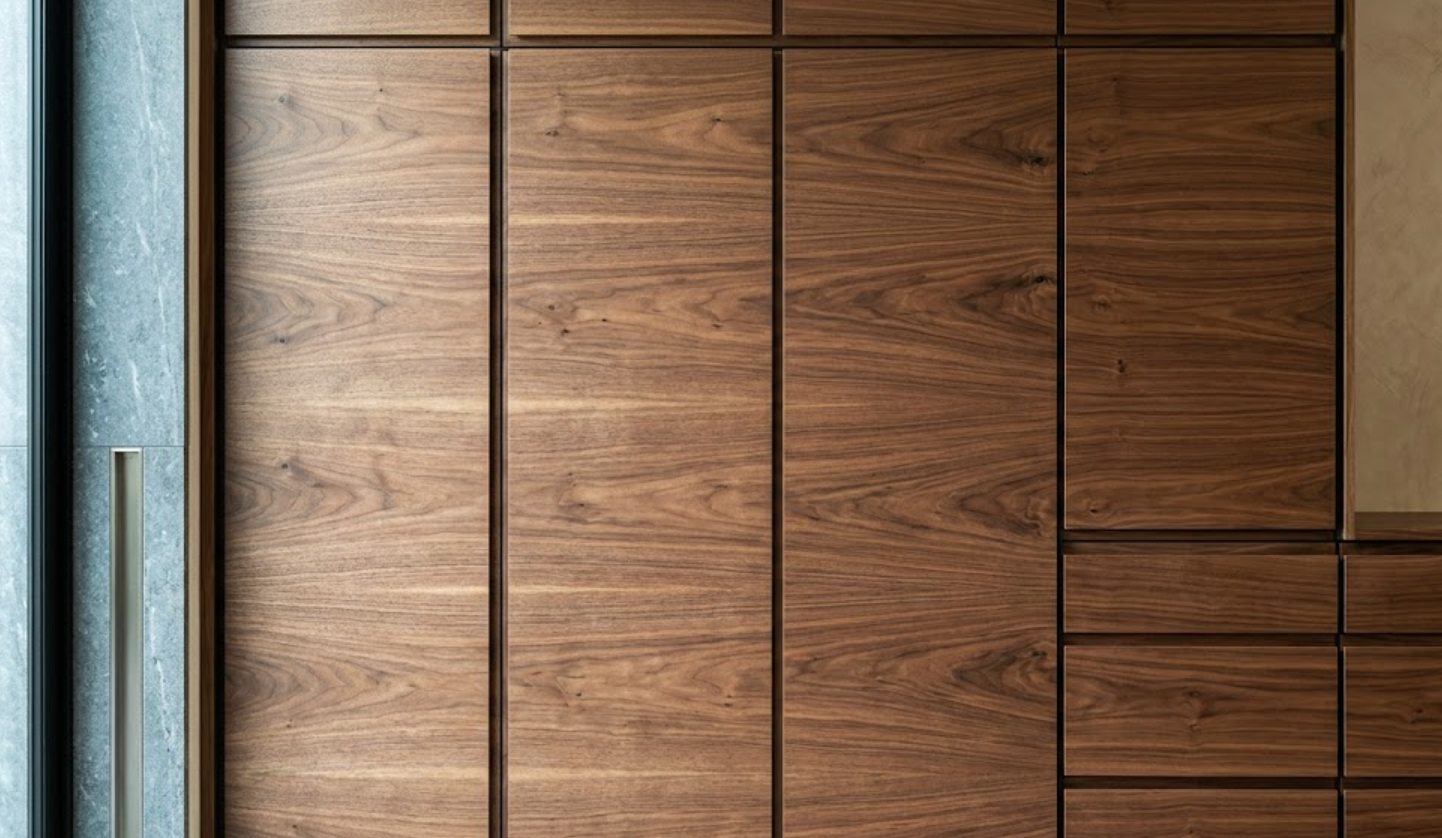
A slab door has a flat, uninterrupted face without the frame and recessed center panel of a Shaker door.
Because the geometry is simpler, other details become more visible. On natural wood slab cabinetry, grain direction and sequencing can become a major part of the design. With painted slab doors, the color and proportion of each panel take on greater importance. Hardware can become a deliberate visual element, or integrated pulls and touch-latch systems can make the cabinetry appear even quieter.
Slab cabinetry is frequently associated with contemporary interiors, but “slab” does not describe one specific aesthetic. A warm walnut slab door can feel rich and residential. A pale matte finish can feel minimal. Dark wood with integrated hardware can create an entirely different effect.
The simplicity of the door puts more responsibility on everything around it.
Are Shaker Cabinets More Traditional Than Slab Cabinets?
Generally, Shaker doors introduce more architectural detail, while slab doors create a quieter surface. But neither style belongs exclusively to one type of home.
This distinction matters when looking at inspiration images. A Shaker door can work beautifully in a transitional interior, but changing its proportions can move it toward a much cleaner architectural expression. Likewise, slab cabinetry does not require an ultra-modern glass-and-concrete house.
Consider a renovated older home in Menlo Park. If the architecture has original millwork, deeper window openings, or other visible detailing, a restrained Shaker profile may establish a natural relationship with those elements without attempting to reproduce historic cabinetry.
In a contemporary new build in Atherton or Palo Alto, large slab panels might support cleaner architectural lines and allow stone, lighting, or exterior views to take more visual attention.
The door should respond to the room rather than to a label.
Which Style Makes a Kitchen Feel More Minimal?
Slab cabinetry generally creates less visual movement because the door face is uninterrupted. Across a large kitchen, this can make a significant difference.
Imagine an entire wall of tall cabinetry. With Shaker doors, every door introduces four additional lines around its center panel. Multiply that across a large elevation and those lines become part of the room's visual rhythm. With slab doors, the primary lines are usually the gaps between cabinets.
That can make a large amount of cabinetry feel quieter. But minimal does not automatically mean better.
In some rooms, completely flat cabinetry can feel disconnected from the architecture or overly severe. A subtle Shaker profile can add just enough dimension to make a large cabinetry installation feel more residential.
The amount of cabinetry in the room should therefore influence the decision just as much as the style of an individual sample.
How Does Door Style Affect the Way Color Looks?
A paint color is not experienced independently from the shape underneath it.
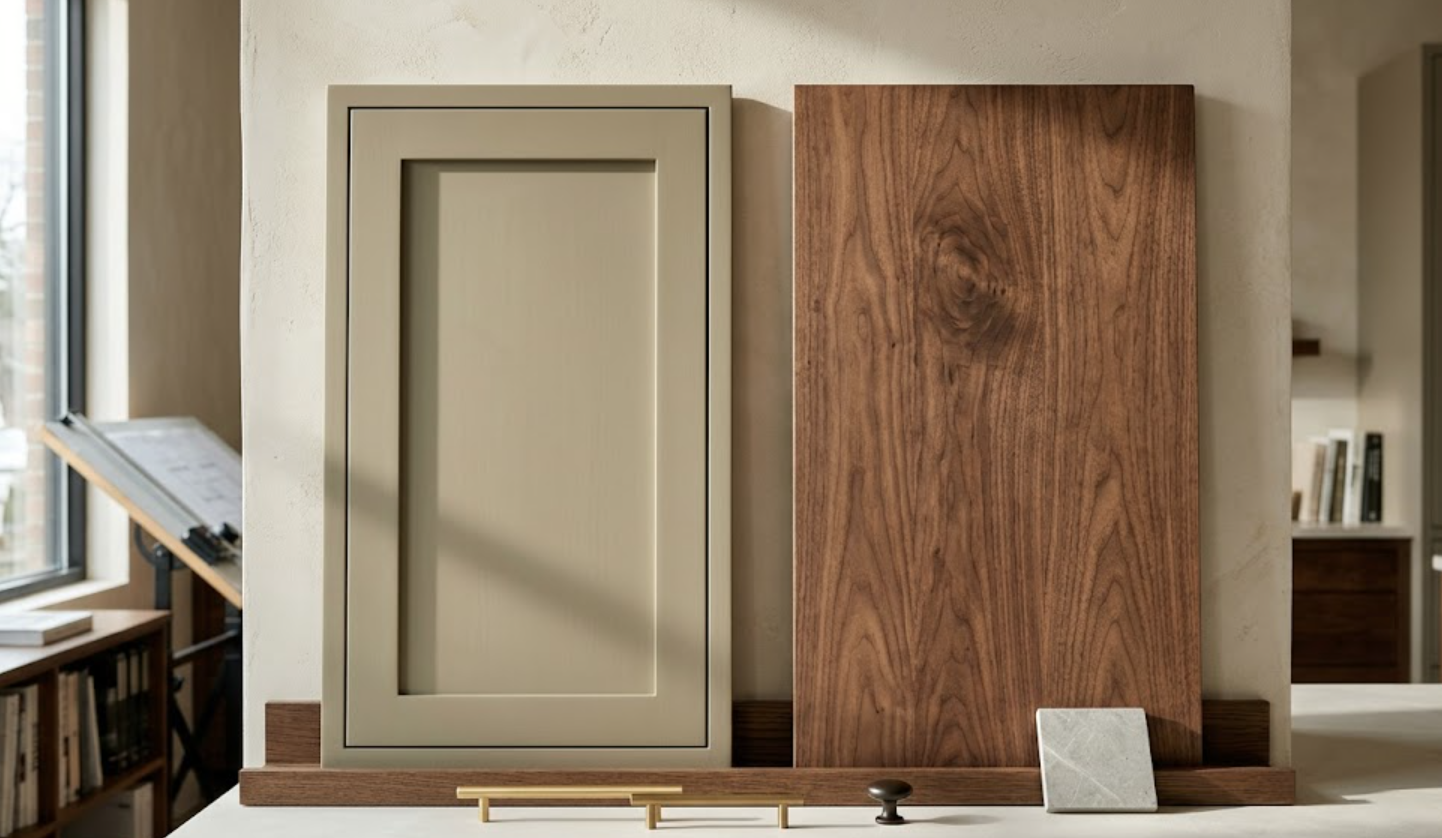
On a slab door, color appears across one broad surface. On a Shaker door, the same finish moves across rails, stiles, edges, and a recessed center panel. That creates changes in light and shadow throughout the day.
In rooms with substantial natural light, something common in many Peninsula homes, those differences can become particularly noticeable.
A deep green Shaker door may reveal considerably more dimension as sunlight moves across it. The same color on a slab door may read as a larger, calmer field of color.
Neither effect is inherently preferable. It depends on whether the cabinetry is intended to introduce architectural texture or provide a quieter background for other materials.
Does Wood Grain Look Better on Shaker or Slab Cabinets?
There is no universal winner, but slab cabinetry gives natural grain the largest uninterrupted canvas. That makes grain selection especially important.
Walnut can have expressive movement and tonal variation. Rift-sawn white oak can create a more linear appearance. On slab doors, those characteristics can extend across large surfaces and become one of the room's defining visual elements.
Shaker doors break the material into rails, stiles, and center panels. That can create a more furniture-like expression, but it also means grain direction needs to be considered across multiple components of each door.
For either style, a small wood sample is not enough to understand the final result. The question is how the material will behave across an entire elevation.
How Does Hardware Change Shaker and Slab Cabinetry?
Hardware can reinforce the door style or deliberately contrast with it.
On Shaker cabinetry, knobs and pulls sit within an already detailed composition. Their scale and placement need to work with the width of the frame and the proportions of the door.
On slab cabinetry, hardware often becomes more visually prominent because there is less happening on the door itself. A long pull across a slab drawer can become an architectural line. Alternatively, integrated channels, edge pulls, or other minimal solutions can preserve the uninterrupted appearance of the door.
This is why choosing hardware from a small board at the end of the project can be limiting. It is better to see the door, finish, and hardware as one composition.
Which Cabinet Style Is Easier to Maintain?
Slab doors have fewer profiles where dust and residue can collect, making their flat surfaces straightforward to wipe down.
Shaker doors introduce inside edges around the recessed panel that may require slightly more attention. In a working kitchen, that difference can matter, particularly around cooking areas where airborne grease and dust can settle over time.
Material and finish also affect maintenance. A very dark matte slab door, for example, may reveal fingerprints more readily than a mid-tone wood finish. A painted Shaker door may be easy to maintain overall but require occasional cleaning along the recessed edges.
So while door geometry matters, it should not be evaluated separately from finish and household use.
Can You Mix Shaker and Slab Cabinets in the Same Home?
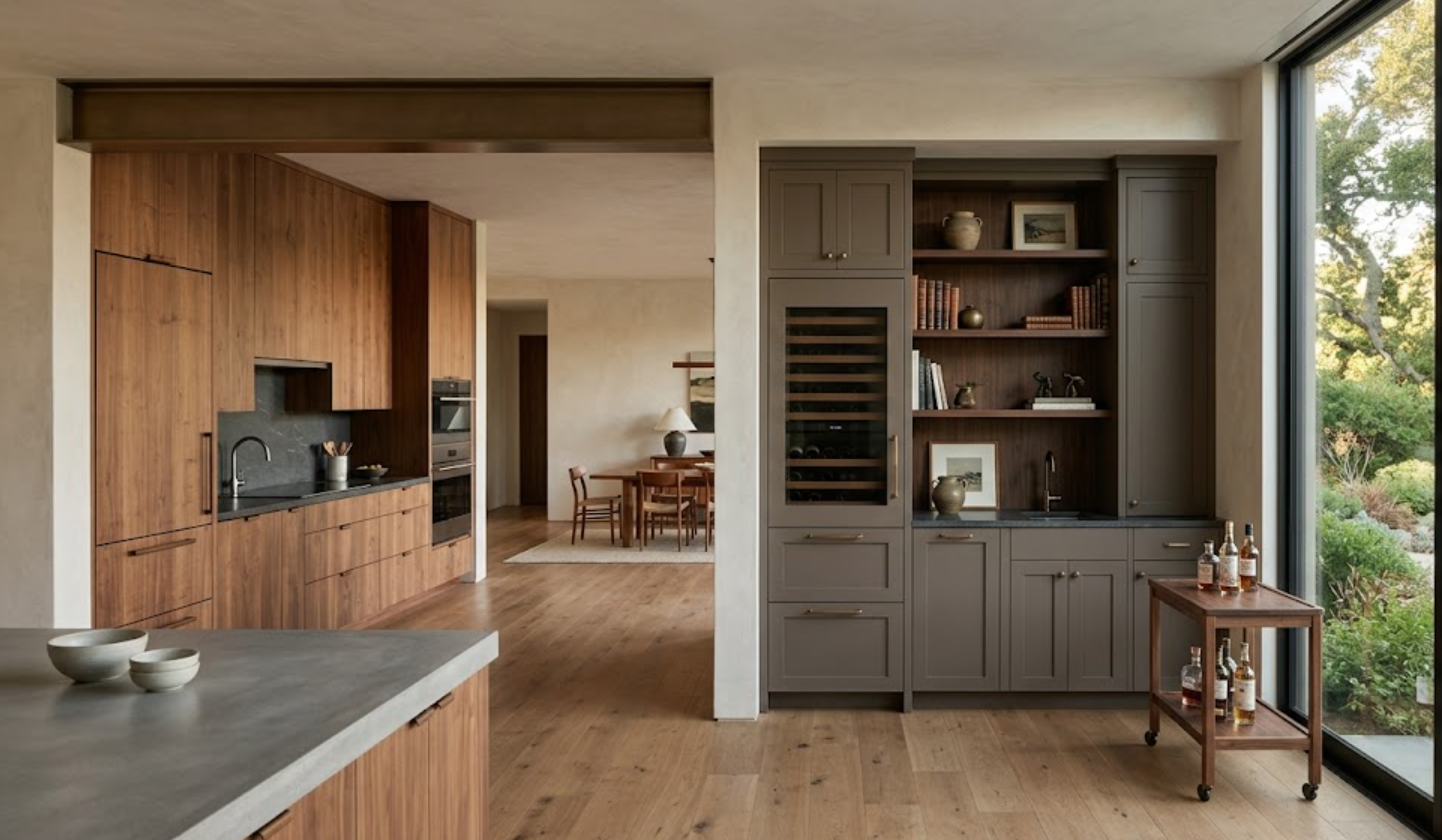
Yes, and sometimes the most cohesive whole-home cabinetry does not use one door style everywhere.
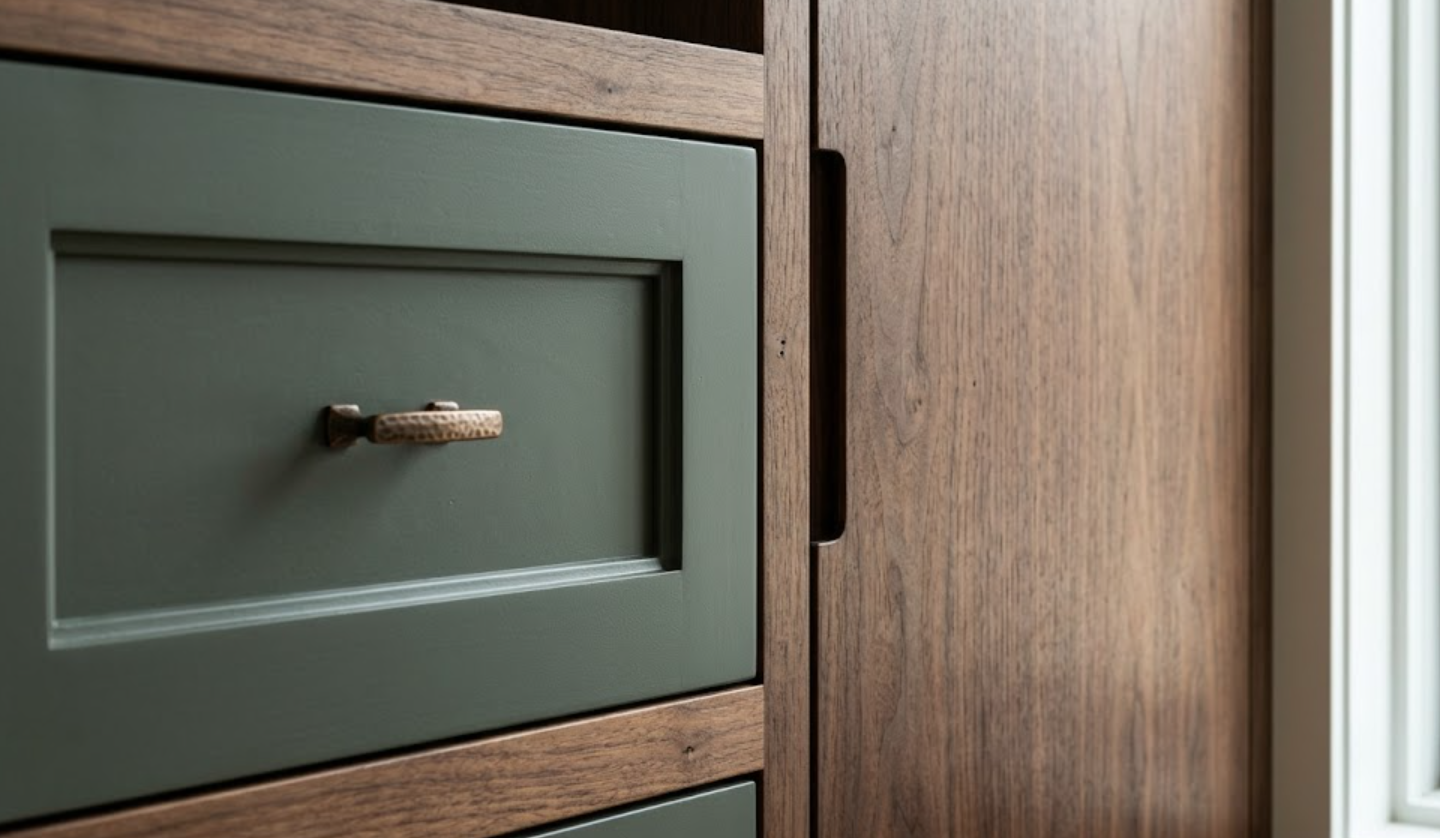
A kitchen might use slab walnut cabinetry while a nearby bar introduces a painted Shaker profile. A primary bathroom may reinterpret one of those finishes. A wardrobe or home office might simplify the language further.
The goal is not necessarily repetition. It is relationship.
Wood species, color, hardware, proportions, and architectural details can establish continuity even when the door construction changes.
This becomes especially relevant when cabinetry extends throughout a luxury home. Kitchens, bathrooms, bars, wardrobes, libraries, offices, and laundry rooms do not all need to feel identical simply because they belong to the same residence.
A whole-home approach can create consistency without making every room a copy of the last.
What Should You Look at When Comparing Cabinet Door Samples?
Do not evaluate the sample only from directly in front of it:
Hold it vertically.
Look at it from across the room.
Move it toward natural light and then away from it.
Consider how the profile creates shadows.
Look at the finish from an angle.
If it is natural wood, pay attention to grain direction and variation.
Then think about scale. A door that seems visually interesting as a 15-inch sample may become considerably busier when repeated 25 times across a kitchen. A slab door that seems almost too simple in isolation may become powerful when several large panels are aligned across a wall.
Seeing full-size cabinetry displays can make these differences much easier to understand than comparing isolated photographs online.
So, Should You Choose Shaker or Slab Cabinets?
The better choice is the one that supports the architecture, materials, scale, and character of the home.
Choose Shaker cabinetry when some additional depth and architectural detail benefits the room. Adjusting the frame proportions, finish, and hardware can make the result range from traditional to remarkably contemporary.
Choose slab cabinetry when a quieter surface, uninterrupted material, or cleaner architectural expression supports the design. Pay particular attention to panel proportions, grain, reveals, and hardware because there are fewer decorative details to distract from them.
And do not make the decision from an inspiration photograph alone. Cabinetry occupies too much visual space in a home for the door style to be considered independently from everything around it.
For homeowners and design professionals planning custom cabinetry in Menlo Park, Atherton, Palo Alto, Woodside, Portola Valley, Los Altos, and surrounding Bay Area communities, comparing full-scale cabinetry can help clarify how each option actually feels in person.
Atelier Design Society's Menlo Park showroom provides an opportunity to explore cabinetry styles, finishes, materials, hardware, and construction details before those decisions are carried throughout the home.