Should All the Cabinetry in Your Home Match?
A home can feel beautifully cohesive without using the same cabinetry in every room.
In fact, repeating the exact same finish, door style, hardware, and material from the kitchen to the bathrooms, wardrobes, home office, bar, laundry room, and media spaces can make a custom home feel too uniform.
The stronger approach is usually more subtle. Instead of asking whether every cabinet should match, ask whether the cabinetry throughout the home should relate.
That relationship can come from:
Wood species
Hardware
Paint undertones
Door proportions
Reveal widths
Interior finishes
Construction details
The way cabinetry meets the architecture
The rooms can still feel different. The kitchen can be warm and architectural. The bar can become darker. The bathroom can feel quieter. The wardrobe can become more personal. The office can feel more furniture-like. The cabinetry does not need to match exactly to make the home feel connected.
Why Can Matching Everything Make a Home Feel Too Repetitive?
Because different rooms have different jobs.
A kitchen needs to support food preparation, appliances, pantry storage, cleanup, and everyday use. A bathroom deals with plumbing, mirrors, lighting, toiletries, linens, and moisture. A wardrobe needs hanging, drawers, shoes, accessories, luggage, and personal storage. A home office needs work surfaces, files, technology, charging, and equipment. A bar may need refrigeration, glassware, wine storage, integrated lighting, and a different atmosphere altogether.
If every one of those spaces uses identical cabinetry, the rooms can begin to lose their individual character. The same walnut slab door that feels perfect across a large kitchen wall may feel unnecessarily heavy in a small bathroom. The same painted narrow-frame door used in the kitchen may not be the strongest choice for a media wall that should visually disappear.
Matching everything can create consistency. But consistency is not the same as good continuity.
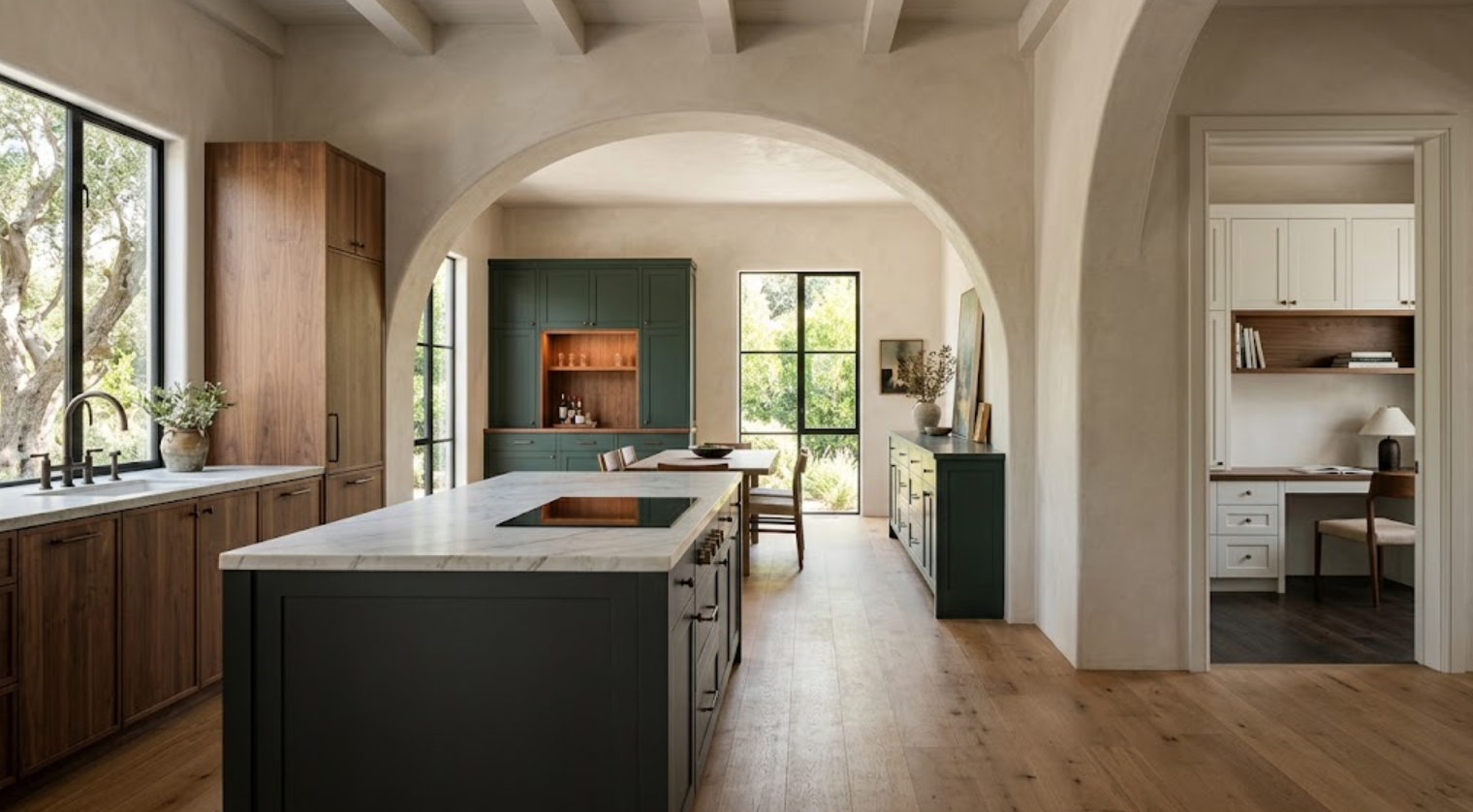
What Should Match Throughout the Home?
Usually, not everything. But a few recurring elements can create a strong visual connection.
Hardware is one of the easiest. The kitchen might use long bronze pulls while the bathroom uses smaller bronze knobs and the office uses subtle bronze edge pulls. The shapes change. The metal family stays related.
Cabinet proportions can also repeat. Tall doors may use similar widths. Drawer stacks may follow related horizontal divisions. Open niches may use similar thicknesses. Reveal widths can remain consistent even when the door styles change.
Interior wood is another useful connector. A walnut kitchen can relate to painted bathroom cabinetry through walnut drawer interiors. The bar can repeat walnut inside an open niche. A wardrobe can use the same wood for shelves or drawers.
These connections are often more sophisticated than simply repeating the same exterior finish everywhere.
Should the Kitchen Set the Cabinetry Style for the Whole Home?
Often, but only as a starting point.
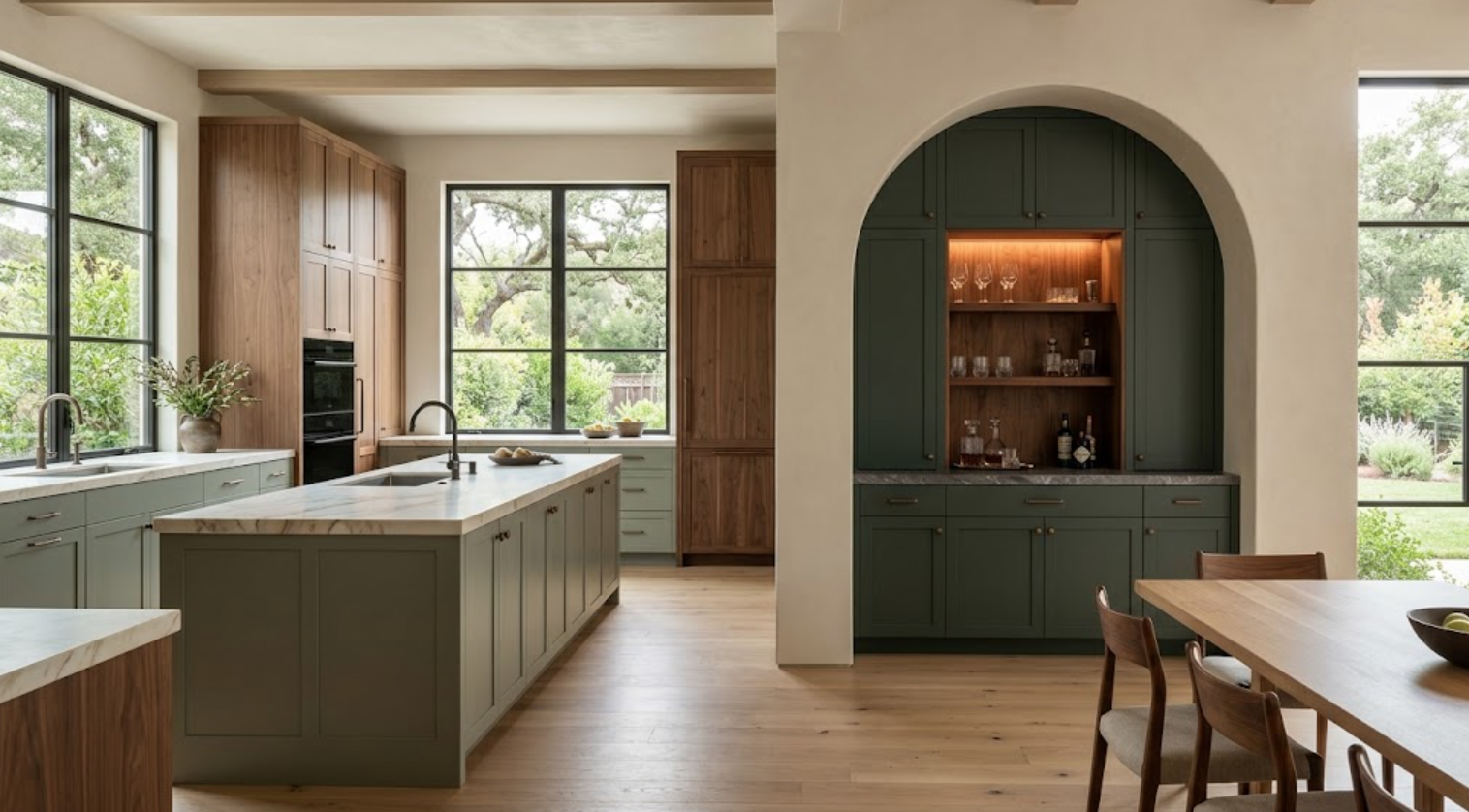
The kitchen usually contains the largest amount of cabinetry. That makes it a natural place to establish some of the home’s broader design language. For example:
Primary wood species
Hardware direction
Paint undertones
Interior wood finish
General level of detailing
Reveal widths
Construction quality
But the other rooms should adapt that language. The bathroom does not need to become a smaller version of the kitchen. The home office should not look like kitchen cabinets surrounding a desk. The wardrobe should not prioritize visual repetition over useful storage.
Think of the kitchen as establishing a vocabulary. The rest of the house can speak the same language differently.
Should Bathroom Cabinetry Match the Kitchen?
Usually not exactly.
Bathrooms have different scale and technical requirements. Plumbing affects the cabinet interiors. Mirrors and sconces share the same elevation. Stone thickness affects finished vanity height. Outlets may need to be integrated. Floating vanities can require structural blocking. The cabinetry should respond to those conditions first.
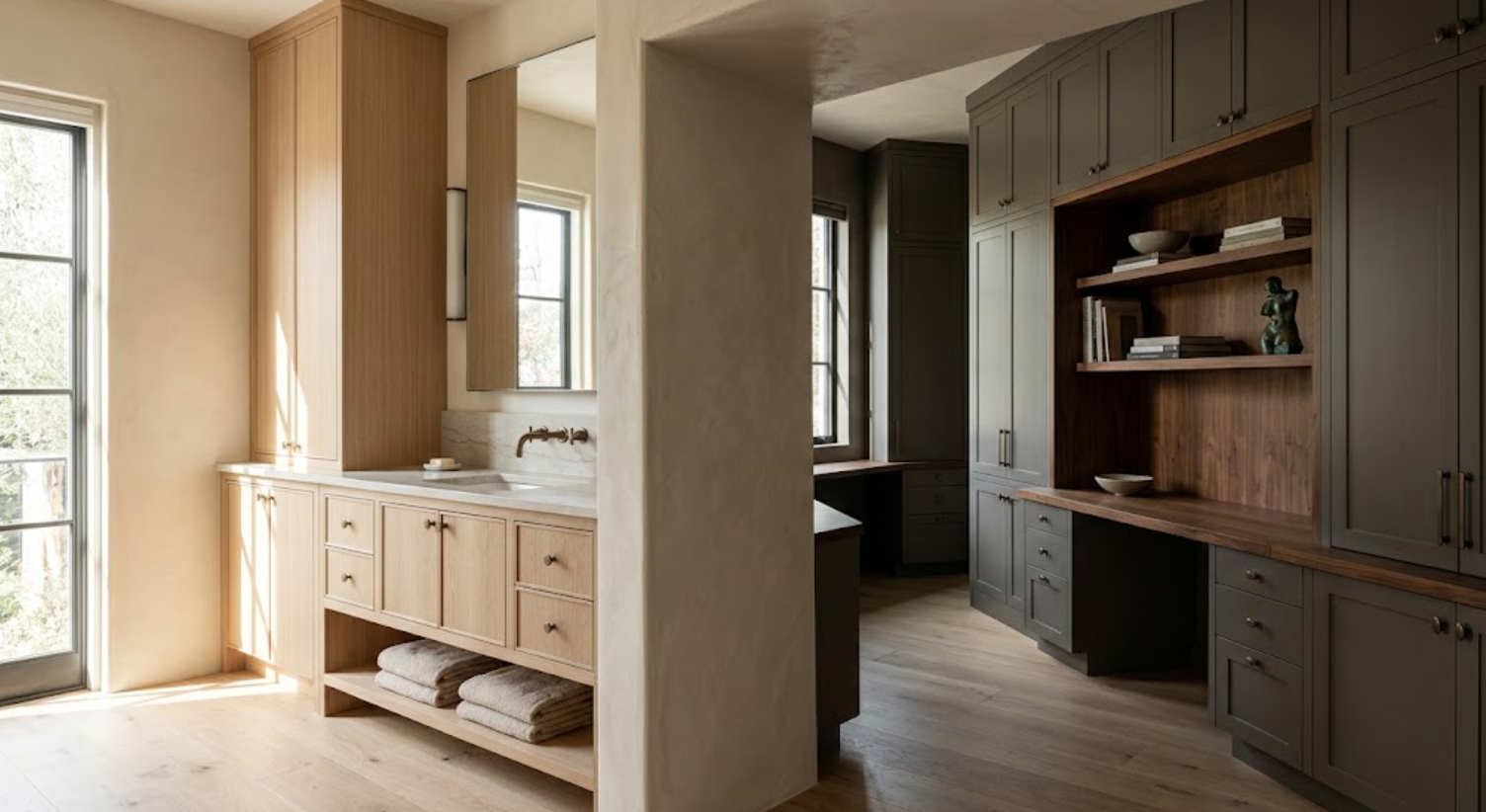
The connection to the kitchen can be subtler. A bathroom might use rift-sawn white oak instead of walnut but retain the same bronze hardware. A painted vanity might use walnut drawers inside. The stone can share similar undertones without being the same slab. Door proportions may remain related. That is enough to create continuity.
Should Wardrobes Match the Rest of the Home?
The wardrobe should feel connected, but function should lead.
Hanging storage
Shoes
Drawers
Luggage
Accessories
Jewelry
Open display
Closed storage
Those requirements should determine the interior. The exterior can then connect to the rest of the home through material or detailing.
For example, a kitchen using walnut prominently might lead to a wardrobe with muted painted exteriors and walnut interiors. The same hardware family can continue. The same warm lighting can repeat. The result feels related without making the wardrobe look like another kitchen.
What About Home Office Cabinetry?
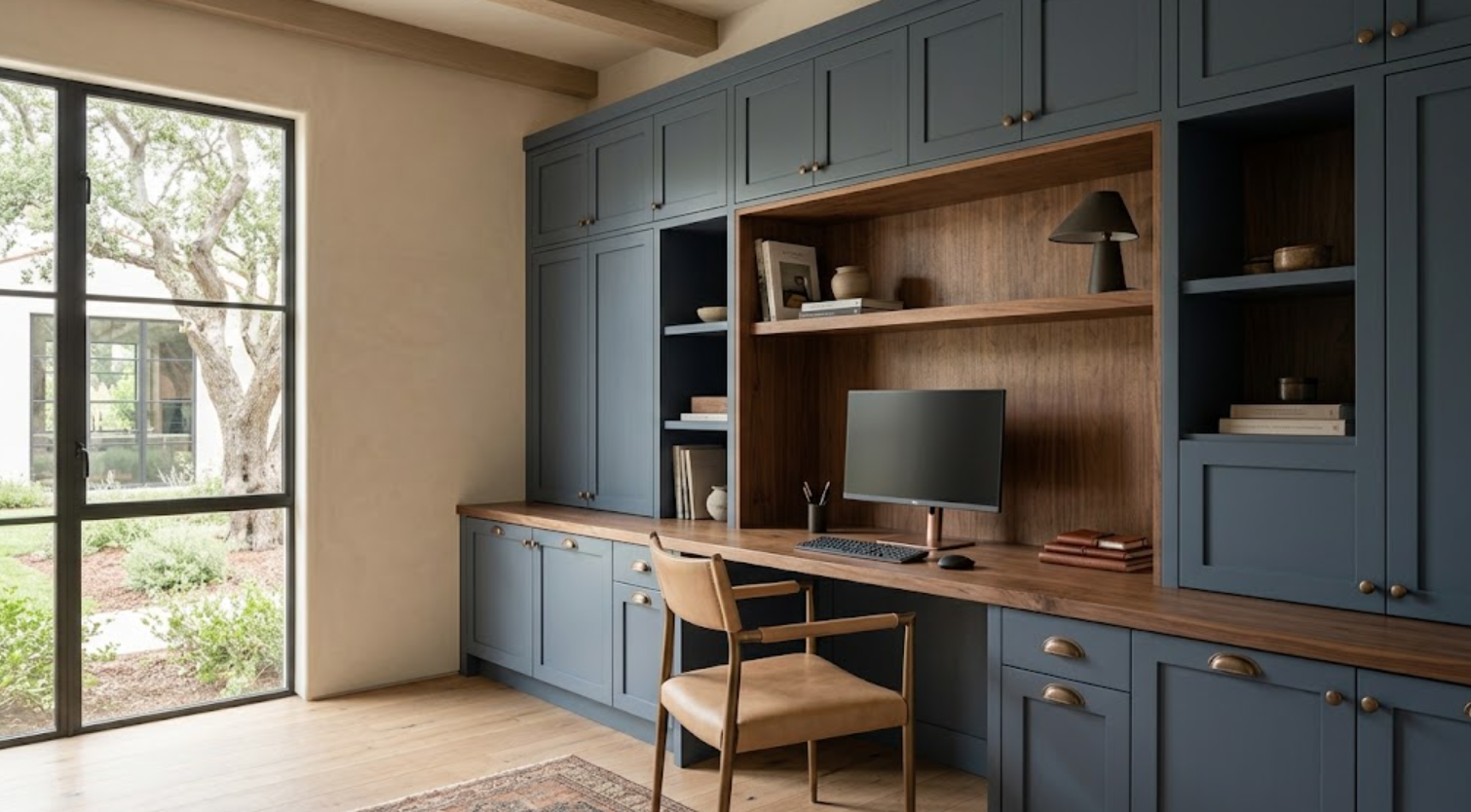
Home offices usually benefit from a more furniture-like approach.
Deeper painted finishes can create a different atmosphere. Open shelves may make more sense. The work surface can introduce natural wood. Technology can disappear behind broad panels. Printers, routers, files, and charging can be built into the storage.
Continuity can come from one repeated material. Perhaps walnut used in the kitchen becomes the office desktop and a few shelves. Bronze hardware returns. Door proportions remain familiar. That is enough. The office should feel like part of the same home, not part of the same room.
How Should Bars and Entertaining Spaces Relate to the Kitchen?
Bars can usually be more expressive. They are smaller. They are used differently. And they often benefit from a stronger atmosphere.
A kitchen may use quiet painted cabinetry and walnut. The bar can take the same materials and deepen them:
Darker paint
Walnut interiors
Ribbed glass
A darker stone
Integrated lighting
The connection remains. The intensity changes. This is a good example of continuity without matching. The bar belongs to the same house because the materials and detailing are related. It still has its own identity.
What About Laundry Rooms and Mudrooms?
These spaces should prioritize durability and organization. They usually do not need the same material investment as the kitchen. A simplified painted finish may be more practical.
But the cabinetry can still maintain the same discipline:
Similar door profile
Related hardware
Consistent reveal widths
A natural wood bench or interior niche
The same warm undertones
Matching the kitchen exactly may actually make these rooms feel overly formal. A simplified version of the broader design language often works better.
Should Media Cabinetry Match the Kitchen?
Usually not.
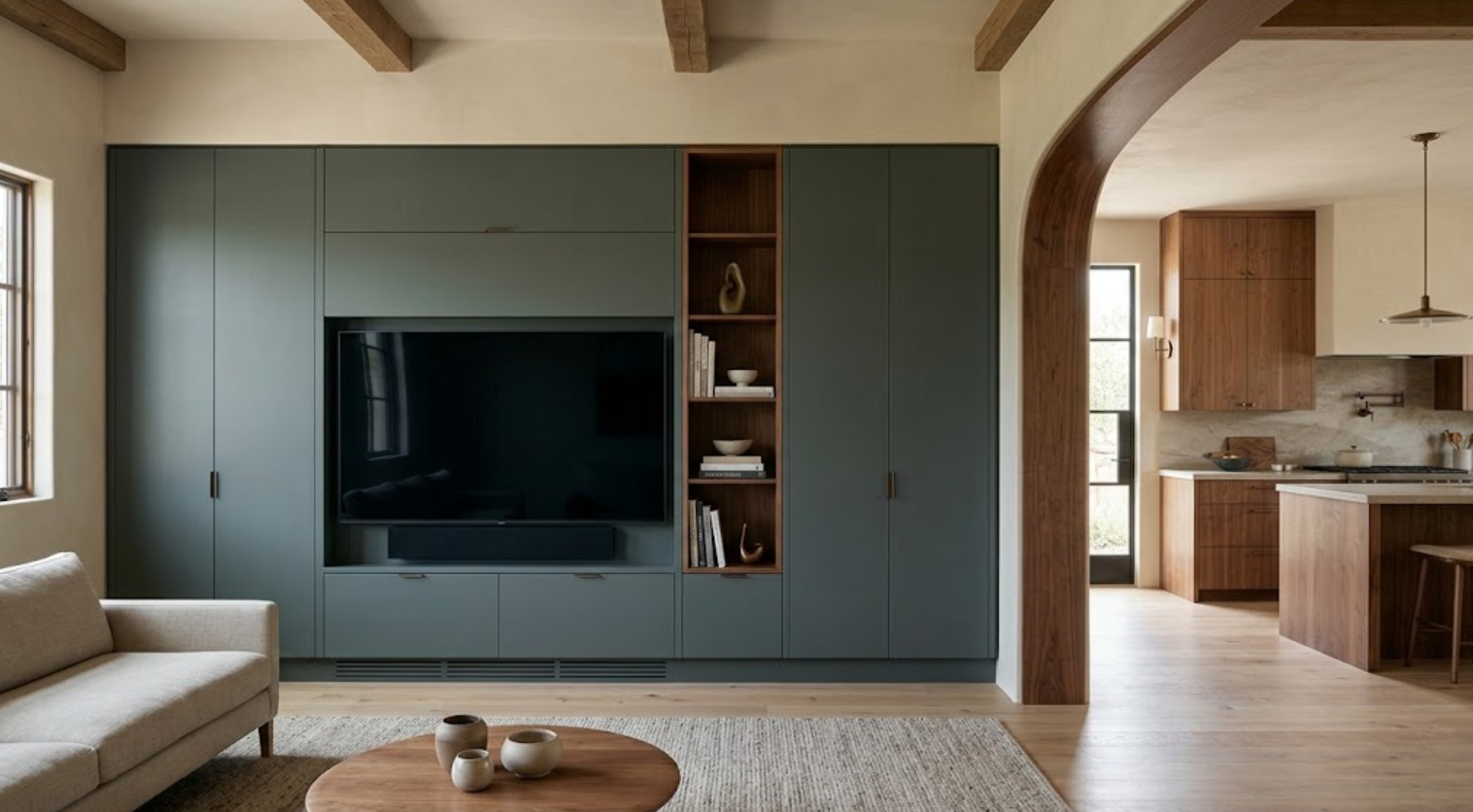
Media cabinetry often benefits from becoming visually quiet:
Broad panels
Concealed equipment
Minimal hardware
Ventilation hidden within the design
Open niches used selectively
A television already creates visual weight. The cabinetry around it may need to recede rather than attract more attention. The kitchen wood might return in one niche. The same painted finish could become darker. Hardware can nearly disappear. The relationship remains, but the cabinetry responds to the room.
How Many Cabinet Finishes Can a Home Handle?
There is no fixed number. But more finishes require more control.
A custom home could use walnut, white oak, and several painted colors successfully. The key is giving each material a clear role. Walnut might dominate the kitchen. White oak may belong to the primary bathroom. A deep paint can define the office and bar. A simpler painted finish can handle laundry and mudroom cabinetry.
What usually creates confusion is not the number of finishes itself. It is finishes that appear without a clear relationship. Two nearly matching woods can be harder to coordinate than two intentionally different woods. Three unrelated paint colors can feel more chaotic than three colors from the same warm family.
Think about the entire palette. Not each room separately.
Can Different Wood Species Work in the Same Home?
Yes. They just should not look accidental.
Walnut and white oak can work together because they are clearly different. Walnut brings depth and warmth. White oak is lighter and more linear. That contrast can create hierarchy.
Problems often appear when two woods are close enough in color that they look as though they were intended to match, but their grain and undertones are noticeably different. Clear contrast is easier to understand. Painted cabinetry can also create useful separation between multiple wood species.
Should Hardware Match Everywhere?
It can. But it does not need to be the exact same piece.
A better approach is often to use a related hardware family — same bronze tone, different scale, different form. Long pulls in the kitchen. Smaller knobs in the bathroom. Edge pulls in the office. Minimal hardware in the media room.
This gives each room the hardware it needs while maintaining continuity. It also prevents the home from feeling overly coordinated.
What About Stone?
The same principle applies. You do not need one stone throughout the entire residence.
The kitchen may use a quiet warm quartzite. The bar can use something darker. The bathroom may use another natural surface with similar undertones. Continuity can come from temperature, finish, or level of movement.
One exact slab everywhere can become repetitive. Completely unrelated stone in every room can feel fragmented. Again, think in families.
How Does Natural Light Affect Whole-Home Cabinetry Decisions?
A lot. The same finish can look very different from one room to another.
A warm mushroom paint can look more gray in a north-facing office. Walnut can become much richer in afternoon light. White oak can show stronger golden undertones near large windows. A deep cabinet color may feel elegant in a bright room and overly heavy somewhere darker.
That means exact repetition can sometimes work against the home. Adjusting the finish slightly from one room to another may create better visual continuity than forcing the same color into very different lighting conditions.
How Can One Cabinetry Partner Help?
A whole-home cabinetry partner can make these relationships easier to manage. Not because every room has to use the same cabinetry line, but because the broader material and detailing strategy can be reviewed together.
The team can compare:
Wood species
Paint finishes
Door profiles
Hardware
Interior materials
Construction
Reveal widths
Cabinet proportions
Instead of designing eight unrelated rooms and trying to connect them afterward, the relationships can be established early. This can also make finish development and revisions easier. If one walnut changes, the team knows where else it appears. If the hardware family changes, the effect across the home can be reviewed at once.
How Do You Decide What Should Repeat?
Choose a few elements. Not all of them. For example:
Primary wood: Walnut
Secondary wood: Rift-sawn white oak
Hardware: Warm bronze family
Interior wood: Walnut
Paint: Several related warm mineral tones
Construction language: Narrow reveals and restrained door proportions
Those rules create a framework. Then each room can be designed independently within it. This creates much more flexibility than saying: “Every cabinet should be walnut with the same bronze pull.”
How Do You Avoid Going Too Far in the Other Direction?
Too much variation can be just as problematic.
If the kitchen uses walnut, the bar uses oak, the office uses black cabinetry, the bathroom uses blue, the wardrobe uses white, the laundry uses green, and none of the hardware or detailing relates, the rooms may begin to feel like separate projects. That does not mean any individual room is badly designed. The whole home simply lacks a common language.
This is why it helps to review cabinetry plans and finish samples together before everything is ordered. Look at the full house. Not just the room currently being designed.
When Should Whole-Home Cabinetry Relationships Be Established?
Early.
You do not need every final cabinet finish before construction begins. But it helps to know which rooms contain cabinetry and how those rooms should relate.
If the kitchen is the first cabinetry area being designed, consider the rest of the home at the same time:
Will walnut appear elsewhere?
Does the bar need its own finish?
What direction will the primary bathroom take?
Does the wardrobe need natural wood interiors?
What should the home office feel like?
These questions prevent the kitchen from establishing a material direction that becomes difficult to work with later.
Should All the Cabinetry in Your Home Match?
No. It should belong together. That is different.
Matching relies on repetition. Continuity relies on relationships. The same hardware family can repeat. A wood species can appear in different ways. Cabinet proportions can remain familiar. Paint colors can come from one family. Interior wood can connect several spaces. Construction details can remain consistent.
The kitchen can be walnut. The bathroom can be white oak. The bar can be dark paint with walnut inside. The office can become more furniture-like. The media cabinetry can almost disappear. The laundry can remain practical. Each room gets what it needs. The house still feels like one project.
That is usually a much more interesting approach than making every cabinet match.
Explore Whole-Home Cabinetry With Atelier Design Society
Atelier Design Society works with homeowners, architects, interior designers, builders, and other design professionals planning premium cabinetry throughout kitchens, bathrooms, wardrobes, home offices, bars, laundry rooms, mudrooms, media spaces, and other parts of the home.
At the Atelier Design Society showroom in Menlo Park, you can compare natural woods, painted cabinetry, hardware, construction, interior materials, and full-scale cabinetry while developing a broader whole-home strategy.
For a larger remodel or custom residence, bring architectural plans for more than just the kitchen when possible.
It can be much easier to determine what should repeat, what should change, and how each room can maintain its own identity when the entire cabinetry scope is considered together.