The Case for Fewer, Better Materials in Luxury Kitchen Design
Luxury kitchens are often expected to show more — more stone, more wood, more metal, more contrast, more custom details, more moments designed to catch attention.
But some of the most convincing kitchens do the opposite. They use fewer materials. The difference is that those materials are selected more carefully, used at a larger scale, and detailed well enough to carry the room without relying on constant visual change.
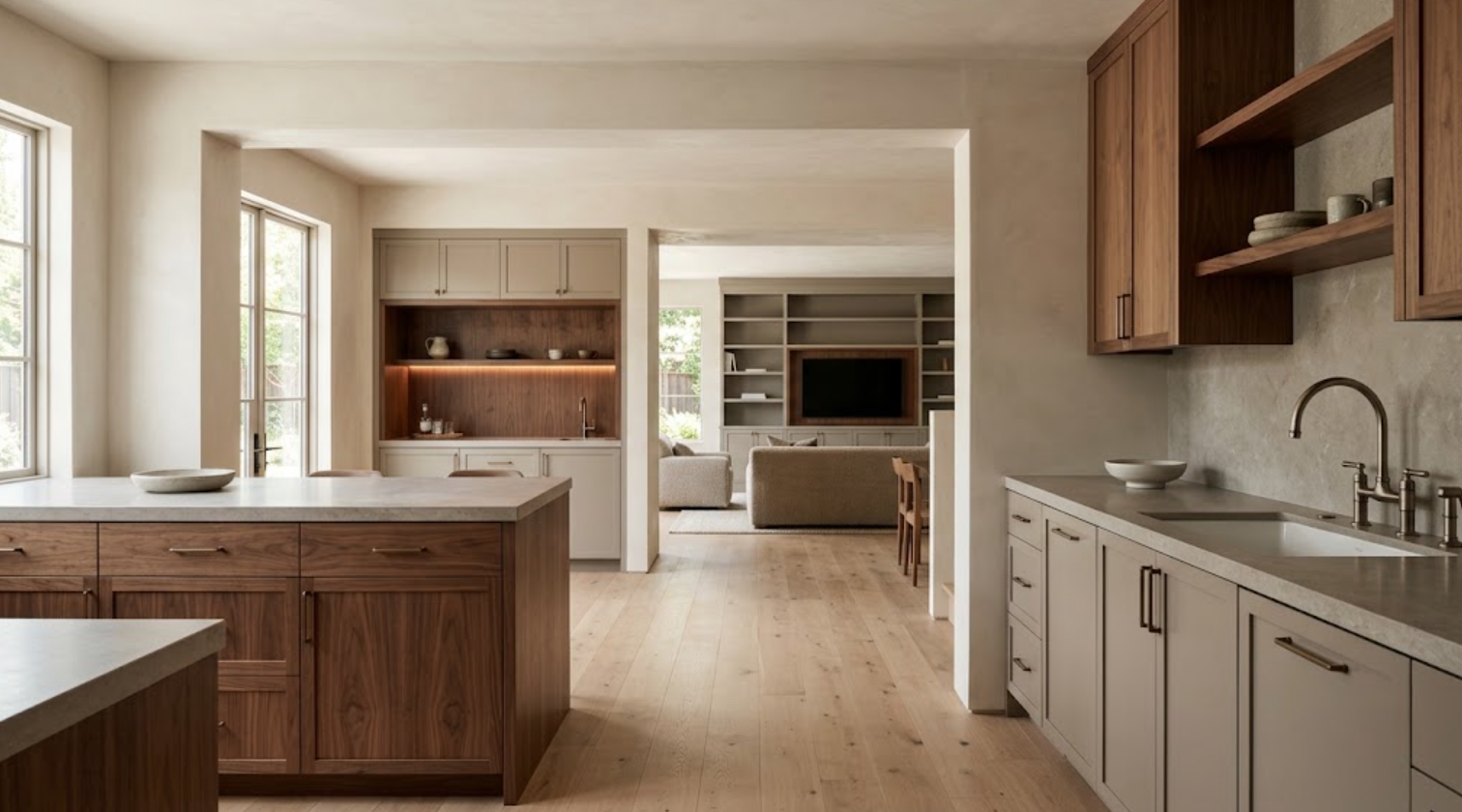
A single walnut cabinetry wall can do more than several unrelated wood finishes. One strong natural stone can be more memorable than three competing surfaces. A restrained painted cabinet finish can give both wood and stone more room to matter.
This is not minimalism for the sake of minimalism. It is hierarchy.
For homeowners, architects, and interior designers planning a high-end kitchen, using fewer, better materials can make the room feel calmer, more architectural, and more durable over time. The goal is not to strip the kitchen of character. It is to decide which materials deserve to create it.
Why Do Too Many Materials Make a Kitchen Feel Less Luxurious?
Because every material asks for attention.
A highly figured wood introduces grain. An expressive stone introduces movement. Paint introduces color. Hardware introduces metal. Tile introduces pattern. Glass introduces reflection. Plaster introduces texture. Each can be beautiful. The problem begins when all of them are trying to lead.
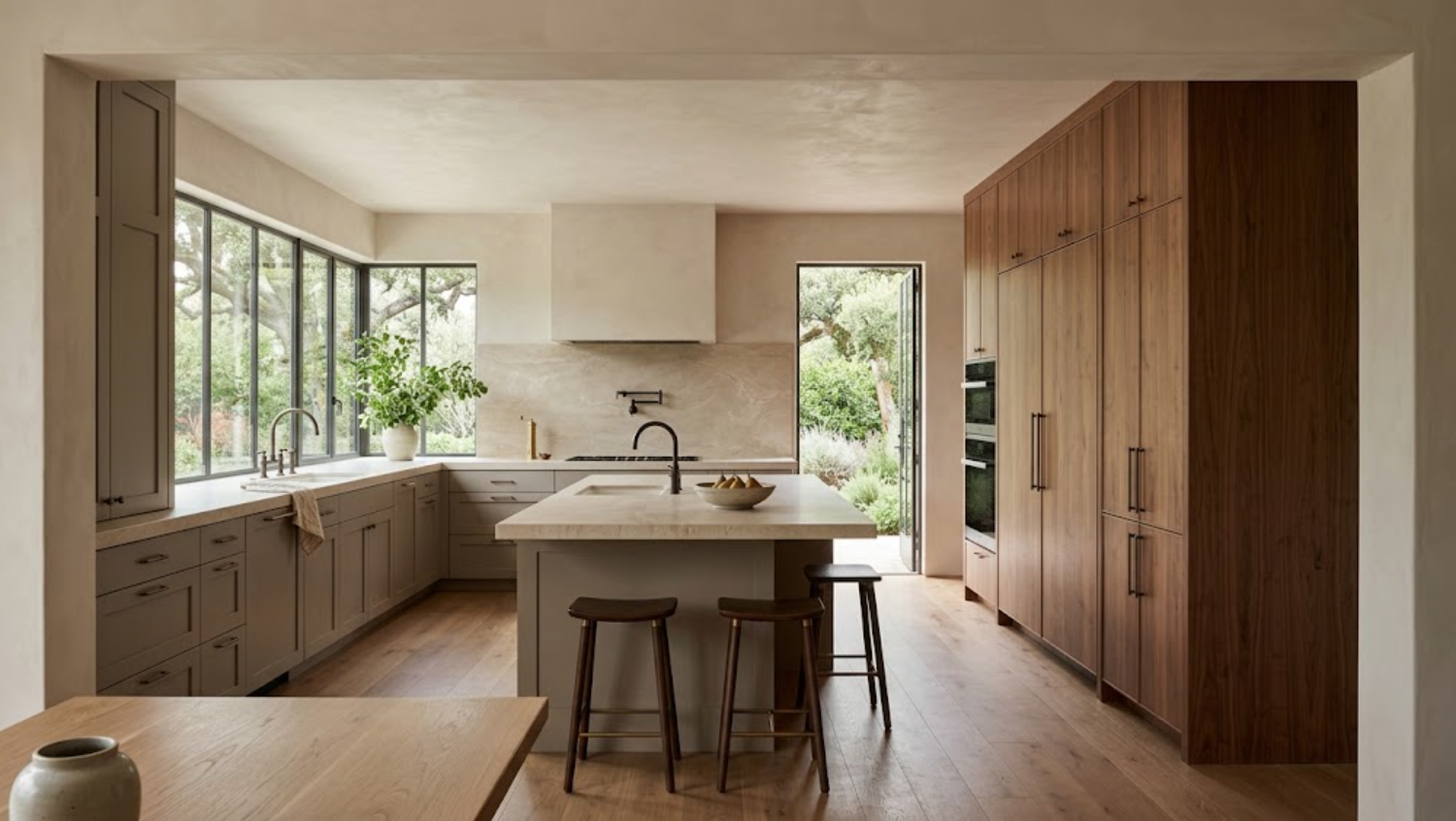
Imagine a kitchen with natural walnut cabinetry, white oak on the island, heavily veined quartzite, patterned backsplash tile, brass hardware, black metal framing, a contrasting hood, and a second stone at the bar. Nothing may be wrong individually. Together, the room can become difficult to read.
Luxury often feels quieter because the visual hierarchy is clearer. One material leads. Another supports it. The rest become background. That restraint allows better materials to be noticed more clearly.
What Does “Fewer, Better Materials” Actually Mean?
It does not mean the kitchen must use only two finishes. It means every major material has a reason to be there.
A useful way to think about the palette is by role:
Primary material — This is often the material that gives the kitchen most of its identity. It could be walnut cabinetry, rift-sawn white oak, a strong painted cabinet color, or an expressive natural stone.
Supporting material — This material creates contrast without competing. Painted cabinetry may support walnut. Quiet limestone can support expressive wood. White oak may support a dramatic quartzite.
Connecting material — This may be a metal finish, plaster, flooring, or repeated surface that helps the main materials relate to the rest of the home.
The palette can contain nuance. What it should avoid is redundancy. If two stones are doing essentially the same visual job, perhaps only one is needed. If three wood species are being introduced without a clear reason, the composition may be stronger with fewer.
Why Does Material Quality Become More Important When the Palette Is Smaller?
Because there is nowhere for weak material to hide.
If a kitchen uses one large natural wood volume, that wood will be seen repeatedly. Grain selection matters. Finish quality matters. Panel composition matters. Natural variation matters.
If one stone is used across the island and perimeter, the slab quality and detailing become more important. If most cabinetry is painted in one restrained finish, sheen, undertone, and application become more visible.
Fewer materials place more responsibility on each selection. That is exactly why the result can feel more luxurious. Instead of creating interest through quantity, the design depends on quality.
How Can Natural Wood Carry an Entire Kitchen?
Through scale and variation.
A natural wood does not need elaborate detailing to create character. Walnut can introduce depth, grain, warmth, and tonal variation across a broad architectural wall. Rift-sawn white oak can create a lighter, more linear texture. The wood already contains visual information. Adding several competing finishes around it may weaken that effect.
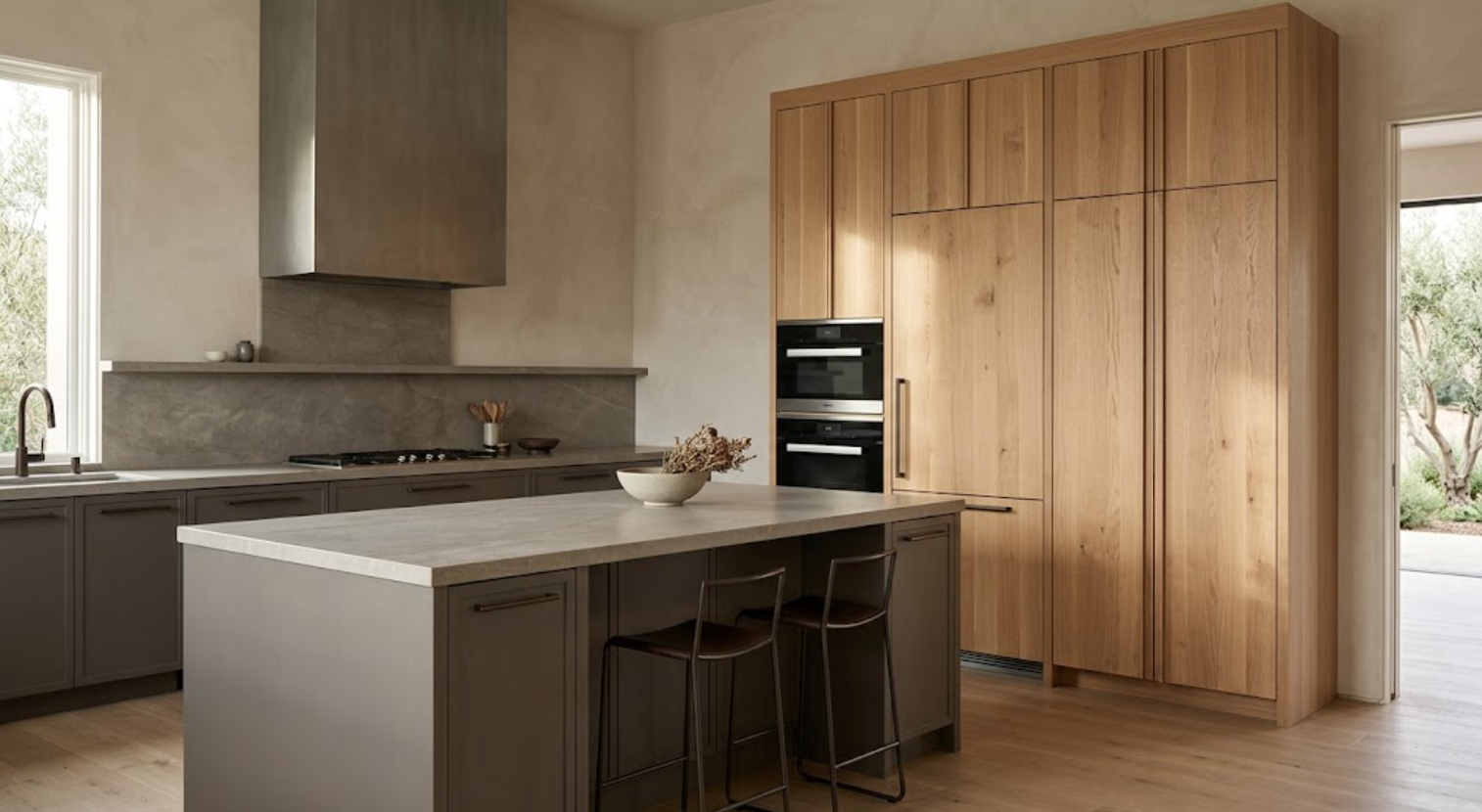
This is why natural wood often works best when concentrated — one tall cabinet wall, one island, one architectural volume. Not necessarily every cabinet. The rest of the kitchen can become quieter and allow the material to do more.
Should the Cabinetry and Island Use Different Materials?
Only if the change improves the composition.
A contrasting island is common. That does not make it necessary. If the kitchen already contains a strong walnut cabinet wall, painted perimeter cabinetry, and expressive stone, changing the island finish again may introduce more contrast than the room needs. Using the same painted finish on the island and perimeter can make the walnut stronger.
In another project, the kitchen may be almost entirely painted. A white oak or walnut island can then become the single natural material that brings warmth into the room.
The question is not: should the island be different? It is: does the room need another material? Sometimes the most luxurious answer is no.
Why Can One Stone Be Stronger Than Several?
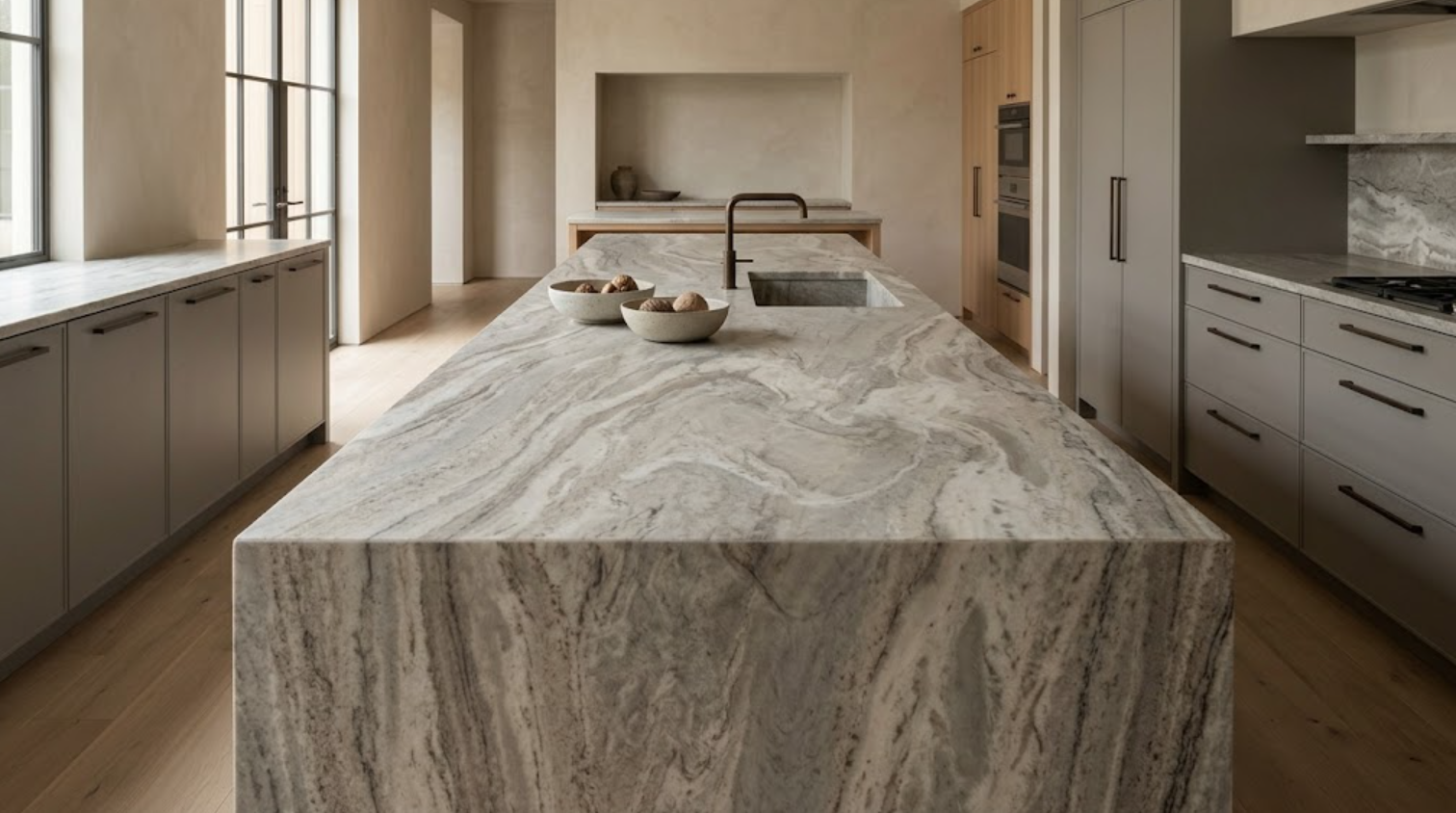
Because natural stone already contains variation — color, veining, mineral changes, movement, texture. A beautiful slab does not need another stone beside it to prove that the kitchen is high-end.
Using one stone consistently can also create architectural continuity. The island, perimeter, and backsplash may read as part of one material system. That does not mean every surface needs to be covered in stone. In fact, restraint matters here too. A full-height backsplash can be powerful. So can stopping the stone and allowing plaster to remain visible elsewhere.
The goal is to use the material where it contributes most. Not wherever it can physically be installed.
When Should Stone Be the Main Material?
When it deserves to be.
A particularly expressive quartzite can become the focal point. If so, cabinetry should usually become quieter. Paint can create a controlled backdrop. Rift-sawn white oak can add warmth without excessive grain movement. Hardware can remain restrained. The room does not need another dramatic material competing with the slab.
Material hierarchy becomes especially important when stone has strong movement. If every surrounding finish is also visually active, the stone loses impact.
How Does Paint Help Simplify a Material Palette?
Paint can create visual rest. This is especially useful when the kitchen already contains natural wood and stone.
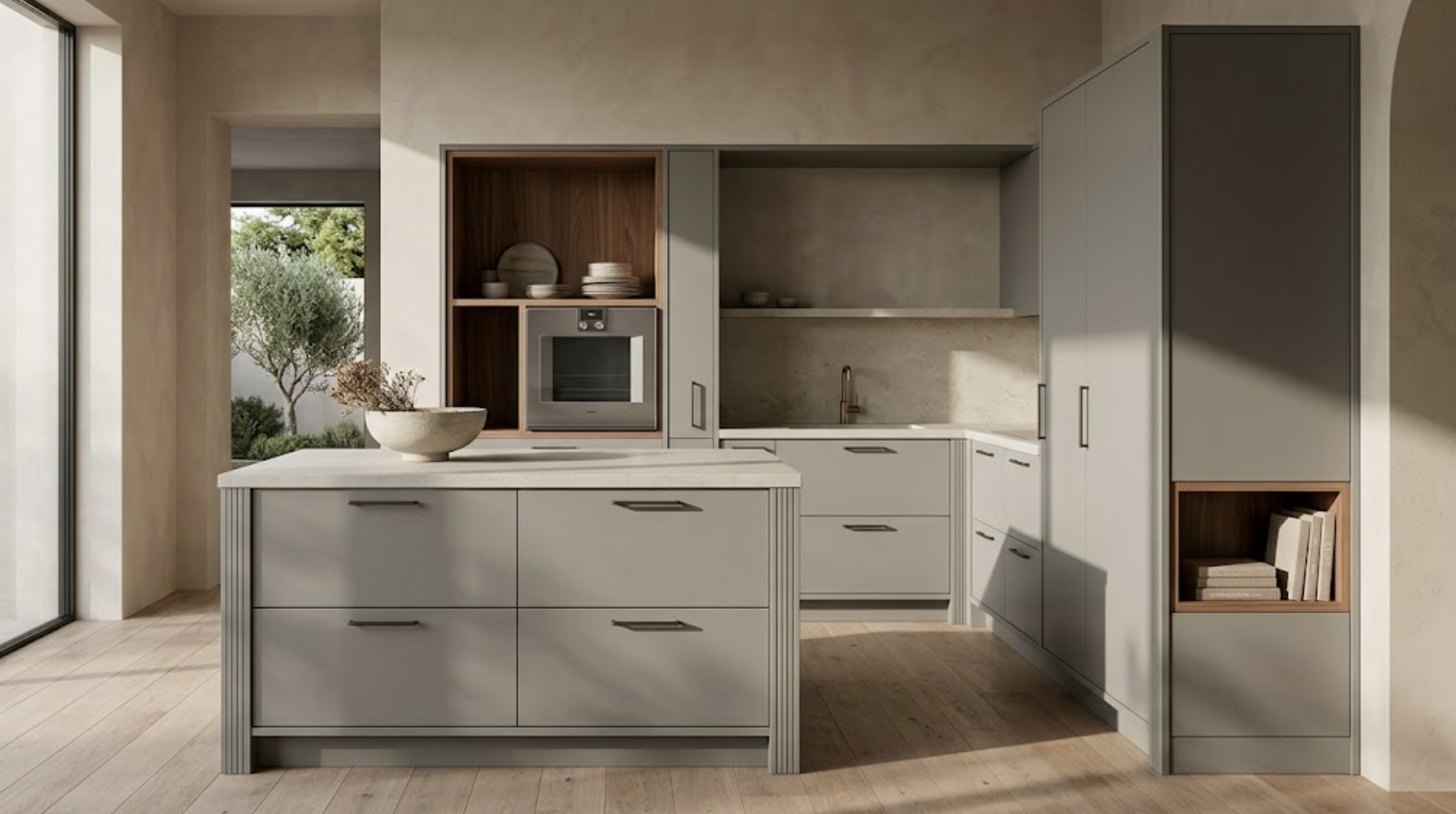
A painted finish provides a more consistent field. There is no grain movement. Less tonal variation. The color can be developed to support the surrounding palette. That does not mean the paint needs to be neutral. A deep mineral green, mushroom, clay-gray, or muted charcoal can create significant character. The important thing is that the finish behaves as one surface.
If walnut is doing the textural work and stone is doing the geological work, the paint can provide calm. That makes all three materials stronger.
Does a Limited Palette Mean the Kitchen Will Feel Boring?
No. Not if proportion, texture, light, and craftsmanship are strong.
A kitchen does not need many materials to create depth. The same walnut surface changes between direct light and shadow. Honed stone has texture. Paint sheen responds to light. Plaster introduces another subtle surface. Cabinet reveals create fine shadow lines. Hardware adds small points of contrast. An open walnut-lined niche inside painted cabinetry can create a meaningful material change without introducing a completely new palette.
Depth does not always require more finishes. Sometimes it comes from allowing fewer materials to be experienced more fully.
How Can You Add Interest Without Adding Another Material?
Change the architecture. Not the palette. For example:
Change cabinet depth
Create a recessed niche
Use a pocket-door cabinet
Change the height of one volume
Introduce an open wall
Let an island become furniture-like
Change grain direction
Use integrated lighting selectively
Adjust the door profile
These moves create depth while preserving material consistency. That is often a stronger approach than introducing another finish simply because the room feels too simple.
What Role Does Hardware Play in a Restrained Kitchen?
A larger one than you might expect.
When the palette is limited, hardware becomes easier to notice. That means scale and finish need to be considered carefully. A warm bronze can connect walnut, paint, and stone. Nickel can create a cooler, more precise relationship. Integrated pulls can reduce visual interruption. Larger appliance panels may need substantial hardware even if smaller drawers remain more restrained.
There is no need to introduce several metal finishes simply to make the room feel layered. One well-chosen hardware family may be enough. The different sizes and applications can create variation while the metal itself remains consistent.
Should the Backsplash Introduce Another Material?
Not automatically.
The backsplash is one of the easiest places for material palettes to become unnecessarily complicated. Cabinetry, then countertop, then tile, then grout, another color, another texture, another pattern. Sometimes that is exactly what the room needs.
Other times, continuing the countertop material or using plaster creates a stronger composition. If the kitchen already has expressive cabinetry and stone, a simple backsplash may preserve hierarchy. If both are extremely quiet, tile might introduce useful texture.
Again, the decision should come from what is missing. Not from a checklist of kitchen materials.
How Do Flooring and Existing Architecture Affect the Material Count?
They already count. This is easy to overlook.
A kitchen may appear to use only three new materials. But if the room already has oak flooring, exposed wood beams, painted windows, bronze doors, and plaster walls, the actual palette is much larger. New cabinetry should respond to those materials rather than behaving as though it is starting from an empty room.
This is especially important with wood. Adding white oak cabinetry to an existing oak floor may create one relationship. Walnut may create a clearer contrast. Paint can provide separation. The entire room matters. Not only the kitchen selections.
How Can Fewer Materials Make an Open-Plan Home Feel More Cohesive?
By reducing the number of transitions visible from adjacent rooms.
In an open-plan home, the kitchen may be seen from the living and dining areas at the same time. If the kitchen contains five cabinetry and surface materials while nearby rooms introduce several more, the interior can become visually fragmented.
A restrained kitchen palette can connect more naturally. One wood might repeat in a nearby bar. A painted cabinetry color can relate to another built-in. The same bronze hardware can continue. The kitchen feels part of the home rather than a separate material showroom.
How Do You Decide Which Materials Are Worth Keeping?
Ask what each one contributes.
Does the walnut add warmth that the room needs? Does the paint create contrast? Does the stone provide the right level of movement? Does the metal finish connect other elements? Does the backsplash introduce useful texture?
If two materials are performing the same role, one may be unnecessary. This editing process can be surprisingly difficult. Design teams often spend time finding beautiful materials. Removing one can feel like losing something. But a material can be beautiful and still not belong in the final palette.
Luxury design benefits from editing.
Why Can Restraint Make Craftsmanship More Visible?
Because fewer materials put more focus on execution.
When a kitchen is visually busy, small details can disappear. With a restrained palette, the eye notices:
Reveal consistency
Door proportions
Stone edges
Hardware placement
Grain direction
Finished panels
Cabinet-to-wall transitions
Drawer construction
Material junctions
That means a simpler palette demands stronger craftsmanship. This is part of why restrained kitchens can feel particularly refined. There is less decoration between the viewer and the actual quality of the work.
What About Whole-Home Cabinetry?
A limited material palette becomes even more useful when cabinetry continues beyond the kitchen.
You do not need a different wood for every room. The kitchen may establish walnut as the primary wood. A bar can use walnut inside painted cabinetry. A home office can use walnut shelving. A bathroom can switch to a different cabinet finish while repeating the same hardware.
The material does not need to appear equally everywhere. Controlled repetition makes the entire residence feel more connected.
Does This Approach Mean Avoiding Trends?
No. A trend can still fit within a restrained palette.
Maybe you like white oak — use it. Perhaps you want a deeper green painted cabinet — that can work. The difference is avoiding a stack of trend signals within one room: white oak, cream stone, fluted island, brass, arches, open shelves, reeded glass, all together.
Any one of those may work beautifully. Using all of them because they are currently recognizable can make the room feel more tied to a particular moment. Editing gives trends more longevity.
How Do You Know When the Material Palette Is Finished?
When adding another material does not solve a real problem. This is a useful test.
If another finish improves hierarchy, function, or architectural transition, it may belong. If it is being added because the kitchen feels “too simple,” first look elsewhere. Could proportion improve? Could lighting improve? Could an architectural recess create depth? Could natural wood grain provide enough variation? Could hardware add the needed contrast?
Simple does not automatically mean unfinished. A strong palette often feels obvious only after considerable editing.
The Case for Fewer, Better Materials in Luxury Kitchen Design
Luxury does not require visual abundance. A kitchen can feel richer with fewer materials when each one has enough quality and enough space to matter.
Natural wood can provide warmth. Paint can provide calm. Stone can provide movement. Metal can create precision. Plaster and architecture can provide breathing room. That may be enough.
The details can then do more. Grain becomes easier to notice. Stone becomes more important. Cabinet proportions become clearer. Craftsmanship becomes visible. The room feels calmer because the eye understands what matters.
Fewer materials do not make a kitchen less designed. They force the design to become more intentional.
Explore a More Refined Material Palette With Atelier Design Society
Atelier Design Society works with homeowners, architects, interior designers, builders, and other design professionals planning premium and custom cabinetry throughout Menlo Park and the surrounding Bay Area.
At the Atelier Design Society showroom in Menlo Park, you can compare full-size natural wood and painted cabinetry, stone, hardware, construction, and material combinations at a scale that makes hierarchy much easier to understand.
Bring flooring, stone, paint, or other materials already selected for the home when possible.
The goal is not to find as many beautiful finishes as possible.
It is to identify the ones the project actually needs.