Where to Shop for Luxury Kitchen Cabinets in Menlo Park
Shopping for luxury kitchen cabinets is different from shopping for most finishes in a remodel. You can choose a paint color from a sample. You can evaluate a faucet by its specifications. You can often understand a light fixture from photographs and dimensions.
Cabinetry is harder. A cabinet door sample does not tell you how an entire wall of cabinetry will feel. A photograph cannot show you the weight of a drawer, the quality of a finish under natural light, the precision of the reveals, or how an integrated refrigerator panel actually aligns with the cabinets beside it.
For Menlo Park homeowners planning a high-end kitchen remodel or custom home, where you shop for kitchen cabinets matters almost as much as what you select. The right cabinetry showroom should give you more than products to browse. It should give you a place to compare construction, materials, finishes, storage, customization, and design possibilities while considering how those decisions will work in your actual home.
So before deciding where to shop for luxury kitchen cabinets in Menlo Park, here is what you should be looking for.
Should You Shop for Luxury Cabinets Online or in Person?
Online research is useful. It can help you discover cabinetry styles, manufacturers, wood species, door profiles, storage ideas, and general design directions. But for a significant cabinetry investment, there are decisions that are much easier to make in person.
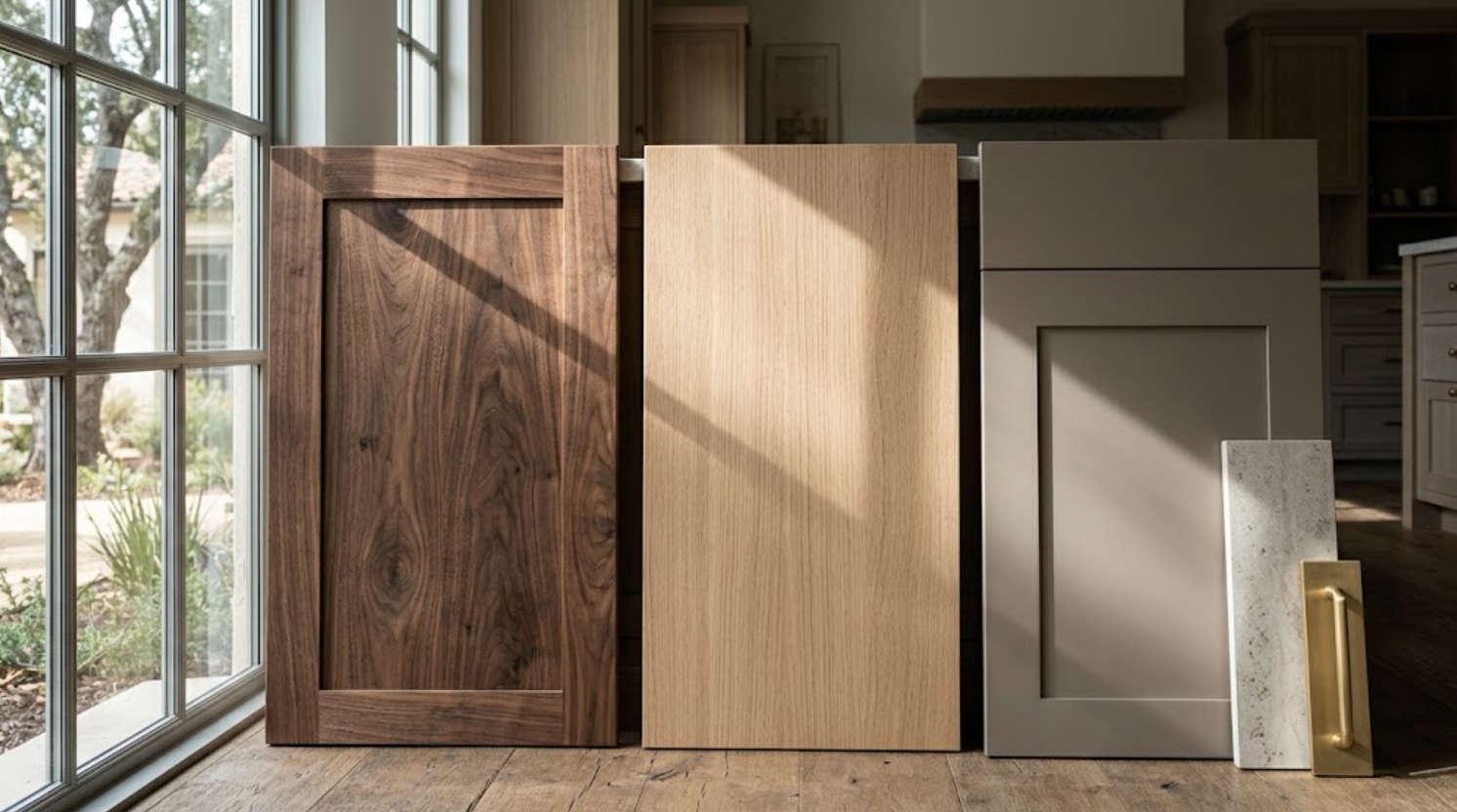
Wood is one example. Walnut can vary substantially in tone and grain. White oak can look pale and quiet in one finish and considerably warmer in another. Paint colors can reveal undertones that were almost invisible on a screen.
Construction is even harder to judge digitally. You need to:
Open a drawer.
Look inside a cabinet.
Feel the hardware.
Study how doors align.
See how an integrated appliance actually meets the surrounding cabinetry.
Online research can help you arrive informed. A showroom helps you understand what you are actually buying.
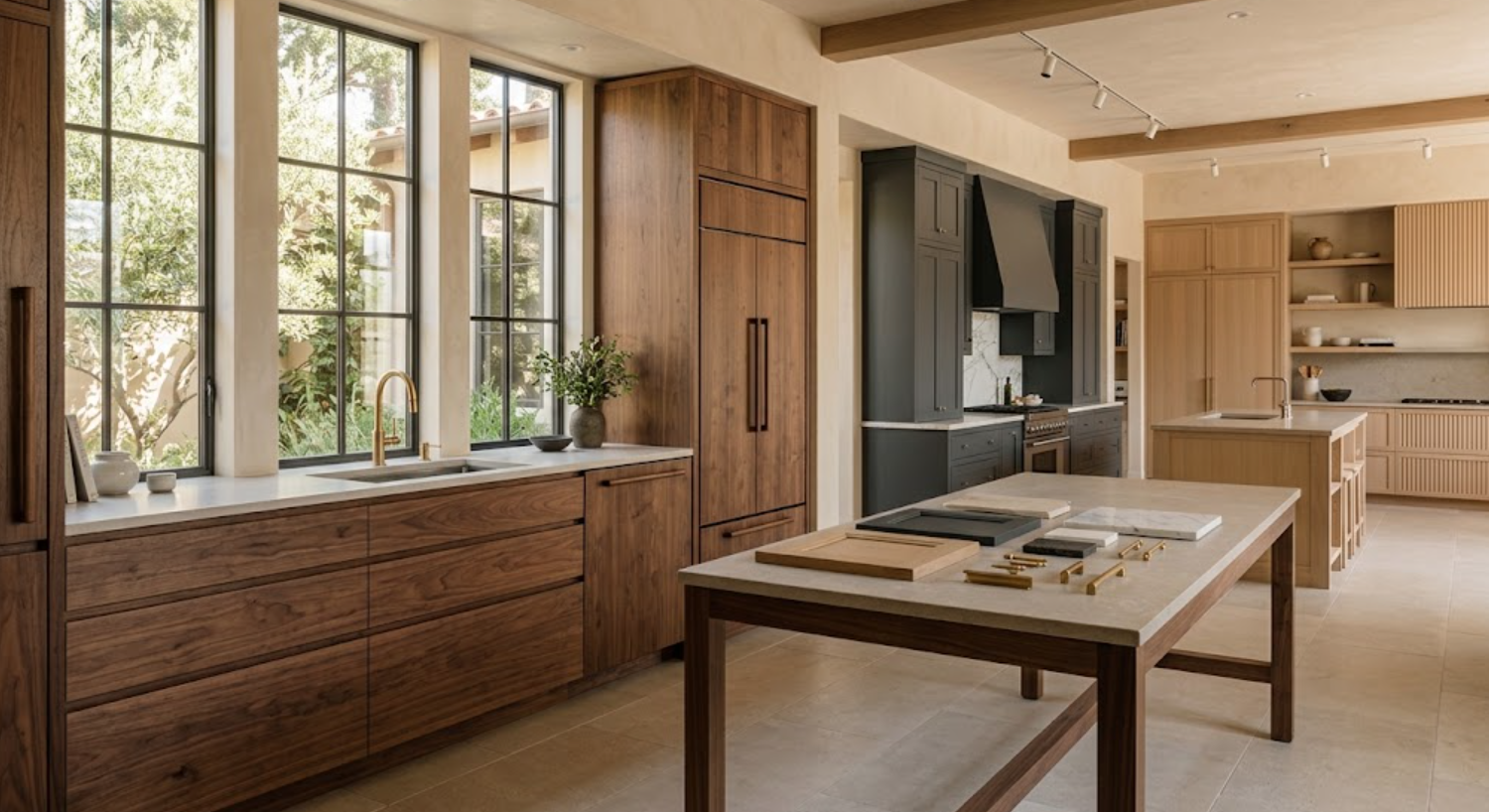
What Should a Luxury Cabinet Showroom Let You Compare?
More than door styles. A useful showroom should allow you to compare cabinetry at several levels.
Start with construction. Open drawers and cabinets. Look at interior materials, shelving, hinges, runners, edge details, and how the cabinetry operates.
Then look at finishes:
Compare painted cabinetry with natural woods.
See walnut and white oak at a larger scale.
Look at sheen.
Notice how finishes respond to natural and artificial light.
Then step back. Look at complete elevations:
How are tall cabinets proportioned?
How are appliances integrated?
How consistent are the reveals?
How does cabinetry terminate at walls and ceilings?
The goal is to move between the big picture and the details. Both matter.
Where Should Menlo Park Homeowners Start Looking for Kitchen Cabinets?
For a high-end residential project, start with a cabinetry-focused showroom or design resource that works at the level of your project.
Menlo Park and the surrounding Peninsula have cabinetry stores, kitchen and bath studios, custom cabinetmakers, and broader remodeling companies. Those businesses can serve very different needs. A homeowner replacing existing cabinets without substantially changing the room may need something different from someone renovating an entire kitchen with integrated appliances, custom dimensions, specialty finishes, and cabinetry continuing into a pantry or adjacent living space.
Before scheduling a visit, ask what kinds of projects the showroom typically handles:
Do they primarily sell cabinetry?
Do they provide cabinetry design?
Can they review architectural plans?
Do they work with custom and semi-custom options?
Can they coordinate with your interior designer, architect, or builder?
Can they support cabinetry outside the kitchen?
Those answers can narrow the search considerably.
Should You Visit More Than One Cabinet Showroom?
Often, yes. Especially early in the process.
The purpose is not necessarily to collect as many quotes as possible. It is to understand the differences.
One showroom may emphasize highly customized cabinetry.
Another may specialize in contemporary European systems.
Another may offer premium semi-custom cabinetry with a broad range of finishes and modifications.
Pay attention to how the conversation feels. Are you immediately being shown door colors? Or is someone asking about the architecture, appliances, storage, project team, and how you use the kitchen?
For a luxury project, those questions matter.
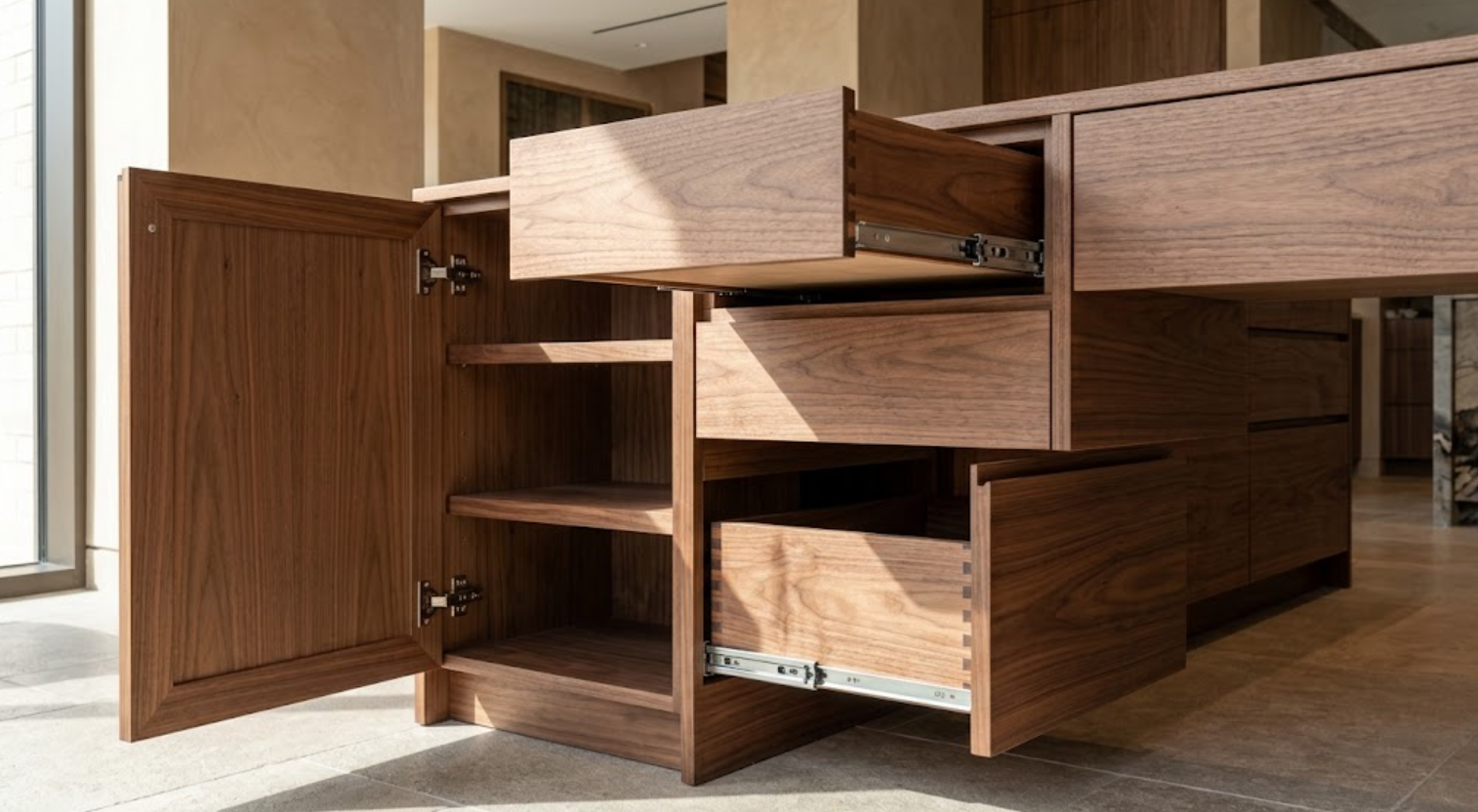
What Cabinetry Brands Should You Look For?
The brand matters, but it should not be the first or only decision. Different cabinetry manufacturers offer different levels of customization, finish options, construction approaches, aesthetics, and price points.
A strong showroom can help explain those differences and determine which line fits the project rather than automatically directing every client toward the same product. Atelier Design Society works with cabinetry resources including Grabill Cabinets, Columbia Cabinets, Dura Supreme, and Urban Effects.
That range matters because not every Menlo Park kitchen needs the same cabinetry solution.
A highly bespoke project may prioritize extensive dimensional and finish flexibility.
A contemporary project may prioritize clean slab cabinetry and sophisticated material options.
Another home may benefit from a premium cabinetry system that provides substantial customization without requiring every cabinet to be completely bespoke.
The right manufacturer is the one that supports the design.
Should You Choose a Cabinet Brand Before Designing the Kitchen?
Usually not. Start with what the room needs. Consider:
The architecture.
Appliances.
Storage.
Cabinet proportions.
Material direction.
Level of customization.
Budget.
Then determine which cabinetry line can execute that design well.
Choosing a manufacturer first and forcing the room into its limitations can reverse the design process. That does not mean cabinetry systems should be ignored until the design is complete. The capabilities of the manufacturer need to be understood early.
The design and cabinetry system should develop together.
How Do You Know if You Need Custom or Semi-Custom Cabinets?
Look at where the project becomes difficult.
If standard cabinet dimensions fit naturally, the desired finish already exists, and the storage requirements can be handled within an established system, premium semi-custom cabinetry may be an excellent solution.
Custom cabinetry becomes more useful when the architecture repeatedly asks for something unusual:
An off-center window.
A specific ceiling transition.
Unusual cabinet depths.
Highly integrated appliances.
A specialty finish.
Precise alignment with adjacent architecture.
Storage designed around something very specific.
Do not pay for customization simply because it sounds more luxurious. Use it where it improves the kitchen.
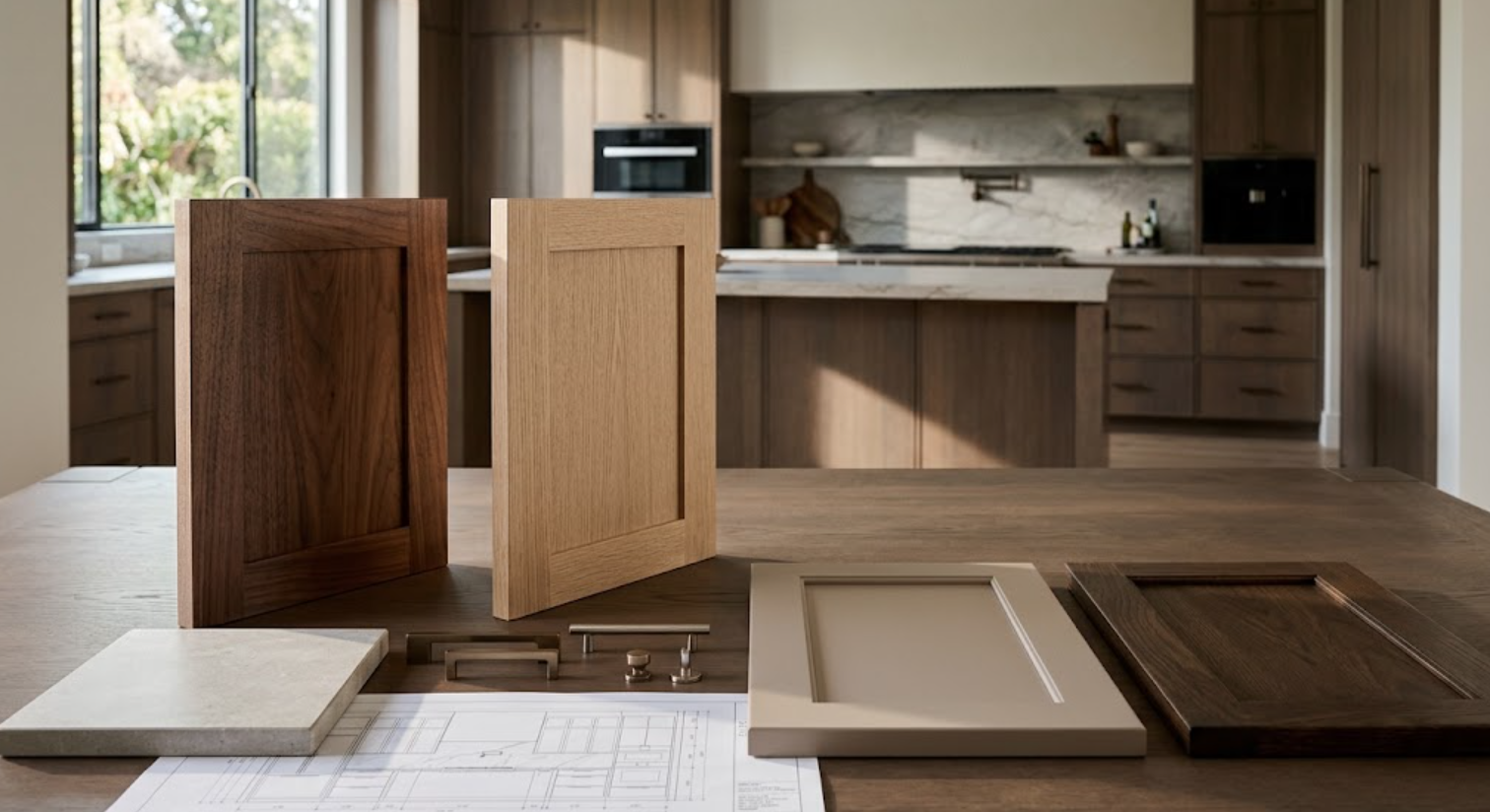
Why Should You Bring Your Kitchen Plans to the Showroom?
Because cabinetry becomes much easier to discuss when everyone is looking at the actual room.
Architectural plans can reveal:
Wall lengths.
Windows.
Doors.
Ceiling conditions.
Circulation.
Appliance locations.
Adjacent rooms.
Potential architectural conflicts.
A cabinet sample tells you what a finish looks like. A floor plan tells the cabinetry designer what needs to be built.
If architectural drawings are not available yet, that should not prevent you from visiting. Photos and approximate measurements can still make an early conversation more productive.
What Should You Ask About Appliance Integration?
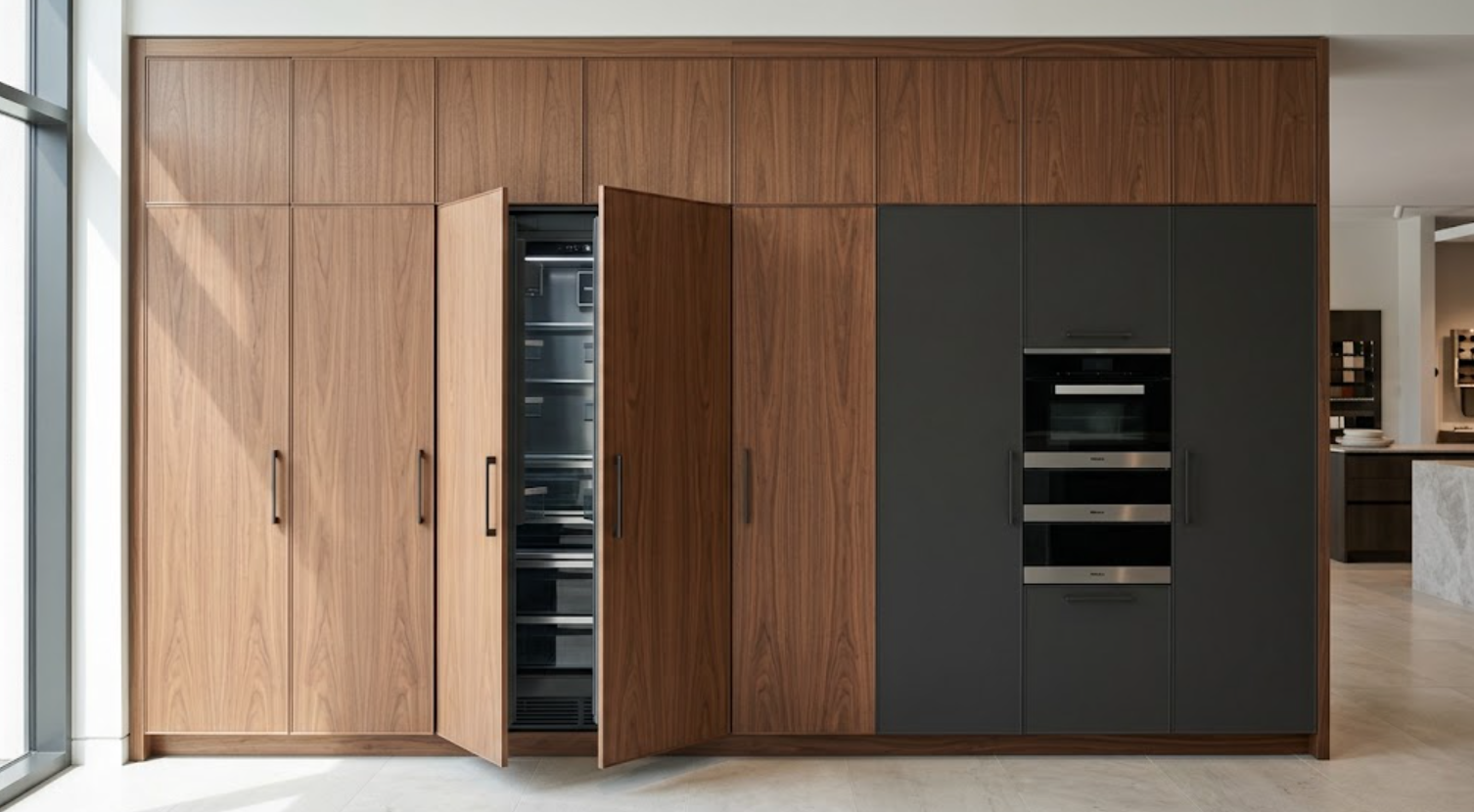
If you are considering panel-ready appliances, ask to see examples. Look closely:
Do the refrigerator panels align with adjacent cabinetry?
Are horizontal lines coordinated?
How are fillers handled?
What happens around the appliance when the doors open?
How does the cabinetry accommodate ventilation?
What does the side of the appliance wall look like?
Integrated appliances can look effortless when finished. They require considerable coordination to achieve that simplicity.
A showroom with full-scale displays allows you to see what that coordination actually looks like.
Should You Shop for Countertops at the Same Time?
You do not necessarily need to purchase cabinetry and countertops from the same place. But you should consider them together.
Cabinet color affects stone. Stone affects cabinet color. A richly veined quartzite may need quieter cabinetry. Walnut can change how warm a stone appears. Painted cabinetry may reveal undertones when placed beside a countertop sample.
Countertop thickness also affects cabinetry proportions. Full-height stone backsplashes interact with upper cabinetry, windows, outlets, and hoods.
Bring stone samples to cabinetry appointments if you already have them. If you do not, compare potential cabinetry finishes with several surface directions before making a final decision.
What About Kitchen Cabinet Storage?
Ask to use it:
Open the pantry.
Pull out the waste cabinet.
Try the interior drawers.
Look at tray dividers.
Open an appliance garage or pocket-door cabinet.
The question is not how many accessories can be added. It is which ones would improve your kitchen.
If you rarely bake, a specialized baking station may have little value. If several small appliances permanently occupy the countertop, concealed appliance storage could transform the room.
Good storage planning begins with habits. Not accessories.
How Should You Compare Cabinet Finishes?
Do not compare finishes only while they are lying flat on a table. Cabinet doors are installed vertically.
Stand samples up.
Move them toward natural light.
Look at them from several angles.
Place them beside stone and flooring.
Natural wood deserves particular attention. Walnut contains variation. White oak contains variation. Two doors from the same species may not be identical. That is part of using natural material.
A good showroom conversation should help you understand and plan for that variation rather than pretending it does not exist.
Should Your Interior Designer or Architect Come With You?
If you are already working with one, it can be useful.
Cabinetry intersects with architecture, interiors, appliances, lighting, electrical, plumbing, flooring, and stone. Having the design team involved early can reduce the chance that those decisions develop separately.
For complex projects, the cabinetry showroom should be comfortable collaborating directly with architects, interior designers, builders, and other professionals. The goal is not to replace the design team. It is to give them a cabinetry resource capable of translating the design into a buildable system.
How Early Should You Start Shopping for Kitchen Cabinets?
Earlier than the final finish-selection stage.
Cabinetry can affect:
Appliance specifications.
Plumbing locations.
Electrical.
Lighting.
Island dimensions.
Stone.
Wall conditions.
Ceiling details.
Construction schedules.
Starting early does not mean choosing every cabinet immediately. It means understanding the cabinetry direction while the rest of the kitchen still has enough flexibility to coordinate around it.
This becomes particularly important in a luxury remodel where small alignment decisions can affect the entire room.
What Should You Know About Cabinetry Lead Times?
Ask early. Lead times vary by cabinetry manufacturer, level of customization, finish, project size, and current production conditions. Custom finishes or unusual modifications may require additional time.
Design and approval happen before production begins, so the manufacturing lead time is only one part of the schedule. There may also be:
Field measurements.
Design development.
Revisions.
Shop drawings.
Approvals.
Ordering.
Production.
Delivery.
Installation.
Final adjustments.
Cabinetry should therefore be incorporated into the construction schedule rather than treated as a finish that can simply be ordered near the end.
How Do You Compare Cabinetry Quotes?
Do not compare only the total. Determine what each proposal includes:
Cabinet construction.
Finish.
Panels.
Interior accessories.
Appliance panels.
Hardware.
Custom modifications.
Delivery.
Installation.
Design services.
Field measurements.
A lower number may exclude components included in another proposal. Likewise, a higher number may include customization that the project does not actually need.
The goal is an apples-to-apples comparison based on the design.
Where Should You Shop for Luxury Kitchen Cabinets in Menlo Park?
Look for a showroom where you can evaluate more than appearance. You should be able to understand:
How the cabinets are constructed.
How they operate.
What can be customized.
Which manufacturers are available.
How finishes behave at full scale.
How appliances are integrated.
How storage can be tailored.
How cabinetry will coordinate with your architect, designer, builder, and other materials.
Atelier Design Society describes its approach as collaborative and works with designers, builders, architects, and clients. Its team also includes cabinetry design experience in technical drafting, 3D rendering, space planning, and on-site measurement.
Those capabilities matter because shopping for luxury cabinetry should eventually move beyond choosing a product. It becomes part of designing the room.
Visit Atelier Design Society for Luxury Kitchen Cabinetry
Atelier Design Society works with homeowners and design professionals planning premium cabinetry for Menlo Park and the surrounding Bay Area.
A showroom visit can give you the opportunity to move beyond inspiration images and evaluate cabinetry as something you will actually live with: construction, materials, proportions, finishes, storage, appliance integration, and customization.
Bring architectural plans if you have them.
Bring material samples.
Bring appliance information.
And bring the questions the kitchen still needs to solve.
Those are often more valuable than arriving with the perfect cabinet color already selected.