Why Custom Cabinetry Is Worth Considering for a Luxury Home
In a thoughtfully designed home, cabinetry does far more than provide storage. It influences proportion, circulation, sightlines, material transitions, and the way a room functions every day.
That distinction becomes especially important in luxury residential projects. A home may have unusual ceiling heights, carefully positioned windows, integrated appliances, architectural millwork, or rooms designed around very specific routines. Standard cabinet dimensions can work well in many settings, but they can also require the architecture to adapt to the cabinetry rather than the other way around.
Custom cabinetry offers a different approach. Instead of beginning with a predetermined set of cabinet sizes, the design can begin with the room itself, the architecture surrounding it, and the people who will use it.
For homeowners and design professionals working on residences in Menlo Park and across the Peninsula, that flexibility can make cabinetry feel less like something installed into a room and more like an intentional part of the home.
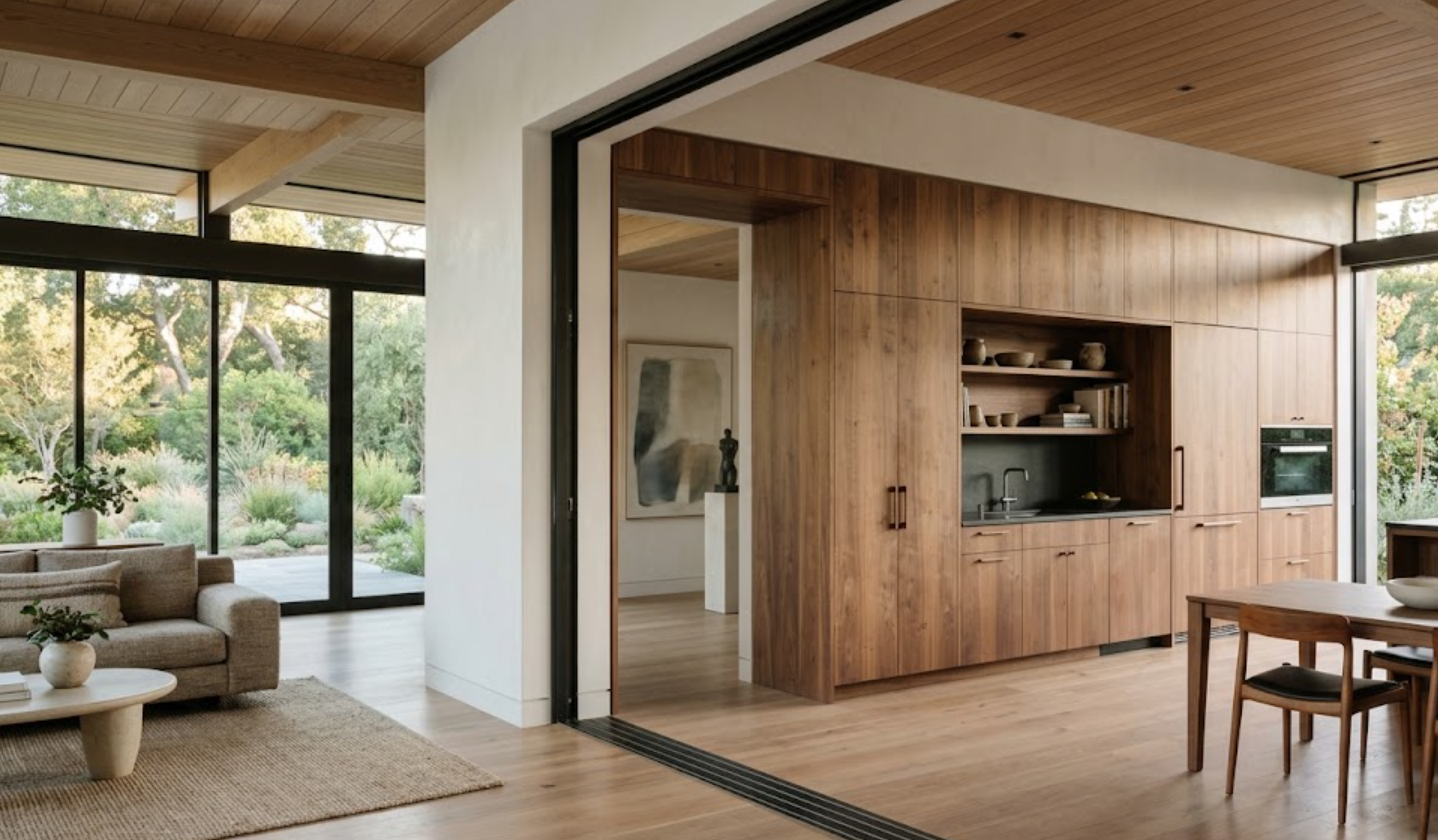
What Actually Makes Cabinetry “Custom”?
True custom cabinetry is designed around a specific project rather than assembled primarily from a catalog of predetermined dimensions.
That difference affects much more than appearance. Cabinet heights and widths can respond to the proportions of a room. Interior storage can be planned around particular objects and routines. Materials, finishes, hardware, reveals, door styles, and construction details can be considered as part of a larger architectural composition.
This does not mean that every cabinet needs an unusual feature. Often, the value of customization is quieter. A run of cabinetry can terminate precisely at a wall. Upper cabinets can relate correctly to a window or ceiling. A tall appliance can be incorporated without leaving an awkward filler panel beside it.
The goal is not customization for its own sake. It is greater control over how cabinetry fits, functions, and relates to everything around it.
Why Does Architecture Matter So Much in Cabinetry Design?
Because rooms are rarely as simple as they appear on a floor plan.
Walls may not be perfectly symmetrical. Ceilings change height. Windows interrupt cabinet runs. Doorways establish important sightlines. Existing homes can contain conditions that were never designed around contemporary kitchens, appliances, or storage needs.
These considerations are particularly relevant throughout the Peninsula, where residential projects range from new construction to substantial renovations of homes built in very different architectural periods.
In Menlo Park, Atherton, Palo Alto, Woodside, Portola Valley, and Los Altos, a cabinetry solution may need to respond to anything from restrained contemporary architecture to a traditional home being carefully updated.
Custom cabinetry allows the design to respond to those conditions rather than conceal them with unnecessary fillers, oversized trim, or compromised proportions.
A difficult corner can become intentional storage. Cabinetry beneath a sloped ceiling can follow the architecture. A wall of millwork can align with nearby openings. A transition from kitchen cabinetry to an adjacent living area can be resolved as one composition rather than two unrelated systems.
That architectural responsiveness is one of the strongest reasons to consider custom cabinetry.
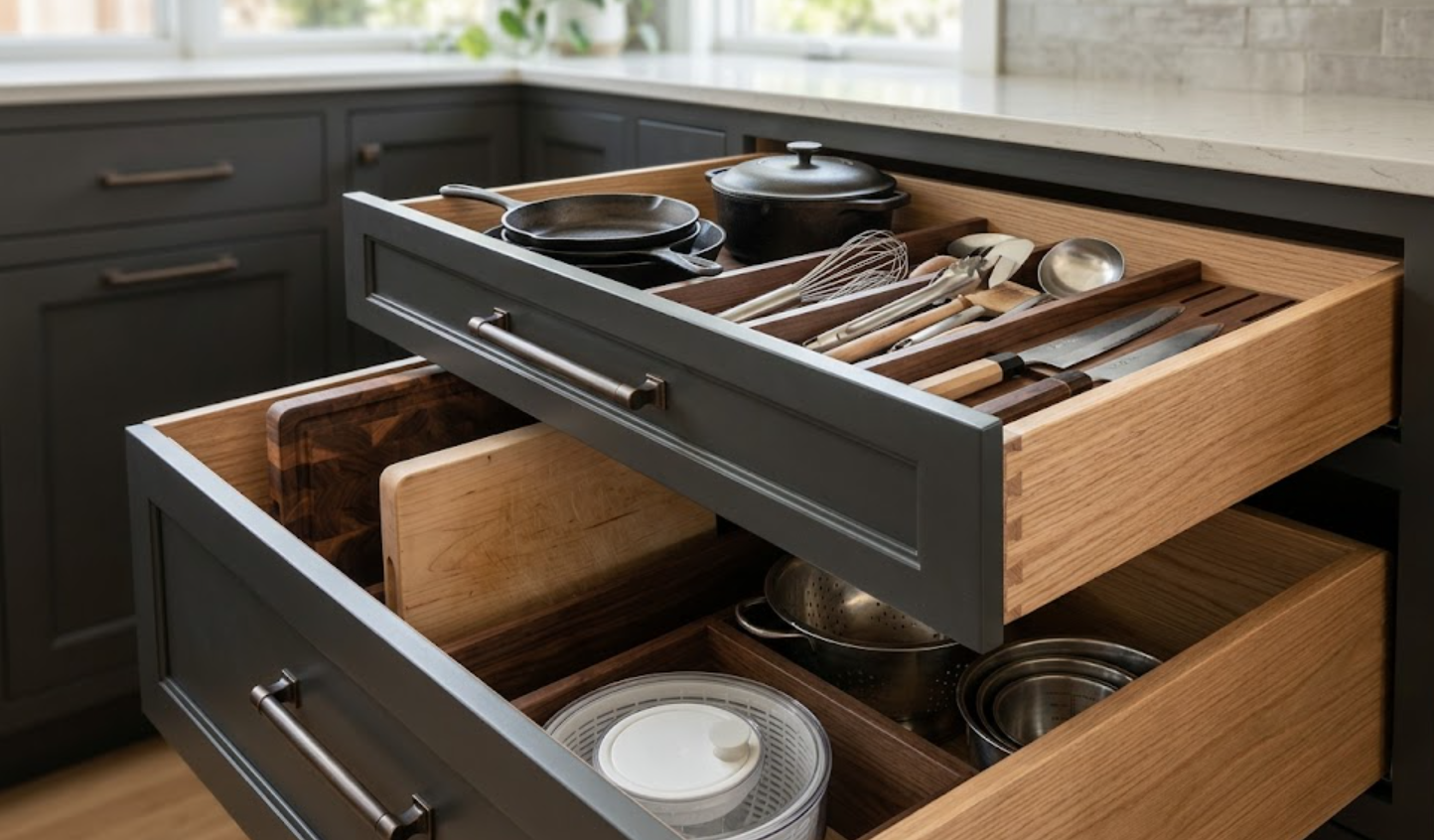
Storage Can Be Designed Around the Household, Not the Other Way Around
Good storage is not simply about fitting more things into a cabinet. It is about putting the right things in the right places.
A household that cooks frequently may prioritize deep drawers near the range, dedicated spaces for small appliances, vertical tray storage, or carefully organized pantry cabinetry. Someone who entertains often may need serving pieces, glassware, linens, wine storage, and a bar arranged around how guests move through the home.
The same principle extends beyond the kitchen.
A wardrobe can be designed around the actual proportions of a homeowner's clothing and accessories. A bathroom vanity can accommodate grooming tools without cluttering the counter. An office can incorporate files, equipment, books, and concealed charging. A mudroom can give each member of the household a logical place for everyday belongings.
With custom cabinetry, the question changes from “What can we fit in this cabinet?” to “What needs to live here, and what is the most sensible way to store it?”
That is a small change in thinking, but it can have a significant effect on daily use.
Materials and Finishes Become Part of the Architecture
Cabinetry occupies a substantial amount of visual space, particularly in kitchens, libraries, dressing rooms, and rooms with floor-to-ceiling millwork. Its material character therefore has an outsized influence on how an interior feels.
Custom work opens a broader conversation around:
Wood species
Grain direction
Veneer selection
Painted finishes
Stains
Sheen levels
Hardware
Interior materials
The relationship between cabinetry and adjacent surfaces
The important question is not simply which finish looks luxurious. It is which material makes sense for the architecture.
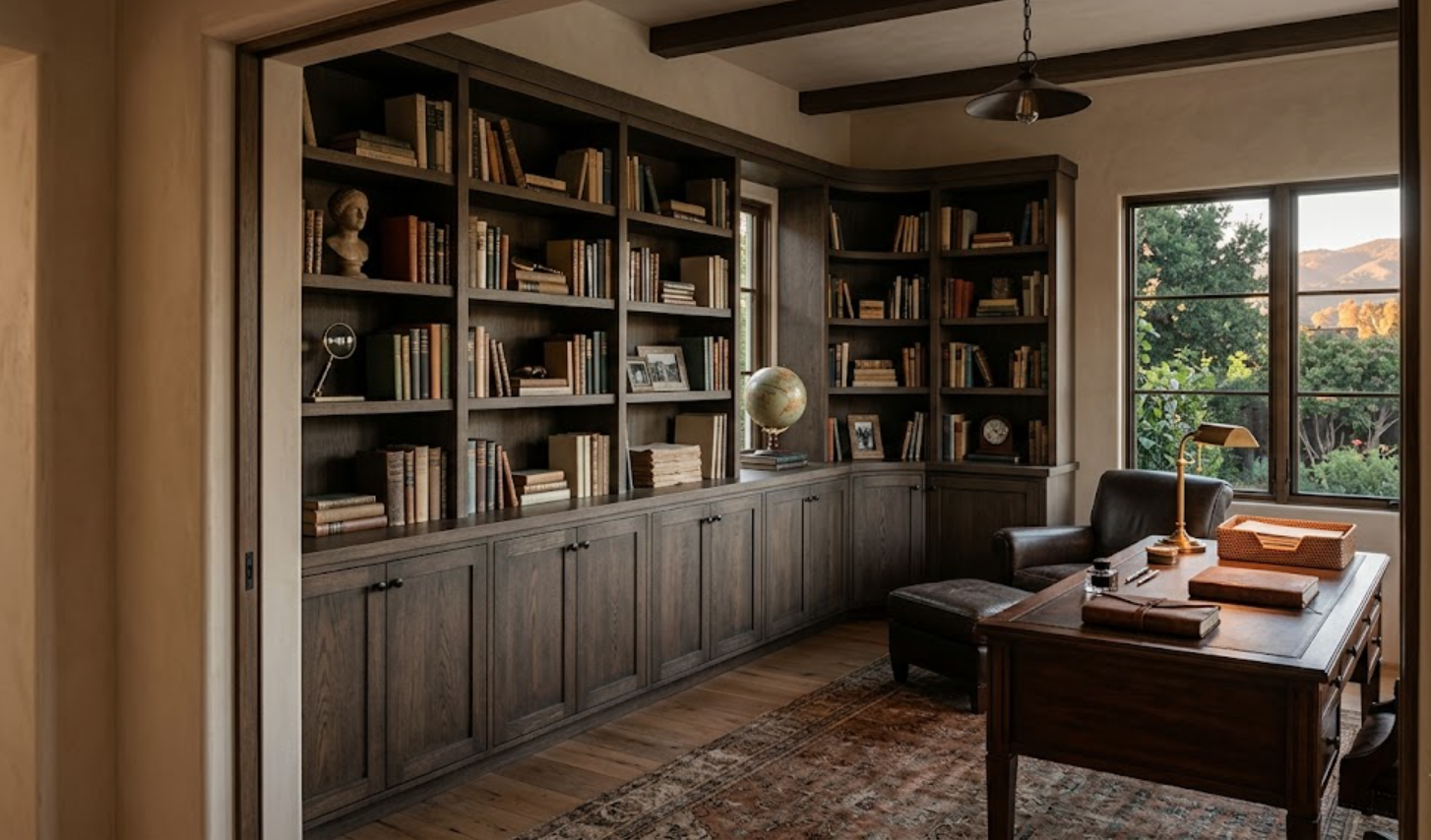
A darker wood might give definition to a library or bar. Painted cabinetry may create a quieter relationship with architectural walls. Natural wood can introduce warmth into a restrained contemporary interior. In another project, cabinetry may deliberately contrast with stone, plaster, metal, or flooring rather than attempting to match it.
These decisions are most successful when materials are considered together, not selected independently at the end of the process.
Craftsmanship Often Shows Up in the Details You Notice Least
Well-resolved cabinetry tends to look effortless, but achieving that simplicity requires precision.
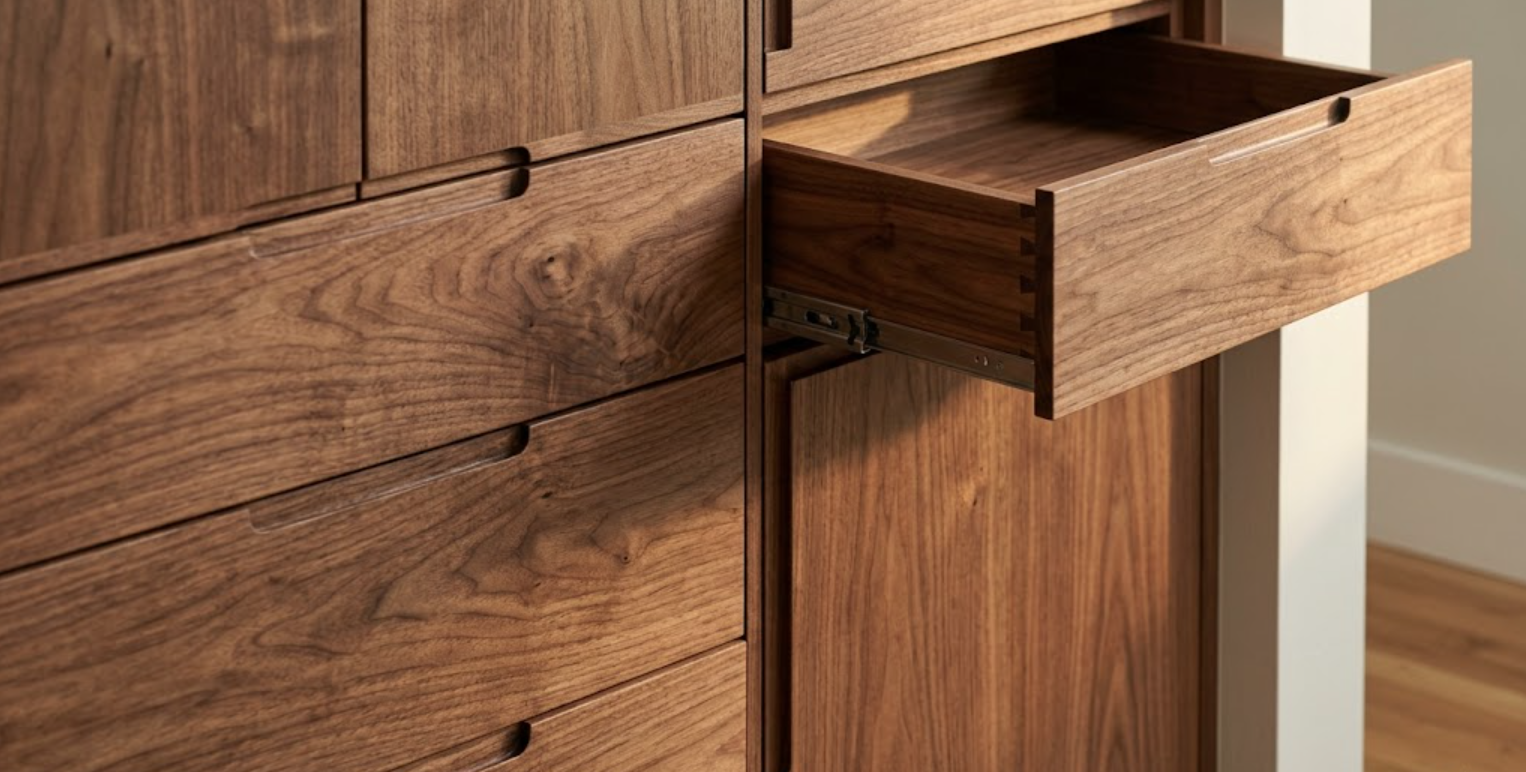
Consistent reveals, aligned doors and drawers, clean intersections, carefully considered grain direction, appropriate edge details, and thoughtful transitions all influence the finished result. The quality of drawers, hinges, hardware, and interior construction also affects how cabinetry feels long after installation.
Many of these details are subtle. A visitor may never consciously notice that a reveal continues perfectly across several cabinet fronts or that a wood grain was deliberately sequenced.
They will notice, however, when the room feels composed.
This is one reason craftsmanship matters so much in minimal or highly architectural interiors. The simpler the design appears, the more visible small inconsistencies can become.
How Does Custom Cabinetry Improve Appliance Integration?
Modern kitchens often contain a complex collection of appliances, and integrating them convincingly requires more than placing panels over refrigerator doors.
Refrigeration, wall ovens, dish ovens, dishwashers, coffee systems, ventilation, wine storage, and smaller countertop appliances all introduce dimensional and technical requirements. Clearances, ventilation, door swings, electrical locations, and manufacturer specifications have to coexist with the intended cabinetry composition.
Custom cabinetry gives the design team greater control over how these elements relate visually.
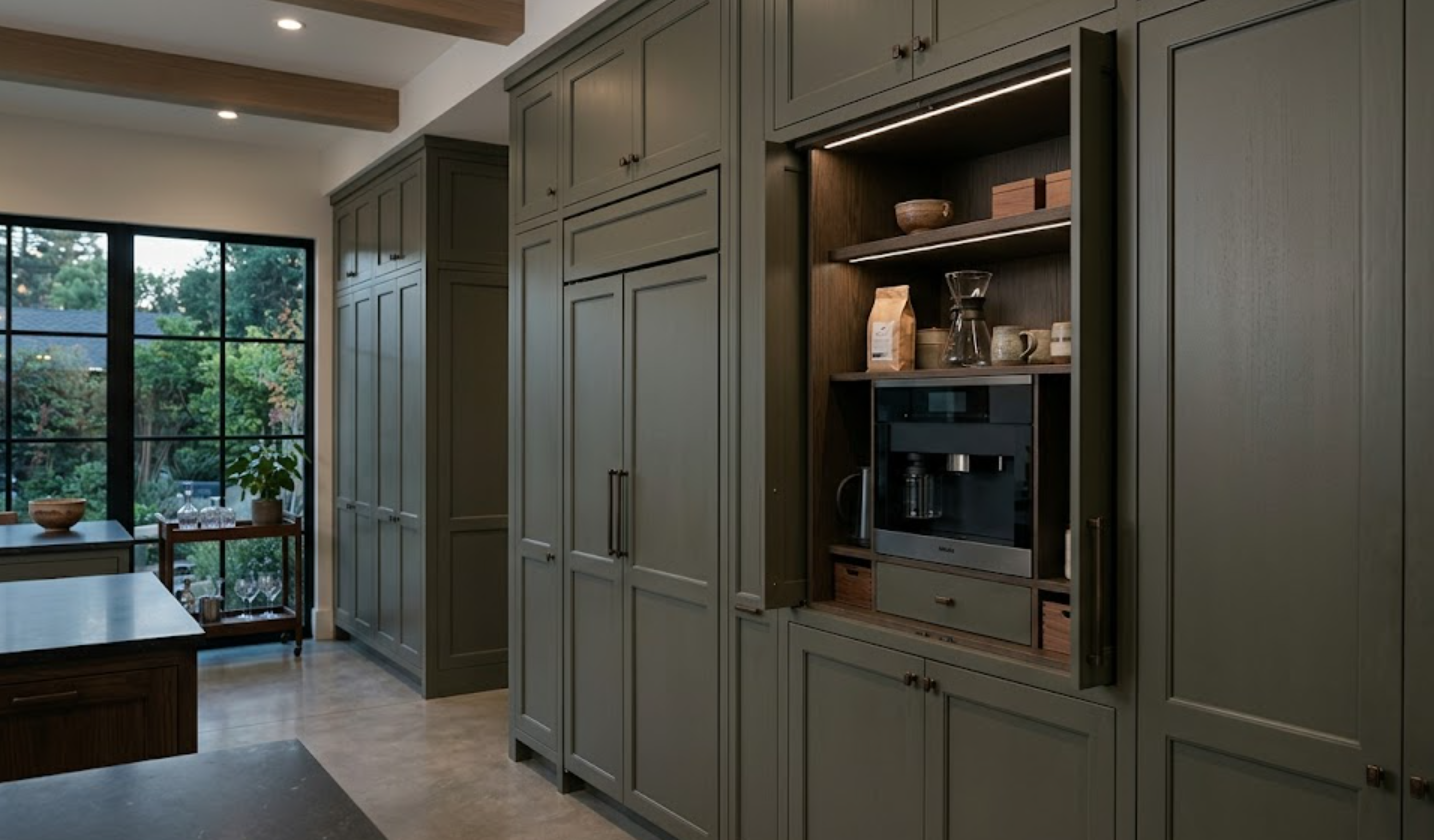
A refrigerator can be incorporated into a full-height wall of cabinetry. A coffee station can disappear behind pocket doors when it is not being used. Smaller appliances can have dedicated storage rather than permanently occupying the counter. Panels, fillers, and surrounding cabinetry can be proportioned so the appliance feels integrated rather than inserted.
The result is not necessarily a kitchen in which every appliance is hidden. It is a kitchen in which visible and concealed elements have been considered deliberately.
What Happens at the Difficult Parts of a Room?
Some of the strongest arguments for custom cabinetry appear where standard solutions struggle.
An uneven wall, a narrow return beside a window, an unusual corner, a change in ceiling height, or a transition between rooms may represent only a small portion of the project. Visually, however, these areas can determine whether the finished cabinetry feels integrated or unresolved.
Custom cabinetry gives designers the ability to treat these conditions as design opportunities.
A cabinet can be shallower where circulation requires it. Shelving can wrap an architectural corner. Millwork can frame a window without overwhelming it. Cabinetry can transition from one depth to another gradually rather than ending abruptly.
These details are rarely the first thing someone notices in a completed room. They are often part of why the room feels right.
Why Think Beyond the Kitchen?
Once cabinetry is treated as part of the architecture, its role can extend naturally throughout the home.
A kitchen may establish a material or detailing language that reappears in:
A bar
A pantry
A bathroom
A home office
A library
A media room
A wardrobe
Built-in storage elsewhere in the residence
This does not mean repeating identical cabinetry in every room.
Visual continuity can come from subtler relationships, such as a consistent reveal, recurring hardware finish, related wood tones, similar proportions, or a shared approach to detailing. Individual spaces can still have distinct personalities while belonging to the same home.
This whole-home approach can be particularly effective in open or interconnected floor plans, where cabinetry is visible across multiple rooms and abrupt changes in style become more noticeable.
Is Custom Cabinetry Always Worth It?
Not necessarily. Customization is most valuable when the project actually benefits from the flexibility it provides.
For a straightforward secondary space with standard dimensions and simple storage requirements, a well-made semi-custom or premium cabinet system may be entirely appropriate. Spending more simply to label something “custom” does not automatically produce a better room.
Custom cabinetry becomes particularly compelling when architecture, proportion, specialized storage, unusual dimensions, appliance integration, material continuity, or highly specific design details matter to the project.
It can also make sense when cabinetry appears throughout several rooms and needs to support a consistent architectural language across the home.
The better question, then, is not whether custom cabinetry is universally superior. It is whether the additional design control will meaningfully improve the particular residence.
When Should Cabinetry Be Considered in the Design Process?
Ideally, early.
Cabinetry affects dimensions, electrical planning, plumbing, lighting, appliance specifications, wall conditions, flooring transitions, and sometimes even window and doorway relationships. Waiting until those decisions are fixed can unnecessarily limit the cabinetry design.
For new construction and substantial renovations, early collaboration between homeowners, interior designers, architects, builders, appliance specialists, and cabinetry professionals can help identify conflicts before they become expensive site problems.
It also creates more room for good ideas.
Instead of asking cabinetry to fill whatever space remains, the design team can consider how millwork and architecture should work together from the beginning.
The Value Is in How the Home Comes Together
The case for custom cabinetry is ultimately less about exclusivity and more about resolution.
It offers the ability to respond precisely to architecture, create storage around real routines, integrate appliances thoughtfully, explore materials with greater freedom, and carry a coherent design language through multiple rooms.
In the right project, those advantages can affect both how a home looks and how naturally it functions every day.
For homeowners, designers, architects, and builders considering custom cabinetry for a project in Menlo Park or elsewhere on the Peninsula, Atelier Design Society offers a place to explore cabinetry, materials, details, and possibilities in person.
Visit the Atelier Design Society showroom in Menlo Park or book a consultation to begin the conversation.