Wine Cellar Cabinetry: Designing a Space Worth Gathering In
A wine cellar does not have to feel like storage. It can feel like a room.
That distinction changes almost everything.
If the goal is only to hold bottles, the cabinetry can be almost entirely functional. If the goal is to create a place where people actually want to spend time, the cabinetry has to do more.
It needs to:
Organize the collection
Support proper storage
Handle serving
Integrate refrigeration where needed
Create visual rhythm
Introduce warmth
Contribute to the atmosphere of the room
A successful wine cellar should make the collection feel considered without turning the space into a retail display. It should also feel comfortable enough that people want to linger there.
For custom homes and major remodels, that often means treating wine cellar cabinetry as part storage system, part architecture, and part furniture.
What Makes a Wine Cellar Feel Like a Gathering Space?
Usually, it comes down to proportion and atmosphere.
A cellar filled wall to wall with bottle racks can be impressive, but it can also feel visually dense. If every surface is occupied by wine, there is little room for the eye to rest.
A gathering-oriented wine cellar usually benefits from a mix of functions:
Bottle storage
Closed cabinetry
Display
Serving surface
Seating
Lighting
Negative space
The room should support both the collection and the people using it.
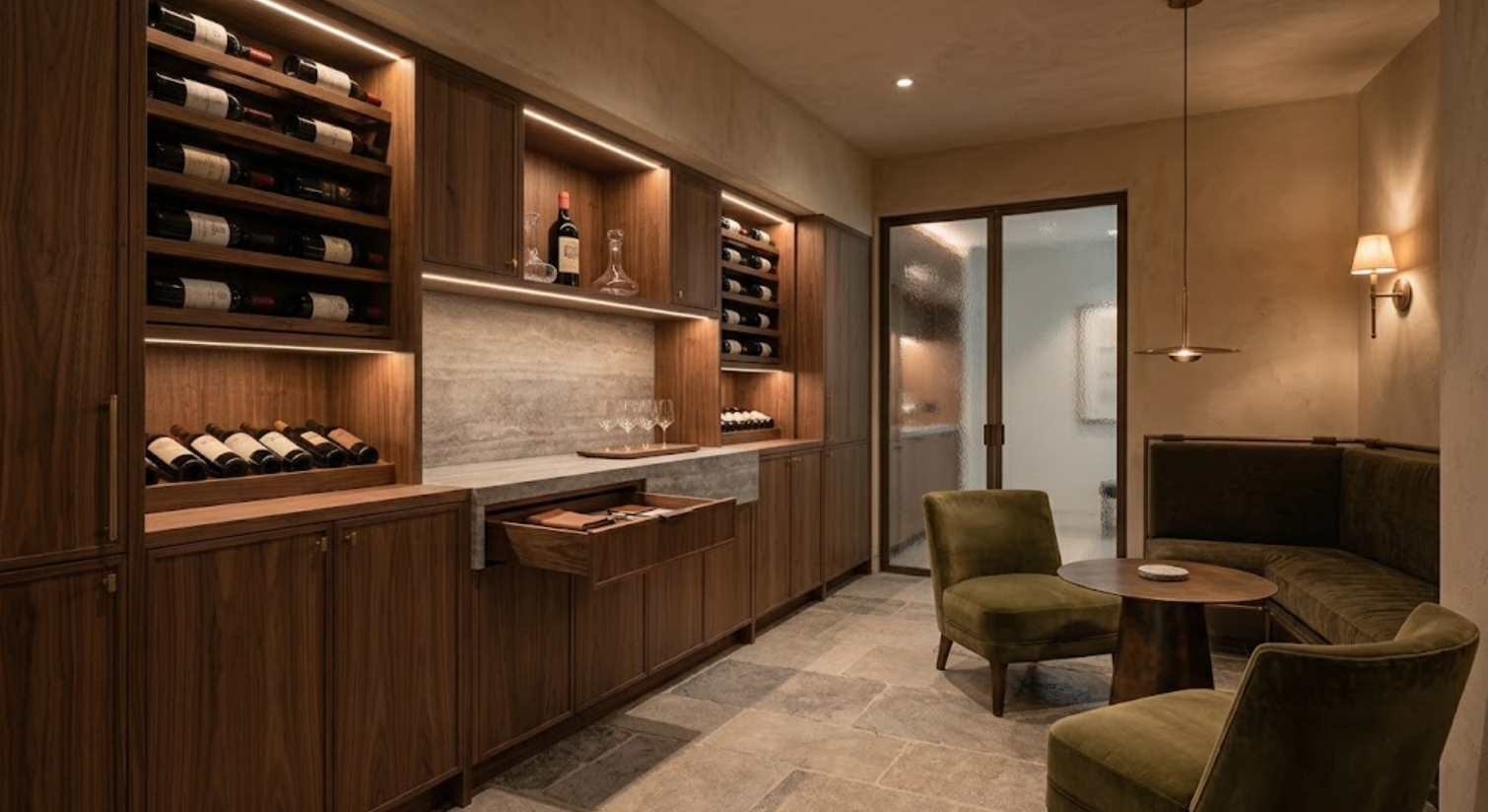
That may mean one wall is highly organized for bottles while another is more architectural. A central cabinet can provide serving storage. A built-in bench or small table can create a place to sit.
The cabinetry should make the room feel composed, not packed.
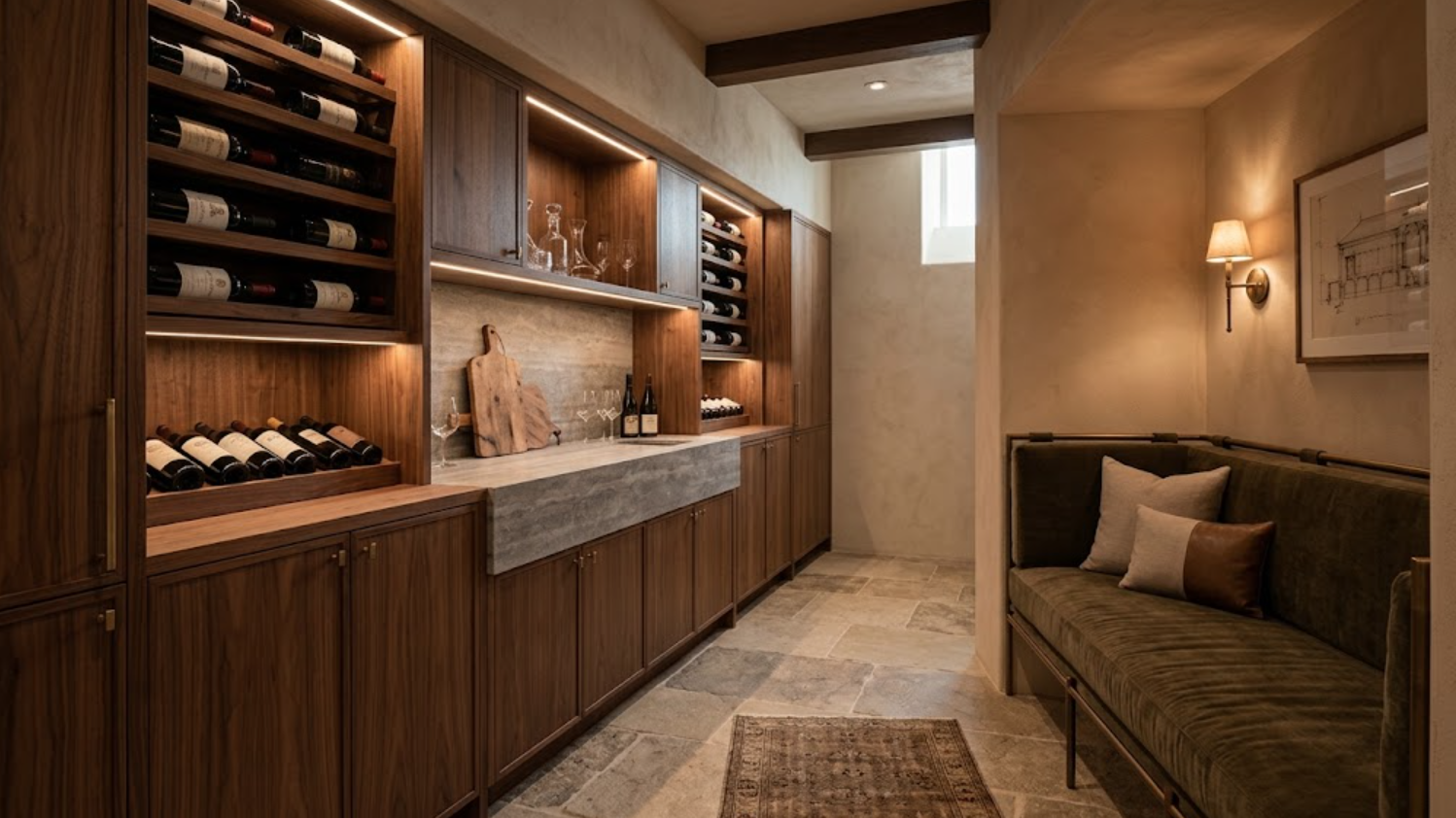
Should a Wine Cellar Be Fully Enclosed?
Not necessarily.
Some projects benefit from a dedicated enclosed room. Others may integrate wine storage into a dining room, lounge, bar, or transition space.
The correct approach depends on:
The size of the collection
Temperature requirements
Humidity control
Exposure to light
Available floor area
How often the space is used
Whether the wine is meant to be displayed
A serious long-term collection may need a more controlled environment.
A smaller lifestyle collection may work well in a conditioned display room or integrated cabinetry wall.
The architecture should follow the actual storage requirements, not the assumption that every wine space needs to look like a traditional cellar.
How Should the Collection Be Organized?
By the way the homeowner actually uses it.
Some collections are organized by:
Region
Varietal
Vintage
Producer
Occasion
Daily drinking versus long-term aging
The cabinetry needs to support that system.
Bottle orientation matters. Label visibility matters. Shelf depth matters. Different bottle shapes matter.
Consider:
Champagne bottles
Burgundy bottles
Magnums
Special-format bottles
If the storage is too standardized, certain bottles may not fit comfortably.
Custom cabinetry can account for those differences while keeping the exterior visually controlled.
Should Every Bottle Be Visible?
No.
This is one of the most important design decisions.
Displaying every bottle can quickly make the room feel busy. Some collectors want maximum visibility. Others prefer a quieter architectural space.
A balanced approach can include:
Visible bottle storage for frequently accessed wines
Closed cabinetry for less visually important storage
Drawers for tools and accessories
Concealed storage for cases
A few display shelves for special bottles
The cabinetry should support the collection without requiring the collection to become the entire visual identity of the room.
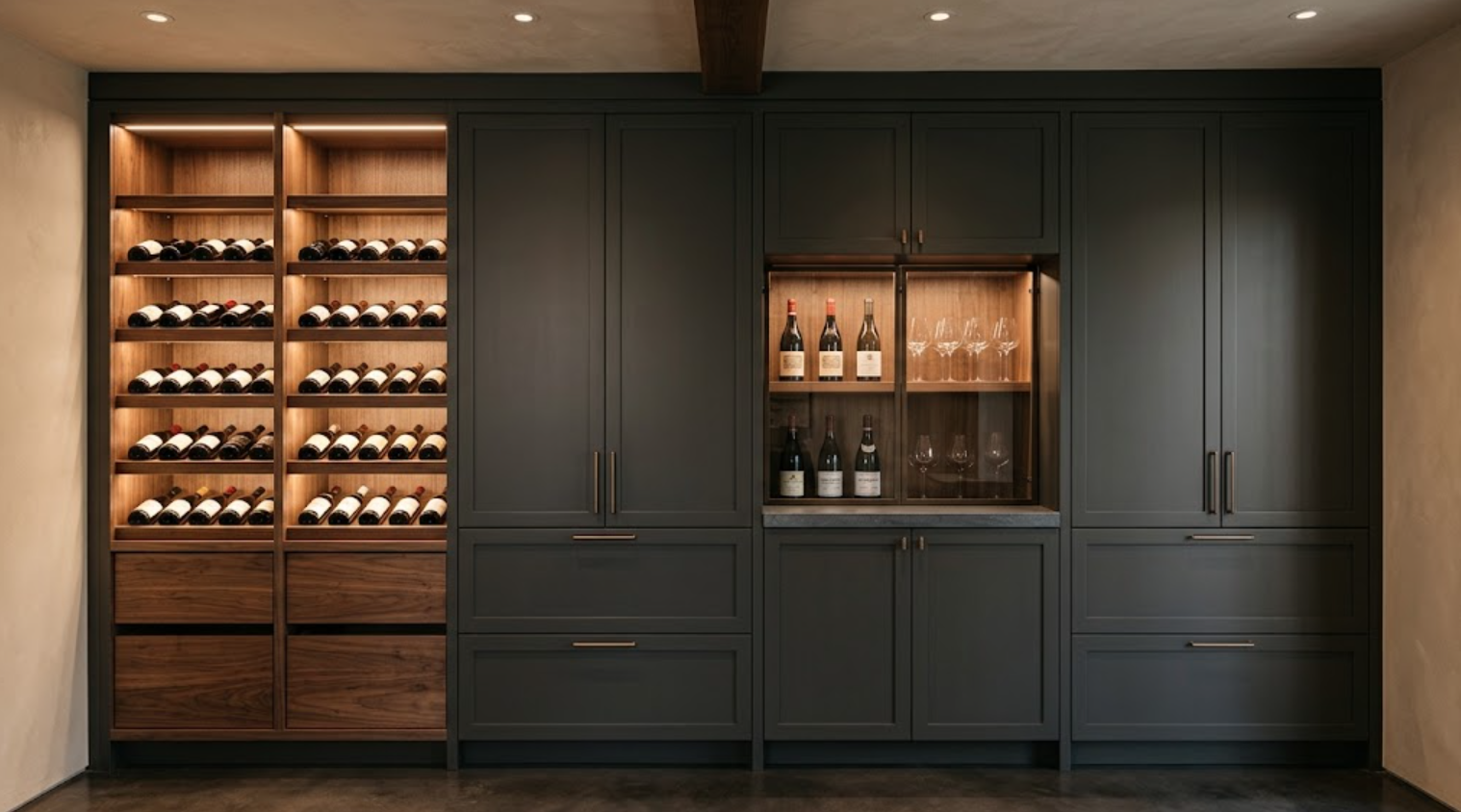
What Materials Work Best in a Wine Cellar?
Materials should support both atmosphere and function.
Natural walnut is a strong option because it creates warmth and depth. Rift-sawn white oak can produce a lighter and more contemporary cellar. Painted cabinetry can make bottle storage visually quieter.
Metal can be useful in smaller doses. Stone works well for serving surfaces. Glass can introduce transparency without making everything fully open.
The strongest rooms usually rely on a limited palette:
One primary cabinetry material
One supporting material
Stone
Metal
Controlled glass
That is often enough.
A wine cellar does not need to look themed. It should feel like part of the house.
Should the Cabinetry Match the Kitchen or Home Bar?
Not exactly, but it should relate.
A wine cellar may be darker than the kitchen, more atmospheric, and more enclosed.
The home bar may use walnut and charcoal cabinetry. The wine cellar could continue the walnut but shift into a deeper paint. Or it might use white oak with the same bronze hardware family.
The connection can happen through material, hardware, proportions, or detailing. It does not need to happen through exact duplication.
That is especially important if the wine cellar sits near a dining room or home bar.
The spaces should feel related without becoming copies of each other.
How Should Temperature Control Affect the Cabinetry?
It should be considered early.
Wine storage can require controlled temperature and humidity depending on the collection and the intended storage duration.
That can affect:
Room construction
Insulation
Door selection
Mechanical systems
Ventilation
Cabinet placement
Material stability
The cabinetry should not be designed independently from those systems.
If a dedicated cooling system is required, the mechanical equipment and airflow need to be coordinated with the architecture and cabinetry.
Grilles and vents should not be treated as afterthoughts.
A beautiful wine wall loses its refinement quickly if mechanical components are placed randomly after the cabinetry is complete.
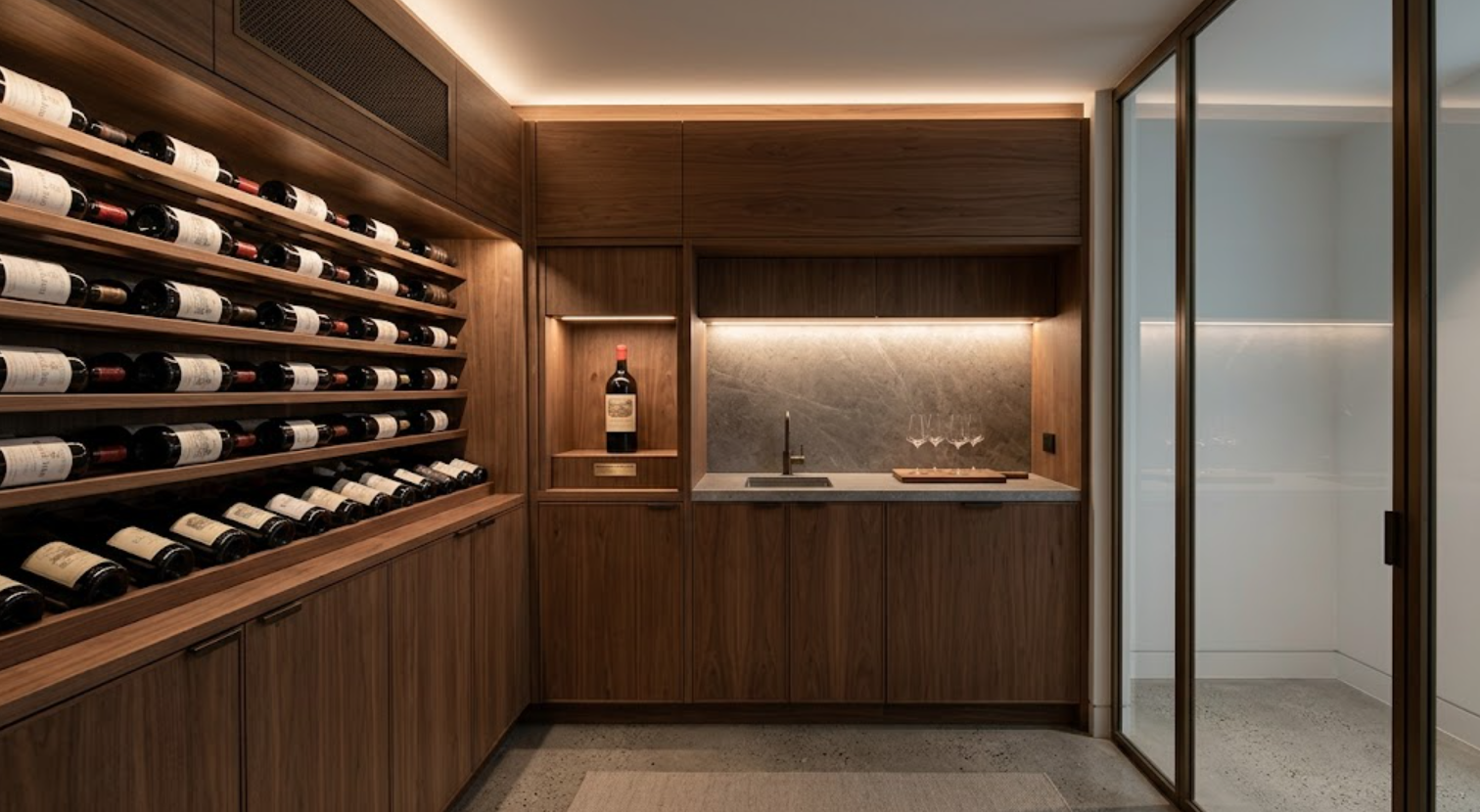
Does a Wine Cellar Need a Glass Door?
No, but glass can be useful.
A full-height glass door can visually connect the wine room to an adjacent dining room or lounge. That can make a small wine cellar feel more integrated into the house.
It also allows the cabinetry and collection to contribute visually even when the room is closed.
But glass introduces technical considerations:
Insulation
Sealing
Condensation
Temperature performance
Glare
Privacy
If the room requires tighter environmental control, the door system needs to support that.
The architectural idea and the technical requirements should be resolved together.
How Much Seating Should a Wine Cellar Have?
Only as much as the room can support comfortably.
A wine cellar does not need a full dining table to become a gathering space.
Possible options include:
A built-in bench
Two lounge chairs
A small tasting table
A narrow counter with stools
The key is circulation.
If seating blocks access to the cabinetry, the room becomes frustrating. If the space is too small, standing room with a good serving surface may be more appropriate.
The goal is not to force entertaining into the cellar. It is to support the amount of lingering the room can realistically accommodate.
What Kind of Serving Surface Works Best?
A dedicated surface is extremely useful.
It gives the room a place for:
Opening bottles
Decanting
Pouring
Glassware
Small serving pieces
A tasting setup
The surface can be integrated into the cabinetry.
Honed stone works well because it is durable and easy to clean. Natural wood can feel warmer but may require more care.
A stone-topped cabinet can also contain drawers below for tools, linens, and accessories.
This small functional zone can make the wine cellar feel much more complete.
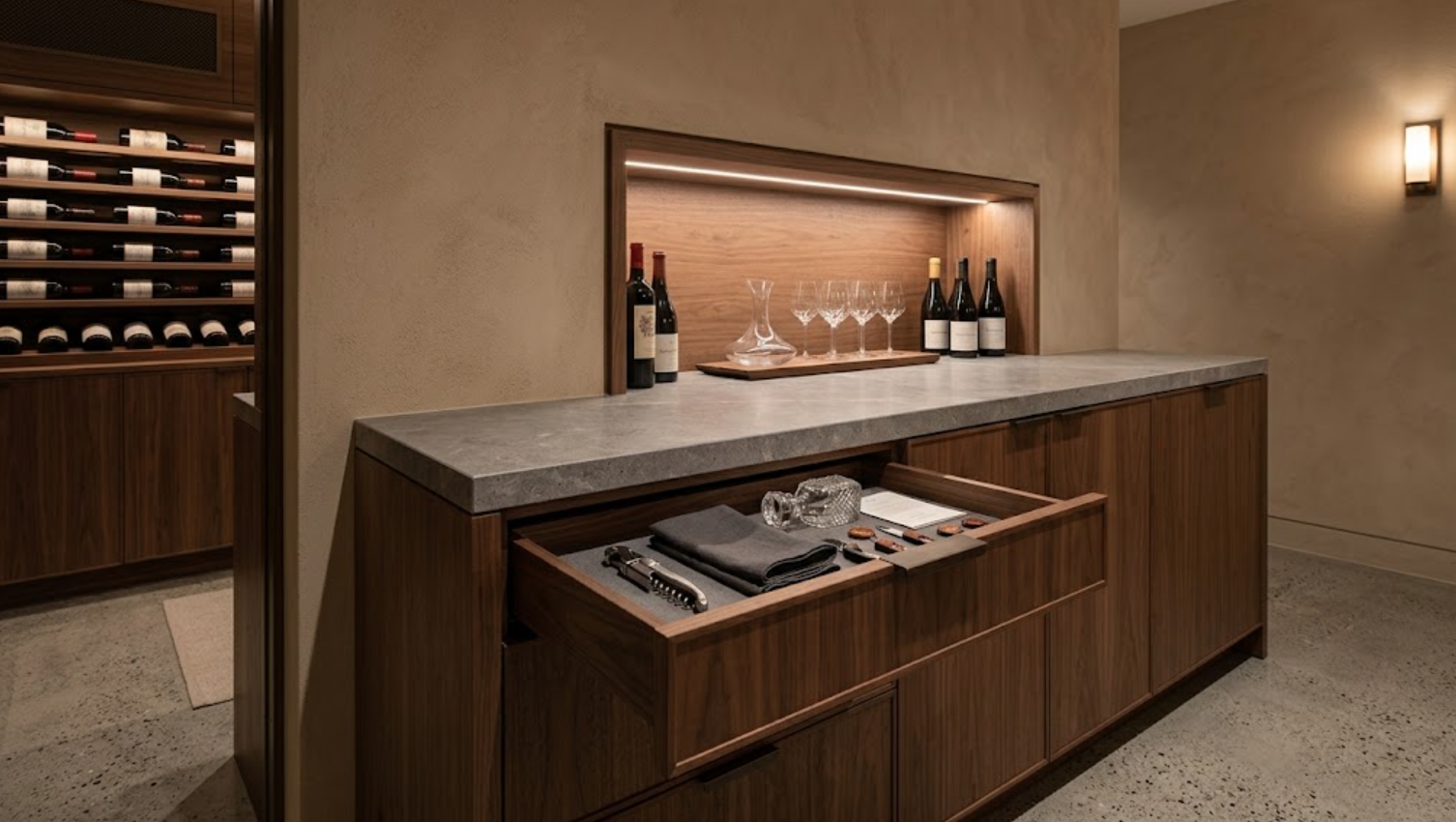
What Should Be Stored Besides Wine?
A well-designed cellar often needs more than bottle racks:
Glassware
Decanters
Corkscrews
Wine keys
Openers
Napkins
Small plates
Serving trays
Tasting notes
Larger-format bottles
Cases
Cleaning supplies
Those items should be planned into the cabinetry rather than stored wherever space remains.
Drawers are particularly useful for tools and linens. Closed cabinets can handle less attractive accessories. Glass-front storage can work for selected glassware.
The collection may be the focus, but the support items determine whether the room actually functions well.
Can a Wine Cellar Include Refrigeration?
Yes.
Refrigeration can be especially helpful when the cellar itself is not fully conditioned or when different wines need different service temperatures.
Undercounter refrigeration can support white wine, champagne, or other beverages. Panel-ready units can disappear into the cabinetry.
Glass-front wine refrigeration can also work when it is intentionally integrated.
The appliance should be selected early because it affects:
Cabinet dimensions
Ventilation
Electrical
Door swing
Panel design
Service access
Do not design the cabinetry first and then look for refrigeration that happens to fit.
How Should Lighting Be Designed?
Carefully.
The goal is atmosphere without turning the room into a display case.
Integrated shelf lighting can reveal bottle labels. Lighting inside glass cabinets can create depth. A concealed linear light can wash the serving surface. Low-level ambient lighting can make the room feel comfortable.
But not every shelf needs to glow. Too much lighting makes the cellar feel commercial.
The best lighting is layered:
Some for function
Some for atmosphere
Some for orientation
The light source should also be selected with the wine-storage environment in mind.
Should There Be Decorative Lighting?
Yes, if it contributes to the room.
A pendant over a tasting table can create a focal point. A pair of restrained sconces can soften a wall.
Decorative lighting can make the cellar feel more like a room and less like storage, but it should not compete with the cabinetry.
If the cabinetry already includes several materials, glass fronts, stone, and integrated lighting, the decorative fixture may need to be very simple.
The room should have hierarchy, not multiple focal points fighting for attention.
How Can a Small Wine Cellar Feel More Spacious?
Avoid filling every wall.
This can feel counterintuitive. More cabinetry creates more storage, but visually, it can make a small room feel compressed.
One highly organized bottle wall may be enough. Another wall can hold serving cabinetry. The third can remain relatively quiet.
Other strategies include:
Using glass doors to increase visual depth
Selecting lighter materials
Using a floating cabinet to reveal more floor
Incorporating vertical proportions to make a low room feel taller
The design should balance storage capacity with room quality.
Can a Wine Cellar Work in a Hallway or Transitional Space?
Sometimes.
Wine cabinetry can be integrated into a dining corridor, stair landing, lounge transition, or space between entertaining rooms.
This works best for collections that do not require a fully enclosed, tightly controlled cellar environment.
Full-height glass-front wine cabinetry can create a strong architectural feature. Closed storage below can support serving. A stone counter can create a small tasting or staging area.
The space becomes useful without requiring an entirely separate room.
Again, the technical storage requirements need to determine whether this approach is appropriate.
How Do You Keep the Space From Feeling Like a Wine Store?
Reduce repetition.
Commercial wine storage often relies on rows and rows of visible bottles. A residential wine room can be more varied:
Bottle storage
Closed panels
Stone
Wood
Seating
Plaster
Negative space
Glass
Lighting
The collection should still be easy to access, but the cabinetry can create a more residential rhythm.
This is where custom cabinetry becomes especially valuable. It can integrate highly practical storage without requiring the room to visually advertise every bottle it contains.
How Should the Wine Cellar Connect to the Rest of the Home?
Through material relationships.
If walnut appears in the kitchen or home bar, it may continue here. If bronze hardware runs throughout the residence, it can reappear.
The stone can become darker while keeping a similar honed character. Paint can shift deeper while maintaining the same undertone family.
The wine room is an ideal place to intensify the material story. It can feel more intimate and atmospheric than surrounding spaces, but it should still feel like part of the same residence.
Should the Wine Cellar Match the Home Bar?
Not exactly.
They may share functions, but they have different priorities.
The home bar focuses on beverage preparation and service. The wine cellar focuses more heavily on storage and collection.
The bar may include sinks, ice makers, refrigeration, and coffee. The wine cellar may need more bottle capacity and environmental control.
The material relationship can still be strong:
Walnut
Bronze
Stone
Deep paint
But the cabinetry should respond to the specific function of each space.
What Should Be Planned First?
Start with the collection:
How many bottles?
What formats?
How quickly is the collection growing?
Which bottles need long-term storage?
Which should remain easily accessible?
Then determine the room:
Enclosed or integrated?
Conditioned or not?
Gathering space or primarily storage?
From there, determine:
Bottle storage
Serving area
Refrigeration
Mechanical systems
Electrical
Lighting
Seating
Cabinetry materials
Those decisions are interconnected.
The cabinet finish can wait longer than the technical requirements.
When Should a Cabinetry Partner Become Involved?
Early.
This is especially important if the wine room will include:
Custom bottle storage
Integrated refrigeration
Temperature control
Glass doors
Electrical
Integrated lighting
Stone
Built-in seating
The cabinetry layout can affect framing, mechanical requirements, lighting, and circulation.
For new construction, planning should happen while the architecture is still flexible. For a remodel, ideally before the room is fully constructed.
The earlier the cabinetry, mechanical systems, and architecture are coordinated, the cleaner the finished room can be.
Wine Cellar Cabinetry: Designing a Space Worth Gathering In
The strongest wine cellars do not feel like storage rooms with expensive finishes. They feel like rooms people want to enter.
The collection remains important, but it is supported by architecture.
Cabinetry provides organization. Closed storage creates visual rest. A serving surface makes the room useful. Lighting creates atmosphere. Seating encourages people to stay. Materials connect the room to the rest of the residence.
Technical systems disappear into the background.
That balance is what makes a wine cellar feel complete. It is not simply a place to keep wine.
It is a place to open it, share it, and spend time around it.
Explore Custom Wine Cellar Cabinetry With Atelier Design Society
Atelier Design Societyworks with homeowners, architects, interior designers, builders, and other design professionals planning premium cabinetry for wine rooms, home bars, kitchens, wardrobes, bathrooms, and other whole-home applications throughout Menlo Park and the surrounding Bay Area.
At the Atelier Design Society showroom in Menlo Park, project teams can compare natural woods, painted cabinetry, hardware, interior construction, storage solutions, and complementary surfaces while developing a wine cellar that supports both the collection and the way the room will actually be used.
For a wine cellar project, bring architectural plans when available. It is also helpful to know the approximate size of the collection, bottle formats, refrigeration needs, and whether the space is intended primarily for storage or gathering.
Those decisions should shape the cabinetry from the beginning.